


Fix NAP in 30 Days for AI Search: Local Citation Management for SMBs
Local citation management is the ongoing process of creating, correcting, and monitoring every online mention of your business name, address, and phone number (NAP) across directories, apps, and data platforms. If you do nothing else this month, build one canonical NAP record and claim your core profiles, since every downstream fix depends on that single source of truth existing first.
TL;DR:
- Claim and verify your core profiles first, including Google, Bing, Apple, Yelp, and Facebook, before addressing aggregators or niche directories.
- Ensure your business name, address, and phone number are formatted consistently across all listings to prevent confusion and ranking issues.
- Expect updates from data aggregators to take six to twelve weeks before corrections appear across downstream directories and AI-based search results.
- Regularly audit and log all citation changes, focusing on fixing duplicates and outdated listings before submitting new corrections.
- Prioritize quality over quantity by avoiding low-authority bulk submissions and never publish call-tracking numbers on public listings.
Table of Contents
- What Is Local Citation Management? Quick Actions For The Next 30 Days
- What Counts As A Local Citation, And Why Does NAP Formatting Matter?
- Do Local Citations Still Affect Rankings And AI Recommendations?
- Which Citations Should You Prioritize First? A Tiered Approach
- How Do You Audit And Fix Existing Citations?
- What Does A 90-Day Citation Management Plan Look Like?
- Which Tools Actually Help With Citation Management?
- How Do You Measure Whether Citation Management Is Working?
- What Are The Most Common Citation Mistakes?
- Where Citation Cleanup Fits Into A Full Local SEO Strategy
- Want Citation Management Handled Without The Spreadsheet?
- Sources
What Is Local Citation Management? Quick Actions For The Next 30 Days
You don’t need a six-month plan to start seeing results. These steps, done in order, fix the highest-impact problems first:
- Lock your canonical NAP: exact business name, suite number format, and one primary phone line, written down in a single document.
- Claim and verify Google Business Profile, Bing Places, Apple Business Connect, Yelp, and Facebook.
- Submit corrections directly to data aggregators: Data Axle, Localeze/Neustar, and Foursquare.
- Run a full inventory audit to find duplicate or outdated listings before submitting anything new.
- Set a recurring quarterly check with a simple tracking sheet logging every change and date.
That order matters more than the speed. Aggregators feed dozens of smaller directories automatically, so fixing them early prevents you from chasing the same error across twenty sites later.
What Counts As A Local Citation, And Why Does NAP Formatting Matter?
A citation is any online mention of your business name, address, and phone number, whether or not it links back to your website. Search engines and AI models use these mentions to confirm you’re a real, operating business at a real location, which is the core function Moz describes in its local citation management guide.
Citations split into two types. Structured citations live in predictable formats, like directory listings and business profiles, where NAP fields are clearly labeled. Unstructured citations show up in news articles, blog mentions, or social posts, where your address might be written in passing, without a dedicated field.
Small formatting differences break consistency more often than people expect. “St.” versus “Street,” “Ste. 200” versus “Suite 200,” or dropping the “LLC” suffix on one directory but not another all count as mismatches. None of these look like errors to a human reader. To a system cross-referencing thousands of listings, they read as three different businesses at the same address, which dilutes the trust signal you’re trying to build.
Do Local Citations Still Affect Rankings And AI Recommendations?
Yes, and the reasoning has shifted slightly from a few years ago. Citations were always a trust and verification signal for the Local Map Pack. Now they carry added weight because AI systems pull from the same directory data when generating recommendations in chat-based search.
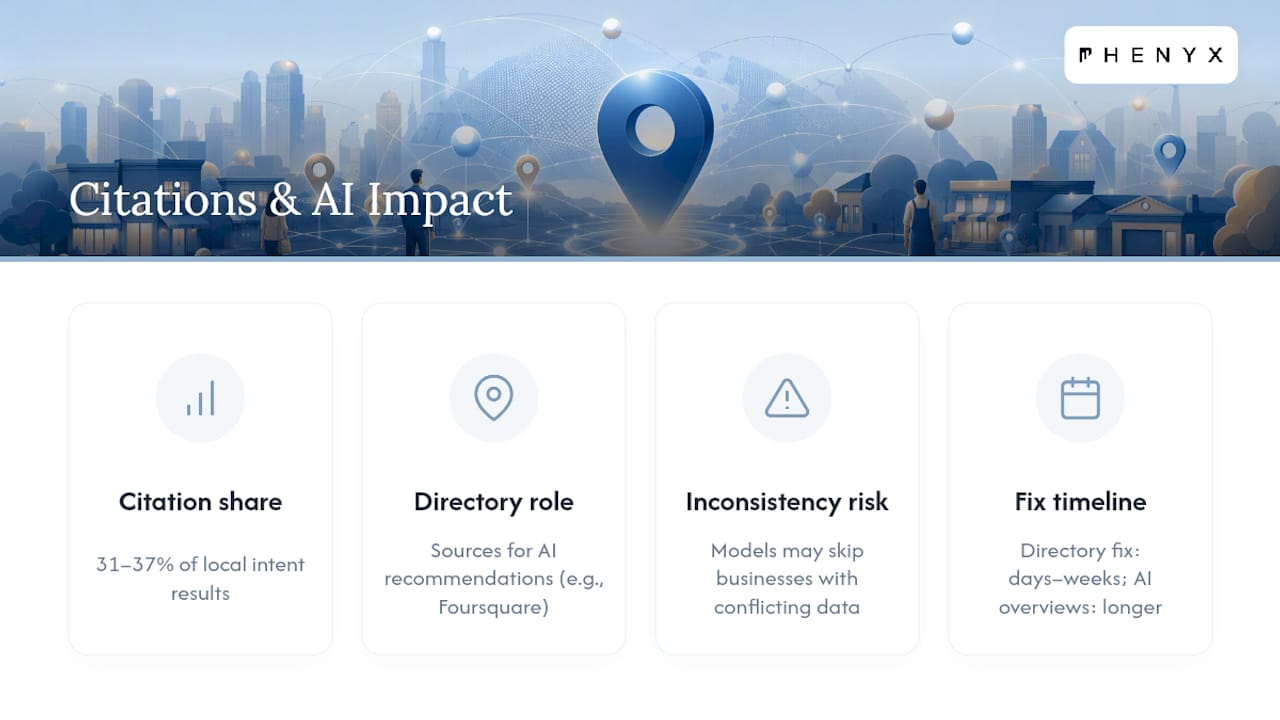
Directory listings make up roughly 31 to 37 percent of local intent search results, which means a meaningful share of what shows up when someone searches for a business like yours comes straight from citation sources, not your website. Practitioners also report that aggregators like Foursquare feed a disproportionate share of AI-driven local recommendations, since large language models cross-check multiple sources before naming a business in a response. That cross-checking behavior raises the cost of inconsistency: a model that finds multiple different addresses for the same business name is more likely to skip you rather than guess.
Timelines differ depending on where you’re looking. Fixing a duplicate listing or correcting a phone number typically shows up in that directory within days to a few weeks. Appearing correctly in AI-generated overviews takes longer because those systems refresh their underlying data on a slower cycle than a standard search index.
Which Citations Should You Prioritize First? A Tiered Approach
Not every directory deserves the same effort. A tiered system keeps you from wasting hours on listings that carry little weight while ignoring the ones that actually move the needle.
Tier 1: Core platforms. Google Business Profile, Bing Places, Apple Business Connect, Yelp, and Facebook. These are the profiles customers see directly and the ones most local search results pull from first. Claim and verify these before anything else.
Tier 2: Data aggregators. Data Axle, Localeze (Neustar), and Foursquare collect and redistribute business data to hundreds of smaller sites automatically. A single correction here can ripple outward without you having to touch every downstream directory individually. This is also where AI-driven recommendation engines pull heavily, since aggregator data feeds a large share of AI listing sources.
Tier 3: Vertical directories. Industry-specific sites, like legal directories for law firms or Houzz for contractors, carry disproportionate authority within their niche. A landscaping company benefits more from a clean listing on a home services vertical than from a fifth generic business directory.
Tier 4: Local and hyperlocal sources. Chamber of commerce sites, local news mentions, and neighborhood association pages round out the list. These matter less on their own but reinforce the geographic signal when combined with the tiers above.
Work top to bottom. Skipping Tier 2 to chase Tier 4 listings is one of the more common mistakes small businesses make when they try to handle this without a plan.
How Do You Audit And Fix Existing Citations?
An audit isn’t optional if you’ve been in business more than a couple of years, changed addresses, rebranded, or worked with a previous marketing vendor. Old data has a way of surviving on directories long after it’s wrong everywhere else.
- Inventory every existing listing. Search your business name, phone number, and old addresses across major search engines and citation-checking tools to surface everything currently indexed.
- Capture the right fields for each listing. Track business name, address, phone, website URL, category, and hours, so you can compare each listing against your canonical record at a glance.
- Publish your canonical NAP as the reference document your whole team, and any vendor, works from going forward.
- Fix duplicates first. Claim ownership where possible, request merges on platforms that allow it, and contact the aggregator directly when a listing won’t merge on its own.
- Correct aggregator data before individual directories. This follows the same logic as the tier system: fix the source, not just the symptom.
- Log every change with a date, the platform, and what was corrected, so you’re not guessing later whether a fix actually went live.
Pro Tip: Keep your tracker in a shared spreadsheet with columns for platform, submission date, verification status, and last-checked date. Six months from now, that log is the only way you’ll know which corrections actually stuck versus which ones silently reverted.
What Does A 90-Day Citation Management Plan Look Like?
Spreading the work out matters as much as doing it correctly. Submitting to fifty directories in one week can look like manipulation to some platforms and creates a mess if you need to correct something later.
- Weeks 1 to 2: Finalize and document your canonical NAP. Nothing else starts until this is locked.
- Weeks 3 to 4: Claim and verify Tier 1 core profiles: Google Business Profile, Bing Places, Apple Business Connect, Yelp, Facebook.
- Weeks 5 to 8: Submit corrections to Tier 2 aggregators and monitor for propagation, which typically takes 6 to 12 weeks.
- Weeks 9 to 12: Move into Tier 3 vertical directories relevant to your industry, plus any Tier 4 local sources worth claiming.
- Ongoing: Quarterly audits, with an out-of-cycle check triggered by any address change, rebrand, phone number swap, or ownership transfer.
Pacing submissions this way also gives you room to catch errors before they compound across dozens of listings.
Which Tools Actually Help With Citation Management?
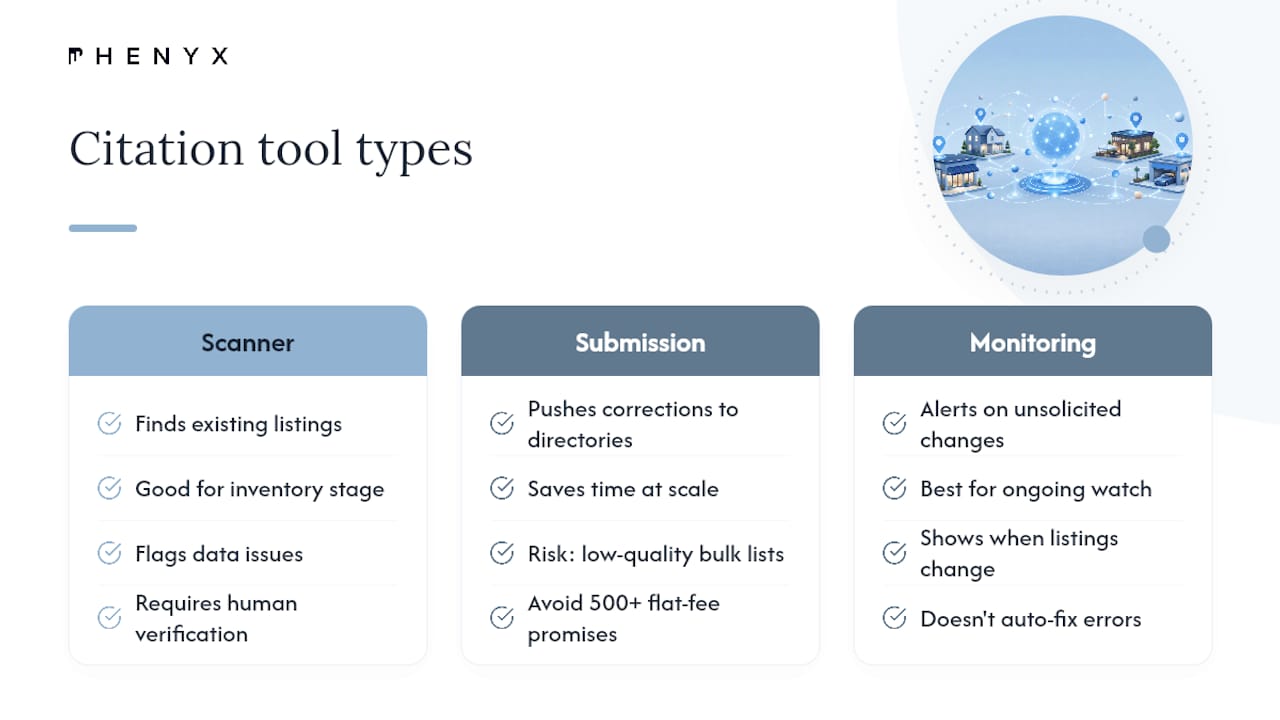
Three tool categories cover most of what a small business needs: citation scanners that find where you’re already listed, submission services that push corrections to multiple directories, and monitoring tools that alert you when something changes without your input.
Automation earns its keep when you’re managing multiple locations, where manually checking fifty listings per site becomes impractical fast. Manual review still wins for vertical directories and final verification, since tools can scan and flag issues but shouldn’t be trusted to self-correct without a human checking the result. An automated tool that misreads your suite number and “corrects” it incorrectly across twenty sites creates more work than it saves.
Two practices cause more harm than the errors they’re meant to fix. Avoid bulk submission services promising 500-plus directory listings for a flat fee. Most of those directories carry no authority and some no longer get crawled at all, so quality consistently outperforms volume. Never publish call-tracking numbers on public listings either. A tracking number that doesn’t match your canonical phone number creates the exact inconsistency you’re trying to eliminate.
How Do You Measure Whether Citation Management Is Working?
Results show up in stages, not all at once. Knowing the expected timeline keeps you from judging a healthy campaign as a failed one three weeks in.
| Metric | What it tells you | Typical timeframe |
|---|---|---|
| Aggregator propagation | Corrections reaching downstream directories | 6 to 12 weeks |
| AI overview appearance | Accurate data reflected in AI-generated answers | 6 to 12 weeks |
| Google Business Profile impressions/queries | Visibility trend in direct searches | Weekly, ongoing |
| Map Pack rank | Position changes for target search terms | Monthly review |
| Indexed citation count | Growth in correctly listed, authoritative citations | Quarterly audit |
Set a quarterly cadence for full reviews, with alerts for anything that changes outside that schedule, like a duplicate listing reappearing or a review platform flagging your profile as unverified.
What Are The Most Common Citation Mistakes?
Most citation problems trace back to a handful of repeatable errors:
- Inconsistent NAP formatting across listings. Fix this by enforcing your canonical document on every new submission and correction, no exceptions.
- Publishing tracking numbers publicly instead of your primary business line, which creates a permanent mismatch.
- Buying bulk low-quality submission packages that create duplicates instead of solving them.
- Skipping the audit step and submitting new listings before checking whether outdated ones already exist.
Each of these is fixable, but they compound quietly if left alone. A single wrong suite number from three years ago can still be sitting on a directory that never got updated.
Where Citation Cleanup Fits Into A Full Local SEO Strategy
Citations don’t work in isolation. They’re one entity signal among several, alongside your website’s structured data, your Google Business Profile setup, and the consistency of your brand mentions across the web. Treating citation cleanup as a standalone task misses how much it reinforces everything else in a local SEO plan.
A business with a handful of locations and the time to manage a spreadsheet can realistically handle this alone. Once you’re juggling multiple locations, staff turnover, or a rebrand, the coordination overhead grows faster than most owners expect. That’s usually the point where a structured, done-for-you approach starts to pay for itself instead of costing more hours than it saves.
Citation and entity management are best treated as part of a broader local visibility retainer, not a one-time cleanup project, because the businesses that maintain consistency quarter over quarter are the ones that keep showing up when it matters.
— PHENYX
Want Citation Management Handled Without The Spreadsheet?
An alternative to piecing together tools, freelancers, and DIY spreadsheets for citation cleanup is having one in-house team handle the audit, the aggregator corrections, and the ongoing monitoring, so you’re not the one tracking submission dates across a dozen platforms.

Our SEO and AEO services fold citation audits into a broader local visibility plan that covers your Google Business Profile, structured data, and how AI tools represent your business when someone asks for a recommendation nearby. If your listings need more than a weekend cleanup, or you’re managing locations across markets like Denver, Tampa, or Dallas-Fort Worth, request an audit and we’ll show you exactly where your NAP data is inconsistent before recommending anything. For related local SEO strategies for service businesses, that page breaks down tactics that pair well with a citation cleanup.
Sources
A few sources back the claims in this guide and are worth reading directly if you want more detail:
- Local Citation Management | Local SEO — Moz
- Local citations and why they matter — BrightLocal
- Citation building tips for local SEO — DirJournal

