


Always-On Marketing: A Practical Guide for Growth
Always-on marketing is a continuous strategy that keeps your brand visible, relevant, and generating pipeline every day of the year, not just during scheduled campaign windows. Where a campaign has a start date and an end date, an always-on program never stops working. According to Odicci, it combines evergreen content, email journeys, retargeting, and on-site experiences to sustain engagement year-round. If you are a marketing leader deciding where to invest next quarter, the short answer is this: build the always-on foundation first, then layer campaigns on top.
Quick Summary
-
Always-on marketing runs continuously, capturing buyer intent at any stage, any hour, without a campaign deadline forcing it to stop.
-
Sustained visibility compounds over time, lowering cost per acquisition and raising lifetime value as your content library and nurture sequences mature.
-
B2B buyers complete a significant portion of their research before contacting sales, which means your content must be present long before a prospect raises their hand.
-
The four continuous motions of a healthy always-on engine are: identify, qualify, route, and optimize.
-
Campaigns and always-on programs are not rivals. Campaigns spike awareness; the always-on engine converts and retains what campaigns attract.
-
Measurement shifts from campaign-level ROAS to lifetime value, retention rate, and cost per acquisition over time.
-
Automation and AI accelerate the engine, but human review and data governance keep it accurate.
Your 90-day pilot checklist
-
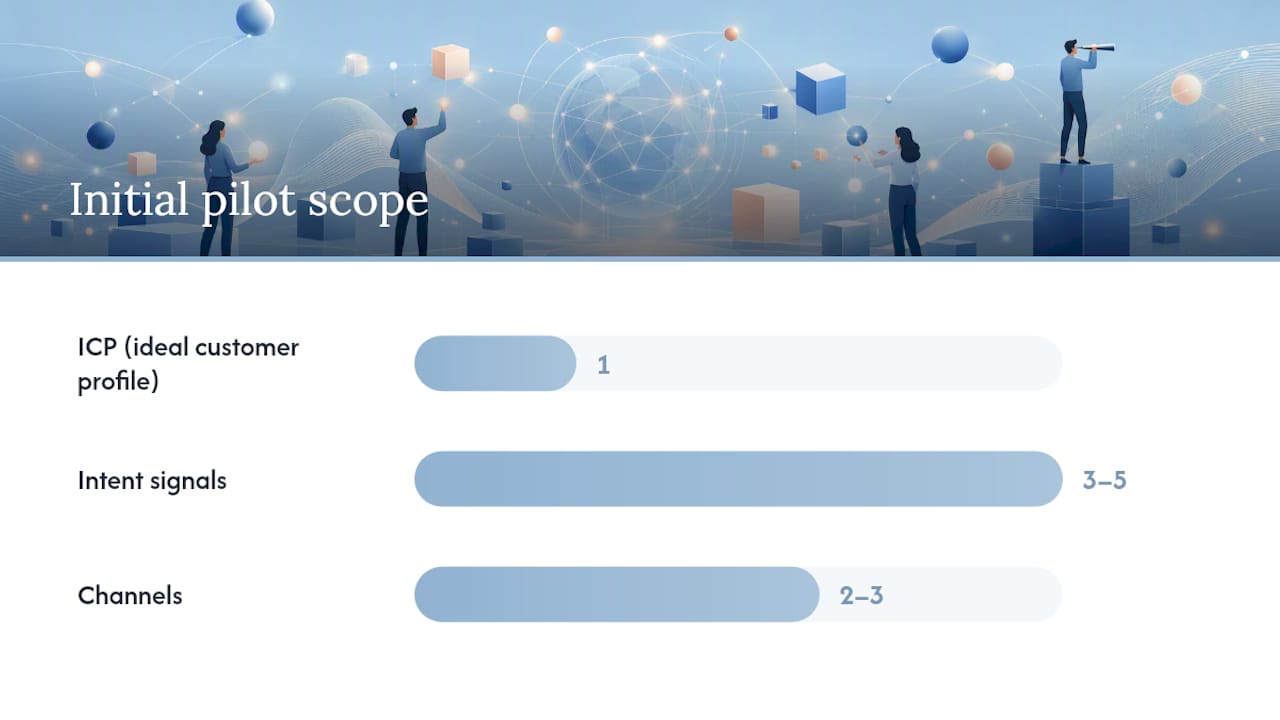
Pick one ideal customer profile (ICP) or vertical to pilot, not your entire market.
-
Audit existing content for evergreen assets you can activate immediately (SEO pages, nurture emails, retargeting audiences).
-
Define 3–5 intent signals you will track (page visits, content downloads, ad engagement, email opens).
-
Set up automated scoring and routing so qualified leads reach sales without manual handoffs.
-
Establish a weekly measurement rhythm: review signal quality, conversion rates, and content performance every Monday.
Key Takeaways
Always-on marketing builds a compounding pipeline by running continuously across SEO, nurture, retargeting, and content, while campaigns layer on top to drive short-term awareness spikes.
| Point | Details |
|---|---|
| Start with a narrow pilot | Focus on one ICP and 3–5 intent signals before scaling to additional segments or channels. |
| B2B buyers research independently | Buyers complete 57–70% of their research before contacting sales, so content must be present before they raise their hand. |
| Measure LTV and CPA over time | Campaign-level ROAS misses the compounding value; track retention rate, MQL velocity, and declining CAC quarterly. |
| Pair AI with human review | Automated signals accelerate optimization, but human judgment validates patterns before budget shifts. |
| Phenyx MODS retainer | Phenyx bundles SEO, content, video, paid media, and analytics into a single monthly retainer for consistent always-on output. |
Table of Contents
-
Why does always-on marketing matter for growth and retention?
-
What actually separates programs that work from those that stall
Why does always-on marketing matter for growth and retention?
The business case is straightforward: buyers are always researching, so your marketing needs to always be present. Salesforce frames this as being present at the “moment of relevance” — the precise instant a prospect is ready to engage. Miss that moment because your campaign ended last month, and a competitor who stayed visible wins the conversation.
The compounding benefits are what make continuous marketing worth the operational investment:
-
Sustained visibility builds brand recall across long, non-linear buying cycles.
-
Better retention and LTV come from nurture sequences that keep existing customers engaged between purchases or renewals.
-
Steadier pipeline replaces the feast-or-famine pattern that campaign-only programs produce.
-
Richer personalization signals accumulate over time, letting you tailor messaging based on actual behavior rather than assumed intent.
-
Lower CAC over time as evergreen content and automated nurture reduce the marginal cost of each new conversion.
ROI Brief’s analysis of always-on demand generation describes this as turning demand into a living system: one that detects buyer signals continuously, qualifies them automatically, routes them to the right sales motion, and optimizes allocation week over week. Organizations that adopt this rhythm shift their revenue forecasting from episodic guesswork to predictable quarterly output.
How does always-on compare with campaign-based marketing?
The distinction is not about which approach is better. It is about which job each one does.
| Dimension | Always-On Marketing | Campaign-Based Marketing |
|---|---|---|
| Purpose | Sustain visibility, capture intent, nurture and retain | Drive awareness spikes, support launches, seasonal events |
| Timing | Continuous, no end date | Fixed start and end dates |
| Primary KPIs | LTV, retention rate, CAC over time, MQL velocity | Reach, impressions, campaign ROAS, leads generated |
| Content type | Evergreen SEO, nurture sequences, retargeting | Promotional creative, time-limited offers, event assets |
| Resource pattern | Steady weekly cadence | Burst production followed by quiet periods |
| Risk profile | Lower per-period risk, slower initial ramp | Higher short-term spend, faster visibility spike |
When to prioritize a campaign: product launches, seasonal promotions, competitive conquests, or any moment where you need a fast awareness spike in a defined window.
When to keep the motion continuous: lead nurture, SEO content, retargeting, customer onboarding, loyalty programs, and any channel where buyer intent is present year-round.
The practical rule of thumb for hybrid planning is to treat always-on as the foundation and campaigns as overlays. Your campaign planning process should plug into an existing always-on engine, not replace it. When the campaign ends, the engine keeps running and converts the residual interest the campaign generated.
Hybrid planning checklist:
-
Confirm your always-on channels (SEO, email nurture, retargeting) are active before launching a campaign.
-
Map campaign creative to the same ICP your always-on engine targets.
-
Set a post-campaign retargeting audience so the engine captures campaign-driven traffic automatically.
-
Review campaign lift against always-on baseline metrics, not in isolation.
What channels and tactics belong in an always-on program?
A well-built continuous marketing program covers the full funnel with content and channels that keep working without a deadline.
Full-funnel content mapping
-
Top of funnel: Evergreen SEO pillar pages, educational blog posts, short-form video, and organic social content that answers the questions your ICP searches for daily.
-
Mid-funnel: Comparison guides, case studies, webinar replays, and gated assets that capture intent and move prospects toward a decision.
-
Bottom of funnel: Triggered nurture emails, retargeting ads tied to specific page visits, personalized on-site experiences, and sales-enablement content for active opportunities.
-
Retention: Onboarding sequences, product education content, loyalty touchpoints, and re-engagement campaigns for lapsed customers.
Channel roles in an always-on engine
-
SEO and AEO: Creates discoverable, durable assets that generate organic traffic and answer-engine citations without ongoing ad spend.
-
Paid search (SEM): Captures high-intent queries continuously; budget should be steady, not burst-and-pause.
-
Email and marketing automation: Delivers triggered, behavior-based sequences that nurture leads and customers based on actions, not calendar dates.
-
Retargeting: Re-engages visitors who showed intent but did not convert; audiences refresh automatically as traffic flows in.
-
Organic social: Maintains brand presence and distributes content; LinkedIn’s always-on social guidance emphasizes content continuity as the primary driver of discoverability while buyers self-educate.
-
On-site personalization: Adapts landing pages, CTAs, and content recommendations based on visitor behavior and segment.
Creative cadence guidance
A sustainable cadence typically looks like this: one monthly pillar asset (a long-form guide, a video, or a research piece), four to six weekly micro-content pieces derived from that pillar (social posts, short clips, email snippets), and triggered nurture sequences that fire based on behavior rather than a fixed schedule.
Pro Tip: Before producing new creative, audit your existing library for assets that can be repurposed. A well-structured pillar page can generate 10–15 derivative pieces across social, email, and paid channels. Reuse extends your always-on runway without proportionally increasing production costs.
How do you plan, staff, and budget an always-on program?
90-day ramp template
The most reliable way to validate a continuous marketing motion is a focused pilot, not a full-scale rollout. A realistic 90-day pilot concentrates on 3–5 high-confidence intent signals, a small set of channels, and weekly measurement cycles.
| Phase | Weeks | Focus |
|---|---|---|
| Foundation | 1–4 | Define ICP, audit content library, configure tracking, set up scoring and routing |
| Activation | 5 | Launch SEO content, activate nurture sequences, turn on retargeting, begin weekly reviews |
| Optimization | 12 | Analyze signal quality, A/B test subject lines and CTAs, adjust budget allocation, document learnings |
Roles and responsibilities
| Role | Responsibility |
|---|---|
| Content lead | Produces and maintains evergreen assets; manages the editorial calendar |
| Media/paid lead | Manages SEM and retargeting budgets; monitors pacing and performance |
| Marketing ops/analytics | Owns scoring models, routing rules, attribution, and reporting |
| Creative | Supplies visual and video assets on the weekly cadence |
| Strategy/program owner | Sets ICP priorities, reviews weekly metrics, escalates to leadership |
Budget and staffing considerations
-
In-house team: Best when you have existing headcount across content, media, and ops. Works well for organizations with a mature marketing function and clear ownership.
-
Agency retainer: Faster to activate, especially for content production and paid media management. A retained agency partner provides consistent output without the hiring lag.
-
Hybrid: A common model for growing businesses: in-house strategy and analytics ownership, agency execution for content and creative production.
How do you measure an always-on engine?
Campaign metrics like impressions and short-window ROAS tell you very little about the health of a continuous program. The right measurement framework tracks compounding value over time.
Core KPIs for always-on programs
| KPI | What it measures | Review cadence |
|---|---|---|
| Customer lifetime value (LTV) | Long-term revenue per customer | Monthly/quarterly |
| Retention rate | Percentage of customers who renew or repurchase | Monthly |
| Cost per acquisition (CPA) over time | Whether CAC is declining as the engine matures | Quarterly |
| MQL to SQL velocity | Speed at which marketing-qualified leads become sales-qualified | Weekly |
| Conversion rate by path | Which content and channel combinations convert best | Weekly |
| Organic traffic and rankings | Health of the SEO foundation | Weekly |
Attribution guidelines
Always-on programs require multi-touch attribution, not last-click. A prospect who reads three blog posts, downloads a guide, and then converts via a retargeting ad did not convert because of the ad alone. Time-decay models that weight recent touchpoints more heavily tend to reflect always-on buyer journeys more accurately than first-touch or last-touch models. Align your attribution model with your sales team and RevOps so pipeline credit is consistent across systems.
The Drum’s analysis of AI in marketing analytics makes a point worth taking seriously: AI is most valuable when paired with governance and human judgment. Automated attribution models can surface patterns quickly, but a human reviewer needs to validate those patterns against business context before reallocating budget.
Experimentation checklist
-
Run A/B tests on one variable at a time (subject line, CTA, landing page headline) so results are interpretable.
-
Use holdout groups to measure lift: a segment that receives no nurture email lets you isolate the email’s contribution to conversion.
-
Set a minimum test duration based on your traffic volume before calling a winner.
-
Document every test result, including failures, in a shared log your team reviews monthly.
-
Never pause the always-on engine to run a test. Tests run alongside the steady program, not instead of it.
What technology does an always-on program require?
You do not need every platform on day one. The priority order matters more than the list.
-
Analytics platform (Google Analytics 4, or a similar tool): The non-negotiable foundation. Without clean event tracking, every other decision is guesswork.
-
Marketing automation platform (HubSpot, Marketo, or similar): Manages nurture sequences, lead scoring, and routing. This is where the always-on logic lives.
-
Customer data platform (CDP): Centralizes behavioral and transactional data across channels so personalization and segmentation are based on a unified profile.
-
Ad platforms (Google Ads, Meta, LinkedIn): Run continuous paid search and retargeting; budget pacing should be steady, not burst-and-pause.
-
Intent data tools (G2, Bombora, or similar): Surface in-market buyers who are researching your category but have not yet engaged with your brand directly.
-
Personalization tools: Adapt on-site experiences based on visitor segment, behavior, or account.
Automation patterns that sustain the engine
-
Triggered nurture: Emails and ads fire based on specific behaviors (page visit, content download, pricing page view) rather than fixed send dates.
-
Scoring and routing: Leads accumulate points based on engagement; when a threshold is crossed, the lead routes automatically to the right sales rep or sequence.
-
Closed-loop reporting: CRM data feeds back into the marketing platform so you can see which content and channels produced revenue, not just leads.
Explore how AI and automation can accelerate these patterns without replacing the human judgment that keeps them accurate.
Pro Tip: Define canonical metrics before you build. Agree on exactly what counts as an MQL, what constitutes a “conversion,” and who owns each data definition. Ambiguous definitions produce noisy signals that make optimization impossible, no matter how sophisticated your tech stack is.
How Phenyx builds always-on programs for clients
Phenyx approaches continuous marketing through a structured pilot-to-scale model. The process starts narrow: one ICP, a defined set of intent signals, and a small channel mix. Once the pilot demonstrates consistent signal quality and conversion patterns, the program scales across additional segments and channels. Governance checkpoints at each stage keep data definitions clean and attribution reliable.
Services Phenyx deploys in always-on programs include:
-
SEO and AEO: Building the evergreen content foundation that generates organic discovery 24/7. Phenyx’s SEO and AEO services are designed to create durable visibility assets, not one-time ranking spikes.
-
Website design: Conversion-optimized site architecture that supports on-site personalization and modular content for continuous optimization.
-
Video production: Short-form and long-form video assets that supply the always-on creative pipeline across social, on-site, and paid channels. Video production is a core component of the creative cadence Phenyx manages for clients.
-
Content operations: Editorial planning, production, and distribution tied to a weekly cadence rather than campaign bursts.
-
Analytics and attribution: Multi-touch reporting setup and ongoing measurement review.
-
Paid media management: Continuous SEM and retargeting management with steady budget pacing.
Phenyx bundles these services under a MODS retainer, giving clients predictable monthly output across every channel in their always-on engine without managing multiple vendors. The result is a consistent brand signal, a unified data layer, and a team that reviews performance every week rather than at campaign wrap.
When will you see results from an always-on program?
This is the question most marketing leaders ask before committing to a continuous model, and the honest answer is that the timeline depends on your starting point.
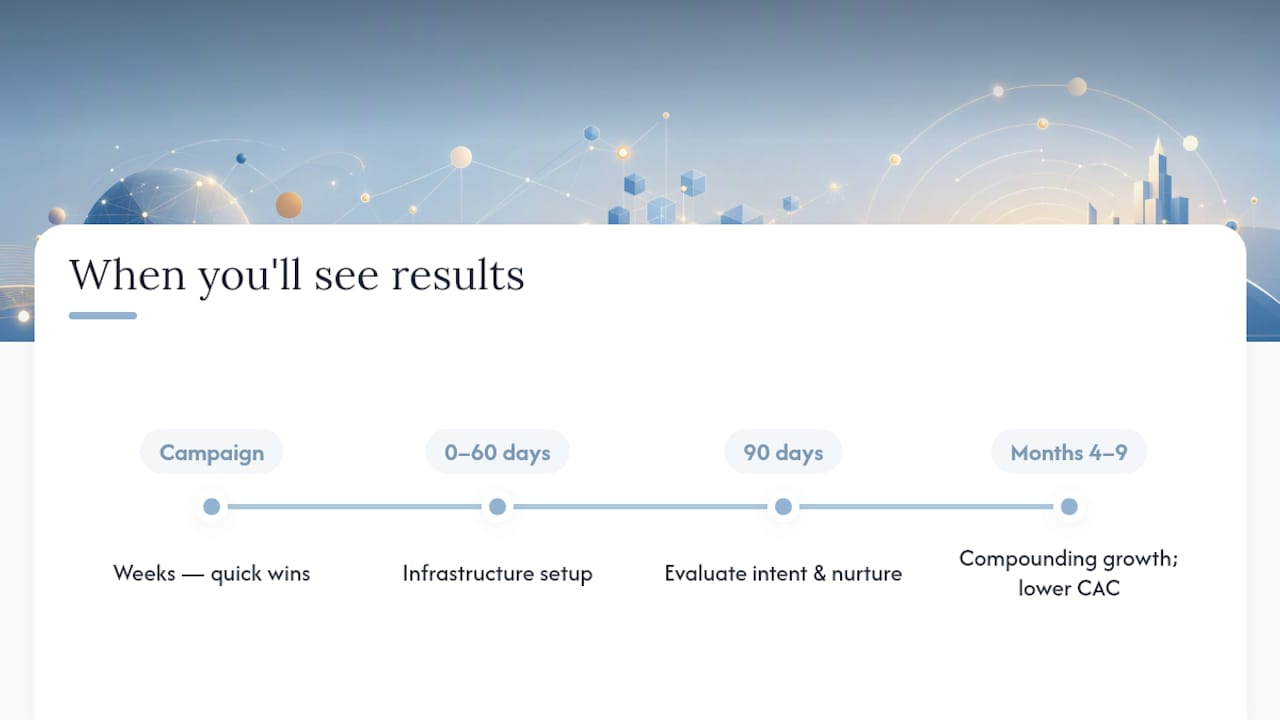
A campaign has a defined window: you spend, you measure, you stop. An always-on engine works differently. The first 30–60 days are primarily infrastructure: content audits, tracking setup, automation configuration, and baseline measurement. You are not expecting pipeline from week two.
By the end of a 90-day pilot, you should have enough signal to evaluate whether your intent detection is working, whether your nurture sequences are moving leads forward, and whether your content is generating qualified organic traffic. That is the evidence base for scaling.
The compounding effect becomes visible in months four through nine. Organic rankings improve as your content library grows. Retargeting audiences deepen as more visitors flow through. Nurture sequences accumulate behavioral data that makes personalization sharper. CAC tends to decline as the engine matures because you are converting more of the traffic you already paid to attract.
Contrast this with a campaign timeline: a well-executed campaign can generate awareness and leads within weeks, but when the campaign ends, so does the pipeline it produced. The always-on engine keeps converting that residual interest. That is the structural advantage, and it is why the two models work best together rather than in competition.
What actually separates programs that work from those that stall
The most common failure pattern is not a bad strategy. It is trying to flip everything to always-on at once. Teams that attempt a full-channel, full-funnel rollout in month one almost always hit resource exhaustion before they have enough data to optimize anything.
The programs that compound reliably share a few habits. They start narrow: one ICP, three to five intent signals, two or three channels. They centralize their signals into a single system before adding complexity. They run a weekly review rhythm where someone looks at the numbers, asks what changed, and makes one adjustment. And they pair AI-generated outputs with human review before acting on them, because AI is most valuable when it automates routine work and preserves human judgment for interpretation.
Practical habits that consistently produce results:
-
Pilot narrow, scale on evidence, not on enthusiasm.
-
Centralize all behavioral signals into one platform before building automation on top.
-
Maintain a weekly rhythm: review, adjust, document.
-
Pair every AI-generated insight with a human question: “Does this match what we know about our buyers?”
-
Treat your content library as a living asset, not a production backlog.
The brands that treat always-on marketing as infrastructure rather than a campaign type are the ones that build durable competitive advantage. The compounding returns are real, but they require patience in the first 90 days and discipline in the following 12 months.
Phenyx runs the always-on engine so you can focus on growth
Running a continuous marketing program requires consistent execution across SEO, content, paid media, video, and analytics every single week. For most growing businesses, that is more operational complexity than an internal team can absorb without dropping something.
Phenyx delivers always-on marketing as a unified monthly service under its MODS retainer model. One team, one strategy, one consistent brand signal across every channel. No vendor coordination, no production gaps, no campaign-only thinking. Whether you need to build the SEO foundation, activate a nurture engine, or get video assets into your always-on creative pipeline, Phenyx structures the work to compound over time rather than spike and fade.
Explore Phenyx’s content marketing approach to see how continuous programs are structured, or contact Phenyx to book a pilot assessment and get a clear scope of work for your first 90 days.
Sources
These sources informed the strategy, definitions, and measurement frameworks in this guide:
-
What Is Always-On Marketing? Strategy, Channels and Gamification
-
How to Build an Always-On Demand Generation Strategy - The LeadCrafters
FAQ
What does “always-on marketing” mean?
Always-on marketing is a continuous strategy that keeps a brand visible and generating pipeline year-round through evergreen content, automated nurture, retargeting, and on-site experiences, rather than relying on periodic campaign bursts.
How is always-on marketing different from campaign marketing?
Campaigns have fixed start and end dates and are designed to spike awareness around a specific event or offer. Always-on marketing runs continuously with no end date, capturing and nurturing buyer intent at any stage of the buying cycle.
What does “always on” mean in social media?
In social media, “always on” refers to maintaining a consistent posting cadence and paid presence year-round rather than activating social channels only during campaign periods. The goal is continuous discoverability while buyers self-educate.
What is the 3-3-3 rule in marketing?
The 3-3-3 rule is not a single standardized framework with one canonical definition. Some practitioners use it to describe a content ratio (one-third promotional, one-third educational, one-third engagement-focused), but definitions vary by source and context.
How long does it take to see results from an always-on program?
The first 30–60 days focus on infrastructure setup. By the end of a 90-day pilot, you should have clear signal quality data and early conversion patterns. Compounding returns on CAC and organic traffic typically become visible in months four through nine.