
Brand Voice Guidelines: How to Write and Use Them
Brand voice guidelines are a short, written reference that describes how your business sounds: the personality behind your words, the vocabulary you favor, and how that personality flexes from a website headline to a complaint reply. The best ones fit on a few pages, include real examples, and get used every week. This guide shows what to put in yours and how to build it.
TL;DR
- Voice is your brand’s stable personality. Tone is how that personality adjusts to a situation.
- Choose three to five voice traits, define each one, and show do’s and don’ts.
- Add examples. Adjectives like “friendly” or “bold” get misread without them.
- Roll the guidelines out to everyone who writes for you, including freelancers and AI tools.
Table of Contents
- Quick Summary
- What brand voice is, and how it differs from tone
- What should brand voice guidelines include?
- How to build a brand voice chart in six steps
- Brand voice examples worth studying
- How to adapt tone across channels without losing your voice
- Rolling out your guidelines, including to AI tools
- Our perspective on brand voice
- Put your brand voice to work with PHENYX
- FAQ
- Sources
Quick Summary
- Brand voice is the personality in your communications; tone is the situational shift.
- Guidelines should cover voice traits, tone by situation, word choice, and style rules.
- A voice chart (we are, we are not, example phrases) is the most usable format.
- Start from your audience and company values, not from adjectives you like.
- Test the draft on real copy: a homepage section, an email, a social post.
- Review the document at least once a year and after any major change in offer or audience.
- A consistent voice supports recognition across every channel you run.
What brand voice is, and how it differs from tone
Brand voice is the distinct personality a company expresses through its communications. Asana’s explanation adds that it should complement company values, speak to the target audience, and stay recognizable as yours.
Tone is the situational expression of that personality. The same source notes that tone shifts with the message, medium, audience or circumstance while remaining inside the voice.
A simple way to hold the difference: voice is who you are, tone is how you show up. HubSpot’s guide gives an example: a blog post might read as instructive and detached, while a customer email can be more personal and descriptive. Same company, different register.

Voice also differs from messaging. The U.S. Chamber of Commerce frames voice as how a business says things and messaging as what it says. Messaging can change with each campaign. Voice should not. If you want the messaging side as well, our six-step brand messaging framework pairs voice rules with the claims you make.
What should brand voice guidelines include?
The Content Marketing Institute’s guidance on brand guidelines lists logo and design rules, writing rules, voice, tone, word choice, and web and print design. A voice document does not need the visual rules, but the writing half is essential. In practice, a working set includes these parts.
Voice traits with definitions
Qualtrics recommends selecting three to five main voice characteristics and defining each one. Defining matters because a word like “vibrant” means different things to different writers. The Content Marketing Institute’s style guide advice warns that without defined examples, attributes get misread and copy drifts toward bland.
Tone by situation
List the situations your team actually writes for: product launches, onboarding emails, support replies, apologies, hiring announcements. For each, note how the tone moves. The same Qualtrics guidance recommends documenting context-specific tone, along with do’s, don’ts and examples.
Word choice and style rules
Capture the practical details writers ask about:
- Words and phrases you use, and ones you avoid
- Sentence length and paragraph habits
- How you address the reader (“you,” “we,” a company name)
- Punctuation and formatting preferences, such as contractions or numbered lists
- Jargon rules: which industry terms are fine and which need plain-language explanation
Real examples
Include a few before-and-after samples drawn from your own site. A paragraph that sounds right and one that sounds wrong teach faster than a page of descriptors.
How to build a brand voice chart in six steps
A voice chart is the core of most guidelines. The Content Marketing Institute describes a chart with three primary characteristics, short descriptions, and columns for do’s and don’ts. Here is a sequence that gets you there.
- Start with your audience. Write down who you want to reach and what they need from you. Toptal’s guidance says to research the audience, review company values and mission, and then describe the brand’s personality.
- Describe the brand as a person. The U.S. Chamber suggests deciding whether your business would present itself as confident, calm, playful, formal, casual, humorous, professional or an expert guide. Pick the combination that fits your customers.
- Choose three traits. Resist the urge to list ten. Three traits you can actually apply beat a long list nobody remembers.
- Write a “we are / we are not” line for each trait. For example, “We are direct” is paired with “We are not blunt.” The contrast stops a trait from tipping into its opposite.
- Add example phrases. Give two or three real sentences per trait, and one that breaks the rule.
- Add tone notes for key situations. Cover a complaint, a product launch and a routine update, at minimum.
Here is a compact sample of the format, using a fictional local service business:
| Trait | We are | We are not | Example |
|---|---|---|---|
| Practical | Specific and useful | Vague or salesy | “Your first estimate arrives within two business days.” |
| Warm | Friendly and plain-spoken | Overly casual or chatty | “Thanks for waiting. Here is what we found.” |
| Confident | Calm and certain | Boastful | “We know this process well.” |
The example sentences are illustrative, not real client copy. Replace them with lines from your own business.
If you want the guide to live inside a broader document, see how to ship a working brand style guide in three pages.
Brand voice examples worth studying
Public style guides are the best classroom. Mailchimp’s voice and tone guide describes its voice as plainspoken, genuine and dryly humorous, and says tone should reflect the reader’s emotional state. It also explains that the voice does not change much from day to day, while tone does.
Three lessons carry over to any business:
- Pick traits with texture. “Professional” describes almost everyone. “Plainspoken” tells a writer what to cut.
- Let the reader’s mood steer tone. A cheerful line suits a success message and not an error message.
- Publish the rules. A guide that anyone can open gets used. One buried in a shared drive does not.
Now apply it to a small business. A Tampa dental practice, a Dallas roofing company and a Denver software startup might all choose “helpful” as a trait, but they would phrase it differently. The practice might favor reassuring, short sentences. The startup might allow a technical term when its audience expects it. The point is that your chart reflects your people, not a template.
How to adapt tone across channels without losing your voice
Asana gives different audiences, media and circumstances, such as a product launch versus a hiring freeze, as reasons to vary tone. Its view is that consistency and adaptability work together: a stable voice builds recognition, and flexible tone supplies the nuance. Qualtrics frames it as empathy, since adjusting tone shows you understand what your audience is feeling.
A practical approach is to map your channels and set a tone dial for each one:
- Website and landing pages: clear, confident, benefit-led. Sentences stay short and headlines carry the promise.
- Email: more personal. Use “you,” a direct subject line, and one clear next step.
- Social media: lighter and quicker, with more room for personality, while keeping your core traits intact.
- Support and service replies: calm and empathetic first, solution second.
- Ads: compact. Pick the one trait that does the most work in a few words.
When channels drift apart, readers notice. Our guide to fixing brand consistency across channels walks through that problem from the marketing team’s side.
Rolling out your guidelines, including to AI tools
A guide only works if the people writing can find it and use it. Keep it short, put it where the team already works, and walk through it in a live session with real examples. Ask each writer to rewrite one old piece using the chart. Their questions show where the document is unclear.
AI writing tools now sit in many content workflows. Search Engine Land’s guide to training in-house models notes that real content examples, sometimes called few-shot examples, show a model which voice to mimic. It also describes prompt templates that include role context, tone guidelines and signature examples. Your voice chart and sample sentences translate directly into those prompts.
The same discipline applies to every message you send. Even the difference between transactional versus outreach email shapes tone: a receipt or password reset needs a different register than a first-touch introduction, yet both should still sound like you.
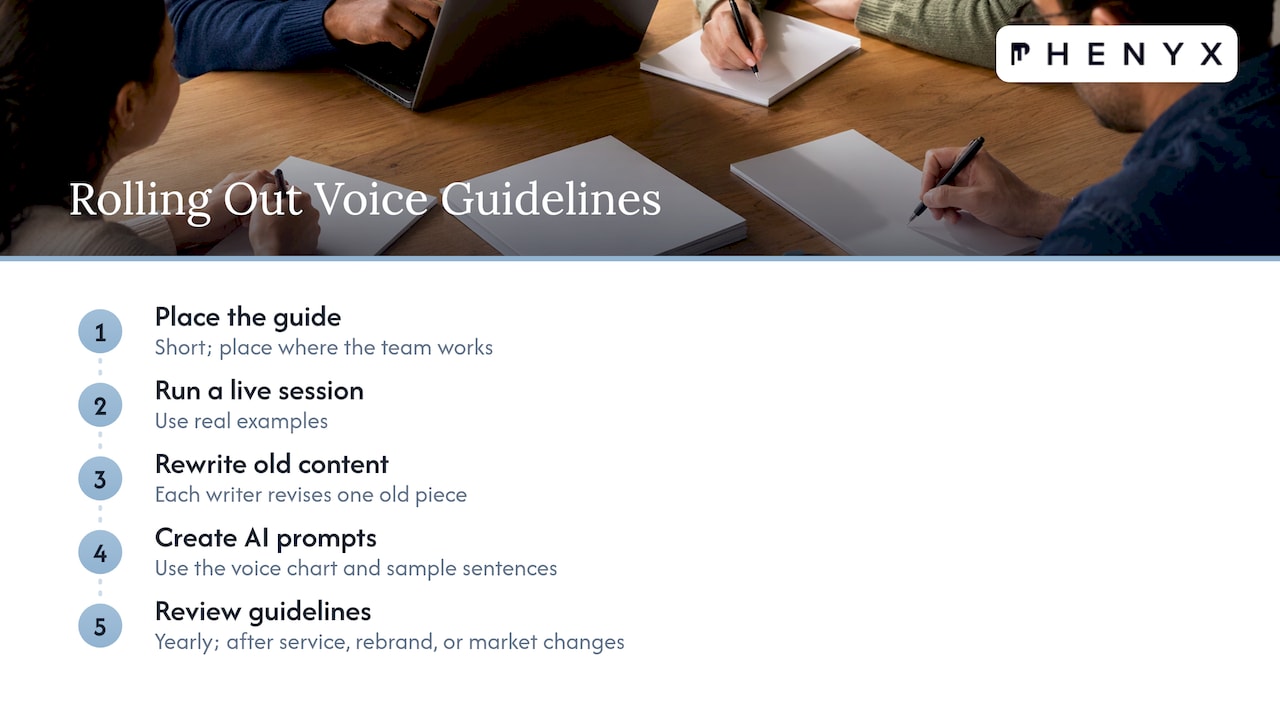
Finally, schedule a review. Revisit the document once a year, and after a new service line, a rebrand or a move into a new market. Small updates keep it alive. For a wider view of how voice fits into identity, our 2026 branding and messaging guide is a good companion.
Our perspective on brand voice
Most businesses we meet do not have a voice problem. They have a coordination problem. The website was written by one person, the video script by another, the ads by a third vendor, and each of them sounds slightly different.
That is why we do the writing, design, video, web and SEO work with one in-house team. When the same people work from the same voice rules, the brand sounds like one company everywhere, and turnaround is faster because nobody is decoding another vendor’s choices.
We also believe voice guidelines should be tailored, not templated. We use a structured approach to learn how a client’s customers talk and what they need, then translate that into rules the whole team can apply. Voice becomes a working tool for every page, post and video.
PHENYX
Put your brand voice to work with PHENYX
Writing the guidelines is one task. Applying them to your website, search content, video and ads is where the effort goes. PHENYX is a full-service marketing agency, and our in-house team handles branding, web design, SEO and AEO, video production and paid media under one roof, so your voice stays consistent from the first draft to the final cut.
For ongoing support, our MODS monthly subscription starts from $4,000 per month. If you would like help turning your voice into guidelines and then into real marketing, we serve businesses in Denver and Lafayette, Colorado, Tampa, Florida, and the Dallas-Fort Worth area in Texas.
FAQ
What are brand voice guidelines?
Brand voice guidelines are a document that defines how your company communicates in writing. They usually include three to five voice traits, tone guidance for different situations, word choice rules and examples. Their purpose is to help every writer produce copy that sounds like the same company.
What is the difference between brand voice and tone?
Voice is the consistent personality of your brand. Tone is how that personality adjusts to the audience, channel or moment. A support apology and a product launch announcement can sound different in tone while still clearly coming from the same voice.
How long should brand voice guidelines be?
Short enough that people read them. For most small and midsize businesses, a few pages with a voice chart, tone notes and sample sentences is plenty. You can add detail later as questions come up, but start with something your team can absorb in one sitting.
How do I find my brand voice?
Start with your audience and your company values, then describe the brand as if it were a person. Choose three traits, define what each one is and is not, and test them on real copy. Revise after you see how the traits read on your website and in emails.
How often should I update my guidelines?
Review them at least once a year and whenever your offer, audience or markets change. A new service line or a rebrand is a natural trigger. Update the examples first, since real sentences age faster than trait definitions.
Sources
- What is a Brand Voice? Plus, 7 Tips to Develop One (Asana)
- Consistent brand voice: How to be unmistakable (HubSpot)
- How to Create a Memorable Brand Voice (U.S. Chamber of Commerce)
- Brand Guidelines to the Rescue (Content Marketing Institute)
- Branded Content: Create the Ultimate Style Guide (Content Marketing Institute)
- Brand Voice and Tone: 5 Ways to Define and Use in Content (Content Marketing Institute)
- Brand Voice: Definition, Benefits & Tips (Qualtrics)
- Brand Voice Guidelines: Finding and Developing Your Voice (Toptal)
- Voice and Tone (Mailchimp Content Style Guide)
- How to train in-house LLMs on your brand voice (Search Engine Land)