

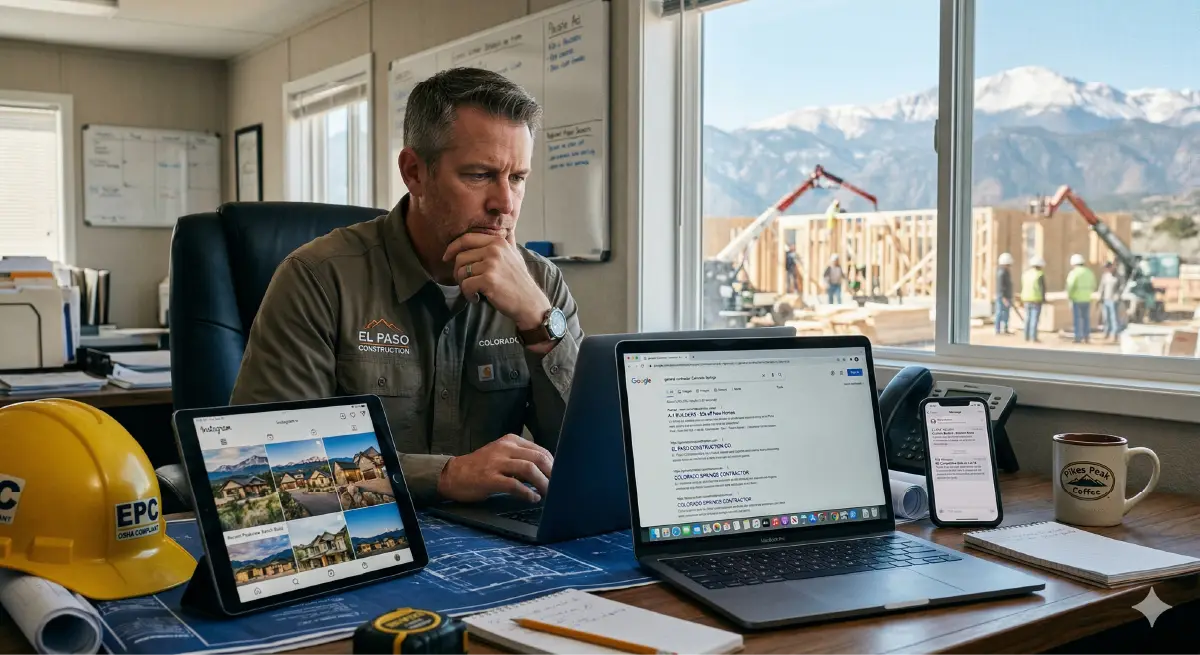
Colorado Springs construction companies that invest in digital marketing — search visibility, targeted advertising, and a conversion-ready website — win more bids, attract better subcontractors, and reduce their dependence on referral-only growth. The construction companies still relying on word-of-mouth alone are watching market share shift to competitors who got online first.
A local general contractor with 15 years in business and a strong portfolio was generating almost all of their new work through repeat clients and referrals. That model worked well until 2023, when two well-funded regional competitors entered the market with professional websites, active Google ad campaigns, and a steady stream of project photos on social media. Within 18 months, the established contractor's bid pipeline had thinned noticeably — not because their work had declined, but because their digital presence was invisible compared to the newcomers.
Digital marketing for construction companies in Colorado Springs has crossed from "nice to have" into necessary business infrastructure. Property developers, commercial property managers, and homeowners planning significant renovations are finding contractors online before they ask for referrals. The construction businesses positioned well in digital channels capture those opportunities first. The ones without a digital strategy are often not in the conversation at all.
Why Construction Digital Marketing Is Different From Other Industries
Construction digital marketing is the practice of building and maintaining an online presence that generates qualified project inquiries from the specific customer types a construction company wants to serve. It differs from retail or service business marketing in meaningful ways: sales cycles are longer, average job values are higher, and the buyer's evaluation process involves more scrutiny of credentials, past work, and reputation before a first conversation even happens.
This means digital marketing for construction companies must accomplish two things simultaneously: create enough visibility to be found, and provide enough proof of quality to be trusted. A homeowner planning a $150,000 addition doesn't click on an ad and call immediately. They visit the website, scroll through the project gallery, read reviews, check the contractor's license status, and spend days evaluating options. The digital marketing strategy has to support every step of that evaluation process.
Colorado Springs presents specific market dynamics worth understanding. The city has experienced sustained population and construction growth, with residential and commercial building permits consistently above the state average for the past four years. That growth has attracted outside contractors and national construction firms competing for the same project pipeline. Local construction companies that establish strong digital presence now are building a competitive advantage that becomes harder to overcome as time passes.
The Digital Channels That Generate Real Construction Leads
Google Search is the highest-intent digital channel for construction businesses. When a property owner searches "commercial contractor Colorado Springs" or "custom home builder Pikes Peak area," they are actively looking to hire. Organic SEO and Google Ads both compete for that traffic, and construction companies appearing in both paid and organic results capture significantly more clicks than those appearing in only one position.
Google Local Services Ads — the "Google Guaranteed" placements that appear above standard paid ads — are particularly effective for residential construction and remodeling businesses. These placements display a verification badge, show the company's review rating prominently, and charge per lead rather than per click. For general contractors doing residential work, Local Services Ads often deliver the lowest cost-per-qualified-lead of any paid channel.
Email marketing to past clients and professional contacts remains one of the highest-ROI channels for construction companies. A quarterly email featuring recent project photos, a featured subcontractor, and a brief market update keeps your company visible to the property owners, architects, and developers most likely to hire you again or refer new work. Many construction companies abandon email marketing because they're unsure what to write. The answer is almost always project photos with context — the starting condition, the challenge, and the finished result.
Houzz and similar project-based platforms capture buyers earlier in the decision process — when they're still exploring what they want rather than searching for a specific contractor. Construction companies with complete, photo-rich profiles on these platforms create brand familiarity that converts into contact requests weeks or months after initial discovery.
What a Construction Company Website Must Do to Convert Visitors Into Contacts
The Project Portfolio as Your Primary Sales Tool
For construction companies, the website portfolio is the single most persuasive element of the entire digital marketing stack. A prospective client evaluating a $500,000 commercial renovation wants to see completed projects of similar scope, in similar industries, with visual documentation of quality. Generic stock photos or a portfolio with three projects from five years ago communicate that the company doesn't prioritize its own presentation — which raises doubts about whether it prioritizes documentation and detail on the job site.
An effective construction portfolio includes professional photos of completed work, project descriptions that mention client type, location, scope, and notable challenges overcome, and ideally a brief testimonial from each client. Each portfolio entry should be search-optimized with specific terms — "commercial office renovation in the city" or "custom home El Paso County" — so individual project pages accumulate organic search traffic independently of the main website.
The website structure should make it easy for visitors to self-sort by project type. Residential clients should find residential projects immediately. Commercial property managers should land in a commercial section. A single undifferentiated portfolio is far less effective than clearly organized categories that let each visitor quickly confirm you do the type of work they need.
Paid Advertising Strategies That Work for Construction Businesses
Paid digital advertising works differently for construction companies than for most businesses. Construction campaigns should be tightly geographically targeted — Colorado Springs, El Paso County, and specific surrounding areas where the company is licensed and has established relationships. Broad geographic targeting wastes budget on inquiries from areas where fulfillment would require impractical travel or licensing complications.
The highest-performing paid campaigns use conversion-focused landing pages rather than directing ad traffic to the homepage. A homeowner clicking an ad for "kitchen remodel near me" should land on a page specifically about kitchen remodeling — with a project gallery, typical investment ranges, a simple contact form, and a phone number. Sending that visitor to a generic homepage with no clear next step wastes the ad spend entirely.
Retargeting campaigns — ads that follow previous website visitors as they browse other sites — are effective for the long construction sales cycle. A property owner who visited your website, reviewed your commercial portfolio, and left without contacting you is not a lost lead; they are a prospect still in their evaluation phase. Retargeting keeps your company visible during that extended consideration period, and many construction companies report retargeting as their lowest-cost conversion channel.
Social Proof and Reputation Management in the Construction Industry
Construction is a high-trust purchase. A client hiring a contractor for a six-figure project is making a commitment with significant financial consequences if the choice is wrong. Social proof — reviews, testimonials, awards, and third-party verification — reduces the perceived risk of that decision and directly influences whether prospective clients reach out.
Google reviews are the most impactful form of social proof for construction companies. A contractor with 80 Google reviews averaging 4.7 stars is perceived as significantly more credible than one with 8 reviews at 5.0 stars, even though the average rating is technically higher. Volume signals longevity and consistency. Systematically requesting reviews from satisfied clients after every project completion should be a standard operational process, not an afterthought.
Industry association memberships — such as AGC Colorado and the Colorado Association of Home Builders — function as trust signals on a construction company website. These credentials don't replace project quality, but they reduce friction for prospective clients evaluating your company without a personal referral.
Case studies are the highest-value content asset a construction company can publish. A written case study describing a project's initial challenges, the construction approach taken, the timeline and budget management, and the final outcome gives prospective clients a detailed preview of what working with you looks like. Construction companies publishing two to four case studies per year create a content library that generates organic search traffic and serves as a compelling leave-behind in the bid presentation process. PHENYX develops full digital marketing campaigns for construction companies in Colorado, including content strategy, paid advertising, and conversion optimization.
Common Questions
What is digital marketing for construction companies and why does it matter?
Digital marketing for construction companies is the practice of building online visibility and generating qualified project inquiries through search engines, paid advertising, social media, and a conversion-optimized website. In Colorado Springs, where construction demand is strong and competition has increased with the arrival of regional and national contractors, digital marketing determines which companies get found when property owners and developers begin their contractor search. Construction businesses without a digital presence are systematically excluded from project opportunities that begin online — a growing share of all new work statewide.
How much should a construction company spend on digital marketing?
Most construction companies should allocate between 2% and 5% of gross annual revenue to digital marketing, depending on growth goals and competitive intensity in their specialty. A residential remodeler generating $2 million in annual revenue might invest $40,000 to $100,000 per year — a figure that seems large until compared to the value of one or two additional project wins. Commercial contractors bidding larger projects typically invest at the lower percentage because individual project values are higher. The most important starting point is not total budget but allocation: prioritize channels that capture active buyers before expanding to broader awareness channels.
What digital marketing results should a construction company expect in the first year?
In the first year of a focused investment, construction companies typically see website traffic increase between 40% and 150%, depending on the starting baseline. Google Business Profile improvements often appear within 60 to 90 days of optimization. Organic search rankings for competitive project-type keywords improve significantly within six to nine months. Lead volume increases are usually measurable within three to six months of campaign launch, with lead quality and conversion rate continuing to improve beyond the first year as campaign data accumulates and informs ongoing optimization.
If your construction company is ready to compete for Colorado Springs projects online the way your best competitors already do, reach out to PHENYX — we build digital marketing strategies that generate real project pipelines for contractors.









%20(2).svg)
%20(1).svg)
