SEO for Med Spas: How to Rank #1 for "Botox Near Me" in Your City
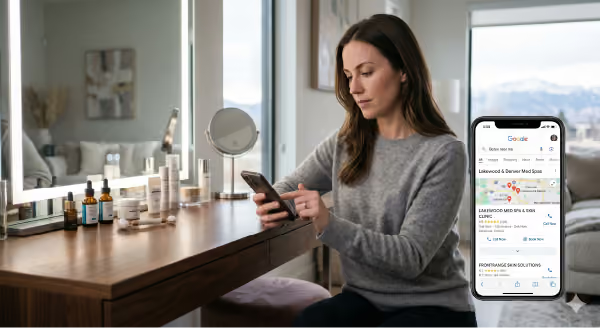
When someone types "Botox near me" into Google, they are not browsing. They are ready to book. That search intent is about as warm as it gets in local marketing, and the med spa that shows up first captures the overwhelming majority of that business.
So how do you become that med spa in your city?
This guide walks through the exact SEO strategy that separates the practices ranking at the top from everyone else sitting on page two where almost nobody looks.
Why SEO Is the Highest-ROI Marketing Channel for Med Spas
Paid ads stop the moment you stop paying. Social media reach is increasingly throttled unless you boost posts. Lead platforms sell your potential patients to multiple practices simultaneously.
Organic search is different. A page that ranks on page one of Google for "Botox near me" in your city generates inbound traffic every single day without a per-click cost. The patient found you specifically. They were not sent to three other med spas at the same time. They clicked your listing because Google told them you were the most relevant answer to their search.
That is an entirely different quality of lead, and it compounds over time in a way that paid channels simply cannot replicate.
The med spas investing in SEO today are building an asset. The ones skipping it are renting attention indefinitely.
How Google Decides Which Med Spas Rank First
Before diving into tactics, it helps to understand what Google is actually trying to do. Its goal is to show the most relevant, trustworthy, and useful result for every search query. For local searches like "Botox near me," Google weighs three primary factors.
Relevance: Does your website clearly communicate that you offer this specific treatment in this specific location?
Distance: How close is your practice to the person searching?
Prominence: How well-known and credible does Google perceive your business to be, based on reviews, links, citations, and overall online presence?
You cannot control distance. But relevance and prominence are entirely within your control, and they are where a smart SEO strategy focuses its energy.
The Med Spa SEO Strategy That Actually Works in 2026
Step 1: Get Crystal Clear on Your Target Keywords
Not all keywords are created equal. "Botox" is a broad term with enormous national competition. "Botox near me" is high intent but location-dependent. "Botox in Denver CO" is specific, local, and winnable for a practice in that market.
Start by building a keyword list that covers three categories.
Treatment-specific keywords: Botox, dermal fillers, lip filler, CoolSculpting, laser hair removal, HydraFacial, Morpheus8, chemical peels, microneedling. Each of these deserves its own dedicated page on your website.
Location-modified keywords: Combine your treatments with your city, neighborhood, and surrounding areas. "Botox Denver," "lip filler Cherry Creek," "CoolSculpting Aurora CO." The more specific, the lower the competition and the higher the intent.
Question and concern keywords: "How much does Botox cost in Denver," "best med spa near me," "Botox before and after," "is CoolSculpting worth it." These fuel your blog content and FAQ pages and increasingly drive visibility in AI-generated search results.
Free tools like Google Search Console and Google's autocomplete suggestions are a solid starting point for building this list. A professional SEO partner will go deeper with competitive gap analysis to find the keywords your competitors are ranking for that you are not.
Step 2: Build Dedicated Service Pages for Every Treatment
This is the single most impactful on-site SEO change most med spas can make, and it is almost universally underexecuted.
A single "Services" page that lists all your treatments in paragraph form cannot rank competitively for individual treatment searches. Google needs a dedicated, content-rich page to understand that your business is genuinely authoritative on a specific treatment.
Every core treatment you offer should have its own page. That page should include the treatment name and your city in the title tag, H1 heading, and naturally throughout the content. It should explain what the treatment is, who it is right for, what to expect during and after, how much it costs in your market, and why your practice is the right choice for this specific treatment.
A well-built page for "Botox in [Your City]" is not just an SEO asset. It is a trust-building, objection-handling, conversion tool that works around the clock.
Step 3: Dominate Your Google Business Profile
For local searches, your Google Business Profile is often the first thing a potential patient sees before they ever visit your website. It is the listing that appears in the Google Map Pack, which shows up at the top of local search results and captures a disproportionate share of clicks.
Fully optimizing your profile means completing every available field without exception. Business name, address, phone number, website, hours, and service area all need to be accurate and consistent with what appears on your website.
Beyond the basics, the practices that dominate the Map Pack do these things consistently.
They upload fresh photos regularly, including treatment rooms, staff, and real patient results where appropriate. They post updates to their profile at least twice a month. They list every treatment they offer as a service within the profile. They respond to every review, both positive and negative, in a professional and personalized way. And most importantly, they actively generate new reviews on an ongoing basis rather than letting them accumulate by chance.
Reviews are one of the most heavily weighted factors in local ranking. A practice with 200 recent reviews will almost always outrank a competitor with 40 reviews, even if the competitor's website is technically stronger. Building a consistent review generation process is not optional in a competitive med spa market.
Step 4: Fix the Technical Foundation of Your Website
Content and reviews will only take you so far if the technical foundation of your website is working against you. Google cannot rank a site it struggles to crawl, index, and evaluate.
The technical issues most commonly holding med spa websites back include the following.
Slow page speed: Google has explicitly confirmed page speed as a ranking factor. Image-heavy med spa sites are particularly vulnerable to this. Compress images, minimize unnecessary code, and use a fast, reliable hosting provider.
Poor mobile experience: With the majority of local searches happening on mobile devices, a site that does not perform well on a smartphone is actively losing rankings and patients simultaneously.
Missing or weak meta tags: Every page on your site should have a unique title tag and meta description that includes the primary keyword for that page and gives searchers a compelling reason to click.
No schema markup: Schema markup is code that helps Google understand the specific content of your pages. For med spas, LocalBusiness schema, MedicalClinic schema, and Review schema all help Google serve your content more accurately in search results.
Broken links and crawl errors: These signal to Google that your site is not well maintained, which can quietly suppress your rankings over time. Regular technical audits catch and fix these before they compound.
Step 5: Build Local Authority Through Citations and Backlinks
Google measures prominence in large part by how consistently and widely your business appears across the web. Local citations and backlinks are the two primary signals that build this authority.
Citations are mentions of your business name, address, and phone number on directories, review sites, and local platforms. The most important for med spas include Google Business Profile, Yelp, RealSelf, Healthgrades, Zocdoc, and your local Chamber of Commerce. Every listing should show exactly the same business information. Even small inconsistencies in how your address is formatted can dilute your local SEO signals.
Backlinks are links from other websites pointing to yours. They function as votes of credibility in Google's eyes. High-quality backlinks for med spas can come from local news features, partnerships with complementary businesses like plastic surgeons or dermatologists, guest content on industry publications, and sponsorships of local events or organizations.
You do not need hundreds of backlinks to compete locally. A smaller number of genuinely relevant, high-authority links will outperform a large number of low-quality ones every time.
Step 6: Create Content That Answers What Your Patients Are Searching
Content marketing and SEO are not separate strategies. Every piece of content your med spa publishes is an opportunity to rank for an additional search query and pull a potential patient into your orbit.
The most effective content for med spa SEO targets the specific questions patients ask before booking a treatment.
"How much does Botox cost in [city]" is one of the most searched questions in the med spa space and one of the most commonly ignored content opportunities. A thorough, honest answer to that question on your website builds trust, ranks for a high-intent query, and positions your practice as transparent and knowledgeable before a patient ever calls.
Other high-value content topics include treatment comparison posts like "Botox vs. Dysport: What Is the Difference," procedure guides like "What to Expect at Your First Lip Filler Appointment," and local authority content like "Best Treatments for Sun-Damaged Skin in [City]."
This content also increasingly feeds into AI-generated search results. Google AI Overviews, Perplexity, and ChatGPT are pulling answers from well-structured, authoritative websites when answering health and beauty questions. Med spas that invest in expert content today are positioning themselves to capture that AI-driven visibility as it continues to grow.
Step 7: Track What Is Working and Adjust
SEO without measurement is guesswork. The practices that consistently improve their rankings do so because they track their performance, identify what is working, and double down on it.
At minimum, set up Google Search Console and Google Analytics on your website. Search Console shows you exactly which queries are driving impressions and clicks to your site, which pages are performing well, and where technical issues exist. Analytics shows you what visitors do after they arrive, which pages lead to consultation requests and which ones see visitors leave immediately.
Review this data monthly. Watch your keyword rankings for your core treatment and location terms. Track the volume of leads coming through your website versus other channels. Use what you learn to prioritize your next round of improvements.

How Long Does Med Spa SEO Take to Work
This is the most common question, and the honest answer is that meaningful results typically begin appearing within 60 to 90 days for low-competition terms, with more competitive terms like "Botox near me" in larger cities taking four to six months or longer.
The timeline depends on how competitive your market is, how strong your starting point is, and how consistently the strategy is executed. SEO is not a switch you flip. It is an investment that builds momentum over time and continues paying dividends long after the initial work is done.
The med spa that started six months ago is already ahead of the one starting today. The best time to begin was six months ago. The second best time is now.
Why Most Med Spas Struggle With SEO
The honest reason most med spas never achieve strong organic rankings is not that SEO is too complicated or too competitive. It is that they treat it as a one-time task rather than an ongoing strategy.
They optimize their site once at launch, never update their content, let their Google Business Profile sit dormant, and wonder why competitors keep outranking them. SEO rewards consistency. The practices investing in it month over month build a compounding advantage that becomes increasingly difficult for competitors to overcome.
How PHENYX Helps Med Spas Rank and Grow
This is precisely the type of long-term, compounding marketing challenge that PHENYX was built to solve for local service businesses.
PHENYX is a full-service digital marketing agency based in Denver, Colorado, with direct experience helping service businesses including med spas build organic search visibility that generates consistent, high-quality leads. The approach starts with a thorough audit of your current rankings, competitive landscape, and website performance, then moves into a structured strategy covering on-page SEO, Google Business Profile optimization, content creation, local citation building, and ongoing performance tracking.
For med spas that want a comprehensive solution rather than piecemeal fixes, the PHENYX MODS subscription provides access to a complete in-house marketing team covering SEO, content, web, social, and paid ads at a fraction of what it costs to build that capability internally. It is the kind of sustained, integrated effort that actually moves rankings and keeps them moving over time.
If your med spa is not showing up where your ideal patients are searching, that is a solvable problem.
Frequently Asked Questions
How competitive is it to rank for "Botox near me" in a large city?
In major metros like Denver, Dallas, or Miami, competition for top Botox-related keywords is significant but very much winnable with the right strategy. The practices ranking at the top almost always have strong Google Business Profiles with consistent review generation, dedicated service pages with local keyword optimization, and a history of consistent SEO investment. In smaller cities and suburbs, the same strategy can produce page one results considerably faster.
Do I need to hire an SEO agency or can I do this myself?
Basic optimizations like completing your Google Business Profile, adding location keywords to your page titles, and publishing regular blog content can be done in-house. Competitive local SEO in a meaningful market, however, requires technical expertise, ongoing effort, and a level of strategic depth that most practice owners and managers do not have time to develop and execute. The cost of a good agency is almost always justified by the leads it produces.
How many Google reviews does a med spa need to rank well locally?
There is no magic number, but volume, recency, and response rate all matter. In most mid-size markets, practices with 100 or more reviews that are actively adding new ones consistently tend to perform well in local rankings. What matters more than hitting a specific number is building a repeatable process for asking satisfied patients to leave a review after every appointment.
Should I focus on SEO or paid ads first for my med spa?
For most practices, the most effective approach combines both. Paid ads like Google Search Ads produce immediate visibility while your organic rankings build. Once your SEO strategy gains traction, you can reduce paid spend and rely more heavily on organic traffic. Relying entirely on paid ads without building an organic presence means your lead flow is entirely dependent on your ad budget indefinitely.
Does social media activity affect my med spa's Google rankings?
Social media does not directly influence Google search rankings in a measurable technical sense. However, active social media builds brand awareness, drives direct traffic to your website, and can generate links and mentions that indirectly support your SEO. More importantly, a strong Instagram or TikTok presence builds the kind of credibility and familiarity that converts a Google searcher into a booked patient once they land on your site.
Ready to start ranking for the searches that matter most in your market? PHENYX builds and executes SEO strategies for med spas and local service businesses across Colorado and nationwide. Schedule a free 15-minute intro call to find out where your practice stands and what it will take to get to the top