


Business Buyers: Get Line Item Video Production Estimates for 2026
Expect to pay amounts ranging from a few thousand dollars for a short social clip, several thousand to tens of thousands for a typical corporate or explainer video, and significantly more for a large-scale brand film. Production choices, not finished runtime, drive most of that spread. Before you sign anything, get a line-item quote and a written list of included revision rounds to help avoid unexpected costs later.
TL;DR:
- Cost estimates should always include line-item breakdowns for pre-production, production, and post-production to avoid unforeseen expenses.
- Vague quotes with unlimited revisions or unlisted deliverables often hide scope creep, so clarify revision limits and usage rights upfront.
- Multi-location shoots, advanced animation, and talent licensing significantly increase costs beyond basic filming, especially for brand films or campaigns.
- Freelancer options work best for small, simple projects, whereas agencies suit larger, complex deliverables, with batching shoots being the key to lowering costs.
- Additional expenses such as permits, travel, licensing, and extra revisions can add 5 to 10 percent or more to the initial budget if not explicitly planned.
Table of Contents
- What Drives Video Production Cost?
- How Much Does Video Production Cost by Type?
- What’s the Cost Breakdown by Production Stage?
- Freelancer vs. Agency vs. In-House: Which Fits Your Budget?
- What Hidden Costs Should You Watch For?
- How Do You Get an Accurate Video Production Quote?
- How Long Does a Video Project Take?
- What Should You Know About Licensing Stock Footage?
- Do Drones and 4K/8K Filming Increase Cost?
- What Do Small, Medium, and Large Video Budgets Look Like?
- Does Location Affect Video Production Pricing?
- How Phenyx Structures Video Budgets to Avoid Surprises
- Get a Line-Item Video Production Estimate
- Sources
What Drives Video Production Cost?
- Entry-level projects ($1,500–$5,000): short social cuts, single-location interviews, simple templated edits.
- Mid-range projects ($5,000–$25,000): most corporate videos, explainer content, and short brand pieces with a script and crew.
- Premium projects ($25,000+): multi-location brand films, custom animation, or campaigns with paid talent and usage buyouts.
- Fastest ways to cut cost: batch multiple deliverables into one shoot day, use internal team members as on-camera talent, and lock deliverables before you request quotes.
- Standard terms to insist on: two included revision rounds, line-item pricing (not a flat lump sum), and a clear usage/licensing window.
- Red flag: any quote with vague deliverables or “unlimited revisions.” That phrase usually means the scope was never defined.
How Much Does Video Production Cost by Type?
The type of video you need matters more than most buyers expect, and not always in the direction you’d guess. A 60-second animated explainer can cost more than a 5-minute interview because animation is priced by labor hours, not seconds of footage.
- Social clips. Entry level runs $1,500 to $4,000 for a single-location shoot with light editing. Mid-market social content with custom motion graphics or paid ad optimization runs $4,000 to $8,000. Premium social campaigns with multiple concepts and platform-specific cuts can hit $10,000 or more.
- Testimonial and interview videos. These stay relatively affordable because they rely on one location and one or two subjects. Entry level sits around $2,000 to $5,000. Add professional lighting, a second camera angle, and tighter scripting, and you’re at $5,000 to $12,000. Executive interviews with heavy branding and multiple locations can climb past $15,000.
- Explainer and animation. This category breaks the “short equals cheap” assumption. A basic 2D explainer starts around $3,000 to $8,000. Custom character animation or 3D work commonly runs $10,000 to $30,000, because every second requires frame-by-frame labor rather than a camera and a crew day.
- Brand films. These sit at the top of the range because they combine cinematic production values with strategy, scripting, and often multiple locations. Expect $15,000 on the low end and $25,000 to $75,000 or more for national campaigns with talent and licensing fees attached.
- Event coverage. Single-day coverage with one or two shooters typically runs $2,500 to $8,000. Multi-day conferences with same-day edited recap videos push into the $10,000 to $20,000 range.
- Training modules. Simple screen-capture or talking-head training runs $1,500 to $5,000 per module. Modules requiring custom graphics, branching scenarios, or professional narration run $5,000 to $15,000 each.
Templated tools and AI-assisted editing have genuinely lowered costs for commodity short-form content like social cutdowns and auto-generated captions. What hasn’t changed is the human effort required for strategy, scripting, and executive-level interviews. Software can trim a clip. It can’t build the narrative arc that makes a viewer care.
What’s the Cost Breakdown by Production Stage?
Every video project moves through three stages, and each one claims a predictable share of the budget. Pre-production typically runs 10 to 15 percent of the total, production accounts for 50 to 60 percent, and post-production takes up the remaining 25 to 35 percent.

Pre-production (10–15%) covers scripting, storyboarding, location scouting, and permits. Typical line items include script development ($500–$2,500), location permits ($100–$1,000 depending on the municipality), and casting or talent booking ($300–$3,000).
Production (50–60%) is where crew day rates live. A basic one-person crew runs $800 to $1,500 per day. A full crew with a director, camera operator, sound engineer, and gaffer can run $3,000 to $8,000 per day. Multi-location shoots add cost fast because crew, travel, and equipment costs all scale with each additional site.
Post-production (25–35%) covers editing, color grading, sound design, and motion graphics. Editing hours often run $75 to $200 per hour depending on complexity. Post-production frequently dominates the surprise costs buyers didn’t plan for, especially when motion graphics or heavy color work gets added mid-project.
A short checklist to request in any quote:
- Line-item pricing broken out by stage, not a single flat number
- Crew day rate and number of shoot days included
- Editing hours or a flat post-production fee, clearly stated
- Number of revision rounds included, in writing
- Music licensing and any usage/buyout terms spelled out separately
Costs that scale with shoot days (crew, location fees, equipment rental) are variable. Costs like script development or a licensed music track are fixed regardless of how many days you shoot.
Freelancer vs. Agency vs. In-House: Which Fits Your Budget?
The vendor model you choose shapes your budget as much as the video type does.
Freelancers typically charge day rates of $400 to $1,200 and work well for single-camera, single-location projects. You save on overhead, but you’re managing the project yourself, including revision rounds and file delivery.
Agencies charge project-based fees that bundle crew, editing, project management, and usage rights handling into one number. You pay more per project, but you get polish, consistency, and someone else managing the revision cycle. This model fits best when you need multiple deliverables, brand consistency, or tight timelines.
In-house production works when you have recurring, simple needs (weekly social clips, internal training). It’s cheapest per video once you’ve invested in equipment, but quality and consistency vary with staff skill.
- Choose a freelancer for a single, well-defined project with a flexible timeline.
- Choose an agency when you need multiple deliverables, brand consistency, or don’t have internal bandwidth to manage revisions.
- Choose in-house when volume is high and complexity is low.
- Batching multiple deliverables into one shoot day, regardless of vendor model, is the single biggest lever for lowering your per-video cost.
What Hidden Costs Should You Watch For?
Budget surprises rarely come from the obvious line items. They come from the ones nobody mentioned until week three.
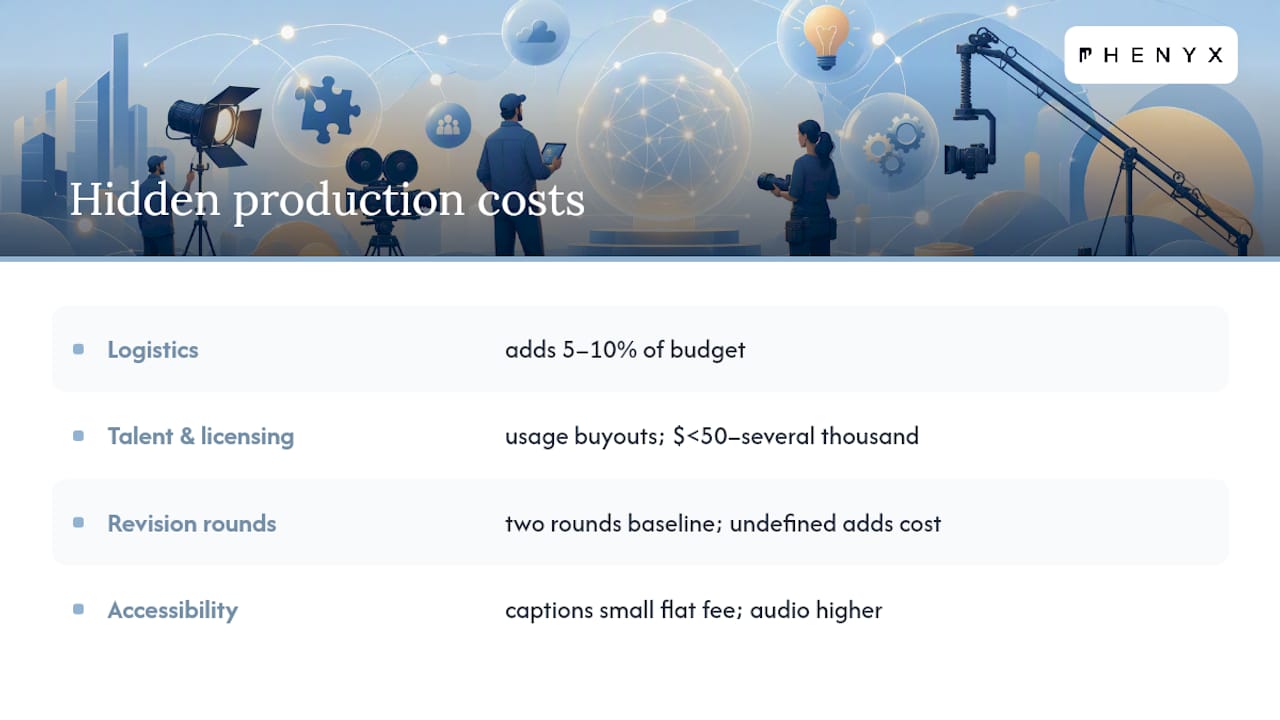
Logistics top the list. Multi-location shoots commonly add 5 to 10 percent to the total budget through travel, parking, permits, and extra setup time per site. A “quick second location” is never actually quick.
Talent and licensing create ongoing exposure. A one-time talent fee often only covers limited usage. Broadcast rights, extended digital usage, or a multi-year usage window can trigger separate buyout fees. Music licensing ranges from under $50 for a royalty-free track to several thousand dollars for a recognizable song with broad usage rights.
Revision rounds are the most common source of scope creep. Two rounds is the standard baseline, and projects that leave rounds undefined routinely run over both budget and timeline.
Accessibility and compliance costs are often small but easy to forget. Captions typically add a modest flat fee per video. Audio description and certain accessibility compliance work require meaningfully more time and budget, and that cost should carry the same upfront planning as any other production requirement.
Pro Tip: Get your revision round count and your usage/licensing terms in writing before the first shoot day, not after the first cut arrives. Renegotiating scope mid-edit almost always costs more than defining it up front.
How Do You Get an Accurate Video Production Quote?
A vague brief produces a vague quote, and a vague quote is where budgets go sideways. Build your ask before you contact anyone.
- List every deliverable you need (the hero video plus every cutdown, aspect ratio, and platform version) before requesting quotes.
- Ask for line-item pricing, including per-day crew rates, not a single bundled number.
- Confirm the number of revision rounds included, and get it in writing.
- Build in a 10 to 15 percent contingency for unplanned location or talent needs.
- Negotiate ownership and usage terms explicitly, especially if you’ll reuse footage across paid campaigns.
- Confirm captions and platform-specific exports are included, not billed as extras later.
- Ask on the first call: What’s your day rate? How many revision rounds are standard? What happens if we need an extra shoot day?
A quote that dodges these questions, or bundles everything into one flat number with no breakdown, is a sign to keep shopping.
How Long Does a Video Project Take?
- Single live-action piece: typically 4 to 8 weeks from script to final delivery.
- Animation projects: often 8 to 12 weeks, since every frame is built rather than filmed.
- Enterprise training programs: can run 3 to 6 months across multiple modules.
- Revision practice: defining two rounds upfront, as most production professionals recommend, keeps both cost and schedule predictable.
- Stakeholder management: appoint a single approver and consolidate feedback into one review window per round, rather than letting comments trickle in from five people over two weeks.
- Contingency planning: outdoor shoots need a weather backup day; secure or restricted locations need extra lead time for access approval.
What Should You Know About Licensing Stock Footage?
Stock footage can shave thousands off a budget, but the licensing terms determine whether that savings is real or temporary. A standard royalty-free license, often $20 to $200 per clip, usually covers web and social use but may exclude broadcast, paid advertising, or resale.
Extended licenses, which cost more, typically cover broader commercial use, including paid media campaigns. Skipping this distinction is a common mistake: a business buys a basic license, runs the footage in a paid ad campaign, and finds out later the license didn’t cover that use.
Editorial stock footage (news clips, real event footage) usually cannot be used in commercial or advertising contexts at all, regardless of license tier. Always confirm the specific use case, footage isn’t just “commercial or not,” it’s commercial for what.
The other consideration is exclusivity. Standard stock licenses are non-exclusive, meaning a competitor could license the same clip. For brand films or campaigns where visual distinctiveness matters, custom footage costs more upfront but avoids the risk of your hero shot showing up in a competitor’s ad six months later.
For most explainer videos and internal training content, stock footage licensing is a smart cost-saver. For brand films meant to carry a distinct visual identity, the licensing savings often aren’t worth the tradeoff.
Do Drones and 4K/8K Filming Increase Cost?
Drone footage and higher-resolution capture have both gotten more affordable, but they still shift your budget in specific, predictable ways.
Drone footage typically adds $500 to $2,000 per shoot day, covering the pilot’s certification, equipment, and insurance. FAA-certified drone operators charge more than general crew because the certification and liability requirements are higher. For real estate, event coverage, or brand films that need establishing shots, this is often a worthwhile add. For a talking-head interview, it’s an unnecessary expense.
4K filming is now close to standard and rarely adds meaningful cost, since most modern cameras capture in 4K by default. 8K filming is a different story: it requires more storage, longer render times in post-production, and often specialized equipment, which can add 10 to 20 percent to post-production costs. Unless you have a specific reason to future-proof footage for large-format displays, 4K delivers the same viewer experience at a lower cost.
The bigger cost driver isn’t the resolution itself, it’s what higher resolution demands downstream: more storage, longer color grading sessions, and heavier files for your editor to manage. Buyers who ask for 8K “just in case” often pay for capability they never actually need in the final delivered video.
What Do Small, Medium, and Large Video Budgets Look Like?
Seeing a full budget laid out, rather than just a range, makes the numbers easier to plan around.
Small project ($3,000–$6,000): A single-location testimonial video with one subject, half a day of shooting, basic lighting, and standard editing. Roughly $500 for pre-production, $2,500 for a one-day crew and equipment, and $1,500 for editing and color.
Medium project ($12,000–$18,000): A corporate explainer with light animation, a professional voiceover, and two locations. Expect around $1,800 for scripting and pre-production, $8,000 for two shoot days with a full crew, and $5,000 for editing, motion graphics, and sound design.
Large project ($40,000–$70,000): A brand film with three locations, paid talent, custom animation sequences, and a licensed music track. Pre-production might run $6,000 for scripting, casting, and location scouting. Production, spread across four to five shoot days with a full crew and travel, often runs $30,000 to $45,000. Post-production, including color grading, custom motion graphics, and sound mixing, typically lands at $10,000 to $20,000.
These bands shift based on talent fees, usage terms, and how many finished deliverables you need from a single shoot, which is exactly why a line-item quote matters more than a single “how much does this cost” number.
Does Location Affect Video Production Pricing?
Where you shoot changes your budget in ways that have nothing to do with creative quality. Crew rates in major metro markets run higher than in smaller markets, simply because of local cost of living and demand for skilled crew.
Permit costs vary widely by municipality. Filming in a public park might be free in one city and require a $200 permit fee in another. Filming on private property (a restaurant, a retail location, a corporate campus) usually requires separate location agreements, which can include a rental fee.
Multi-location projects compound these costs. Every additional city or site adds travel, lodging for crew if the distance requires it, and setup time. This is the same logistics factor that adds 5 to 10 percent to multi-site budgets industry-wide.
For businesses operating across several markets, whether that’s Denver, Tampa, or Dallas-Fort Worth, this is worth planning for early. A brand film that requires footage from three different cities isn’t just three times the shoot cost. It’s three times the travel, permitting, and logistics coordination, which is exactly the kind of expense that catches buyers off guard when it wasn’t priced into the original quote.
How Phenyx Structures Video Budgets to Avoid Surprises
Video production is often run alongside strategy, web design, and SEO, which can help ensure a single team owns the deliverables list from script to final export instead of passing your project between vendors. That structure alone eliminates a lot of the miscommunication that inflates budgets.
Every project starts with a line-item estimate, a defined number of revision rounds, and a deliverables list built before the first shoot day. Batching multiple assets into one shoot, when it fits the brief, is a standard part of how Phenyx keeps corporate video costs predictable rather than open-ended.
— PHENYX
Get a Line-Item Video Production Estimate
Working with a single provider that handles production, strategy, and post-production under one roof can offer a single point of contact, one quote, and one team accountable for the final deliverable instead of multiple invoices and timelines to coordinate.
When you reach out, ask for a line-item estimate that breaks down crew days, revision rounds, and usage terms, along with a reference portfolio relevant to your industry. That’s the same standard this guide recommends asking any vendor for, and it is a best practice to scope every project from the first call. If your business is weighing a corporate video, a brand film, or a batch of social content, start with the Video Production page and request a quote built around your actual deliverables, not a generic package.
Sources
StudioBinder’s pricing guide and Corcino Productions’ budgeting checklist cover line items and percent-of-budget standards in more depth.
- How Much Does Corporate Video Cost? Pricing Guide for 2026 — StudioBinder
- How to Budget for Corporate Video Production (2026) — Corcino Productions
- Video Production Cost in 2026: Realistic Price Guide — Elephant Productions
- Corporate Video Production Cost: Full 2026 Guide — DMAK Productions

