


How to Get Found in ChatGPT and Google AI
To get found in ChatGPT and Google AI, make sure the systems can reach your site, give them clear and trustworthy pages worth retrieving, and measure your presence by testing real questions. There is no secret switch. Most of the work is sound SEO, applied with a sharper eye for how an answer engine reads your business.
This guide is written for owners and marketing leads at small and midsize businesses. It walks through the access checks, the content that earns citations, the myths you can ignore, and how to track progress.
TL;DR
- Check first that ChatGPT’s search crawler and Google’s index can reach your pages. Blocking them quietly removes you from the running.
- Traditional SEO is still the foundation. Clear, original, expert content on pages that stand on their own is what gets retrieved and cited.
- You do not need an llms.txt file or special “AI schema” to appear in Google.
- Measure by asking real customer questions, tracking referral traffic, and watching Search Console, not by chasing a single rank.
Table of Contents
- Quick Summary
- How ChatGPT and Google AI decide what to show
- Step 1: See where you stand today
- Step 2: Make sure the systems can reach you
- Step 3: Give them something worth retrieving
- What you can safely ignore
- Where traditional SEO fits
- Step 4: Measure what is changing
- Our perspective
- When to bring in help
- Frequently asked questions
- Sources
Quick Summary
- Test 10 to 20 questions your ideal customer asks, in ChatGPT and Google, and record who gets mentioned.
- Confirm your robots.txt does not block OAI-SearchBot and that your pages are indexed with a snippet.
- Make each important service or product page complete enough to answer a question alone.
- State who you are, where you work and what you do in plain, consistent language across your site and profiles.
- Show real expertise: named authors, original examples, accurate details.
- Track ChatGPT referrals in analytics and review the new generative AI reports in Search Console.
- Repeat your tests monthly, because answers change from run to run.
How ChatGPT and Google AI decide what to show
Both systems lean on live search. A 2025 analysis from Search Engine Land explains that Google’s Gemini-powered experiences are commonly tied to live Search, and ChatGPT can pull from live sources when retrieval is turned on. In both cases, the answer is grounded in pages the system retrieved.
ChatGPT does not simply copy Google, though. A 2026 study from a researcher at the National University of Singapore found that ChatGPT rewrites queries and filters candidate pages, and that pages appearing more often across retrieval runs were more likely to be cited later. The same study found Google Search and OpenAI’s API together recovered only about a quarter of cited URLs and about half of cited hostnames. In practice, that means two things:
- Being a consistent, recognizable source across many related questions matters more than winning one query.
- Your whole domain’s reputation counts, not just one page.
Ahrefs reported something similar: ChatGPT cited ranking domains roughly three times as often as ranking pages. Different pages from a trusted site can be chosen, which rewards a cluster of related, well-built pages over a single lucky article.
We go deeper on this logic in our piece on how AI search engines decide what to recommend.
Step 1: See where you stand today
Before changing anything, find out what customers see. Open a fresh browser session, log out of your accounts, and ask the questions a buyer would ask. Mix three types:
- Location questions: “best commercial roofer near Tampa” or “web design agency in Fort Worth.”
- Attribute questions: “accounting firm for restaurants” or “video production company that handles scripting and editing.”
- Problem questions: “why is my website not generating leads?”
Run each in ChatGPT and in Google, noting whether Google shows an AI Overview. Write down three things per question: whether you are mentioned, whether you are linked, and which competitors appear. Repeat the run a few times, since answers vary between runs. One company’s walkthrough suggests this repeat-and-record approach gives a more reliable read than a single check.
The result is a baseline. It also tells you which questions matter most, because you will see the gaps in plain view.
Step 2: Make sure the systems can reach you
This is the least glamorous step and the one most often broken.
ChatGPT
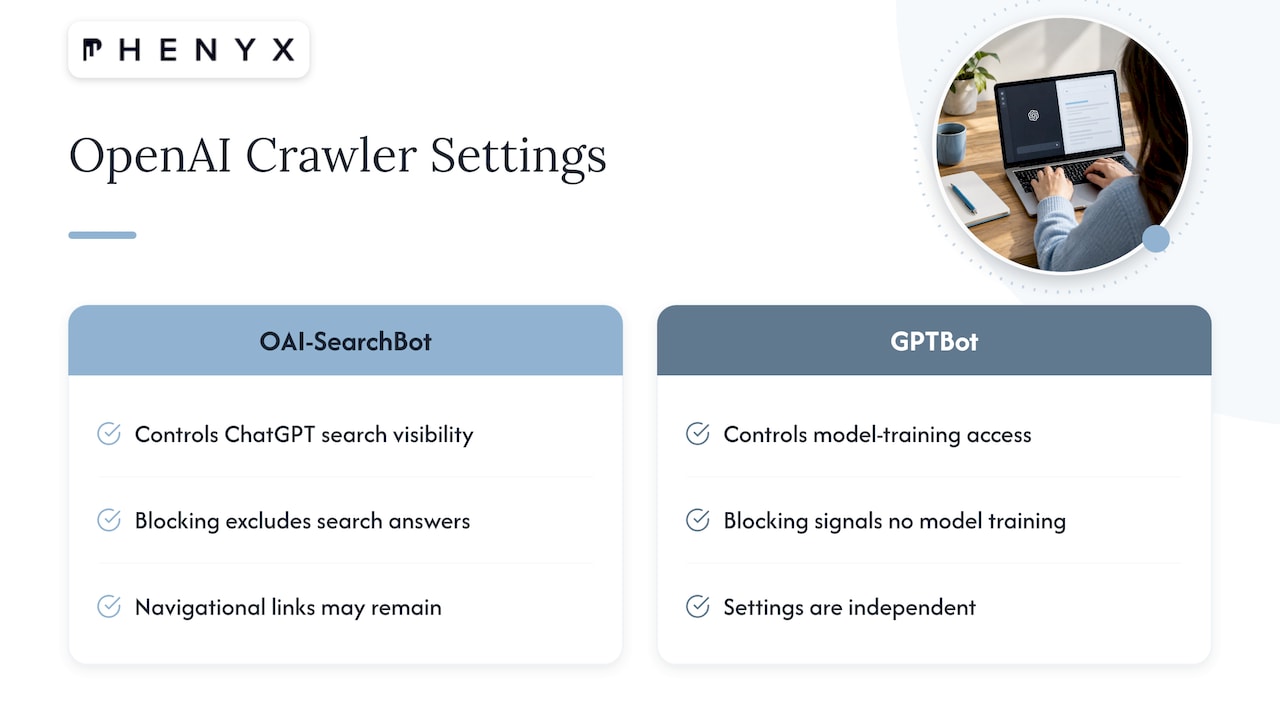
OpenAI runs a crawler named OAI-SearchBot that surfaces sites in ChatGPT search. Its documentation says that blocking it keeps a site from being shown in ChatGPT search answers, though the site may still appear as a navigational link. OpenAI’s publisher FAQ adds that OAI-SearchBot and GPTBot settings are independent, and disallowing GPTBot signals that your content should not train its foundation models. So you can opt out of training and still be eligible for search results.
Open yourdomain.com/robots.txt and read it. Many sites inherited broad blocking rules from a host, a security plugin or a developer who wanted to cut bot traffic. If OAI-SearchBot is disallowed, that is a business decision someone should make on purpose.
Google’s guide to generative AI features says that a page must be indexed and eligible to appear in Search with a snippet to be a supporting link in AI Overviews or AI Mode. Check in Search Console that your key pages are indexed, that no stray noindex tag sits on them, and that snippet controls are not set to suppress your text.
Technical basics also still apply: fast loading, mobile-friendly layouts, clean internal links and content that is visible in the HTML rather than hidden behind scripts. If your site was built years ago and struggles on these points, a rebuild may be the fastest fix. Our website design team builds sites with crawlability in mind from the start.
Step 3: Give them something worth retrieving
Being reachable gets you into the pool. Being useful gets you cited. Three habits do most of the work.
Make your business easy to describe
An answer engine has to summarize you in a sentence. Help it. Say plainly what you do, who you serve, where you operate and what makes you different, and say it the same way on your homepage, About page, Google Business Profile and directory listings. Inconsistent names, old addresses or vague slogans make you harder to recommend with confidence.
Let important pages stand alone
Each core service deserves its own page that fully answers the common questions: what it is, who it is for, how the process works, what it costs or how pricing is set, and what to expect. A thin page that depends on three other pages to make sense is a poor candidate for retrieval.
Some writers advise formatting every paragraph around one main idea. That is good writing practice anyway. Short, direct paragraphs under clear headings are easy for people and machines to lift accurately. You do not need to chop articles into tiny fragments to do it.
Show real expertise
Conductor’s analysis in Search Engine Land points to helpful, authoritative content, authorship, relevance and topical authority as factors that can affect AI visibility. Translate that into action:
- Put real names and credentials on articles.
- Include first-hand detail: your process, your photos, your numbers, your mistakes.
- Answer the questions customers actually ask on sales calls.
- Build a cluster of related pages around each core service so your site covers a topic from several angles.
A note on AI-written content. Google’s guidance says that using AI to generate content mainly to manipulate rankings violates its spam policies, while appropriate use is not inherently spam. The test is whether a person would find the page original and helpful. Mass-produced filler fails it, whoever or whatever wrote it.
What you can safely ignore
A lot of advice in this space is noise. Here is what the official sources say.
- llms.txt: Google states that Google Search does not use llms.txt files, and creating one neither helps nor harms visibility there. Skip it unless some other tool you use asks for it.
- Special AI schema: There is no separate markup to unlock AI Overviews. Standard structured data that accurately describes your business, products and articles remains useful for search generally. Do not expect it to act as a ranking lever on its own.
- AEO or GEO hacks: The same Google guide emphasizes that its generative features rely on the same people-first quality signals as traditional Search. Be wary of anyone selling a trick.
That last point is not an argument against specialist help. It is an argument for help that focuses on fundamentals, measurement and consistency. Our generative engine optimization playbook covers that practical side.
Where traditional SEO fits
Similarweb’s 2026 guide puts it clearly: traditional SEO remains the foundation of AI visibility, while measurement shifts toward brand mentions and citation frequency. Quality content, technical health and domain authority still decide eligibility. What changes is the scoreboard. A page can earn a citation without being the top blue link, and a brand can be named in an answer without any click at all.
This changes how you judge success. Rankings and organic sessions remain useful, but add mention share, citation presence and referral traffic from AI tools to your reporting.
Step 4: Measure what is changing
You have four practical sources of data.
- Your own prompt tests. Keep a spreadsheet of your 10 to 20 priority questions. Rerun them monthly in the same way and log mentions, links and competitors. The NUS researcher suggests that because engines do hidden processing, tracking hostnames and entities is steadier than tracking individual URLs. In other words, ask whether your brand and domain appear, not whether one exact page does.
- Analytics. OpenAI says that ChatGPT adds utm_source=chatgpt.com to referral links for sites that allow OAI-SearchBot. Filter for it in your analytics platform to see visits, and more importantly, whether those visitors call, fill out a form or buy.
- Search Console. Google announced dedicated reports for impressions and pages in generative AI features, rolling out first to a subset of sites. If you have access, review them alongside your regular performance data.
- Visibility tools. Similarweb lists metrics such as brand visibility score, brand mention share, prompt coverage and sentiment as ones to follow. A paid tool can automate the prompt testing, but a spreadsheet is enough to start.
Tie it all to business outcomes. A mention that never produces an inquiry is a vanity metric. Our guide to ad tracking beyond clicks and impressions shows how to connect visibility to leads.
Our perspective
We see businesses make the same mistake in two opposite directions. Some assume AI search is a separate discipline and rush into tactics before checking whether their site is crawlable. Others assume nothing has changed and keep reporting rankings while customers get answers elsewhere.
The better path is a structured one. Fix access, tighten the site, build pages that answer real questions in your own voice, then measure and adjust. We follow a structured approach at PHENYX for exactly this reason, and it works because the pieces are connected: the site, the content, the brand message and the technical SEO all affect whether a system can describe you accurately.
That connection is why we keep these services under one roof. When web design, SEO and AEO, branding and video are handled by one in-house team, the message stays consistent and fixes move faster than when several vendors each own a piece. We also customize strategy to the goals and market of each client rather than applying a template, and local markets such as Denver, Tampa and Dallas-Fort Worth each have their own competitive picture.
— PHENYX
When to bring in help
You can run the baseline test and the robots.txt check yourself this afternoon. Consider help when the findings point to bigger work: a site that is slow or poorly structured, thin service pages, inconsistent branding, or no capacity to produce expert content regularly.
Our SEO and AEO services cover audits, technical fixes, content and measurement. If you want ongoing, all-inclusive support across web, SEO, video and branding, our MODS subscription starts from $4,000 per month. You can see how it works on the PHENYX homepage.
Frequently asked questions
How do I check if my business shows up in ChatGPT and Google AI?
Ask the questions your customers ask, in a logged-out browser, across ChatGPT and Google. Record whether you are mentioned, linked or missing, and who appears instead. Repeat the run a few times, since answers shift between attempts.
Do I need to allow OAI-SearchBot to appear in ChatGPT?
Yes, if you want your pages shown in ChatGPT search answers. OpenAI says blocking it prevents that, though a navigational link may still appear. Its settings are separate from GPTBot, so you can decline model training and still allow search.
Do I need an llms.txt file or special schema?
Not for Google. Google says its Search does not use llms.txt, and that creating one does not help or harm visibility. Accurate structured data is fine to keep, but no special AI markup is required.
Is getting found in AI search different from SEO?
Mostly it builds on SEO. Quality content, technical health and authority still drive eligibility. The difference is measurement: you also track brand mentions, citations and AI referral traffic, not just rankings.
How long does it take to show up?
No one can promise a timeline, because answers vary by question, market and competitor strength. Pages must first be crawled and indexed, and then earn repeated retrieval. Track your prompt tests monthly and judge the trend over several months rather than week to week.
Sources
- How different AI engines generate and cite answers (Search Engine Land)
- How ChatGPT Picks What It Cites (National University of Singapore)
- ChatGPT May Scrape Google, but the Results Don’t Match (Ahrefs)
- Overview of OpenAI Crawlers
- Publishers and Developers FAQ (OpenAI Help Center)
- Google’s Guide to Optimizing for Generative AI Features
- How to measure and maximize visibility in AI search (Search Engine Land)
- Google Search’s guidance about AI-generated content
- AI Search Optimization Best Practices (Similarweb)
- Introducing Search Generative AI performance reports

