Move Pipeline in One Quarter with B2B Content Marketing
B2B content marketing is the practice of creating research, stories, and tools that move a buying group toward a purchase decision, measured by pipeline influence rather than clicks. The prescription is simple: target buyers who are actively comparing solutions, build assets around a specific decision backed by real evidence, and track which pieces show up in closed deals. Anchor the work to what industry research actually shows works, not to what generates the most traffic.
TL;DR:
- Focusing on comparison-driven, decision-specific content that addresses each stakeholder’s proof needs increases the likelihood of influencing purchase decisions.
- Building assets around original research and customer outcomes makes content more trustworthy and citable by both buyers and AI answer engines, extending reach.
- Tracking content impact through sales debriefs and multi-touch attribution offers a more accurate measure of pipeline influence than last-click or traffic metrics.
- Prioritizing topics by pipeline impact, standardizing briefs, and repurposing research into multiple formats enhances operational efficiency and content relevance.
- Effectively influencing B2B buyers requires integrating strategy, production, and distribution in-house, with a focus on sales-ready assets that support decision stages.
Table of Contents
- Quick Summary
- What Is B2B Content Marketing, and Why Does It Matter?
- How Do You Build a B2B Content Strategy That Works?
- Which Content Types Actually Influence B2B Buyers?
- How Should You Plan and Operate a B2B Content Program?
- How Do You Measure B2B Content Marketing’s Impact on Pipeline?
- What Do Strong B2B Content Examples Look Like?
- Why PHENYX Is Built for This Kind of Content Work
- The Real Shift: Stop Measuring Attention, Start Measuring Influence
- Ready to Build a Content Program That Moves Pipeline
- Sources
- FAQ
Quick Summary
- Prioritize bottom-of-funnel keywords where buyers are already comparing solutions, not top-of-funnel awareness terms.
- Build every asset around original research or verified customer outcomes, since generic advice rarely earns trust or citations.
- Create at least one “surfacing asset” per quarter that your sales team can pull into live calls.
- Track multi-touch influence across the deal cycle instead of crediting only the last click.
- Repurpose your best research or case study into three or more formats before moving to the next topic.
- Run a sales debrief after every closed deal to learn which content actually got used.
What Is B2B Content Marketing, and Why Does It Matter?
B2B content marketing means producing material that informs, persuades, and equips business buyers across a long, multi-person purchase process. It differs from B2C content in one critical way: you are rarely writing for one person. You are writing for a buying committee, often five to ten stakeholders with different priorities, and your content has to survive being forwarded, debated, and scrutinized by people who never saw your ad.
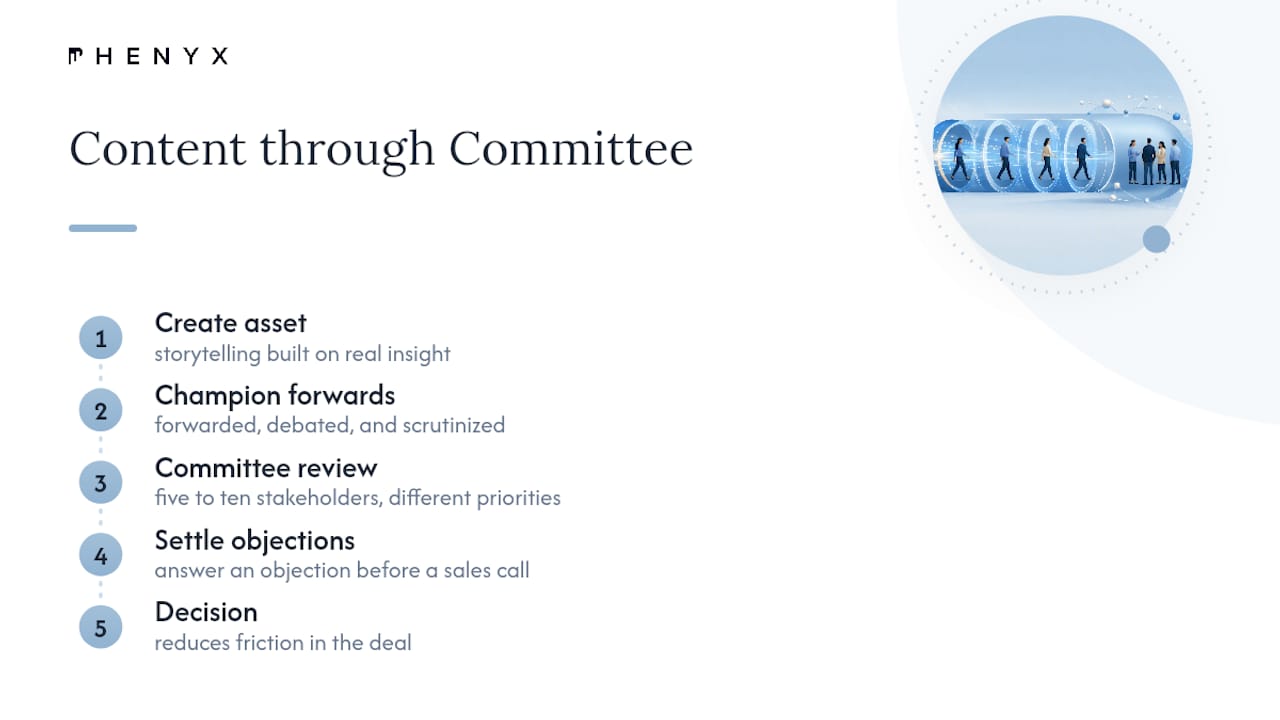
FT Longitude’s framework treats content as storytelling built on real insight, anchored by clear buyer personas and deliberate planning, not just a publishing calendar. That distinction matters because most B2B teams still measure success in sessions and downloads. Traffic without pipeline is the most common failure pattern in the category: a blog ranks well, generates thousands of visits, and contributes nothing to a closed deal because it answered the wrong question for the wrong stage of the buying journey.
Content earns its budget when it reduces friction somewhere in the deal. That could mean answering an objection before a sales call, giving a champion something to forward internally, or settling a debate between finance and IT.
How Do You Build a B2B Content Strategy That Works?
Strategy starts with mapping your buying group, not your persona deck. Most B2B purchases involve a champion, an economic buyer, a technical evaluator, and at least one skeptic. Each one needs a different kind of proof, and your content plan should assign a specific asset to each role rather than assuming one blog post satisfies everyone.
Here’s a practical sequence for building that out:
- Map the buying group to the decision. For each stage of the funnel, ask what decision the buyer needs to make and who else has to sign off on it.
- Write a decision-focused brief before any drafting starts. Include the target reader, the exact decision the piece supports, the evidence you’ll use, and the call to action.
- Develop a defensible point of view. The Content Strategist recommends framing every brief around a specific decision an executive needs to make, then leading with the conclusion instead of burying it in the fifth paragraph.
- Prioritize distribution by buyer stage. Awareness content lives on organic search and social; comparison and proof content belongs in sales enablement and email nurture, where a champion can retrieve it fast.
TopRank’s research on the dual-audience problem points out that original research and named contributors make content citable by both human buyers and AI answer engines, which extends your reach well past the people who visit your site directly.
Pro Tip: Before you approve a topic, write the one sentence that states the decision it needs to support. If you can’t write that sentence, the brief isn’t ready.
Which Content Types Actually Influence B2B Buyers?
Format matters less than fit. A comparison page that lets a buyer defend a shortlist to their boss will outperform a polished explainer video that never mentions a competitor by name.
LinkedIn’s B2B content resource breaks the category into a handful of proven formats, each suited to a different funnel stage:
- Case studies work best when they quantify a specific outcome tied to a role, not a vague “improved efficiency” claim.
- Original research and surveys build authority fast because they give buyers a number nobody else has, which is also why they tend to earn more organic citations.
- Comparison pages directly support the evaluation stage, where buyers are actively weighing options. A structured tool like AmmarAI’s comparison generator can help teams standardize how those pages get built.
- Webinars and video convert well when they feature a named expert answering the exact objection your sales team hears most often. Pulling a strong webinar segment into a short clip built for social extends its life well past the live date.
Weak thought leadership, meaning generic opinion pieces with no new data, is one of the most common reasons B2B content underperforms.
How Should You Plan and Operate a B2B Content Program?
Most content teams don’t fail on ideas. They fail on prioritization and follow-through. A small team publishing constantly on the wrong topics will lose to a small team publishing occasionally on the right ones.
Build your operation around three moves:
- Score every topic by expected pipeline impact before it enters the calendar. A simple grid, ranking each idea by buyer stage and deal size influenced, keeps a small team from chasing low-value traffic plays.
- Standardize the brief. Every brief should include the target buyer, the decision it supports, the evidence to be used, the format, and the call to action. Skip any of those and the writer is guessing.
- Repurpose deliberately. One flagship research report can become a webinar, three short videos, a comparison page, and a set of sales one-pagers. Decide up front which formats get built and which get outsourced.
Practitioner surveys point to resource constraints and unclear metrics as the two most common operational blockers, which is exactly why the prioritization grid matters more than the calendar template.
Pro Tip: Cap your monthly output at what your team can properly brief and repurpose. Three well-researched, multi-format pieces beat ten thin blog posts every time.
How Do You Measure B2B Content Marketing’s Impact on Pipeline?
Last-touch attribution fails in B2B because deals take months and involve multiple people who never touch the same page. CXL’s analysis of B2B content failures names poor attribution as one of the three recurring problems that quietly drains content budgets, alongside targeting the wrong buyer and weak thought leadership.
Multi-touch or assisted-conversion models give a more honest picture, but the highest-signal data often comes straight from sales. Debriefing which assets surfaced in won deals tells you what actually moved a buying committee, not just what got clicked.
| Content Role | What to Track | Where It Shows Up |
|---|---|---|
| Awareness | Organic sessions, branded search growth | Top-of-funnel dashboards |
| Consideration | Time on comparison pages, return visits | Marketing automation |
| Decision | Asset shared in sales calls, downloaded by multiple stakeholders | Sales debrief notes, CRM |
| Retention/expansion | Content used in renewal or upsell conversations | Account engagement scores |
Building this kind of tracking into your existing lead generation efforts closes the loop between content and revenue instead of leaving them as separate reports nobody cross-references.
What Do Strong B2B Content Examples Look Like?
- An original benchmark survey publishes one striking statistic about industry adoption rates, gets cited by three trade publications within a month, and drives a measurable lift in demo requests from readers who cite the report directly.
- A head-to-head comparison page, built to answer the exact question a champion needs to justify a purchase to finance, gets pulled into a proposal deck by the sales team within weeks of launch.
- A 30-minute customer webinar gets cut into five short clips for social and one sales one-pager, extending a single production effort across four months of distribution.
Why PHENYX Is Built for This Kind of Content Work
Executing this playbook takes more than a content calendar. It takes strategy, production, and distribution working from the same brief, which is exactly how Phenyx operates.
- A single in-house team handles strategy, SEO and AEO, video production, and web design, so a case study doesn’t stall waiting on four different vendors.
- Structured brief and prioritization processes keep content tied to decisions and pipeline impact, not just publishing volume.
- Video production capability turns webinars and customer interviews into sales-ready assets without a separate production contract.
- Clients working with Phenyx in Denver/Lafayette, Tampa, and Dallas-Fort Worth get a marketing partner that treats content as a revenue function, not a publishing quota.
The Real Shift: Stop Measuring Attention, Start Measuring Influence
Most B2B teams still optimize for traffic because it’s easy to report. The harder, more valuable discipline is tracking which pieces show up when a deal closes. Make sales debriefs a standing part of your content process, and require every brief to state the decision it supports before anyone writes a word. Run that experiment for one quarter and watch which assets your sales team actually reaches for.
— PHENYX
Ready to Build a Content Program That Moves Pipeline
If you’ve been comparing content agencies or trying to piece together strategy, SEO, and video from separate vendors, you already know how much gets lost in the handoffs. Phenyx runs strategy, SEO and AEO, and video production under one in-house roof, so your decision-focused briefs turn into published, sales-ready assets without three separate contracts and three separate timelines.
A first call with Phenyx starts with a look at your current content and where it’s actually influencing deals, not just where it’s ranking. From there, our SEO and AEO services target the bottom-of-funnel searches your buyers are already running, and our video production team turns your best research or customer story into sales-surfaced assets across formats. If your site itself is the bottleneck, a website redesign can turn your content into a stronger conversion engine. Reach out to Phenyx to map your next quarter of content against real pipeline goals.
Sources
- B2B content marketing: A practical guide - FT Longitude
- B2B content marketing challenges hurting SEO and revenue (and how to fix them) - CXL
- Types of B2B Content Marketing | LinkedIn Ads
- B2B Content for Decision Makers - The Content Strategist
FAQ
What Does B2B Content Marketing Mean?
It means creating research, stories, and sales-ready assets designed to influence a business buying group toward a purchase decision, measured by pipeline impact rather than traffic alone.
What Are the Four Types of B2B Marketing?
Common categories include content marketing, account-based marketing, email and lifecycle marketing, and paid or search advertising, each targeting a different stage of the buyer’s evaluation.
Does B2B Marketing Pay Well?
Compensation varies widely by role, seniority, and company size, and no single figure applies across the field, but demand for marketers who can prove pipeline impact tends to command stronger offers than those focused solely on traffic metrics.
What Are Some Examples of Effective B2B Content?
Original research reports, head-to-head comparison pages, customer case studies with quantified outcomes, and webinars featuring named experts all tend to influence buying groups more than generic blog posts.
How Do You Know If B2B Content Marketing Is Working?
Track whether sales teams actually use specific assets in live deals, and measure multi-touch influence across the buyer journey instead of relying on last-click attribution alone.
Recommended
- B2B Lead Generation Strategies That Actually Drive Pipeline
- How to Prepare for a Quarterly Marketing Meeting and Set Your Brand Up for Success
- What Plano B2B Companies Get Wrong About Brand Identity Before Spending on Marketing
- Why Grapevine Businesses Need a Content Strategy to Compete in DFW Search