Brand Identity Cost: What Small Businesses Should Budget
Most small businesses should budget for a professional brand identity within a moderate price range, with logo-only work starting at a few hundred dollars and full brand systems with rollout support reaching high five to six figures at the agency level. Bootstrapped startups typically fall within the lower end of this range. Early-stage startups with funding or real revenue usually require a mid-range budget. Scaling small businesses preparing for expansion or a rebrand often need a higher budget to cover strategy, a full asset library, and rollout guidance.
Brand identity pricing swings this widely because “branding” means different things to different providers, and comprehensive brand projects can range from a few thousand dollars with freelancers up to six figures or more with full-service agencies. Before you request a single quote, know which band fits your stage.
- Logo-only: Starting at a few hundred dollars up to several thousand
- Basic identity package: Moderate range for essential identity elements
- Full brand identity: Higher range for comprehensive brand development
- Full brand system with rollout: High range covering extensive rollout and support
Your first move: ask any vendor for an itemized scope breakdown before a price, not after.
Key Takeaways
Brand identity cost depends far more on scope and strategy depth than on the label a vendor puts on the package.
| Point | Details |
|---|---|
| Match band to stage | Bootstrapped startups fit $3,000–$8,000; scaling businesses often need $25,000–$60,000. |
| Define scope before quoting | Separate logo-only, basic identity, and full system needs before requesting bids. |
| Budget beyond design fees | Set aside funds for trademark filing, print production, and web implementation. |
| Compare proposals on substance | Ask for itemized deliverables, revision limits, and file ownership terms, not just price. |
| Consider an integrated provider | Phenyx bundles branding, web design, and production to reduce handoffs and rollout surprises. |
Table of Contents
- How Much Does Brand Identity Cost by Scope?
- What Do Brand Identity Packages Cost at Different Provider Tiers?
- What Factors Drive the Price of a Brand Identity?
- Three Sample Brand Identity Packages You Can Request
- What Costs Come After the Design Fee?
- What Questions Should You Ask Before Signing a Branding Quote?
- How an Integrated Agency Structures Brand Costs
- Primary Sources and Further Reading
- Why Most Pricing Guides Get This Wrong
- Get a Brand Identity Built Around Your Business Stage
- Sources
How Much Does Brand Identity Cost by Scope?
The confusion around brand identity pricing almost always traces back to one problem: buyers and vendors are talking about different scopes using the same word. Before you compare a single quote, pin down which of these three tiers you actually need.
1. Logo-only. This covers a primary logo mark, maybe one or two variations (horizontal, stacked), and basic file exports. It does not include a style guide, brand voice work, or supporting graphic assets. Expect vector files (AI, EPS, SVG), a few raster formats (PNG, JPG), and possibly a one-page color and font reference. That’s usually it.
2. Basic identity package. This adds a real color palette with hex and CMYK codes, typography selections, a simple usage guide, and often business card or letterhead templates. It’s the middle ground most small businesses actually need: enough consistency to look professional across a website and social profiles, without the depth of a full brand strategy engagement.
3. Full brand identity or brand system. This is where strategy enters the picture: audience research, positioning, messaging pillars, a comprehensive style guide, icon or pattern libraries, and often templated collateral for sales decks, signage, or packaging. A full brand identity commonly ranges from the low thousands with freelancers to mid-five-figures with boutique studios and six figures with premium agencies, depending on how much original strategy and custom asset work is involved.
Here’s where most buyers get blindsided:
- Missing source files. A cheap logo purchase often comes with a JPG and nothing else. No editable vector file means you’re paying again the moment you need a sign printed or a variation created.
- No usage guidelines. Without documented spacing rules, color codes, and don’ts, every new hire or contractor makes it up as they go. Inconsistency creeps in within months.
- Trademark searches excluded. Almost no design package includes a formal trademark clearance search or filing. That’s a separate legal cost, and skipping it is how businesses end up rebranding two years in.
- Web-ready assets not specified. Favicon files, social media crops, and email signature versions are frequently left out unless you ask for them by name.
A helpful shorthand: think of brand as the full perception a customer holds, identity as the visual system that expresses it, and logo as one piece of that system. Buying a logo when you need an identity is like ordering a wheel when you need the car.
What Do Brand Identity Packages Cost at Different Provider Tiers?
Pricing shifts dramatically based on who you hire, not just what you ask for. A freelancer, a boutique studio, and a full-service agency price the same scope very differently because their overhead, expertise depth, and margin structures differ.
- Entry-level: A freelance designer or small studio delivering a basic identity with limited strategic input.
- Mid-level: A boutique branding studio providing a full identity with some strategy and expanded guidelines.
- Upper-mid-level: A mid-size agency offering deep discovery, full visual system, brand voice guidelines, and rollout support.
- Enterprise-level: A large agency managing complex identity work including governance, multi-market rollout, training, and ongoing brand support.
These ranges shift with geography, industry complexity, and timeline. A regional benchmark comparison shows surface-level identity work priced far lower than research-led identity work, with enterprise projects scaling well beyond that range once governance and global rollout enter the picture. A rushed two-week turnaround also tends to push pricing toward the top of whatever band you’re in, since compressed timelines mean overtime rates and fewer revision cycles.
Use these bands as filters, not final answers. If a quote for a “full identity” comes in at $2,500, that’s a signal the scope has been quietly reduced, not that you found a bargain.
What Factors Drive the Price of a Brand Identity?
Five variables explain most of the price difference between quotes for what looks like the same project on paper.
- Business stage and risk. A funded startup entering a competitive category needs stronger differentiation and more research, which raises cost. A local service business with low competition can often start leaner.
- Strategy depth vs. execution-only work. Research, positioning, and messaging work take far more senior hours than production. Agency pricing reflects labor, overhead, expertise value, and margin targets, and strategic thinking is priced at a premium over template execution.
- Number of surfaces and custom assets. A logo and business card cost far less than a system spanning packaging, signage, a website, and app icons.
- Provider seniority and reputation. A designer with 15 years and a strong portfolio charges more per hour than someone building their first client roster, and that premium usually buys judgment, not just polish.
- Timeline and revision rounds. Compressed deadlines and unlimited revisions both add hours, and hours are what you’re actually paying for.
Pro Tip: *Ask every vendor how many strategy hours versus production hours are baked into their quote.
Three Sample Brand Identity Packages You Can Request
Copy these into your next RFP so vendors quote against the same scope, making comparisons actually meaningful.
-
Starter pack. Primary logo, a few variations, basic color palette, fonts, file formats, and a concise usage guide. Suited to bootstrapped businesses validating concepts early.
-
Growth pack. Includes Starter elements plus positioning statement, expanded guidelines, business and social templates, and brand voice overview. Appropriate for early-stage startups with growing teams.
-
Scale pack. Adds stakeholder research, competitive analysis, icon or pattern libraries, packaging or signage templates, and rollout guidance. Designed for businesses addressing strategic needs to avoid inconsistency.
If your budget can’t stretch to the tier your stage needs, phase it: buy the Starter pack now with an explicit plan to layer in strategy work within 12 to 18 months, once revenue supports it.
What Costs Come After the Design Fee?
The design fee is rarely the full cost of a brand identity project. A basic identity typically takes two to four weeks; a full system with rollout can run eight to twelve weeks, and compressing either timeline usually adds a rush premium.
Beyond the design fee itself, budget for:
- Trademark search and filing, handled separately from design work in most cases
- Print production costs for business cards, signage, or packaging once files are finalized
- Website build or update costs to actually implement the new identity online
- Photography or illustration licenses if stock assets aren’t sufficient
Treat your brand identity as an annual line item, not a one-time purchase. Rebranding is a distinct and often larger scope than initial identity work, so budgeting a modest annual refresh allowance (even a few hundred dollars for updated templates or seasonal assets) tends to be cheaper than a full rebuild every three to five years.
What Questions Should You Ask Before Signing a Branding Quote?
A transparent proposal itemizes deliverables, sets clear milestones, states how many revision rounds are included, and spells out who owns the final files. If a quote is just a single number with “logo and branding” written above it, that’s your first red flag.
Ask vendors these questions before you sign anything:
- What exact files will I receive, and in what formats?
- How many revision rounds are included, and what happens if I need more?
- Do I own full rights to the final files, including source files?
- Is strategy or research included, or is this execution-only?
- What’s excluded from this quote that I might need later?
- What’s your typical timeline, and what happens if it slips?
- Can I see examples of similar-scope projects you’ve delivered?
- Who’s my primary point of contact throughout the project?
- Is trademark searching included or a separate referral?
- What does support look like after final delivery?
Watch for vague deliverable lists, no mention of file ownership, or pricing that seems too low for the scope described. A quote missing clear strategy and research hours is one of the more common signs of value drift, where a “full identity” label doesn’t match a full identity scope.
How an Integrated Agency Structures Brand Costs
Coordinating a logo designer, a separate copywriter, and a third vendor for web templates almost always creates hidden costs: mismatched files, inconsistent guidelines, and rounds of rework nobody budgeted for. An integrated approach, where branding, web design, and production sit under one roof, removes those coordination gaps by design.
- Discovery happens once, informing strategy, design, and rollout together
- Fewer handoffs mean fewer inconsistencies between the logo, the website, and printed materials
- A structured project flow keeps strategy work from getting skipped under deadline pressure
Pro Tip: Ask any prospective provider how many separate vendors your project will touch. Every handoff is a place where scope, cost, or consistency can quietly slip.
Primary Sources and Further Reading
- Branding Agency Pricing Explained
- Brand Identity Design Cost: 2026 Pricing Guide
- What’s Included in a Branding Package
- Real Branding Prices Across Regions
Treat these ranges as planning rails, not fixed quotes. Your actual price depends on scope, provider, and timeline.
Why Most Pricing Guides Get This Wrong
Most articles on brand identity cost hand readers a single number and call it a day. That’s backwards. The real skill isn’t finding “the price,” it’s matching scope to business stage, which is exactly where most small businesses overspend or underspend.
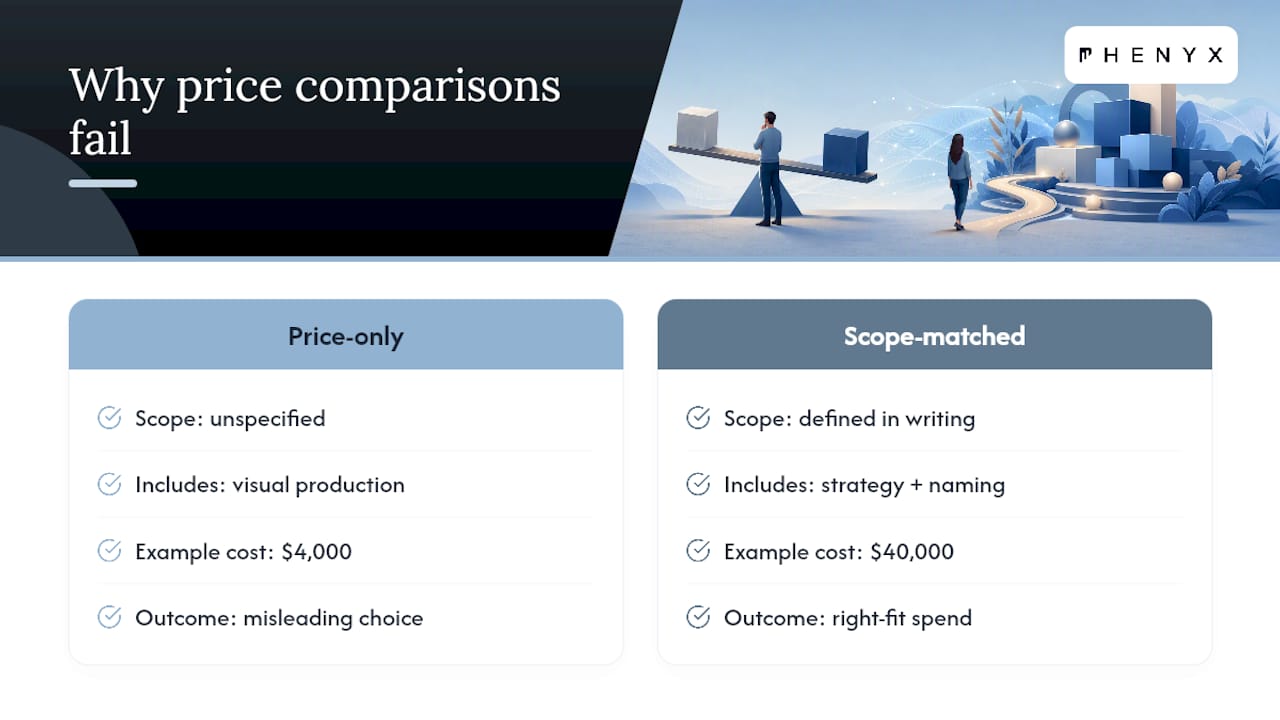
The conventional advice to “get three quotes and pick the middle one” falls apart when those three quotes describe three different scopes. A $4,000 bid and a $40,000 bid aren’t competing offers if one includes strategy and the other doesn’t. Comparing them on price alone is comparing a bicycle to a car because they’re both listed under “transportation.”
What the research actually supports is this: strategy hours are the real cost driver, not design polish. AI has compressed pricing for visual production, but strategic work and naming remain priced on human judgment, which means the gap between a cheap logo and a real identity is widening, not shrinking. If you take one thing from this guide, take this: define your scope in writing before you ask a single vendor for a number.
— PHENYX
Get a Brand Identity Built Around Your Business Stage
Freelancers and boutique studios can deliver a solid logo or basic identity, but coordinating separate vendors for strategy, design, and web rollout is exactly where hidden costs creep in. Phenyx handles branding, web design, and production under one team, so your identity, your website, and your printed materials come from the same discovery process instead of three disconnected ones.
That matters most once your brand identity needs to actually go live somewhere. If your new identity is going to anchor a website redesign, having the same team handle both means your color codes, typography, and voice carry through without a second round of guesswork. Phenyx also handles the graphic design work for templates and collateral that often gets left out of a standalone branding quote.
If you’re weighing your options for a brand identity project, start with a conversation about your scope and stage. Reach out to Phenyx for a quote built around what your business actually needs next, not a generic package.
Sources
- Branding Agency Pricing Explained: How Much Does It Cost?
- Brand Identity Design Cost: 2026 Pricing Guide for Designers | Brainy Papers
- What’s included in a branding package and what does it cost in 2026?
- How Much Does Branding Cost in 2026? Real Prices for the USA, Europe and Asia-Pacific
- Brand — Wikipedia