


Retail Digital Signage That Pays: Platform & Content, 12–24 Month ROI
Digital signage for retail drives measurable sales lift and cuts promotional turnaround time, but only when the content behind the screens gets the same attention as the hardware in front of them. Studies from 2023 point to an average sales increase of roughly 32% for promoted SKUs shown on digital displays. Whether your stores see that kind of return depends less on screen quality and more on whether someone is actually managing what’s on them.
TL;DR:
- Managing the content displayed on digital signage is crucial, as a disciplined content strategy significantly boosts sales and operational savings.
- Proper placement of screens in key store zones, such as aisles and near checkout, enhances conversion rates and customer engagement.
- A secure, centralized platform with location-based targeting and flexible control is essential for effective multi-store digital signage deployment.
- Regular content updates, ideally weekly or daily, prevent signage from becoming stale and maintain their impact on shoppers.
- Measuring ROI through sales lift, A/B testing, and attribution tracking is vital to justify further investment and optimize signage performance.
Table of Contents
- What Is Digital Signage for Retail?
- Benefits and ROI: What Retailers Actually Get Back
- Where Should You Place Screens in Your Store?
- What Should You Look for in a Signage Platform?
- How Much Does Retail Digital Signage Cost?
- How Often Should You Update Signage Content?
- How Do You Measure Digital Signage ROI?
- How Do You Roll Out a Signage Program Without Overspending?
- What Causes Retail Signage Programs to Fail?
- Where Signage Fits Into a Broader Marketing System
- How Phenyx Helps Retailers Launch Signage That Pays for Itself
- Sources
What Is Digital Signage for Retail?
Digital signage for retail is a network of screens, media players, and content management software that replaces static posters, printed menu boards, and paper shelf tags with dynamic, remotely updatable displays. Retailers use the term interchangeably with in-store digital displays, retail digital signage, and point of purchase signage, but they all describe the same setup: a screen connected to a player that pulls content from a central platform.
The category has grown into a serious slice of the broader signage market. Retail alone makes up about 21% of total digital signage market demand, which tells you this isn’t a novelty purchase anymore. It’s infrastructure, the same way point-of-sale terminals or inventory scanners are infrastructure.
Where retailers get tripped up is treating the screen as the product. The screen is just the delivery mechanism. The platform managing it and the discipline behind the content are what separate a store that sees a real sales bump from one that installed expensive wallpaper.
Benefits and ROI: What Retailers Actually Get Back
The sales lift number gets cited often for good reason. That average 32% increase for promoted items reflects what happens when a screen replaces a static sign at the exact point where a customer is deciding what to buy. But sales lift isn’t the only line on the ledger.
Operational savings show up fast once you stop printing. Retailers running multi-location promotions used to ship boxes of laminated signs to every store, then pay staff to swap them out. A central signage platform pushes an update to 50 locations in the time it takes to publish once. That labor and print savings is often what shortens payback windows, sometimes to well under a year when print costs were high to begin with.
The screens that earn their keep aren’t spread evenly across the store:
- End-cap and aisle screens tend to drive the strongest direct sales impact because they catch shoppers mid-decision.
- Point-of-sale screens consistently outperform entrance displays for last-second upsells and add-on purchases.
- Entrance screens build brand awareness and set expectations but rarely close a sale on their own.
The catch is that gains like these compound only with consistent content. A content management discipline, not hardware spend, is what separates a screen network delivering strong returns from one delivering nothing measurable at all.
Where Should You Place Screens in Your Store?
Screen placement should follow how shoppers actually move and decide, not just where there happens to be wall space. Every zone in a store does a different job.
- Entrance: brand messaging, store-wide promotions, and wayfinding. This is awareness territory, not conversion territory.
- Aisles and end-caps: product comparisons, bundle offers, and limited-time pricing. This is where consideration turns into a decision.
- Point of sale and checkout: impulse add-ons, loyalty program prompts, and receipt-free confirmations. This is your last shot before the transaction closes.
- Kiosks: self-service product lookup, size or stock checks, and order-ahead menus.
Vertical matters here. A grocery chain leans hard on digital menu boards near the deli or bakery and dayparted promotions near produce as items near their sell-by window. An apparel retailer gets more mileage from lookbook-style content near fitting rooms and size-availability screens near racks. Both use the same zoning logic. They just fill it with different content.
What Should You Look for in a Signage Platform?
Security, centralized control, and location-based targeting are the three requirements that should eliminate a platform from consideration if it’s missing any of them. Everything else is negotiable; these three aren’t.
- Enterprise-grade security. Every media player on your network is a network endpoint, and an unsecured one is a door into your store’s systems. Look for encrypted connections, role-based access, and vendor patch history before you look at screen resolution.
- Centralized control with local flexibility. Corporate should set brand standards and push chain-wide promotions from one dashboard, while individual store managers get limited permission to swap in local content like a weather closure notice or a regional offer.
- Location-based targeting and integrations. The platform should let you push different content to different stores or regions automatically, and it should connect to your POS and inventory systems through open APIs rather than manual exports.
These three fundamentals, plus a clear SLA on uptime and support response time, are what actually separate platforms built for multi-location retail from ones built for a single lobby screen.
How Much Does Retail Digital Signage Cost?
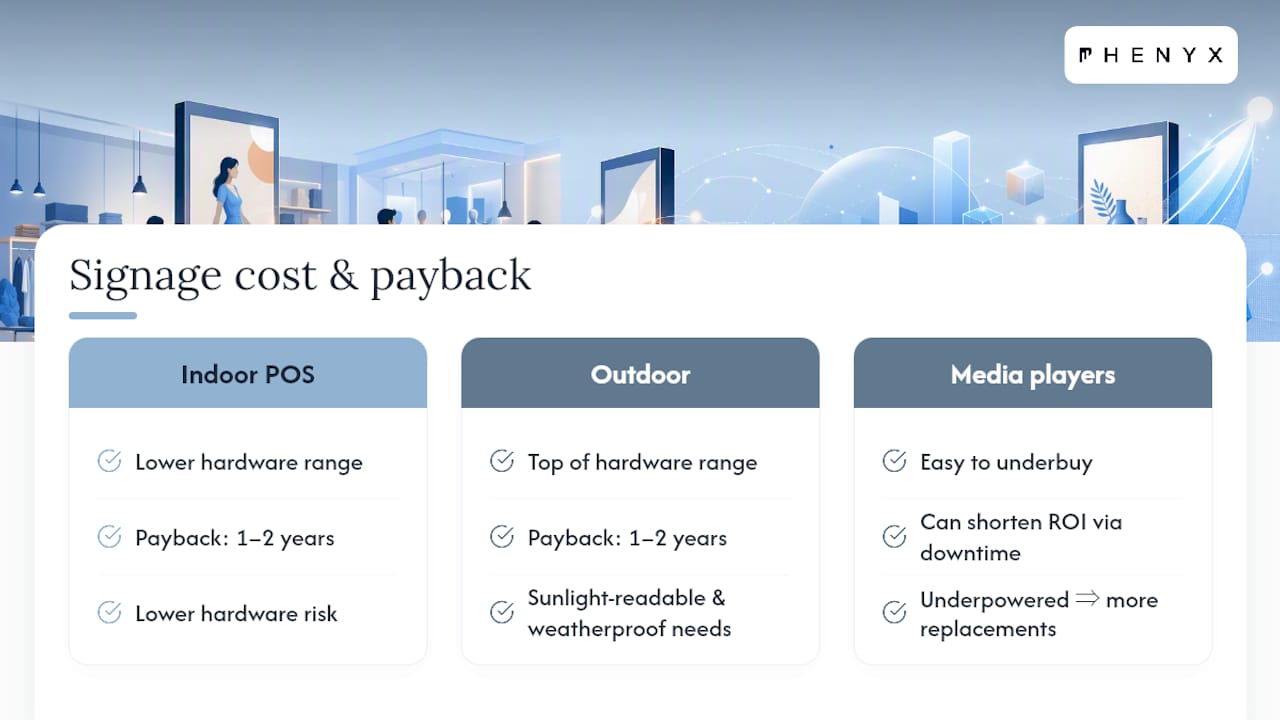
Hardware and software pricing follows fairly predictable bands, and the biggest cost mistake retailers make is underspending on media players to save a few hundred dollars, then paying for it in downtime.
Those figures come from current industry cost benchmarks, and payback typically falls within a one to two year range. Outdoor or high-brightness window displays sit at the top of the hardware range because they need sunlight-readable panels and weatherproof housing. Indoor aisle and POS screens can run closer to the bottom. Media players are where corner-cutting backfires most, since an underpowered player struggles with video content and needs more frequent replacement.
How Often Should You Update Signage Content?
Content that sits untouched for weeks stops working, even on the best hardware. Kitcast’s 2026 research found 90% of retail screens display media and 68% run video, but the median content age across those networks is around 24.5 days. That’s a stale-content problem hiding behind an otherwise active network.
- Update promotional content weekly at minimum; daily for time-sensitive pricing or inventory-driven offers.
- Use dayparting to run breakfast items in the morning and lunch specials by midday, a tactic that measurably lifts ROI in food service and QSR categories.
- Build zone-specific templates so a new promotion drops into the entrance, aisle, or POS format without a designer rebuilding the layout each time.
- Assign one person or team ownership of the content calendar so screens don’t drift into autopilot.
Pro Tip: Treat your signage calendar the same way you treat your email marketing calendar. If nobody owns it, it goes stale exactly the same way.
Our digital signage design resource walks through template structures that make this cadence easier to sustain across zones.
How Do You Measure Digital Signage ROI?
Measurement is where most retailers fall short. Kitcast’s research found that 88.1% of retail operators surveyed don’t measure ROI on their signage investment at all, which means most networks are running blind.
- Track sales lift on promoted SKUs against a control period or control store without the promotion running.
- Run screen-level A/B tests, swapping content variations between similar stores to isolate what’s actually driving purchases.
- Tie screen schedules to POS timestamps so you can attribute a sales spike to a specific promotion window.
- Review performance monthly, not quarterly. Content that isn’t working should get replaced before it drags down a full sales cycle.
A useful ROI framework breaks results into four buckets: sales impact, content performance, operational efficiency, and audience engagement. Payback commonly falls between 12 and 24 months, and that timeline shortens further once you factor in ad tracking and attribution work, an area worth pairing with your broader ad tracking and conversion measurement strategy. Better measurement discipline is also strongly linked to stronger marketing returns overall, a pattern confirmed in broader analytics-driven marketing research.
How Do You Roll Out a Signage Program Without Overspending?
- Pilot in two to three stores for 60 to 90 days with a defined success metric, like sales lift on one promoted category.
- Insist on contract clauses covering uptime SLA and full data portability before signing anything long-term.
- Compare pilot results against a control store running the old static signage.
- Once results clear your threshold, roll out in phases by region rather than all at once.
- Train store managers on their local-edit permissions before the wider rollout goes live.
Our breakdown of signage software evaluation criteria covers the checklist items worth scoring vendors against before you commit budget.
What Causes Retail Signage Programs to Fail?
Most failures trace back to two things: dark screens nobody noticed, and vendor sprawl with no single point of accountability.
- Set up automated alerts for offline players so a dark screen gets flagged within hours, not weeks.
- Consolidate hardware, software, and content under one accountable team or vendor relationship instead of three separate ones.
- Schedule quarterly hardware health checks and firmware updates rather than waiting for a screen to fail visibly.
- Keep a spare media player on hand per location so a failure doesn’t mean a blank screen for days.
Where Signage Fits Into a Broader Marketing System
Screens perform best when they’re not an isolated project bolted onto a store. We’ve seen retailers get the fastest results when signage content, video production, and measurement all run through one coordinated plan instead of three disconnected vendors guessing at what the others are doing. A pilot accelerates dramatically when the same team building your promotional video is also the one wiring up your attribution reporting.
— PHENYX
How Phenyx Helps Retailers Launch Signage That Pays for Itself
There is an alternative to juggling a hardware vendor, a content freelancer, and a separate analytics tool for your signage program: one team that handles the strategy, the on-screen video content, and the reporting that proves it’s working.
If you’re evaluating platforms, our team can run a pilot audit that scores vendors against the security, control, and integration checklist covered above, then builds the promotional and menu-board content your screens actually need. Our video production team creates the short-form content that performs best on aisle and POS displays, and our SEO and AEO services make sure your in-store promotions match what customers are already searching for online. If you’re mid-redesign, our website redesign work often runs alongside a signage rollout so your digital and in-store experience stay consistent. Reach out and ask about a signage pilot audit for your locations.
Sources
- Digital Signage Benefits and Statistics - RiseVision
- Retail digital signage ROI: What the numbers show - Pickcel
- How to choose secure retail digital signage platforms - L Squared
- Retail digital signage statistics and benchmarks - Kitcast (2026)
- Digital Signage in Retail market insights - MarketsandMarkets

