


How to Choose a Dallas Marketing Agency
The best Dallas marketing agency for you is the one that can name your goal in revenue terms, show the people who will do the work, and report on results you can tie to sales. Polished pitches are easy to find in DFW. Clear scope, honest measurement and a team that listens are harder to find, and they are what you should screen for.
This guide walks through the process in order: define what you need, sort the types of agencies, build a scorecard, ask better questions, check the proof, and read the agreement.
TL;DR
- Write down your goal, required services and monthly budget before you take a single sales call.
- Score every finalist on the same criteria: industry fit, team, communication, measurement and contract terms.
- Ask who will actually work on your account, not just who is in the pitch meeting.
- Insist on reporting tied to qualified leads and revenue, not traffic or impressions alone.
- Put ownership of your website, domain, ad accounts and analytics in writing.
Table of Contents
- Start with your goal, services and budget
- What the Dallas market looks like
- The main types of agencies you will meet
- Build a scorecard before the calls begin
- Questions to ask Dallas marketing agencies
- Check the proof, not just the portfolio
- Insist on reporting that ties to revenue
- Local SEO: a place where shortcuts hurt
- Read the agreement like an owner
- Our perspective: consistency beats complexity
- Where PHENYX fits
- FAQ
- Sources
Start with your goal, services and budget
Most bad agency relationships begin with a vague brief. “We need more visibility” can mean a new website, local search work, paid ads, video, or all four. Before you contact anyone, write one page that covers:
- The business goal. More booked consultations, more online orders, more calls from a specific suburb. Pick one primary outcome.
- The services you think you need. SEO, web design, paid ads, branding, video, social media. Mark which are essential and which are nice to have.
- A budget range. The American Marketing Association recommends a structured selection process and notes that sharing a budget estimate helps agencies decide whether they can staff your account properly. Hiding your budget mostly produces proposals you cannot compare.
- Project or ongoing work. The same AMA piece points out that an ongoing partner learns your business more deeply and can bring ideas continuously, while occasional projects require a new ramp-up each time.
If you are still working out the basics of your own plan, our guide on how to market your small business is a good place to sort priorities first.
What the Dallas market looks like
Dallas-Fort Worth is crowded with small companies, and your agency competes for attention in the same market you do. The U.S. Chamber of Commerce’s January 2025 profile reports that the region had 955,962 small businesses, or 99.6% of firms. That number matters for two reasons.
First, you are rarely the only plumber, dentist, law firm or distributor in your category trying to rank. Differentiation has to be part of the plan, not an afterthought. Second, an agency with real local familiarity can tell you how Plano, Frisco, Irving, Fort Worth and Dallas proper behave as separate search markets, which a generic national portfolio cannot.
We cover that suburb-versus-city dynamic in more depth in why Dallas service businesses are losing local search ground to their suburbs.
The main types of agencies you will meet
Ranking lists and directories often mix very different kinds of companies. Sorting by type first saves weeks.
| Type | Strengths | Watch for |
|---|---|---|
| Solo freelancer or very small shop | Low cost, direct access to the person doing the work | Capacity limits, single point of failure if they are ill or busy |
| Specialist agency (only SEO, only ads, only video) | Deep skill in one channel | You may need to manage several vendors and keep their messages aligned |
| Full-service agency with an in-house team | One team for strategy, design, search, video and ads; consistent brand message | Confirm which services are truly in-house and which are subcontracted |
| Large network or holding-company agency | Scale and brand-building budgets | Senior staff in the pitch, junior staff on the account; minimum budgets often out of reach for small firms |
For many small and midsize businesses, the real choice is between a few specialists and one full-service team. Several vendors can work, but someone must coordinate them. The AMA’s guidance on digital marketing communication advises asking how the teams on your account will coordinate before you choose, ideally with team members cross-trained across the full stack. A single in-house team makes that coordination simpler by design.
Build a scorecard before the calls begin
Before comparing Dallas agencies, turn your priorities into a scorecard. A simple version uses a 1 to 5 rating for each of these:
- Goal fit: Did they restate your goal in their own words and propose a plan for it?
- Industry and local experience: Have they worked with businesses like yours, in markets like yours?
- Services under one roof: Can they cover what you need without handing you to a third party?
- Team: Do you know who your account lead, day-to-day contact and creative lead would be?
- Communication: Do they explain tradeoffs plainly and listen more than they pitch?
- Measurement: Will they report on business outcomes?
- Contract terms: Are scope, ownership and exit terms clear?
Weight the scores by what matters most to you. A startup that needs a brand identity first will weight branding and design differently from an established firm that needs lead generation.
Do not skip the human factor. AMA’s Elle Morris frames agency choice as both rational and relational: scope and budget matter, and so does whether you can work well together. Notice how an agency handles your hardest question. That tells you more than the deck.
Questions to ask Dallas marketing agencies
Use the same list with every finalist so the answers are comparable.
About the team
- Who will be my account lead, my regular contact and my creative lead?
- Are those the people in this meeting? If not, when do I meet them?
- Which services do you perform in-house, and which do you outsource?
The AMA specifically advises asking this, because agencies may present senior staff in the pitch and assign different people after signing. Agree on communication frequency, escalation and access up front.
About strategy
- What would you do in the first 90 days, and why that order?
- How would you tailor this plan to my business instead of reusing a template?
- What would you not recommend for us right now?
That last question is a good honesty test. An agency that recommends every service to every client is selling, not advising.
About results
- Which metrics will you report, how often, and how do they connect to sales?
- Can you show a sample dashboard and explain what decision each number would help me make?
- Will you review the first report with me live?
Britney Muller, quoted by the AMA, argues that the strongest reporting begins with understanding the client and the business. If an agency cannot explain a metric in plain English, it is probably not the right metric for you.
About the work itself
- How do you prevent under-scoping, rework and missed deliverables if my plan includes many services?
The AMA cites a survey of 540 professional-services organizations that puts average marketing-agency utilization at about 73%, and warns that fixed-fee or subscription providers can run closer to 68% because of write-offs, rework and low bids. Those are agency operating benchmarks, not promises about your results, but they explain why scope discipline matters on a retainer.
Check the proof, not just the portfolio
Case studies and testimonials are useful, and they are easy to dress up. When you review them:
- Ask which named client each result belongs to, and whether you can speak to that client.
- Ask what was happening around the result: budget, starting point, time frame, other campaigns running.
- Treat anonymous screenshots and guaranteed outcomes as claims that need verification, not proof.
The FTC’s consumer reviews and testimonials rule, effective October 21, 2024, targets fake or deceptive reviews, review suppression and incentives tied to a particular sentiment. The FTC also states that advertising agencies and similar firms can be liable under the rule. A trustworthy agency should be able to explain how it collects, discloses and manages customer endorsements, including your own.
No agency can responsibly promise an exact number of customers in advance. If one does, move on.
Insist on reporting that ties to revenue
Traffic, impressions and calls are activity metrics. They are worth tracking, but they are not the finish line. Ask the agency to connect its work to qualified leads, consultations, sales opportunities, conversion rate or revenue.

The City of Dallas small-business guide recommends tracking website traffic, conversion rate, email open rate and social engagement, and names Google Analytics for website measurement. Treat that as a baseline, then ask each agency which of those numbers will influence revenue and why.
Lead quality is where many partnerships stall. The AMA’s Kris Belau notes that results improve when the agency can see lead quality and talk with sales. Sharing CRM data, tagging campaigns and holding regular cross-functional updates helps separate leads that merely arrive from leads your team can close. Our posts on a KPI scorecard that ties to revenue and on fixing marketing lead quality go deeper on both.
Local SEO: a place where shortcuts hurt
If customers find you by searching near them, ask exactly how the agency handles your Google Business Profile. Google says local ranking depends mainly on relevance, distance and prominence. Its guidelines for representing your business call for your accurate real-world name, a precise address or service area, the fewest appropriate categories, and one profile per business.
That rules out keyword-stuffed business names and duplicate listings, two shortcuts that can get a profile suspended. A good proposal explains how the agency will improve completeness, reviews and prominence while keeping the profile compliant.
Read the agreement like an owner
The contract is where a good conversation becomes a good relationship, or does not. Look for:
- Scope and deliverables written clearly, with what is excluded.
- Ownership and access to your website, domain, analytics, advertising accounts, customer lists, creative files and tracking data.
- Term and exit. Month-to-month or fixed, notice period, and a documented offboarding process.
- Reporting cadence and who attends review meetings.
Ownership is easy to overlook when several vendors touch one program. A GAO review of a federal online marketplace program is a different setting, but its finding is a useful reminder: data-protection requirements need specific monitoring actions rather than vague assurances. Ask what that looks like in your agreement.
Our perspective: consistency beats complexity
We run PHENYX as a full-service agency with an in-house team, and the pattern we see most often is not a lack of effort. It is fragmentation. A designer builds the site, a different vendor handles search, a third makes the video, and nobody owns the message that ties them together. The owner becomes the project manager, which is rarely why anyone started a company.
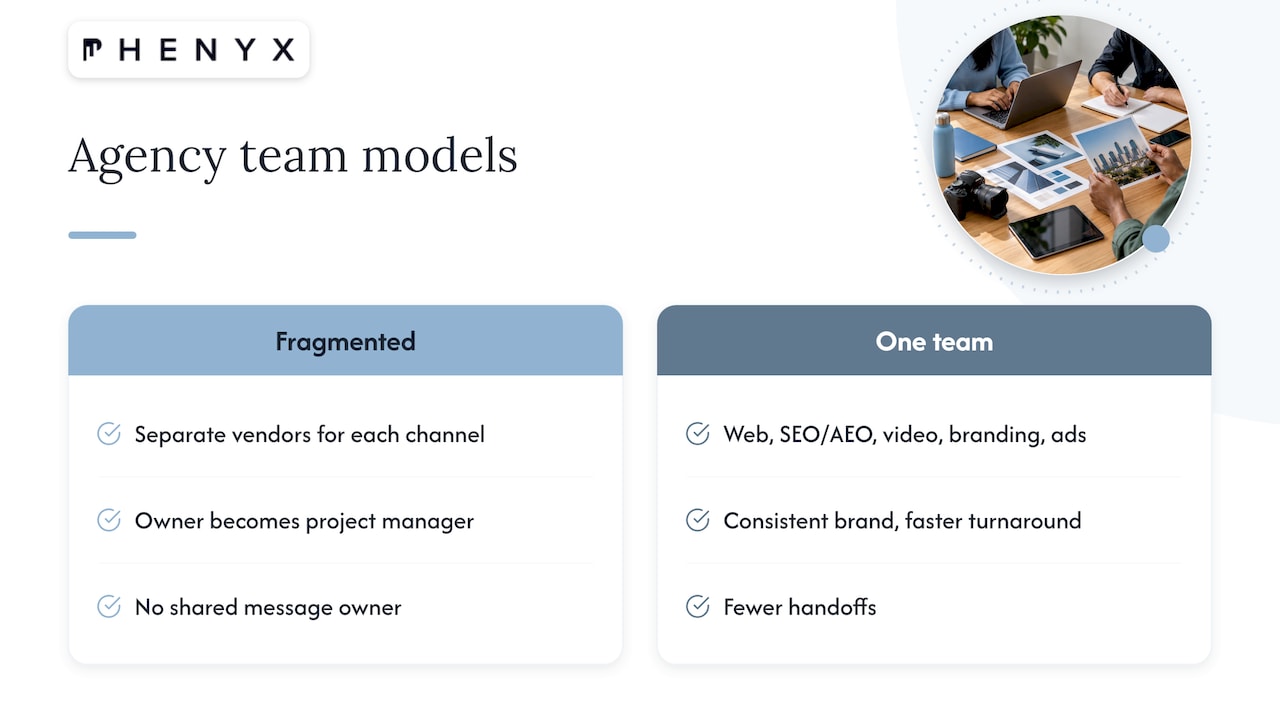
That is why we believe in one team handling web design, SEO and AEO, video, branding and paid ads, with strategy tailored to each client’s goals rather than a fixed template. It tends to bring a more consistent brand, faster turnaround and fewer handoffs. We also use a structured approach to planning, so priorities are set before work starts.
Our advice holds even if you never talk to us: choose the agency that asks the sharpest questions about your customers, explains its reasoning without jargon, and is comfortable being measured against your revenue.
— PHENYX
Where PHENYX fits
If you want one accountable team instead of several vendors, our monthly subscription, MODS, starts from $4,000 per month and covers ongoing, all-inclusive marketing support. For a defined project, you can start with a single service such as website design, SEO and AEO or video production. We serve businesses in Dallas-Fort Worth, and we are happy to walk through our scope with the same questions listed above. For a broader checklist, see our essential considerations for choosing the right marketing agency.
FAQ
How do I find marketing services in Dallas?
Start with referrals from other local owners in your industry, then search for agencies that show named client work in DFW. Narrow to three or four finalists using your scorecard. Ask each the same questions so you can compare answers side by side.
What should I look for in a marketing agency?
Look for clear goal-setting, a team you can name, experience with businesses like yours and reporting tied to revenue. Also look for plain-language explanations and transparent contract terms. Chemistry matters too, because you will be working closely together.
How much should I budget for a Dallas marketing agency?
It depends on your goals and the services involved, so there is no single honest number. Set a range before the calls and share it, since agencies use it to decide how to staff your account. At PHENYX, our MODS subscription starts from $4,000 per month, and individual projects are scoped to the work.
Is a full-service agency better than several specialists?
Not always. Specialists can be excellent in one channel, but you will coordinate them yourself. A full-service in-house team removes that coordination work and keeps your message consistent, provided you confirm the services are truly done in-house.
What are red flags when comparing agencies?
Be cautious of guaranteed customer counts, anonymous testimonials, reports built only on traffic or impressions, and reluctance to name who will work on your account. Vague terms about who owns your website, ad accounts and data are another warning sign.
Sources
- U.S. Chamber of Commerce: The State of American Business by the Numbers, 2025
- AMA: Choosing the Right Design Firm Partner for Your Brand
- AMA: Look Who’s Talking, How Communication Can Solve 5 Key Digital Marketing Challenges
- AMA: How to Stop Confusing Your Clients with Metrics
- AMA: 6 Key Metrics for Marketing Agencies
- FTC: The Consumer Reviews and Testimonials Rule, Questions and Answers
- City of Dallas: Small Business Quick Reference Guide
- Google Business Profile Help: Tips to improve your local ranking
- Google Business Profile Help: Guidelines for representing your business
- U.S. GAO: GSA Online Marketplaces, GAO-21-104572

