


Generative Engine Optimization: A Practical GEO Playbook
Generative engine optimization (GEO) is the practice of structuring and signaling your content so AI-powered answer engines reliably cite your brand. Success is measured not by rankings but by citation frequency and AI share of voice across platforms like Google AI Overviews, Perplexity.ai, and OpenAI’s ChatGPT. Your first move: identify one to three cornerstone pages and make them extractable today — concise answer blocks, verified facts, inline citations, and server-side rendering so AI crawlers can actually read them.
Quick Summary
- GEO optimizes for AI citation, not SERP position — the target output is inclusion in a generated answer, not a blue link.
- GEO-bench experiments show that adding citations, quotations, and statistics can improve source visibility in generative engine responses by around one-third to two-fifths.
- Start with one to three cornerstone pages: add a concise answer block after the H1, short quotable paragraphs, and inline source links.
- Deploy an
llms.txtfile and allow AI crawlers (Googlebot, GPTBot, PerplexityBot) inrobots.txtselectively. - Add speakable, FAQ, and Article schema so structured data surfaces your content in AI-generated answers.
- Build off-site entity signals: consistent brand facts on LinkedIn, Wikipedia, and Wikidata over time.
- Measure citation frequency, AI share of voice, and branded search trends regularly over the first few months.
- GEO and SEO share foundational principles — crawlability, authority, and factual accuracy — so treat GEO as a layer on top of existing SEO hygiene, not a replacement.
Pro Tip: Before optimizing a single page, run five to ten target prompts across ChatGPT, Perplexity.ai, and Google AI Overviews and record which sources get cited. That baseline is your GEO starting point.
Key Takeaways
GEO requires a combination of editorial discipline, technical readiness, and consistent off-site entity signals to reliably earn citations in AI-generated answers.
| Point | Details |
|---|---|
| Audit first | Run target prompts across ChatGPT, Perplexity.ai, and Google AI Overviews before optimizing anything. |
| Optimize cornerstone pages | Add extractable answer blocks and inline citations to your one to three highest-priority pages first. |
| Citations move the needle | GEO-bench research shows citing sources, adding quotations, and including statistics are the three highest-impact tactics. |
| Deploy technical signals | An llms.txt file, updated robots.txt, and speakable/FAQ schema are non-negotiable for AI crawler access. |
| Phenyx as your GEO partner | Phenyx delivers GEO audits, content optimization, and technical fixes as a unified service with measurable citation outcomes. |
Frequently asked questions
What is generative engine optimization in simple terms?
Generative engine optimization is the practice of structuring your content so AI-powered answer engines like ChatGPT, Perplexity.ai, and Google AI Overviews cite your brand in their generated responses. Instead of ranking in a list of links, the goal is to be included in the answer itself.
How is GEO different from traditional SEO?
SEO targets ranked positions in a search results page. GEO targets inclusion in an AI-generated answer. The signals differ too: GEO rewards factual clarity, inline citations, structured data, and entity authority rather than keyword density and backlink volume alone.
Which GEO tactics have the strongest research support?
Fluency rewrites and keyword changes showed weaker results.
How long does it take to see GEO results?
Technical changes like llms.txt and schema deployment can be indexed within days. Content-level improvements typically show measurable citation changes within 8–12 weeks of consistent optimization. Building off-site entity authority is a longer effort, often 6–18 months.
Can I do GEO without a technical team?
Some GEO work — writing extractable answer blocks, adding inline citations, and updating off-site profiles — requires no engineering. Technical steps like server-side rendering, llms.txt, and JSON-LD schema do require developer involvement. Agencies like Phenyx handle both sides as part of a unified engagement.
{
  "@context": "https://schema.org",
  "@type": "FAQPage",
  "mainEntity": [
    {
      "@type": "Question",
      "name": "What is generative engine optimization in simple terms?",
      "acceptedAnswer": {
        "@type": "Answer",
        "text": "Generative engine optimization is the practice of structuring your content so AI-powered answer engines like ChatGPT, Perplexity.ai, and Google AI Overviews cite your brand in their generated responses. Instead of ranking in a list of links, the goal is to be included in the answer itself."
      }
    },
    {
      "@type": "Question",
      "name": "How is GEO different from traditional SEO?",
      "acceptedAnswer": {
        "@type": "Answer",
        "text": "SEO targets ranked positions in a search results page. GEO targets inclusion in an AI-generated answer. The signals differ too: GEO rewards factual clarity, inline citations, structured data, and entity authority rather than keyword density and backlink volume alone."
      }
    },
    {
      "@type": "Question",
      "name": "Which GEO tactics have the strongest research support?",
      "acceptedAnswer": {
        "@type": "Answer",
Fluency rewrites and keyword changes showed weaker results."
      }
    },
    {
      "@type": "Question",
      "name": "How long does it take to see GEO results?",
      "acceptedAnswer": {
        "@type": "Answer",
        "text": "Technical changes like llms.txt and schema deployment can be indexed within days. Content-level improvements typically show measurable citation changes within 8–12 weeks of consistent optimization. Building off-site entity authority is a longer effort, often 6–18 months."
      }
    },
    {
      "@type": "Question",
      "name": "Can I do GEO without a technical team?",
      "acceptedAnswer": {
        "@type": "Answer",
        "text": "Some GEO work — writing extractable answer blocks, adding inline citations, and updating off-site profiles — requires no engineering. Technical steps like server-side rendering, llms.txt, and JSON-LD schema do require developer involvement. Agencies like Phenyx handle both sides as part of a unified engagement."
      }
    }
  ]
}
Table of Contents
- What is generative engine optimization and how does it differ from SEO?
- What are the core GEO strategies marketers should prioritize?
- How do you perform a GEO audit and optimize your content?
- How do you measure GEO performance?
- What are the risks of GEO and how do you govern them?
- What does the research show about which GEO tactics actually work?
- How does an agency like Phenyx operationalize GEO for clients?
- Ready to improve your AI search visibility?
- Sources
What is generative engine optimization and how does it differ from SEO?
Generative engine optimization is the process of structuring content so AI-powered search systems retrieve, synthesize, and cite it in generated answers. Where traditional SEO targets a ranked list of links, GEO targets inclusion in the answer itself. As Search Engine Land explains, GEO focuses on being included in generated answers rather than ranking on SERPs — a meaningful shift in how visibility is defined and measured.
The practical differences matter more than the conceptual ones. SEO rewards keyword relevance, backlink authority, and click-through rate. GEO rewards factual clarity, source credibility, and content structure that an LLM can parse and quote. Platforms like OpenAI’s ChatGPT, Google’s AI Overviews, and Perplexity.ai each synthesize multiple sources into a single response, so the question is no longer “Can I rank?” but “Will I be cited?”
| Dimension | Traditional SEO | Generative Engine Optimization |
|---|---|---|
| Target output | SERP ranking / blue link | Inclusion in AI-generated answer |
| Primary signals | Keywords, backlinks, CTR | Factual clarity, citations, entity authority |
| Success metric | Rankings, organic traffic | Citation frequency, AI share of voice |
| Formatting preference | Long-form, keyword-rich | Short quotable blocks, structured data |
| Platforms | Google, Bing SERPs | ChatGPT, Perplexity.ai, Google AI Overviews |
The good news: foundational SEO work still matters. Crawlability, page authority, and accurate structured data all feed directly into GEO readiness. Think of GEO as an operational layer on top of SEO hygiene, not a separate discipline. Understanding how AI search engines decide what to recommend is the clearest way to see where the two disciplines converge.
What are the core GEO strategies marketers should prioritize?
The Semrush practical guide to GEO identifies extractable answer summaries, structured data, llms.txt, and off-site entity signals as the highest-leverage tactics. Here is how each plays out in practice.
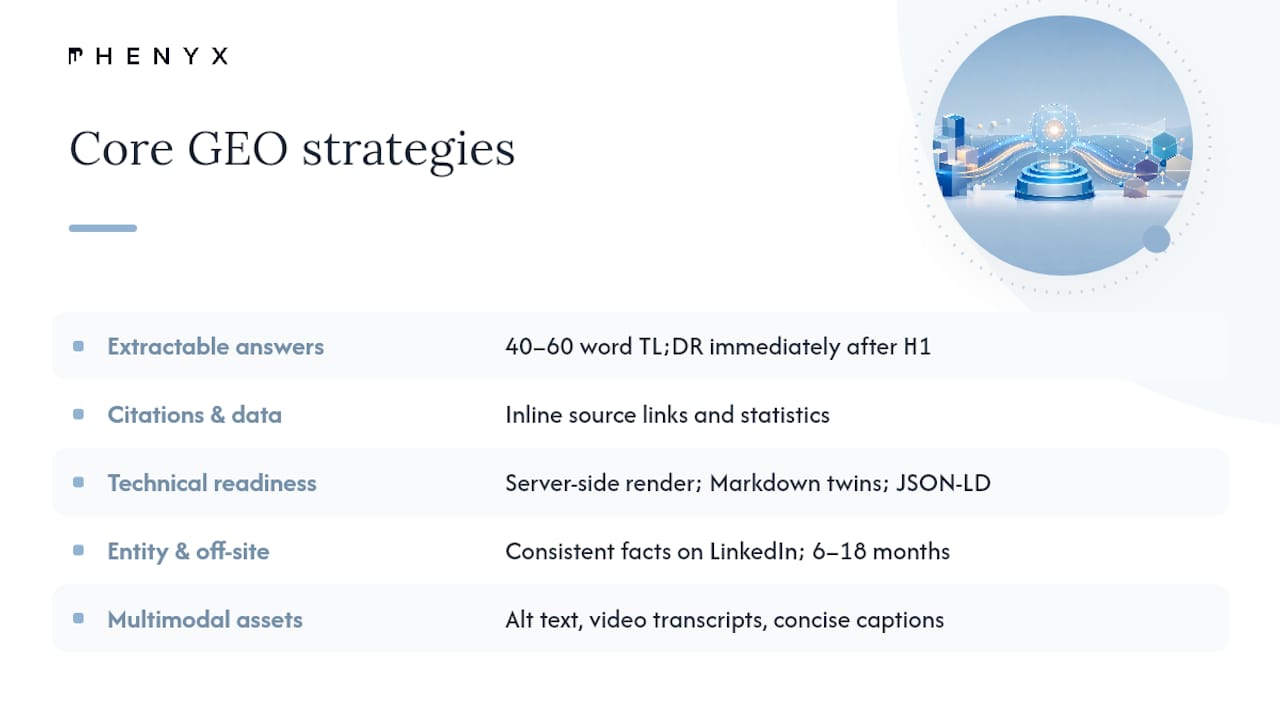
Extractable answer blocks. Place a 40–60 word TL;DR summary immediately after the H1 on every priority page. Follow each major claim with one or two short, self-contained paragraphs an LLM could quote verbatim. Avoid burying the key point in a long narrative.
Citations and verifiable data. Add inline source links and statistics to your pages. The GEO-bench research is direct on this: cited content, quoted evidence, and statistics are the three tactics with the most consistent visibility gains. A page that cites its sources signals credibility to both human readers and generative models.
Technical readiness. Server-side render your key content so AI crawlers are not blocked by client-side JavaScript. Provide Markdown twins of cornerstone pages where possible. Deploy llms.txt at your domain root and use speakable, FAQ, and Article JSON-LD schema. Microsoft’s guidance on AEO and GEO specifically recommends making catalogs and factual data machine-readable so generative systems can use them.
Entity and off-site signals. Consistent brand facts across LinkedIn, Wikipedia, Wikidata, and Crunchbase help AI systems recognize your brand as a trustworthy entity. Third-party mentions from authoritative publications reinforce that signal. Building entity authority typically takes 6–18 months of sustained effort, so starting now matters.
Multimodal assets. Descriptive alt text on images, transcripts for video, and concise captions all increase extractability. Well-labeled visual content gives generative engines additional context when synthesizing answers that include your brand.
Pro Tip: When a topic can be answered in two sentences, write it that way. Short, quotable blocks serve both readers scanning for answers and LLMs looking for citable passages. Save long-form narrative for depth sections that follow the quick answer.
How do you perform a GEO audit and optimize your content?
A structured playbook keeps GEO work from becoming ad hoc. Follow these eight steps in order.
- Audit AI visibility. Query four to six target prompts across ChatGPT, Perplexity.ai, Google AI Overviews, and Bing Copilot. Record which sources are cited, which are missing, and where your brand appears or does not.
- Select priority pages. Choose one to three cornerstone pages that address your most important topics. These become your GEO optimization test bed.
- Add extractable answer blocks. Write a 40–60 word summary after each H1. Break long sections into short, quotable paragraphs with a clear claim at the start of each.
- Add citations and statistics. Link to primary sources for every factual claim. Add relevant statistics with inline attribution. Server-side render the page or provide a Markdown twin so crawlers can parse the content.
- Deploy technical GEO signals. Create an
llms.txtfile at your domain root. Updaterobots.txtto allow GPTBot, PerplexityBot, and Googlebot. Add speakable and FAQ JSON-LD schema to priority pages. Website design best practices for rendering and structure apply directly here. - Update off-site entity signals. Verify that your company name, description, and key facts match across LinkedIn, Wikipedia, and Wikidata. Reach out to authoritative publications for brand mentions.
- Test and capture a baseline. Re-run your target prompts and record citation frequency. Note any inaccuracies in how AI systems describe your brand.
- Iterate and maintain. Run weekly audits for the first 8–12 weeks, then shift to monthly. Update pages whenever facts change.
| Task | Approximate hours | Owner |
|---|---|---|
| AI visibility audit | 3–4 hrs | Content / SEO |
| Extractable answer blocks | 2–3 hrs per page | Content |
| Technical deployment (llms.txt, schema) | 4–6 hrs | Engineering |
| Off-site entity updates | 2–4 hrs | PR / Content |
| Baseline measurement setup | 2–3 hrs | Analytics |
How do you measure GEO performance?
GEO metrics differ from SEO metrics in one fundamental way: you are measuring presence in a generated answer, not position in a ranked list. The table below defines the primary KPIs.

| KPI | What it measures | Data source | Reporting cadence |
|---|---|---|---|
| Citation frequency | How often your brand is cited across target prompts | Manual prompt tracking | Weekly |
| AI share of voice | Your citations as a share of all sources cited for a topic | Manual / third-party tools | Monthly |
| Mention accuracy | Whether AI systems describe your brand correctly | Manual review | Monthly |
| AI referral volume | Traffic arriving from AI platforms (e.g., Perplexity.ai) | Server logs / GA4 | Weekly |
| Branded search trend | Growth in direct brand searches following AI exposure | Google Search Console | Monthly |
Collect data by running a consistent set of 10–20 target prompts across platforms on a fixed schedule. Server logs reveal which AI crawlers are hitting your site and how often. Branded query trends in Google Search Console often reflect growing AI-driven awareness even when direct referral traffic is hard to attribute. For a deeper look at AI content strategy and measurement, the integration of these signals into a unified dashboard is where most teams find the clearest picture.
What are the risks of GEO and how do you govern them?
Hallucination is the most serious GEO risk. When your content contains ambiguous claims, unsourced statistics, or contradictory facts, generative models are more likely to misrepresent your brand in their answers. Poor sourcing does not just hurt credibility — it actively increases the chance an AI system invents a plausible-sounding but wrong version of your position.
A practical governance checklist keeps this risk manageable:
- Verify every factual claim before publishing and link to a primary source.
- Require editorial sign-off on any page targeted for GEO optimization.
- Version-control content and maintain a change log so outdated claims can be identified and corrected quickly.
- Limit automated content rewrites done purely for GEO gains — rewritten pages that lose factual precision create more risk than they remove.
- Monitor AI-generated answers for brand mentions monthly and flag inaccuracies for correction.
Pro Tip: Before publishing any GEO-optimized page, run a “citation stress test”: paste your key claims into ChatGPT and ask it to verify them. If the model hedges or contradicts your claim, the claim needs a stronger primary source or clearer phrasing before the page goes live.
What does the research show about which GEO tactics actually work?
The arXiv GEO-bench paper is the most rigorous experimental evidence available. Researchers tested multiple optimization tactics across generative engines and found that three approaches produced the most consistent visibility gains: Cite Sources, Quotation Addition, and Statistics Addition.
The effect was not uniform across all domains or all engines, which is why later arXiv work frames GEO as a black-box optimization problem requiring domain-specific experimentation. What works for a financial services brand may perform differently for a local service business.
- Cite Sources consistently ranked as the highest-impact single tactic.
- Quotation Addition (adding short, attributed quotes from credible sources) produced reliable gains.
- Statistics Addition (embedding verifiable data points) reinforced both of the above.
- Fluency rewrites and keyword-density changes showed weaker, less consistent effects.
How does an agency like Phenyx operationalize GEO for clients?
Phenyx approaches GEO as a structured, phased engagement built on top of existing SEO and AEO services. The workflow follows a discovery-to-maintenance arc without exposing every proprietary step.
- Discovery audit. Phenyx runs a baseline AI visibility audit across target prompts and platforms, identifying citation gaps and technical blockers.
- Prioritized content roadmap. A 90-day roadmap identifies the three to five pages with the highest GEO potential and sequences optimization sprints.
- Engineering checklist. Technical fixes — server-side rendering,
llms.txt, schema deployment, crawler permissions — are scoped and handed to the engineering team with clear acceptance criteria. - Content rewrite sprints. Content is rewritten to include extractable answer blocks, inline citations, and short quotable passages without sacrificing readability.
Relevant Phenyx services that map directly to GEO work include:
- SEO and AEO strategy and implementation
- Website design and technical optimization for crawlability and rendering
- Content production and structured data deployment
- Measurement dashboards tracking citation frequency and AI referral volume
Phenyx also supports AI-driven marketing transformation for clients who are earlier in their AI visibility journey and need a broader strategic foundation before GEO-specific work begins.
The honest case for treating GEO as a long game
GEO adoption conversations often default to urgency: “AI is eating your traffic, act now.” That framing is not wrong, but it pushes teams toward shortcuts that backfire. Stuffing pages with citations and statistics without improving the underlying quality of the claim does not fool generative models — it produces content that reads as hollow to human visitors and gets deprioritized by AI systems that weight credibility signals holistically.
The more useful frame is this: GEO rewards the same editorial discipline that good content has always required, just measured differently. A brand that has spent years building factual, well-sourced content is already partway there. The GEO layer adds structure, schema, and off-site entity signals on top of that foundation. Teams that treat GEO as iterative — test a tactic, measure citation frequency, adjust — will outperform teams that treat it as a one-time technical fix. Change management matters here: preserve user experience first, and let GEO optimizations serve readers before they serve algorithms.
Ready to improve your AI search visibility?
Phenyx offers a full GEO audit that maps your current citation gaps across ChatGPT, Perplexity.ai, and Google AI Overviews, then delivers a prioritized roadmap to close them. Unlike working with multiple vendors, Phenyx handles SEO and AEO strategy, technical site fixes, content production, and measurement reporting under one roof — so your GEO program moves faster and stays coherent.

Services directly relevant to GEO include SEO and AEO implementation, website redesign for technical extractability, structured data deployment, and ongoing citation tracking. Request a GEO audit at Phenyx and get a clear picture of where your brand stands in AI-generated answers today.
Sources
- SEO vs GEO: What’s different? What’s the same? — Search Engine Land
- Generative Engine Optimization: How to Dominate AI Search — arXiv (abs)