


Google Business Profile Optimization: A Priority Checklist
Claim and verify your Google Business Profile, correct your primary category, complete every contact and service field, upload real photos, and start a weekly review request habit. Those five moves account for most of the visibility gap between profiles that show up in the Local Pack and profiles that don’t. Everything else in Google Business Profile optimization builds on that foundation.
Google ranks local results using three factors: relevance, distance, and prominence. Claiming and completing your profile fixes relevance. Accurate address and service-area data fixes distance. Reviews, photos, and engagement drive prominence. Skip any one of the three and you’re optimizing with one hand tied behind your back.
Two things to do in the next 30 minutes:
- Claim and verify. Search your business name on Google Maps, click “Own this business,” and complete verification (usually by video, phone, or postcard).
- Fix your primary category. Go to Business Information and set the single most specific category that describes what your business is, not what it has.
Key Takeaways
Google Business Profile optimization works because relevance, distance, and prominence respond directly to category accuracy, location precision, and review consistency.
| Point | Details |
|---|---|
| Claim and verify first | Confirm owner-level access before making any other changes to the profile. |
| Category beats keywords | Choose the single most specific primary category instead of stuffing keywords into your business name. |
| Photos signal activity | Upload at least two new photos monthly to keep the profile looking active and current. |
| Reviews drive prominence | Run a weekly request workflow and respond within 48 hours to build rating and volume. |
| Consider Phenyx for scale | Phenyx audits, prioritizes, and manages GBP optimization alongside website and SEO work for multi-location or fast-growth businesses. |
How long does Google Business Profile optimization take to show results?
Basic setup, like claiming, verifying, and completing fields, takes one to three days. Ranking improvements from review growth and content activity typically take 30 to 90 days to become measurable.
What is the most important field to optimize on a Google Business Profile?
Your primary category carries the most weight for relevance. Choose the single most specific option that matches what your business is, not a broad category that dilutes your match to search queries.
How often should I post updates on my Google Business Profile?
Weekly is a solid baseline. Consistent posting signals an active business and gives you regular opportunities to include a call to action like booking or calling.
Can I optimize a Google Business Profile myself, or do I need an agency?
You can absolutely do it yourself, especially the initial setup and field completion. Consider outside help if you manage multiple locations, have a large service catalog, or need faster review growth than your team can sustain.
What should I do if my Google Business Profile gets suspended?
Identify the likely policy violation, such as an inaccurate category or duplicate listing, correct it, and submit a reinstatement request with supporting evidence like photos or a business license.
Table of Contents
- Quick Summary: Google Business Profile Checklist
- How to Optimize Your Google Business Profile Step by Step
- What Photos and Videos Should You Upload?
- How Do You Fill Out Services, Products, and Attributes?
- How Do You Get and Manage Google Reviews?
- Should You Use Google Posts, Q&A, and Messaging?
- What Actually Moves Your Local Ranking?
- How Do You Track Google Business Profile Performance?
- Fixing Verification Failures, Suspensions, and Duplicate Listings
- How Long Does Optimization Take and What Does It Cost?
- Printable Google Business Profile Audit Checklist
- How Phenyx Approaches Google Business Profile Optimization
- Get Help Optimizing Your Google Business Profile
- Sources
Quick Summary: Google Business Profile Checklist
- Claim and verify ownership (instant to a few days depending on method).
- Set the correct primary category (instant, biggest relevance lever you control).
- Complete every field: hours, phone, service areas, description (1 to 3 days of focused work).
- Add products and services with search-friendly names (1 to 3 days).
- Upload photos weekly (ongoing, signals an active business).
- Start a review request workflow (30 to 90 days to build volume).
- Post updates weekly and monitor Q&A (ongoing).
- Check the profile weekly for auto-edits Google makes without asking.
How to Optimize Your Google Business Profile Step by Step
Order matters here. Fix ownership and structure before you touch photos or posts, because those later efforts get wasted on a profile Google doesn’t fully trust yet.
-
Claim and verify first. Confirm you (or your marketing team) hold owner or manager access, not just editor access, since only owners can transfer ownership or resolve suspensions. Set a recovery email and phone number tied to a role, not a person who might leave the company.
-
Choose the right primary category. This is the single most powerful relevance lever you control. Google’s own guidelines for representing your business call for the fewest, most specific categories available. A plumber should pick “Plumber,” not “Contractor.” A bakery that also serves coffee should pick “Bakery” as primary and add “Coffee Shop” as secondary. Ask yourself: does this category complete the sentence “This business is a ___,” not “This business has ___.”
-
Lock down NAP and hours. Your name, address, and phone number need to match your website and other directories exactly, down to abbreviations. List holiday hours ahead of the holiday, not the morning of. Set service areas honestly. If you drive to customers within a 20 mile radius, say so instead of listing a storefront address that doesn’t exist.
-
Write a description that works for humans and AI overviews. Your first sentence should state what you do, where you do it, and who you serve, plus one trust signal. Example: “Riverside Plumbing Co. has served Fort Worth homeowners since 2011, specializing in same-day water heater repair.” AI-driven search increasingly quotes profile descriptions directly, so lead with the fact, not the fluff.
-
Populate services and products with query-matching phrasing. More on this below, but the short version: name entries the way customers search, not the way you’d describe them internally.
-
Set up messaging, booking, and call tracking. Enable messaging only if someone monitors it daily. Link a booking tool if you have one. Since Google shut down its free Business Profile websites in March 2024, make sure your website link points to a stable, live page rather than a defunct GBP site.
-
Maintain on a cadence. Check the profile weekly (Google auto-edits hours and categories sometimes without asking). Respond to reviews within 48 hours. Run a full audit quarterly.
Pro Tip: Set a recurring 15-minute calendar reminder every Monday just to glance at your profile. Google occasionally changes your hours or category based on user suggestions, and catching it early beats losing a week of accurate rankings.
What Photos and Videos Should You Upload?
Photos are one of the cheapest ways to signal an active, trustworthy business, and they show up prominently in both Maps and Search results.
- Storefront and signage shots (helps distance and trust matching).
- Team photos (builds prominence through human connection).
- In-service or before/after shots for trade and home service businesses.
- Product detail shots for retail.
- Branded vehicle photos if you offer mobile or delivery service.
Aim to add at least two new photos a month. Businesses with regularly updated photo activity tend to see stronger engagement, according to Flento’s optimization checklist, because photo freshness is one of the few signals Google can measure directly from owner activity.
Upload the highest resolution version you have; Google compresses automatically, but a blurry source photo stays blurry. For video, a 30 to 60 second clip of a technician mid-job or a walkthrough of your space performs better than a polished commercial. Write a short, specific caption for every upload, such as “Same-day AC repair in Lafayette, CO” rather than “Our team.”

How Do You Fill Out Services, Products, and Attributes?
Services and Products are different sections in your profile, and mixing them up wastes an opportunity. Services fit businesses that sell expertise or labor (plumbers, salons, consultants). Products fit businesses selling physical inventory (retailers, boutiques).
- Service entries: keep names short and specific, like “Water Heater Installation” instead of “Plumbing Services,” and add a one-line description that can include your service area.
- Product entries: use them for actual SKUs or menu items customers might search by name.
- Attributes: enable every truthful one available, including “women-led,” “veteran-owned,” or accessibility features. These improve both trust signals and filtered search visibility.
- Query matching: write service names the way customers type them, such as “Emergency Drain Cleaning Dallas” rather than an internal service code.
How Do You Get and Manage Google Reviews?
Review volume and how recently those reviews came in are two of the most controllable prominence signals you have. Flento’s research suggests consistent weekly review requests paired with prompt responses tend to produce measurable ranking movement within 30 to 90 days in many markets.
Build a simple, repeatable workflow:
- Ask for the review at the point of service, while satisfaction is highest.
- Send a direct review link by text or email within 24 hours.
- Follow up once, a week later, if there’s no response.
- Log every request in your CRM so nothing falls through.
Respond to every review within 48 hours. For positive reviews, thank the customer by name and mention the specific service. For negative reviews, acknowledge the issue without getting defensive, offer to resolve it offline, and keep the tone calm. If a review violates Google’s policies (fake, off-topic, or posted by a competitor), flag it through the profile dashboard with evidence and escalate to Google support if it isn’t removed within a few weeks. For a deeper look at how review patterns shape rankings, see how Google reviews impact SEO.
Should You Use Google Posts, Q&A, and Messaging?
These features exist to keep your profile active between review cycles, and Google rewards activity with more impressions.
Posts: Publish weekly. Rotate between offer posts, update posts, and event posts. End every post with a clear call to action such as “Book Now” or “Call Today.”
Q&A: Pre-fill five or six common questions yourself (parking, pricing ranges, appointment requirements) before customers ask them publicly. Check weekly for new questions from users, since anyone can answer them if you don’t, and a wrong crowd-sourced answer sticks around.
Messaging and booking: Turn on messaging only if you can respond within a few hours. Link your booking tool directly if you have one, and make sure it feeds the same funnel as your website’s contact form.
- Post weekly with a specific CTA.
- Check and answer Q&A weekly.
- Respond to messages within business hours, same day minimum.
What Actually Moves Your Local Ranking?
Google has stated plainly that local ranking comes down to relevance, distance, and prominence, and there is no way to pay for a better spot in the Local Pack.
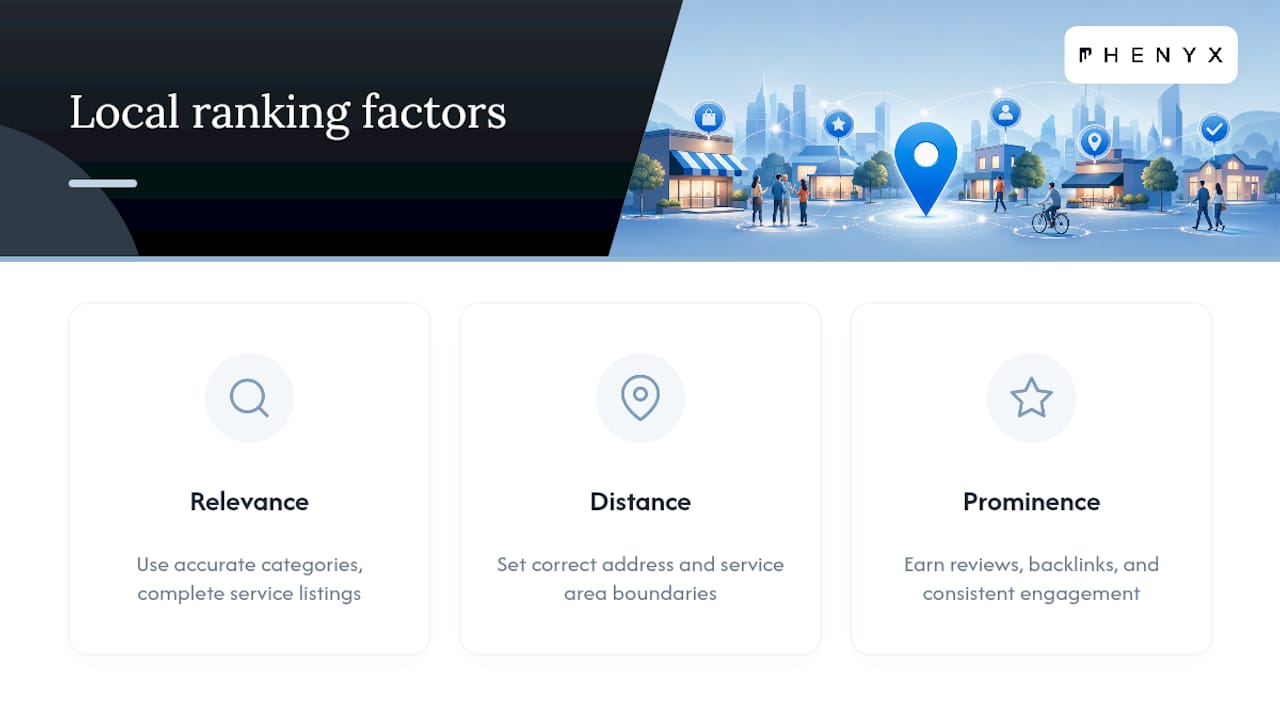
Relevance measures how well your profile matches what someone searched. Fix it with accurate categories, complete service listings, and a description that uses the language customers actually search.
Distance measures how close your business is to the searcher or the searched location. You can’t move your building, but you can make sure your address and service area boundaries are set accurately instead of inflated.
Prominence measures how well-known and well-reviewed your business is, both online and off. Reviews, quality backlinks to your website, and consistent engagement all feed this.
What won’t help: keyword-stuffing your business name (a policy violation that risks suspension), buying reviews, or paying anyone who claims they can “buy” a ranking boost. Watch three numbers monthly to gauge movement: review count and rating, direction requests, and website clicks from the profile.
How Do You Track Google Business Profile Performance?
Google Business Profile Insights gives you searches, views split between Maps and Search, website clicks, direction requests, phone calls, and booking clicks. Pair that with GA4 on your website to see whether profile traffic actually converts once it lands.
- Check weekly for immediate shifts, like a spike in calls after a new post.
- Check monthly for review velocity and rating trends.
- Give ranking changes a full 30 to 90 day window before judging whether a fix worked.
- Set a baseline the day you finish your optimization pass so later comparisons mean something.
Fixing Verification Failures, Suspensions, and Duplicate Listings
Verification problems usually trace back to an address mismatch (a PO box won’t verify) or a name that doesn’t match public records. Re-request verification through the dashboard once the mismatch is corrected.
Suspensions typically follow a policy violation such as a stuffed business name, an inaccurate category, or multiple listings for one location. Submit a reinstatement request with evidence: photos of your storefront, a utility bill, or a business license.
Duplicate listings confuse both customers and Google’s algorithm. Search your business name and address to find duplicates, then either claim and merge them or request removal of the outdated one.
Before contacting Google support, confirm your NAP data matches everywhere, your category is accurate, and you have documentation ready. Support moves faster with evidence attached.
How Long Does Optimization Take and What Does It Cost?
Claiming and verifying takes anywhere from a few hours to a few days, depending on the verification method Google offers you. Full field completion is realistically a one to three day project if you’re doing it yourself with existing brand assets. Review volume growth takes longer, typically 30 to 90 days of consistent requesting before it shows up meaningfully in your rating and ranking.
DIY costs nothing but your time. Agencies typically charge a setup fee for the initial audit and buildout, then a monthly retainer for ongoing posts, review management, and reporting. Consider hiring outside help if you manage multiple locations, run a large service catalog, or need faster review growth than your team has bandwidth for.
Printable Google Business Profile Audit Checklist
Run through this list in 10 to 20 minutes. Mark each row Good, Needs Attention, or Fail.
- Verification status confirmed and owner access current
- Primary category is the most specific match available
- NAP consistent across profile, website, and directories
- Hours and holiday hours current
- At least two new photos uploaded this month
- Services and products populated with query-matching names
- Review count and rating trending upward, no unanswered reviews over 48 hours old
- Posts published within the last 7 days
- Q&A checked and pre-filled questions still accurate
- Booking or messaging links tested and working
- Insights baseline recorded for comparison
Run the quick version weekly and the full version quarterly.
How Phenyx Approaches Google Business Profile Optimization
Phenyx treats profile optimization as a structured process, not a one-time favor: audit the current profile, prioritize fixes by ranking impact, build out a photo and content plan, launch a review request program, and monitor weekly.
Multi-location businesses, brands with low review velocity, or owners who need visibility gains faster than their internal team can deliver tend to benefit most from bringing in outside help. Phenyx’s local SEO work, including projects like the Colorado Springs HVAC SEO guide, follows the same relevance, distance, and prominence framework covered here, applied consistently across every client profile.
What most clients get wrong first
The most common fix isn’t glamorous: it’s the primary category. Owners pick a broad category thinking it casts a wider net, and it does the opposite. The second most common mistake is treating photos as a launch task instead of an ongoing habit, so the profile goes stale within a few months. And too many businesses let their website and profile drift apart, listing different hours or phone numbers, which confuses both customers and Google. Align them, then keep checking.
Get Help Optimizing Your Google Business Profile
Phenyx is the alternative to hiring a separate agency for every piece of your local presence. Instead of juggling one vendor for your website, another for SEO, and a freelancer for review management, Phenyx handles the profile, the website it points to, and the search strategy behind both under one roof.
That matters more than it sounds. A Google Business Profile only performs as well as the website it links to, and since Google retired its free Business Profile websites, a stable landing page isn’t optional anymore. Phenyx’s website design team builds pages that match what your profile promises, while the SEO and AEO services team handles the ongoing category, content, and review work that keeps rankings climbing instead of stalling.
If your business operates across multiple locations or you need faster review growth than your current bandwidth allows, request a profile audit from Phenyx and get a prioritized list of fixes within days, not weeks.
Sources
- Tips to improve your local ranking on Google - Google Business Profile Help
- Google Business Profile Optimization: The Complete 2026 Checklist | Flento