


Instagram Reels: Batch 4–6 Videos in 2 Hours for Small Teams
Small businesses should be using Instagram Reels, and the first move matters more than any other decision you’ll make: build a hook that stops the scroll in the first one to three seconds, then attach a measurable action, like a DM prompt or a link-in-bio click, to every single Reel you post. Reels are now the platform’s strongest organic discovery channel. Quick wins look like rising reach, more profile taps, and a handful of DM inquiries within the first two weeks, not viral fame.
TL;DR:
- Focusing on short, punchy Reels with clear hooks in the first three seconds significantly increases reach and profile engagement.
- Batch filming six or more Reels in a two-hour session using a few content pillars enables consistent posting without overburdening small teams.
- Tracking key metrics like watch time, profile visits, and link clicks provides meaningful insights into Reel performance and audience engagement.
- Prioritizing repeatable formats such as quick tips or product demos over complex production yields better results for small businesses.
- Including a single, clear call to action in every Reel is critical for converting organic reach into measurable business inquiries.
Table of Contents
- Quick summary: 5 to 7 bullets to act on now
- Why Reels matter now and what actually gets rewarded
- High-impact Reel formats and ideas you can batch this month
- How to structure a Reel that actually holds attention
- A production workflow small teams can actually keep up with
- Measuring results: which numbers actually mean something
- What Phenyx sees in client accounts
- The playbook that actually works for lean teams
- How Phenyx builds a Reels program that lasts
- Sources
Quick summary: 5 to 7 bullets to act on now
Test these formats this week instead of overthinking a content calendar:
- Batch four to six Reels in a single two-hour session using one location and outfit.
- Start with short Reels ideal for product demos and quick tips.
- Use moderately longer Reels for tutorials or content that encourages saves.
- Track key metrics like watch time and profile visits as early indicators of performance.
- Try Canva for templates, a scheduler for posting, and your phone’s native editor for speed.
- Post multiple Reels weekly with consistency rather than occasional polished videos.
Why Reels matter now and what actually gets rewarded
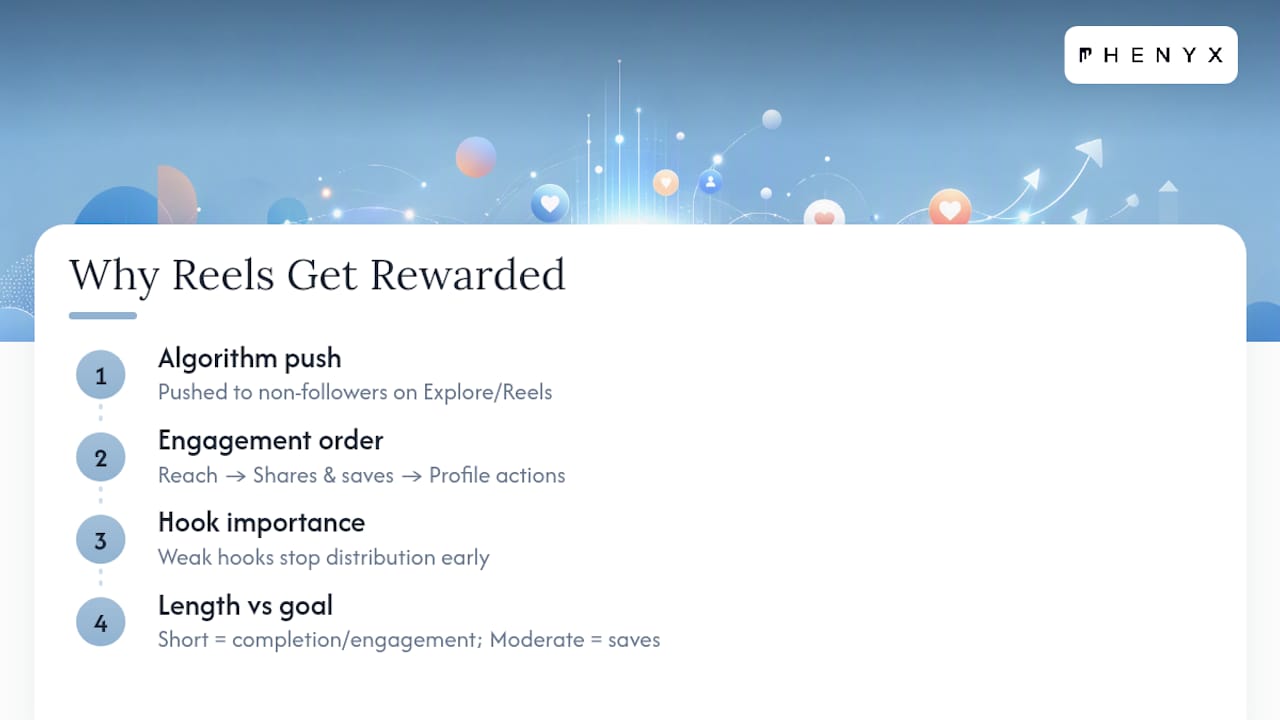
Instagram treats Reels as its main discovery tool, not just another content format. Brands using Reels see significantly more reach than they get from static posts, according to Hootsuite’s Reels research. That gap exists because Instagram’s algorithm actively pushes Reels to non-followers browsing the Explore page and Reels tab, something it doesn’t do nearly as aggressively for photo posts.
Shares and saves come next, followed by profile actions like taps and follows. This is why a weak hook kills a Reel before the algorithm even gets a chance to distribute it widely.
Length matters too. Upgrow’s Reels benchmarks show that Short Reels tend to produce the best mix of completion rate and engagement, while Moderate-length Reels perform well for educational content people want to save and revisit later. If you’re choosing between a punchy tip and a longer tutorial, let the goal decide the length.
High-impact Reel formats and ideas you can batch this month
You don’t need eighteen different production setups. You need a handful of repeatable formats you can shoot in bulk. Here’s a working list broken into four buckets that cover most small business needs.
Utility-first formats:
- Quick tip: solve one small problem your product or service addresses in under 20 seconds.
- Myth-busting: correct a common misconception in your industry.
- “Three things I wish customers knew” style checklist.
- Rapid Q&A pulled from real customer questions.
- Step-by-step how-to using your product or service.
Product-in-use and transformation content:
- Before-and-after clips, even simple ones like a cleaned space or a finished project.
- Unboxing or first-use reaction Reels.
- Side-by-side comparison of your product versus the DIY alternative.
- A “day in the life” using your product naturally.
- Close-up texture or detail shots paired with a voiceover explaining value.
Founder and behind-the-scenes content:
- Founder introduces themselves and why the business exists.
- Behind-the-scenes of a build, prep, or fulfillment process.
- Team member spotlight Reels.
- Mistakes-we-made-and-fixed storytelling.
- Customer testimonial reshared as a Reel with captions.
Trend-friendly and shareable formats:
- Trending audio paired with a relatable business moment.
- Template-based transitions showing product variety.
- “POV” style Reels that put the viewer in a specific scenario your product solves.
Rotate through these buckets weekly so your feed never feels one-note, and pick two or three pillars to repeat consistently rather than chasing all eighteen at once, an approach Socialinsider’s Reels strategy guide recommends for building recognizable content patterns.
How to structure a Reel that actually holds attention
A Reel lives or dies in its first line. Skip the slow intro and open with the payoff, the problem, or a bold claim. “This mistake cost me $400” works. “Hi guys, welcome back to my page” does not.
Match your length to your goal. Keep quick tips and demos in the 15 to 30 second range where completion rates peak. Save 30 to 60 seconds for tutorials or anything you want people to bookmark. Add on-screen text throughout, since most viewers watch with sound off, and your caption needs to carry the message on its own.
End every Reel with one clear action, not three. Pick a single ask:
- “DM us the word TIPS for the full checklist.”
- “Link in bio for pricing.”
- “Tap the product tag to shop this look.”
Pro Tip: Write your CTA before you film anything else. If you can’t state the action in one short sentence, the Reel doesn’t have a clear purpose yet.
A production workflow small teams can actually keep up with
Consistency beats polish, and consistency comes from a repeatable pipeline, not from finding more hours in the week. Here’s a version that works for a one to three person team.
Plan three content pillars and write six short scripts before you ever pick up a camera. Film everything in one two-hour block: stationary product shots, one talking-head segment, and a couple of product-in-use clips. Edit in a single 45 to 90 minute session, batching all six at once instead of finishing one Reel at a time.
For tools, match the choice to your need:
- Speed: your phone’s native editor or Canva’s Reels templates for fast captions and transitions.
- Scheduling: a platform like Hootsuite that lets you queue a week of Reels in one sitting.
- Trend discovery: built-in Instagram audio search, plus scheduling tools that now surface trending sounds directly in their interface.
This single batching session can produce a full week’s worth of content, which turns Reels from a daily scramble into a predictable Tuesday afternoon task.
Measuring results: which numbers actually mean something
Not every metric deserves your attention. Organize what you track into three layers: algorithmic health, growth, and business impact.
- Algorithmic health: watch time, average percent watched, shares, and saves.
- Growth: profile visits, new followers, and reach outside your existing audience.
- Business impact: link-in-bio clicks, DM inquiries, and any UTM-tagged traffic reaching your site.
Set up a unique UTM link for your bio and swap it whenever you run a specific promotion, so you know exactly which Reel sent traffic. Statista’s data on Instagram’s age distribution is worth checking here too, since knowing your audience’s age skew helps you judge whether your reach numbers actually reflect your target customer or just algorithmic luck.
Review short-term numbers weekly, but make real decisions on a 90-day rolling average. Reels performance swings week to week; the trend over a quarter tells you what’s actually working.
What Phenyx sees in client accounts
Working with small business clients on video and social strategy, the same two problems show up again and again. First, tracking conversions. Businesses post consistently but can’t tell which Reel drove a sale because there’s no UTM or DM tracking in place. Second, inconsistent cadence. Teams post five Reels one week, then nothing for three weeks, and the algorithm never gets a clean pattern to reward.

Phenyx typically scopes a Reels engagement around a short discovery call, a pilot batch of content built around two or three pillars, then a reporting checkpoint at 30 and 90 days. Video production and social strategy get handled by the same in-house team, which avoids the back-and-forth that happens when creative and analytics sit with different vendors.
The playbook that actually works for lean teams
The conventional advice on Reels leans hard on production value: better lighting, smoother transitions, trending effects layered on top of trending audio. That advice is backwards for most small businesses. The businesses seeing real results are the ones treating Reels as a system, not a series of one-off videos.
A tracked CTA and a repeatable batching habit will outperform a beautifully shot Reel that nobody knows how to act on. That’s the gap most guides skip. High reach without a next step is just a vanity number. If you only have an hour a week for Reels, spend it writing hooks and CTAs, not hunting for the perfect filter.
Start with three pillars, six scripts, one two-hour shoot. Everything else, the trends, the effects, the polish, comes after the system works.
— Phenyx
How Phenyx builds a Reels program that lasts
Phenyx is the alternative to hiring a separate videographer, social manager, and analytics consultant for your Reels program. One in-house team handles video production, strategy, and measurement together, so your hooks, your posting cadence, and your conversion tracking all come from people talking to each other, not three vendors working in silos.
A typical engagement starts with a discovery call to map your content pillars, moves into a pilot batch of Reels built around your business, and wraps with reporting that shows what actually drove profile visits and DM inquiries. If you’re already running an Instagram business account, Phenyx’s video production services can take the batching workload off your plate entirely, while SEO and AEO support helps make sure the traffic your Reels generate actually gets measured correctly on your website. Reach out to Phenyx to scope a pilot batch for your next content cycle.
Sources
Benchmarks and best practices in this guide draw from Hootsuite, Socialinsider, Sprout Social, Statista, and Upgrow.
- Instagram Reels: best practices + examples (Hootsuite)
- How To Build An Instagram Reels Strategy for Businesses (Socialinsider)
- Age distribution of worldwide Instagram users (Statista)
- Instagram Reels Statistics 2026 (Upgrow)