
Paid Campaigns: Landing Page or Homepage, 6.6% vs 2–3% Conversion
Send paid or campaign traffic to a landing page, not your homepage. If the goal is broad discovery across many audiences, the homepage still does that job better. Dedicated landing pages convert materially better than homepages for paid traffic, so picking the right destination and measuring it correctly changes both your conversion rate and your ad spend. This guide comes from Phenyx’s own campaign and web design work.
TL;DR:
- Landing pages should be used for paid campaigns with specific offers, as they convert at roughly 6.6% compared to 2-3% for homepages.
- Homepages are better suited for brand searches, general awareness, or when visitors are still exploring options.
- Successful landing pages feature a clear headline, a single call to action, minimal navigation, proof elements, and fast mobile loading.
- Running A/B tests and analyzing heatmaps help optimize landing page performance and validate navigation choices.
- SEO strategies differ: short-term landing pages should be noindexed, while long-term pages remain indexed to build brand signals.
Table of Contents
- Landing Page vs Homepage: Quick Summary
- What’s the Real Difference Between a Landing Page and a Homepage?
- Landing Page vs Homepage: The Numbers That Matter
- When Should You Use a Landing Page or a Homepage?
- How Do You Optimize and Test Landing Pages vs Homepages?
- Does SEO Change the Landing Page vs Homepage Decision?
- Landing Page vs Homepage: A Copyable Checklist
- How Phenyx Approaches This for Clients
- Want Help Building the Right Page for Your Campaign?
- Sources
Landing Page vs Homepage: Quick Summary
- The core rule: campaign traffic with one specific offer goes to a landing page; broad or brand traffic goes to the homepage.
- Landing pages convert at a median of roughly 6.6%, versus 2 to 3% for homepages, on paid traffic.
- Strip extraneous navigation links and match your headline to the ad copy word for word.
- Homepages still make sense for brand searches, single-product businesses, and general awareness.
- Run an A/B test or a fast page audit before your next campaign launch.
What’s the Real Difference Between a Landing Page and a Homepage?
A landing page is built for one job: convert visitors who arrived with a specific intent already in mind. It carries a single offer, minimal or no navigation, and one call to action repeated a few times down the page. Everything on it should point at the same next step.
A homepage is your site’s front door. It has to serve first-time visitors, returning customers, jobseekers, investors, and everyone in between, so it carries multiple navigation paths and several competing calls to action. That’s not a flaw. It’s the job a homepage is supposed to do.
There’s one common exception. If you run a single-product business, your homepage can effectively function as a landing page, since there’s only one thing to sell and no competing audience to serve. Outside that case, treating your homepage like a landing page usually means diluting both.
Landing Page vs Homepage: The Numbers That Matter
The gap between these two page types shows up clearly once you look at the axes marketers actually care about.
- Primary goal: landing pages exist to convert one action; homepages exist to help many types of visitors find their own path.
- Typical traffic source: landing pages should receive paid search, paid social, and email campaign clicks; homepages absorb direct traffic, brand search, and organic discovery.
- Navigation and link count: landing pages work best with one to two links total; homepages need a full navigation menu to stay usable.
- CTA structure: landing pages repeat a single call to action; homepages present several, often three or more, aimed at different segments.
- Conversion performance: landing pages post a median conversion rate around 6.6%, compared with 2 to 3% for homepages, according to Foundry CRO’s analysis, and top performers clear 11.45%.
That last figure is where the money question lives. If you’re paying $4 a click on Google Ads and sending that traffic to a homepage converting at 2%, you need 50 clicks per sale. Send the same traffic to a matched landing page converting at 6.6%, and you need roughly 15. Same ad budget, three times the output. Unbounce’s breakdown of the two page types makes the same point: landing pages remove choice on purpose, while homepages are built to offer it.
When Should You Use a Landing Page or a Homepage?
Match the destination to the traffic source before you launch anything:
- Google Ads or Meta Ads with a specific offer → landing page, with the offer stated in the headline before the fold.
- Email campaigns promoting one product or event → landing page, mirroring the subject line’s promise.
- Social ads driving toward a lead magnet or webinar signup → landing page, single CTA, no distracting nav.
- Brand search terms (someone searching your company name) → homepage is fine; they already know who you are and want options.
- General awareness or PR-driven traffic → homepage, since visitors don’t yet have one specific action in mind.
- Single-product or single-service businesses → homepage can double as your landing page.
Before a campaign brief goes out, ask one question: does this visitor already know exactly what they want? If yes, build a landing page. If they’re still exploring, the homepage is the right call.
How Do You Optimize and Test Landing Pages vs Homepages?
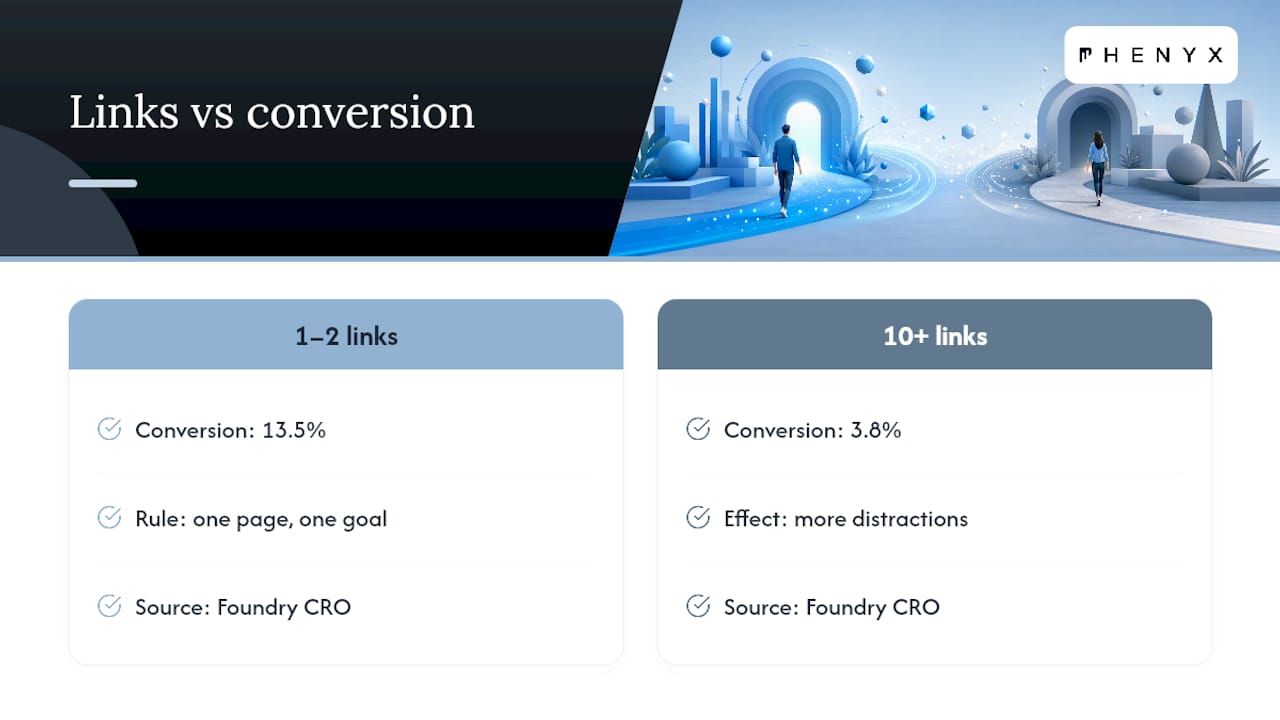
Good landing page design comes down to a short list of rules that hold up across most industries. Keep your attention ratio tight: one page, one goal, and as few links as possible pulling focus away from the CTA. Pages with just one or two links convert at roughly 13.5%, compared to 3.8% for pages carrying ten or more, based on Foundry CRO’s data. Match your on-page message to the exact ad copy that brought the visitor there, and put proof (a testimonial, a logo bar, a number) right next to the button, not buried below it.
Testing this properly means writing an actual hypothesis before you launch a variant. State what you’re changing, what metric moves, and how long the test runs before you call it. Give tests enough traffic to reach a believable sample size rather than pulling the plug after a good day. Behavioral tools like heatmaps and session recordings show you where attention actually goes, which often contradicts what the design team assumed.
Pro Tip: Before you remove or add navigation on a landing page, don’t guess. Run it through a heatmap and check session recordings first. CXL’s research on landing page navigation found that even small nav changes can swing conversion in either direction depending on the audience, so validate before you commit.
Watch for tracking traps too. Duplicate conversion events, UTM parameters that get stripped mid-funnel, and attribution windows set too short all quietly wreck your data before you even get to judge the page.
Does SEO Change the Landing Page vs Homepage Decision?
Short-lived campaign landing pages, the ones built for a single promotion or event, generally don’t need to rank in organic search. Noindex them and let paid traffic do the work. Evergreen landing pages built around a lasting offer are worth indexing since they can pick up organic traffic over time.
Homepages carry the opposite job. They act as your long-term brand signal and the hub search engines associate with your company name, so they need to stay discoverable and well-linked. One more wrinkle for paid search specifically: weak message match and a poor landing page experience can raise your cost per click through a lower Quality Score, so the SEO and the paid-ads decision aren’t as separate as they look.
Landing Page vs Homepage: A Copyable Checklist
Landing page checklist: clear headline matching the ad, single CTA repeated two or three times, proof near the button, minimal or no navigation, tracking pixels installed before launch, and a page that loads fast on mobile.

Homepage checklist: a plain brand statement above the fold, navigation built around your real audience segments, visible trust signals, and content structured so search engines can actually find and index it.
The one-minute test: open your current page and ask whether a stranger could tell, in five seconds, what you want them to do next. Landing pages built for paid traffic that convert at that top tier of 11.45% or higher all pass that test instantly.
How Phenyx Approaches This for Clients
Before building anything, Phenyx looks at where the traffic is actually coming from and what the visitor already knows when they arrive. Paid campaign traffic with a clear, single offer gets a dedicated landing page built for that exact message. Broad or brand traffic usually points to fixing the homepage instead.
That decision runs through a structured review process that looks at current site design, paid ad performance, and search visibility together, rather than treating them as separate problems. Depending on what a client needs, that might mean a paid ads campaign built around new landing pages, or a homepage rebuild focused on why the current site isn’t generating leads. If you’re not sure which one your business needs right now, an audit usually answers that question fast.
— PHENYX
Want Help Building the Right Page for Your Campaign?
You can build and test this yourself with a landing page builder, and plenty of marketers do exactly that with tools built for quick iteration, as seen across reviews on G2. If you’d rather hand the work to a team that builds, tracks, and optimizes both landing pages and homepages for a living, that’s where Phenyx comes in.

Phenyx handles full website redesign work, dedicated landing page builds, paid ad management, and SEO and AEO strategy under one in-house team, so your landing page, your homepage, and your ad spend all get built to work together instead of fighting for the same traffic. If your paid campaigns are still pointing at a generic homepage, that’s usually the first fix worth making. Once conversions start moving, pairing that page with a lead nurturing follow-up sequence keeps those new leads warm instead of letting them go cold.
Whether you’re in Denver, Tampa, Dallas-Fort Worth, or working remotely with our team, request a website design consult and get a straight answer on whether your next campaign needs a landing page, a homepage fix, or both.
Sources
- Homepage vs Landing Page for Google Ads (2026 Data)
- Landing page vs homepage vs website: What’s the difference?
- Use navigation on landing pages: data-driven considerations