B2B Lead Generation Strategies That Actually Drive Pipeline
The most effective B2B lead generation strategy in 2026 is not a single tactic. It’s a system: intent-driven account-based marketing paired with coordinated outbound and content, backed by clean data, fast follow-up, and automation that scales personalization without losing the human judgment that closes deals. Teams that treat lead generation as a pipeline math problem, not a lead-volume contest, consistently outperform those chasing top-of-funnel numbers.
If you’re prioritizing where to spend the next quarter, start here:
- Build a targetable ICP and layer in intent signals before you spend on outbound
- Run account-based marketing for deals with higher values and multiple decision-makers
- Structure a referral program with real incentives, not just an ask
- Fix your MQL to SQL handoff with written definitions and SLAs
- Use AI to draft personalized outreach, then have a rep edit before sending
- Map content to funnel stage and track which pieces actually touch closed pipeline
Two numbers should anchor your planning. Lead to MQL conversion sits around 31% on average, and MQL to SQL conversion tends to lose a significant share of pipeline, varying widely by industry and lead source. Fixing that handoff, not adding more leads at the top, is usually the higher-leverage fix. AI adoption backs this up structurally: 96% of B2B marketers now use AI tools, and efficiency is the benefit they cite most.
Key Takeaways
Pipeline growth in B2B lead generation depends more on fixing the MQL-to-SQL handoff than on adding volume at the top of the funnel.
| Point | Details |
|---|---|
| Prioritize ABM for complex deals | Use account-based marketing when ACV exceeds $25,000 and multiple stakeholders are involved. |
| Fix the handoff first | Write shared MQL/SQL definitions and SLAs before investing in more lead volume. |
| Use AI as a drafting tool | Let AI draft personalized outreach, but have a rep edit before it sends. |
| Track stage-level conversion | Report medians and top-quartiles per funnel stage instead of one blended average. |
| Fix the website, not just the funnel | Phenyx’s in-house SEO and web design work addresses conversion leaks a redesigned site or stronger content can solve. |
Table of Contents
- Quick Summary
- What Are the Best B2B Lead Generation Strategies?
- How Should You Orchestrate Channels for B2B Lead Generation?
- How Do You Build ICPs and Use Intent Signals for ABM?
- What Outbound Tactics Actually Convert in B2B Lead Generation?
- Which Content Formats Move B2B Buyers Through the Funnel?
- What Tech Stack Do You Need to Run These Tactics?
- Why Do So Many Leads Die Between Marketing and Sales?
- How Do Referrals and Partnerships Generate High-Trust Leads?
- Your 30/60/90-Day Lead Generation Action Plan
- How Does Phenyx Help B2B Companies Improve Lead Generation?
- What the Data Actually Tells You to Prioritize
- Get a Website and Marketing System Built for Pipeline, Not Just Traffic
- Sources
Quick Summary
- Intent-driven ABM combined with coordinated outbound and content often outperforms single-channel lead generation
- Lead-to-MQL conversion benchmarks around 31%, but MQL-to-SQL is where pipeline typically leaks
- AI works best as a drafting and triage tool, with reps editing before anything goes out
- Referral programs tend to produce higher-quality leads when designed to reduce friction for referrers
- Written SLAs between marketing and sales close the handoff gap that kills pipeline
- Channel choice should follow deal size and buying-committee complexity, not habit
- A minimum viable stack (CRM, marketing automation, verification, engagement platform) makes every tactic below measurable
What Are the Best B2B Lead Generation Strategies?
Not every tactic deserves equal investment. The list below is roughly ordered by leverage for mid-market B2B companies, with notes on when each one earns its budget.
- Account-based marketing (ABM). Best for deals with average contract values (ACV) above $25,000 and buying committees of four or more people. Time to results: 60 to 120 days. Effort: high, but concentrated on fewer accounts. Next step: build a 50 to 200 account target list scored by fit and intent.
- Referral programs. Best for any ACV, especially service businesses with satisfied customers. Time to results: 30 to 60 days once structured. Next step: define the incentive and build a one-click referral path into your CRM.
- Content and organic search (SEO). Best for long sales cycles and multiple buyer roles researching independently. Time to results: 3 to 9 months for meaningful organic traffic. Next step: audit your top 10 pages against buyer questions.
- Paid search and paid social. Best for filling pipeline gaps quickly or testing new segments. Time to results: days to weeks. Next step: run a two-week test on your highest-intent keyword cluster.
- LinkedIn and social selling. Best for reaching individual buyers and champions before they’re in-market. Time to results: 60 to 90 days of consistent activity. Next step: have reps publish and comment weekly, not just post.
- Cold email and outbound sequencing. Best for known ICPs with clear firmographic triggers. Time to results: 2 to 4 weeks per sequence. Next step: verify your list before sending anything.
- Webinars and events. Best for education-heavy categories and multi-stakeholder buying. Time to results: immediate for attendees, 60+ days for pipeline. Next step: pick one topic tied to a real buying trigger, not a product feature.
- Partnerships and co-marketing. Best for reaching adjacent audiences without paid acquisition cost. Time to results: 90 days to build, ongoing after. Next step: identify three complementary vendors your buyers already use.
How Should You Orchestrate Channels for B2B Lead Generation?
Channel choice isn’t a preference, it’s a function of deal size and buyer behavior. Enterprise deals with long buying cycles need ABM layered with content and events. Transactional SMB deals move faster on paid search, email, and trial offers.
Sequencing matters more than any single channel. A typical high-performing sequence looks like this: intent signal triggers a LinkedIn touch from the rep, followed by a personalized email within 24 hours, followed by a call attempt, followed by inclusion in a nurture track if there’s no response. Gartner’s research on the modern B2B buying journey shows buyers now move across channels non-linearly, which is exactly why single-channel plans underperform.
Track channel-level KPIs separately:
- Cost per qualified lead by channel
- Time from first touch to SQL
- Contact rate on outbound attempts
- Content-assisted conversions before an opportunity opens
Reallocate budget quarterly toward whichever channel shows the shortest path to SQL, not the most raw leads.
How Do You Build ICPs and Use Intent Signals for ABM?
A targetable ICP combines three layers: firmographic data (industry, employee count, revenue band), behavioral data (tech stack, hiring patterns, content consumption), and trigger events (funding rounds, leadership changes, expansion announcements). Gartner recommends tying account selection directly to buying-committee mapping rather than picking accounts on firmographics alone.
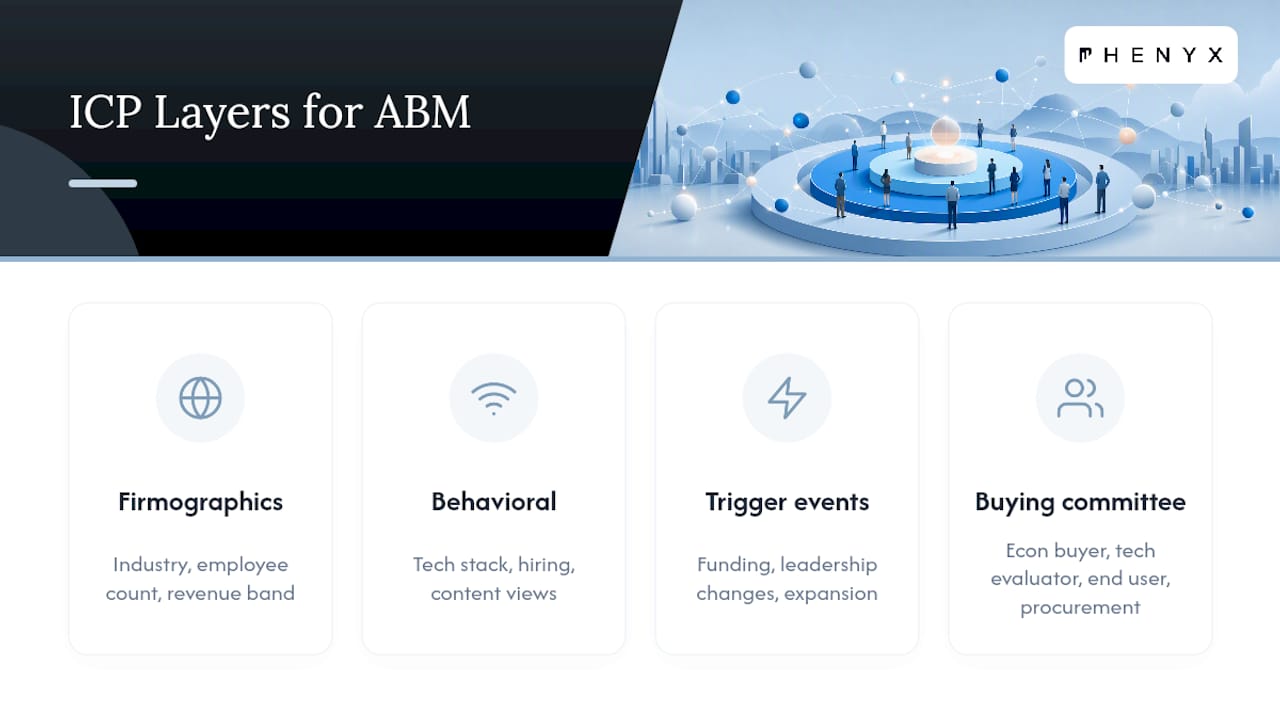
Map the buying committee for each target account: economic buyer, technical evaluator, end user, and procurement. Multithread by reaching at least two roles before your first meeting, since single-threaded deals stall far more often when a champion leaves or goes quiet.
Track intent signals like pricing-page visits, competitor comparison searches, and job postings for roles tied to your product category. Trigger outreach within 24 hours of a high-intent signal, not at the end of the week.
Pro Tip: Score accounts on fit and intent separately. A high-fit account with no intent signal goes into nurture, not into a rep’s outbound queue.
ABM earns its cost premium fastest on accounts with ACV above $25,000, where a handful of closed deals justifies the concentrated effort.
What Outbound Tactics Actually Convert in B2B Lead Generation?
- Verify every email before sending. Bad data damages domain reputation and tanks deliverability for everyone on the team.
- Sequence with intent, not just cadence. Space touches across email, LinkedIn, and phone over 10 to 14 days rather than blasting five emails in a week.
- Draft with AI, edit with a human. Efficiency is the top benefit marketers cite from AI tools, but a rep should still adjust tone and specifics before anything sends.
- Route by SLA, not by queue order. Hot leads with clear intent should hit a rep’s inbox in minutes; routine MQLs can wait hours, not days.
Contact speed compounds. Opportunities contacted early in the sales cycle show measurably higher win rates than those that sit untouched for even a day or two.
Which Content Formats Move B2B Buyers Through the Funnel?
Map content to where the buyer actually is. Top-of-funnel content answers “is this a problem I have,” mid-funnel answers “which approach solves it,” and bottom-funnel answers “why this vendor.” Case studies and ROI calculators do the heaviest lifting near the bottom.
Don’t ignore procurement and finance. These hidden buyers rarely read a product page but do read cost-of-inaction analyses and vendor comparison guides. Give reps snippets of your best content to drop into outbound emails instead of writing from scratch every time.
Attribution doesn’t need to be perfect. Track which content pieces show up in the engagement history of closed-won opportunities, and weight your content calendar toward more of that.
What Tech Stack Do You Need to Run These Tactics?
A minimum viable stack covers four functions: a CRM, a marketing automation platform (MAP), an email verification tool, and an engagement platform for sequencing outbound. Intent and ABM platforms are additive once the basics work.
Score leads on fit plus behavior, then route anything above threshold straight to a rep. Track stage-level conversion rather than one blended number. B2B pipeline benchmarks put lead-to-MQL around 31%, but MQL-to-SQL varies enough by source that a single average hides more than it reveals.
- Report medians and top-quartile figures per stage, not just the mean
- Clean your database of duplicate and stale records monthly
- Watch domain reputation and sending infrastructure, especially during outbound ramp-up
- Track pipeline coverage (3 to 4x quota is a common target) alongside CAC
Why Do So Many Leads Die Between Marketing and Sales?
- Write down one-line definitions. An MQL fits your ICP and has taken a meaningful action; an SQL has a confirmed need, budget signal, and timeline. Both teams sign off on the same wording.
- Set SLAs by lead temperature. Hot, high-intent leads get contacted within minutes to a few hours. Routine MQLs get a 24-hour window.
- Build a real nurture track for not-yet-ready leads. Fit but not ready should not disappear into a generic newsletter.
- Measure the leak directly. Track the percentage of MQLs that get worked within SLA and the percentage that convert to SQL. Most pipeline leakage happens right at this handoff, which makes it the highest-leverage place to fix first.
How Do Referrals and Partnerships Generate High-Trust Leads?
Structure referral incentives so the ask takes 30 seconds, not a favor that requires a follow-up email. Academic research on referral programs shows they consistently improve acquisition quality when friction for the referrer stays low.
- Pair referral asks with a specific trigger, like a renewal or a positive support interaction
- Build channel and co-marketing partnerships with vendors your buyers already trust
- Participate in industry communities where hidden buyers ask real questions
- Review partner activity quarterly and retire the ones that go quiet
Your 30/60/90-Day Lead Generation Action Plan
- Days 1 to 30: Write ICP and MQL/SQL definitions, audit your data for duplicates, and stand up SLA tracking in your CRM.
- Days 31 to 60: Launch one ABM pilot on 25 to 50 accounts and one referral program test, measuring contact rate and SQL conversion.
- Days 61 to 90: Scale whichever channel showed the fastest time-to-SQL, and build a monthly report covering stage conversion, velocity, and pipeline coverage.
How Does Phenyx Help B2B Companies Improve Lead Generation?
Phenyx runs SEO, web design, video production, and branding under one in-house team, which matters when lead generation breaks down at the website itself rather than the top of funnel. A structured approach to auditing conversion paths, content gaps, and technical SEO tends to surface where leads are actually leaking.
- Fixing site conversion so paid and organic traffic doesn’t die on a slow or confusing page
- Building content that reaches hidden buyers like procurement and finance
- Strengthening organic visibility through SEO and AEO services so inbound keeps compounding
For a broader look at how AI and SEO intersect with lead generation, this guide from Babylovegrowth covers useful adjacent context on AI-driven content scaling.
What the Data Actually Tells You to Prioritize
The conventional advice to “generate more leads” misreads where most companies actually lose revenue. The gap between hitting lead-generation goals and proving revenue impact is wide and well documented, and it exists because teams optimize the top of the funnel while the MQL-to-SQL handoff quietly bleeds out the leads that were already qualified.
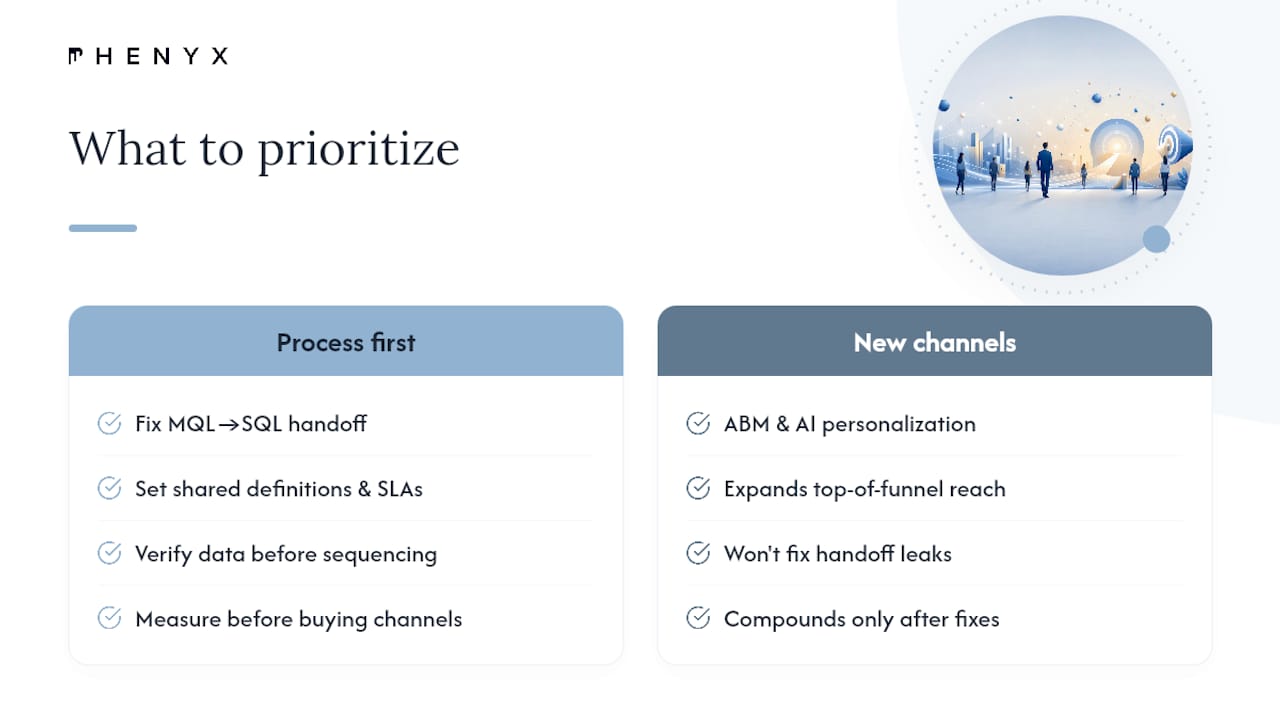
Intent-driven ABM and AI-assisted personalization get most of the attention heading into 2026, and they deserve some of it. But neither fixes a broken handoff or a stale database. The unglamorous work, writing shared definitions, setting SLAs, verifying data before it hits a sequence, is what actually converts more of the pipeline you already have.
If you’re choosing where to spend the next dollar, spend it on measurement and process before you spend it on a new channel. A better-targeted ABM program on top of a leaky handoff still leaks. Fix the handoff first, then let AI and channel expansion compound on a foundation that already converts.
— PHENYX
Get a Website and Marketing System Built for Pipeline, Not Just Traffic
Most of the tactics above fail quietly at one place: the website the leads actually land on. Phenyx builds and manages that entire system in-house, SEO, web design, video, and branding, so a lead generated through ABM or outbound doesn’t stall on a slow page or a form that never gets checked.
That matters for companies in Denver, Boulder, Tampa, and the Dallas-Fort Worth area juggling multiple vendors just to launch one campaign. Phenyx replaces that with one team accountable for the whole funnel, from a website redesign that actually converts to the SEO work that keeps inbound leads coming in months later. If your site is the weak link in the strategies above, request a website redesign consultation and see where your conversion path is losing leads today.
Sources
- Demand Gen Report — The state of B2B marketing trends and insights in 2026
- Referral program analysis — Wharton faculty working paper
- Pipeline generation: 2026 playbook with benchmarks — Prospeo