

Launch Marketing on Demand in 90 Days for Growing Teams
Marketing on demand is a delivery model that gives you vetted senior marketing talent or a flat-rate in-house team for project-based or ongoing work, without the overhead of full-time hires. Its main value is speed: you get campaigns launched, gaps filled, and deliverables shipped on a timeline that matches real business pressure, not a hiring cycle. It fits companies facing a product launch, a sudden leadership vacancy, or a pipeline that needs attention now rather than next quarter.
TL;DR:
- On-demand marketing is suitable mainly for short-term projects or seasonal pushes rather than ongoing, core functions like embedded product marketing.
- Using a 90-day pilot helps define scope, set clear KPIs, and determine if a subscription or in-house team better suits your needs before full commitment.
- Speed metrics such as time to publish and campaign launch should be tracked separately from downstream results like pipeline contribution over the first six to twelve months.
- Flat-rate subscriptions starting at $4,000 per month typically offer better cost predictability and continuity than hourly or project-based pricing for frequent campaigns.
- Internal governance, documentation, and clear approval processes are critical to maintain speed and quality in fast-paced on-demand marketing programs.
Table of Contents
- What Is Marketing on Demand?
- How Does Marketing on Demand Differ From Demand Generation?
- What Are the Core Pillars of Marketing on Demand?
- How Do You Roll Out an On-Demand Marketing Program?
- What KPIs and Timelines Should You Expect?
- Who Benefits Most From On-Demand Marketing?
- The PHENYX View on Delivering Marketing On Demand
- What Does On-Demand Marketing Actually Cost?
- Opinion: Trade-Offs and Governance When Adopting On-Demand Marketing
- Getting Started With PHENYX MODS
- Sources
- FAQ
What Is Marketing on Demand?
Marketing on demand describes a flexible way to buy marketing execution: instead of hiring a full department, you tap fractional specialists, project-based teams, or a subscription-style plan that delivers a defined set of services every month. The term covers several delivery formats, so knowing which one you’re evaluating matters.
Some providers offer fractional experts, a single strategist or channel specialist billed by the hour or the project. Others build project teams around a specific deliverable, a website relaunch or a product video, then disband once it ships. A third format, the flat-rate subscription, bundles multiple services (design, SEO, content, ads) into one recurring plan with a consistent team.
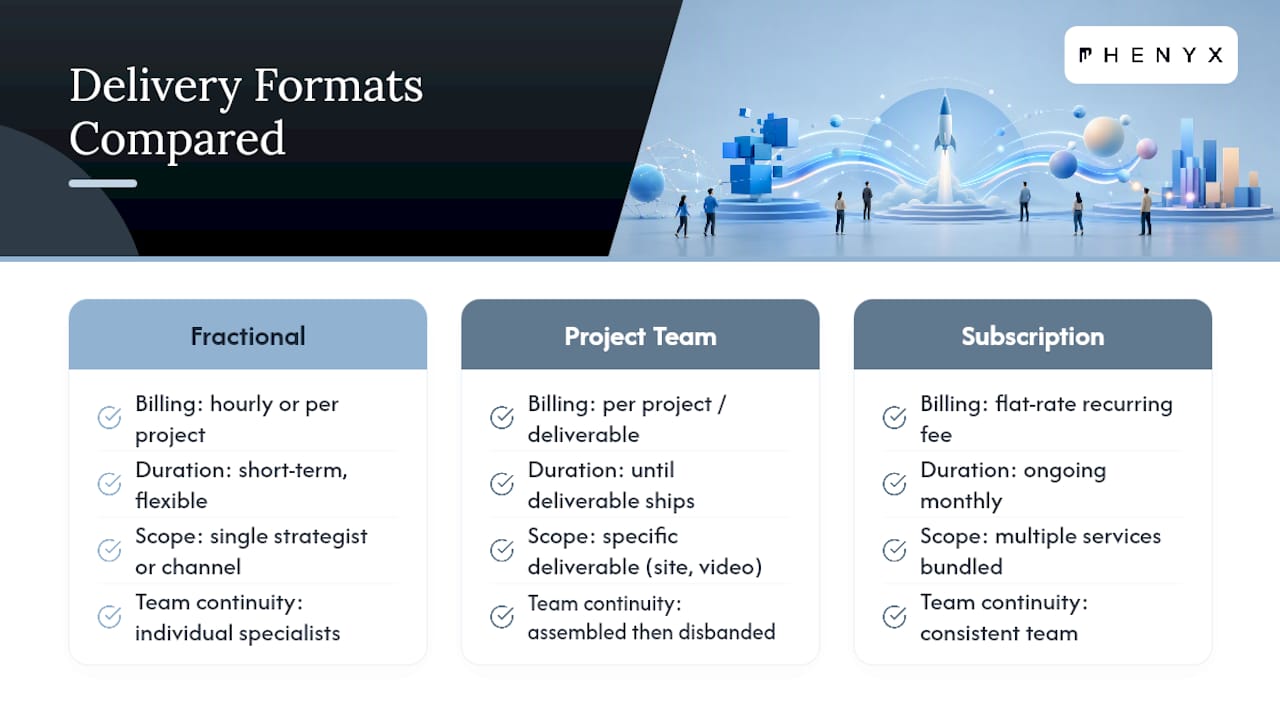
The phrase is genuinely useful shorthand for “fast, flexible marketing execution.” It’s also, frankly, a positioning term agencies use to differentiate from slow-moving retainers. Both things can be true. What matters is matching the format to the problem you’re actually solving, not the label a vendor puts on it.
How Does Marketing on Demand Differ From Demand Generation?
Marketing on demand is a delivery model. Demand generation and lead generation are strategies. Confusing the three leads teams to pick the wrong tool for the job.
Demand generation is a long-term, full-funnel strategy built around brand awareness and market interest, while lead generation is a shorter, conversion-focused process aimed at capturing contact information. Effective marketing programs run both, just at different weights depending on company stage.
- Primary goal: demand gen builds market awareness; lead gen captures identifiable contacts; on-demand marketing delivers the execution behind either goal.
- Funnel stage: demand gen lives top-of-funnel; lead gen operates mid-to-bottom funnel where intent is higher.
- Time to impact: lead gen metrics (cost-per-lead, MQL-to-SQL rate) move in weeks; demand gen effects compound over months.
- Operational differences: demand gen leans on SEO, webinars, and long-form content; lead gen relies more on gated offers, landing pages, and retargeting.
Established companies often run roughly 60% demand generation and 40% lead generation, while early-stage companies lean harder into lead gen to fill an immediate pipeline. An on-demand team or subscription can staff either motion. The choice of strategy comes first; the delivery model comes second.
What Are the Core Pillars of Marketing on Demand?
Speed without structure just produces fast mistakes. Four capabilities separate a reliable on-demand program from a chaotic one.
- Real-time responsiveness. Documented playbooks, active social listening, and pre-approved response templates let a team react within hours instead of waiting on a weekly status call.
- Quality assurance at speed. Templates, style guides, and a defined approval gate keep fast output from turning sloppy.
- Data-driven personalization. A customer data platform, marketing automation tool, and an analytics dashboard are what make real-time personalization possible instead of aspirational.
Pro Tip: Before you hire or subscribe to anything, write down your approval chain on one page. On-demand teams move fast, and the single biggest bottleneck is usually an internal sign-off process nobody documented.
How Do You Roll Out an On-Demand Marketing Program?
A 90-day pilot beats an open-ended commitment because it forces clarity on scope and success criteria before money keeps flowing.
- Define the pilot scope. Pick one campaign or deliverable set, a launch, a content sprint, a website refresh, and attach three metrics: speed-to-market, engagement lift, and MQL movement.
- Choose a staffing model. Decide between a fractional specialist, a project team, or a flat-rate subscription based on how long the need will last. On-demand platforms typically advertise fast matching and short trial periods, which makes this a low-risk way to test fit.
- Set SLAs and cadence. Agree on turnaround times, approval windows, and a weekly production schedule before work starts, not after the first missed deadline.
- Measure, then decide. At the 90-day mark, review your metrics against baseline and decide whether to scale into a retained subscription or bring the function in-house.
Low-barrier, well-scoped starter projects reduce procurement friction and give you real evidence before you sign anything bigger. That evidence, not a sales pitch, is what should drive the scale-up decision.
What KPIs and Timelines Should You Expect?
Short-term and long-term marketing work get measured differently, and mixing them up leads to premature pilot cancellations.
In the first few weeks, watch speed-to-market, content output volume, and early engagement lift. These numbers move fast because they reflect execution speed, not market response.
Over six to twelve months, the metrics that matter shift toward MQL-to-SQL conversion, pipeline contribution, and customer acquisition cost. Demand generation effects compound over time as SEO, content, and brand awareness build on each other, so judging a demand gen investment on 30-day results is a mistake.
- Track velocity metrics (time to first publish, campaign launch speed) separately from downstream influence metrics (SQL conversion, pipeline contribution).
- Use a simple attribution layer, UTM parameters plus landing page and campaign tags, to separate your pilot’s contribution from baseline channel performance.
- Revisit attribution monthly if you’re running multiple vendors or channels at once; overlapping campaigns muddy the numbers fast.
Who Benefits Most From On-Demand Marketing?
Launches, seasonal pushes, and event-driven campaigns are the clearest fit. So are interim leadership gaps, a fractional CMO can keep strategy moving while you search for a permanent hire. Small and midsize businesses that need senior-level thinking without a six-figure salary commitment are the other obvious use case. If your need is truly ongoing and central to the business, like a dedicated product marketer embedded daily with engineering, an in-house hire or a longer retained partnership usually serves you better than a rotating on-demand model.
The PHENYX View on Delivering Marketing On Demand
Phenyx runs on-demand and subscription marketing through a single in-house team, covering web design, SEO and AEO, video, and branding. So clients aren’t managing four vendors to ship one campaign. That structure cuts handoff delays and keeps messaging consistent across every deliverable.
A typical starter engagement begins with one focused project, a site update or a launch campaign, before scaling into the broader MODS plan. [Case study results and specific team credentials are detailed on individual project pages.]
What Does On-Demand Marketing Actually Cost?
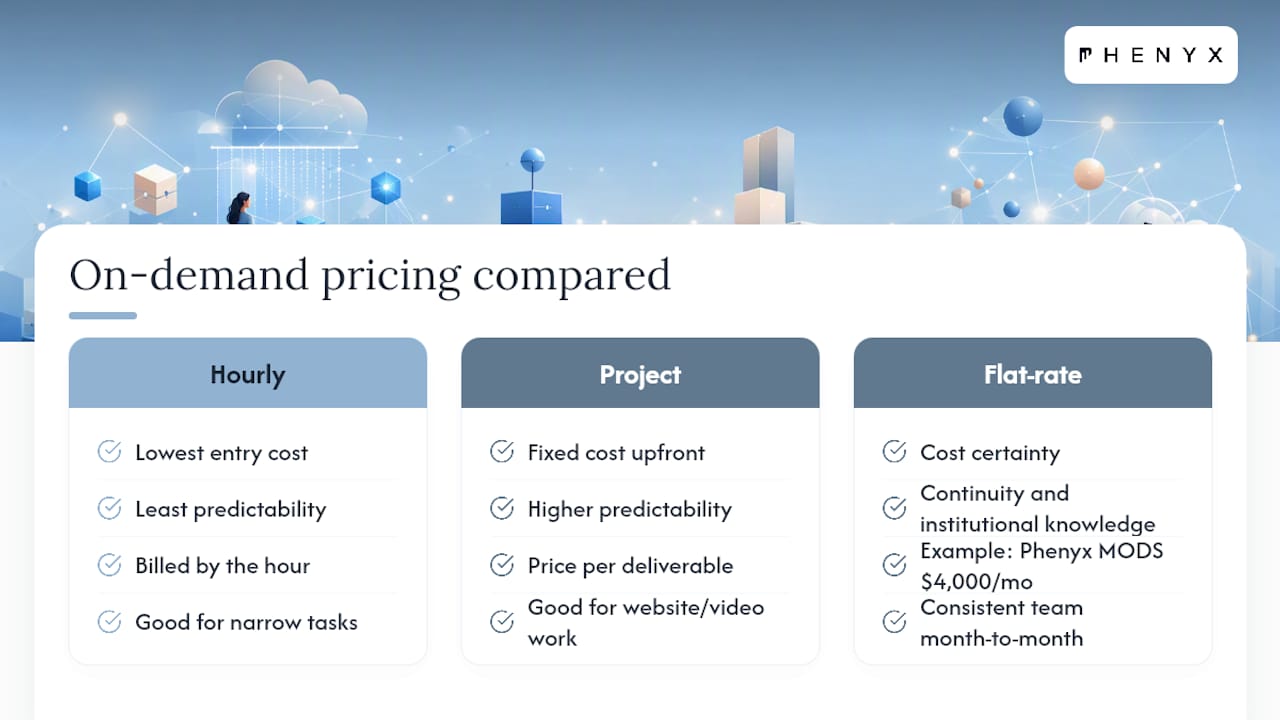
Budget conversations around on-demand marketing usually break down into three buckets: hourly fractional talent, project-based fees, and flat-rate subscriptions. Each carries different risk and predictability.
Hourly fractional specialists offer the lowest entry cost but the least predictability. A specialist billing by the hour can be efficient for a narrow task, but costs climb fast if scope creeps, and you’re often paying for ramp-up time on every new engagement.
Project-based pricing has been gaining ground precisely because it fixes the deliverable and the cost upfront. You know what you’re paying for a website relaunch or a video campaign before work starts, which makes budgeting to a board or a finance team much easier than defending an open hourly tab.
Flat-rate subscriptions, like Phenyx’s MODS plan starting at $4,000 per month, trade some flexibility for cost certainty and continuity. You get a consistent team that carries institutional knowledge forward month to month, instead of re-explaining your brand to a new fractional hire every quarter. For businesses running frequent campaigns, this format often beats piecing together multiple hourly specialists, because you’re not paying separately for account management, tooling, and coordination on every project.
The real cost-effectiveness question isn’t which format is cheapest per hour. It’s which format gets a deliverable shipped with the fewest delays and the least internal management overhead. A cheap hourly rate that requires 10 hours of your own oversight per week isn’t actually cheap.
Opinion: Trade-Offs and Governance When Adopting On-Demand Marketing
Speed and flexibility come with a real cost: institutional knowledge doesn’t transfer automatically when your team rotates. Fast staffing models can under-index on continuity unless someone internal owns documentation and handoffs. Assign one governance owner, set budget guardrails before the pilot starts, and graduate to a subscription or a hire only once your metrics, not your gut, tell you to.
— PHENYX
Getting Started With PHENYX MODS
If your team keeps running into the same wall, good ideas stuck behind slow execution, a starter project is the lowest-risk way to see whether an integrated, in-house model actually fits how you work. Phenyx’s MODS plan gives you a flat-rate, all-inclusive marketing team (web design, SEO and AEO, video, branding, and paid ads) starting at $4,000 per month, with no separate vendor contracts to juggle.
Evaluating a starter project is straightforward: pick one deliverable, a site refresh, a campaign launch, or a brand refresh, and treat it as your test case before committing to a full monthly plan. Businesses in Denver, Tampa, and Dallas-Fort Worth work with Phenyx’s in-house team specifically because everything, from website design to paid ads and PPC, ships from one coordinated group instead of four disconnected freelancers. If you’re weighing whether to scale a pilot into something bigger, the outsourced marketing decision guide walks through the sizing questions worth asking first. Ready to see what a starter project looks like for your business? Reach out through Phenyx’s site to scope one.
Sources
- Demand generation vs lead generation (Search Engine Journal)
- Demand generation vs lead generation (G2 Learn)
- Marketing expertise on demand (MarketerHire blog)
FAQ
What Is Marketing on Demand?
Marketing on demand is a flexible delivery model that gives businesses access to senior marketing talent or a full-service team through fractional hires, project-based engagements, or flat-rate subscriptions like Phenyx’s MODS plan. It solves for speed and skill access without the commitment of full-time hiring.
What Is the 3-3-3 Rule in Marketing?
Definitions of the 3-3-3 rule vary across marketing circles, and there’s no single standardized version tied to on-demand or demand generation strategy specifically. If you’ve seen it referenced for a particular framework, it’s worth confirming the source’s definition before applying it to your own planning.
What Are the 8 Types of Demand in Marketing?
Marketing theory recognizes several demand states, including negative, nonexistent, latent, declining, irregular, full, overfull, and unwholesome demand, each requiring a different marketing response. On-demand marketing execution can address most of these states, but the strategy for each (stimulating latent demand versus managing overfull demand) differs significantly.
What Is the 40-40-20 Rule in Marketing?
The 40-40-20 rule is a general marketing heuristic suggesting that campaign success depends roughly 40% on the audience you target, 40% on the offer itself, and 20% on the creative execution. It’s a useful gut check for where to spend planning time, though it isn’t a precise, research-validated formula.
How Much Does an On-Demand Marketing Subscription Cost?
Pricing varies by format: hourly fractional talent, fixed project fees, or flat-rate subscriptions. Phenyx’s MODS plan, an all-inclusive in-house marketing subscription, starts at $4,000 per month and covers web design, SEO and AEO, video, branding, and paid ads under one team.