

Fix Marketing Lead Quality for B2B: Scoring, Routing, Rejection Data
Marketing lead quality is the probability that a lead converts into revenue, based on three factors: fit with your ideal customer profile, buying intent, and readiness to talk to sales. If you are still reporting lead volume as a win, stop. The fix starts with tying every lead to what happens after the handoff, not before it.
TL;DR:
- Lead quality should be measured by its ability to generate revenue, not just form fills or volume, with metrics like sales acceptance rate and MQL-to-SQL rate providing early signals.
- The most common issues in lead quality happen during the handoff between marketing and sales, often due to mismatched definitions, lack of visibility, and no formal review process.
- Building a reliable scoring framework involves separating fit signals from intent signals, then combining them into tiers tested against actual deal outcomes.
- Improving lead quality requires validating key data fields at capture, recalibrating scoring regularly, and reducing friction in processes like timing and rejection reasons.
- In-house teams that manage the entire funnel from ad to deal closure, including conversion and lead nurturing, see better alignment and fewer lead quality problems.
Table of Contents
- What Is Marketing Lead Quality, Exactly?
- Why Does Lead Quality Break Down Between Marketing and Sales?
- What Metrics Actually Measure Lead Quality?
- How Do You Build a Lead Scoring Framework That Actually Predicts Revenue?
- How Do You Improve Lead Quality in Practice?
- How Do You Align Marketing and Sales Operationally?
- How Do You Report Lead Quality Improvements to Leadership?
- The PHENYX Perspective on Reducing Lead Noise
- A Practitioner’s Note on Where Lead Quality Actually Breaks
- Getting Your Lead Quality Fixed, Not Just Reported On
- Sources
- FAQ
What Is Marketing Lead Quality, Exactly?
Lead quality measures how likely a given lead is to become an opportunity and eventually closed revenue. It is not a vibe, and it is not the same as counting form fills. A marketing-qualified lead (MQL) is a narrow operational construct, usually a scoring threshold that says “this person showed some early engagement.” That threshold tells you almost nothing about whether the lead will ever buy.
Volume alone is misleading because it rewards the wrong behavior. A campaign that generates 500 form fills from students researching a term paper looks fantastic on a dashboard and terrible in a sales pipeline. Quality has to be judged against downstream outcomes: did the lead become a sales-accepted lead, an opportunity, a closed deal? Without that link, “lead quality” is just a phrase teams argue about in Slack.
Tying quality to revenue outcomes matters because it changes what marketing optimizes for. Instead of chasing form-fill counts, teams start chasing the traffic sources, offers, and content that produce buyers.
Why Does Lead Quality Break Down Between Marketing and Sales?
The handoff is where most lead quality problems actually live, not in the top of the funnel. Marketing and sales usually operate from different definitions of what “qualified” even means, and they are often incentivized to disagree. Marketing gets measured on MQL volume. Sales gets measured on closed revenue. Those two goals do not naturally align.
Visibility gaps make it worse. Marketing rarely sees what happens after a lead gets handed off, so it never learns which campaigns produced leads that actually closed. Sales rarely sees the behavioral signals that got someone flagged as an MQL in the first place, so a rep might reject a lead that was genuinely warm just because the timing looked off on a call.
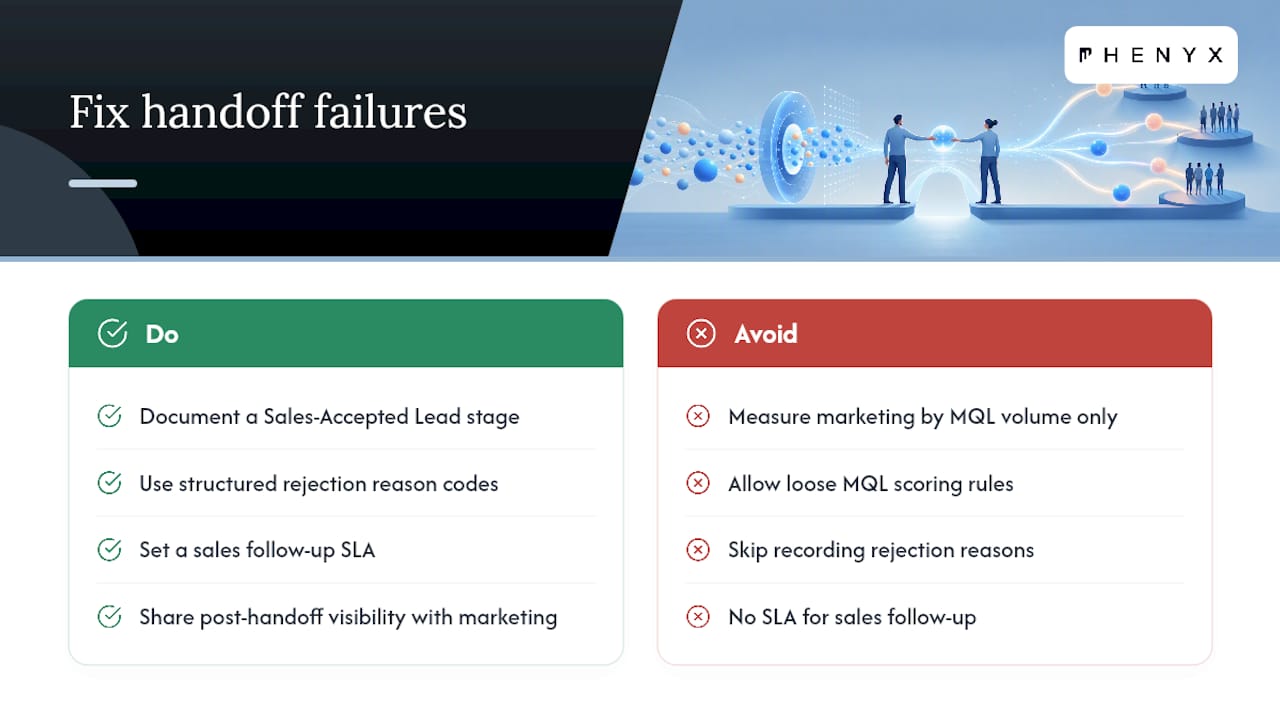
The most common failure modes are structural: loose MQL scoring rules that let almost anyone qualify, no service-level agreement for how fast sales has to follow up, and no formal way to record why a lead got rejected. Research on the marketing-sales handoff points to a fix that sounds simple but rarely gets implemented: a documented Sales-Accepted Lead (SAL) stage with structured rejection reason codes, so complaints turn into data instead of finger-pointing.
What Metrics Actually Measure Lead Quality?
You cannot improve what you will not measure, and most teams are tracking the wrong things. Start with these, in roughly this order of priority:
- Sales acceptance rate: the percentage of MQLs sales actually agrees to work. Low acceptance signals a scoring or definition mismatch.
- MQL-to-SQL rate: how many marketing-qualified leads become sales-qualified leads. This is the cleanest early signal of quality.
- Lead-to-opportunity rate: the share of leads that become a real, tracked sales opportunity.
- Opportunity win rate by source: closing rate broken out by channel or campaign, which exposes which sources produce buyers versus browsers.
- Revenue per lead: total closed revenue divided by total leads from a given source or cohort.
- ICP fit rate and time-to-contact: what percentage of leads match your ideal customer profile, and how fast sales reaches them after they convert.
Pro Tip: Calculate revenue per lead by source every quarter, not just by campaign. Sources drift in quality over time, and a channel that performed well in Q1 can quietly degrade by Q3 if the audience or algorithm targeting shifts.
Practical frameworks for measuring lead quality recommend validating any scoring model against actual historical revenue cohorts before trusting it. A model that looks smart on paper but has never been checked against real closed deals is a guess wearing a lab coat.
How Do You Build a Lead Scoring Framework That Actually Predicts Revenue?
A useful scoring model separates the signals that tell you who someone is from the signals that tell you what they’re doing. Fit signals cover firmographics: company size, industry, job title, budget range, geography. Intent signals cover behavior: page visits, content downloads, email engagement, demo requests.
Keep these two layers separate at first, then combine them into tiers, something like “high fit, high intent” versus “high fit, low intent.” A four-layer revenue measurement framework adds a third and fourth layer on top of fit and intent: sales validation (did a human confirm the signals were real) and revenue correlation (did leads in this tier actually close at a meaningfully higher rate).
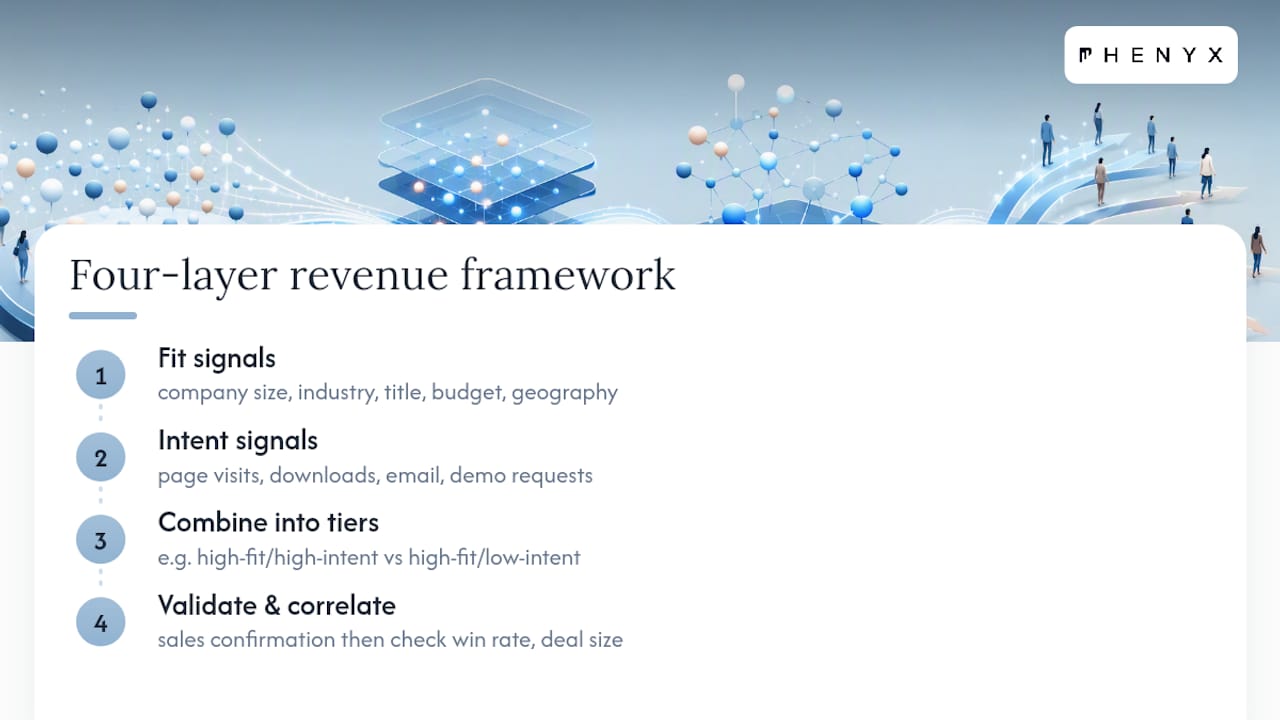
Test the weights using cohort analysis. Pull every lead from the last two quarters, tag them by tier, and check win rate and average deal size per tier. If your “top tier” leads don’t close at a noticeably better rate than your “middle tier” leads, the weights are wrong and need recalibrating. Route top-tier leads to sales immediately; route lower tiers into nurture sequences instead of the phone queue.
How Do You Improve Lead Quality in Practice?
Quality gets built at the point of capture, not fixed after the fact. Work through these in order:
- Validate key fields at capture. Block disposable email domains, require a business email where relevant, and use progressive profiling so you’re not asking for ten fields on a first touch.
- Enrich critical records, but don’t overdo it. Add firmographic and technographic data to fill scoring gaps, but avoid stacking so many form fields or enrichment steps that you tank conversion rates on the landing page itself.
- Recalibrate scoring on a schedule. Seven proven strategies for improving lead quality emphasize aligning qualification rules directly with sales input, not setting them once and forgetting them.
- Use conversion sync to teach your ad platforms. Feeding closed-won and SQL events back into ad platforms as offline conversions helps the algorithm find more people who look like your actual buyers, not just people who click.
- Run conversion rate optimization with ICP-fit offers. A landing page built around a case study relevant to a specific industry will pull in more qualified visitors than a generic “request a demo” page.
Pro Tip: If you run paid campaigns, conversion sync is the single highest-leverage tactic on this list. Platforms optimize toward whatever signal you feed them. Feed them form fills, and you get more form fills. Feed them closed revenue, and the algorithm starts hunting for buyers. A partner guide on lead nurturing strategies covers how to keep lower-tier leads warm without burning sales team time on them prematurely.
How Do You Align Marketing and Sales Operationally?
Most quality problems get solved with unglamorous operational discipline, not clever campaigns. The checklist that resolves the majority of handoff friction:
- Document MQL, Sales-Accepted, and SQL definitions in writing, and enforce them inside your CRM, not just a shared slide deck.
- Add structured rejection reason codes to every lead sales declines: bad fit, bad timing, no budget, wrong contact. Review these weekly as a team.
- Set an SLA for time-to-contact on high-tier leads. Research on lead decay shows response speed matters enormously; a lead that sits untouched for a day is a different lead than one contacted within minutes.
- Assign ownership of scoring recalibration to RevOps, not to whichever team is louder in the current quarter’s blame cycle.
How Do You Report Lead Quality Improvements to Leadership?
Prove improvement with a cohort test: tag every lead’s score at the moment of creation, then track that same cohort through opportunity and closed revenue over the following quarter. This isolates whether your scoring changes actually predicted outcomes, rather than just describing them after the fact.
Calculate revenue per lead and cost per qualified lead for each major source, and build one dashboard that both teams agree is the source of truth. Competing spreadsheets are how sales and marketing end up arguing about numbers instead of strategy.
The PHENYX Perspective on Reducing Lead Noise
Most lead quality problems trace back to friction between vendors: the agency running ads doesn’t talk to the team that built the landing page, and neither talks to whoever owns the CRM. A single in-house team handling site, SEO, and paid media removes those handoff gaps because the same people who see the traffic also see what happens to it after conversion.
Phenyx applies a structured approach to lead scoring and routing as part of its ongoing marketing work, without treating every client’s funnel as a template exercise. The signals worth watching after any engagement: rising MQL-to-SQL rate, tighter time-to-contact, and rejection reasons that shrink instead of pile up.
A Practitioner’s Note on Where Lead Quality Actually Breaks
The pattern shows up almost every time we look closely at a client’s lead flow: data capture is loose, nobody validates fields at the form level, and rejection reasons either don’t exist or get logged as a single vague “not interested” note that helps nobody.
The fix rarely needs to be complicated. A focused starter project, an SLA for time-to-contact, one shared dashboard both teams trust, and a weekly 15-minute review of rejected leads, tends to move MQL-to-SQL rates within a single quarter. The teams that skip this step and jump straight to fancier scoring models almost always end up rebuilding it later anyway.
— PHENYX
Getting Your Lead Quality Fixed, Not Just Reported On
Most agencies hand off a lead-gen campaign and disappear the moment the lead lands in your CRM. Phenyx works differently: the same in-house team that builds your site, runs your SEO and paid campaigns, and designs your conversion pages also watches what happens to those leads after they convert, because eliminating vendor handoffs is the whole point of working with one team instead of five.
If your funnel needs a rebuild rather than a patch, Website Design and conversion-focused SEO & AEO work address quality at the point of capture, while Paid Ads & PPC work applies conversion sync so ad platforms learn to target actual buyers instead of clickers. For teams that want this managed on an ongoing basis, the MODS subscription starts at $4,000 per month and covers this kind of continuous scoring, routing, and reporting work as part of a single retainer. Reach out to talk through where your handoff is actually breaking down.
Sources
- How to improve lead quality: 7 proven strategies
- What Is B2B Lead Quality? A Revenue Measurement Framework
FAQ
What Is the 3-3-3 Rule for Marketing?
Definitions of this rule vary across marketing disciplines, and it is not a standard lead quality benchmark. If you encounter it applied to lead follow-up, treat it as a general reminder to respond fast rather than a fixed formula backed by research.
What Is an MQL and an SQL?
An MQL, or marketing-qualified lead, is someone who has shown enough early engagement (downloads, page visits, email opens) to warrant marketing’s attention. An SQL, or sales-qualified lead, is a lead sales has vetted and accepted as a real opportunity worth pursuing, which is a meaningfully higher bar.
What Is the Role of a Marketing Lead in Lead Quality?
A marketing lead role, in the demand-generation sense, owns the systems that capture, score, and route leads before they ever reach a sales rep. That includes validating form fields, maintaining scoring rules, and reviewing rejection data with sales on a regular cadence.
What Is the Five-Minute Rule for Leads?
The five-minute rule refers to contacting a new lead within roughly five minutes of conversion, based on research showing response speed strongly affects the odds of ever connecting with that lead. Research on lead decay backs the broader principle that speed matters, even where exact timing windows vary by source.
How Do You Evaluate Marketing Leads Without Overcomplicating It?
Start with three numbers: sales acceptance rate, MQL-to-SQL rate, and revenue per lead by source. These three alone will tell you more about real lead quality than a dozen vanity metrics, and they give you a baseline to test any scoring model against.