

Build BOFU Pages First: SEO Lead Generation for SMBs That Converts
Yes, SEO can generate qualified sales leads, but only if you build in the right order. Most businesses write blog posts first and pricing pages last. Flip that. Publish your bottom-of-funnel pages, comparison content, and use-case pages before you chase keyword volume, then wire up attribution so you can prove what’s working. Expect six to twelve months before pipeline feels steady, and model your return rather than waiting for closed revenue to tell the whole story.
TL;DR:
- Prioritize building bottom-of-funnel pages like pricing, comparison, and use-case pages before focusing on keyword volume to accelerate qualified lead generation.
- Use keyword mapping aligned with the buyer’s decision stage, emphasizing commercial intent over search volume to improve conversion potential.
- Ensure technical SEO is optimized with fast mobile speed, proper URL canonicalization, HTTPS, and structured data to prevent technical issues from blocking lead capture.
- Design CTA and forms based on the page’s purpose, offering demos or quotes on decision pages and simple assessments on consideration pages to better qualify leads.
- Model ROI by tracking qualified leads, close rates, and lifetime value over six to twelve months, rather than relying solely on closed revenue.
Table of Contents
- What Is SEO Lead Generation, Exactly?
- Quick Summary
- Which SEO Strategies Actually Generate Qualified Leads?
- How Do You Choose Keywords That Actually Turn Into Leads?
- What Technical SEO Actually Affects Lead Generation?
- How Should You Design Pages to Capture and Qualify Leads?
- How Do You Measure SEO ROI for Lead Generation?
- Why PHENYX Approaches SEO Lead Generation as One Connected System
- SEO or Paid Ads: Which Should You Run First?
- Get an SEO & AEO Plan Built Around Real Pipeline, Not Traffic
- Sources
- FAQ
What Is SEO Lead Generation, Exactly?
SEO lead generation is the practice of using organic search visibility to attract prospects who are actively evaluating a purchase, then converting them into sales-qualified leads through targeted pages and conversion paths. It’s not the same as SEO for traffic. A blog post that ranks for a broad topic might pull in thousands of visitors who never buy anything.
That distinction sits at the center of everything that follows. Search Engine Land’s B2B SEO guide frames this as prioritizing bottom-of-funnel content because it captures buyers closest to purchase and tends to produce pipeline faster than top-of-funnel articles ever will.
Quick Summary
- Publish bottom-of-funnel (BOFU) pages first: pricing, comparisons, vertical and use-case pages.
- Map every target keyword to a buyer stage, and weight intent over search volume.
- Build conversion paths with clear CTAs, and lock first-touch attribution in your CRM before traffic scales.
- Model ROI using qualified leads times close rate times customer lifetime value, not just closed-won totals.
- Budget six to twelve months for organic pipeline to become predictable.
- Run paid ads or outbound alongside SEO to keep pipeline flowing while organic traffic ramps up.
- Treat technical SEO and AI-answer formatting as table stakes, not optional polish.
Which SEO Strategies Actually Generate Qualified Leads?
Most SMBs overinvest in awareness content and underinvest in the pages that actually close business. Here’s the order that works better.
- Build your BOFU pages before anything else. Pricing pages, comparison pages, “alternatives to X” pages, and industry-specific landing pages capture buyers who are days, not months, from a decision. Bemanc’s lead generation blueprint points to these page types plus case studies and conversion-focused landing pages as the direct link between organic traffic and revenue.
- Structure pricing and comparison pages around real buyer questions. Someone searching “[category] pricing” or “[Product A] vs [Product B]” wants specifics: cost ranges, what’s included, and how you differ from the alternative they’re already considering. Vague marketing copy loses these visitors fast.
- Create use-case and vertical pages that speak the buyer’s language. A page titled “SEO for Dental Practices” converts better than a generic services page because the visitor sees themselves in it immediately.
- Build case-study pages tied to specific problems and industries. A page framed as “how we reduced X by Y for [industry]” does double duty: it ranks for consideration-stage searches and gives your sales team something concrete to send prospects.
- Use awareness content as scaffolding, not the destination. Blog posts and guides should exist to funnel authority and readers toward your BOFU pages through internal links and contextual CTAs, not to stand alone as the strategy.
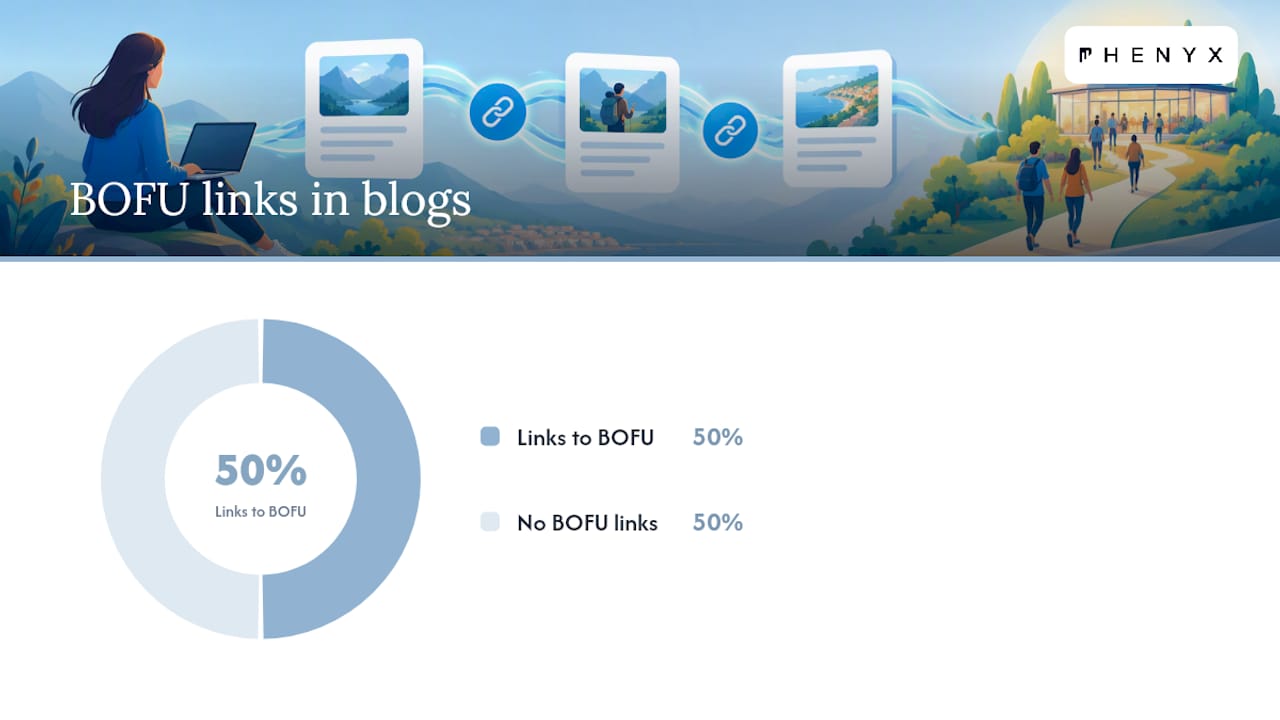
Pro Tip: Audit your last ten blog posts and count how many link to a pricing, comparison, or demo page. If the answer is under half, you’re building traffic without building a path to revenue.
Link-building still matters here. Digital PR, helpful calculators, and partner content remain effective ways to earn the kind of backlinks that lift your BOFU pages in competitive B2B search results, even though they take longer to pay off than the pages themselves.
How Do You Choose Keywords That Actually Turn Into Leads?
Keyword research for lead generation isn’t about finding the biggest search volume. It’s about matching queries to where a buyer actually stands in their decision process.
Break your target keywords into three buckets:
- Awareness stage: broad, informational queries like “what is [problem]” or “signs you need [solution].” Low intent, high volume.
- Consideration stage: comparative and evaluative queries like “[category] tools compared” or “how much does [service] cost.” Medium intent, medium volume.
- Decision stage: specific, commercial queries like “[Your Category] near me,” “[Competitor] alternative,” or “[Service] pricing.” High intent, often lower volume.
Here’s the part that trips up a lot of marketers: a keyword with 40 searches a month and clear purchase intent will usually outperform a keyword with 4,000 searches a month and no commercial signal, once you account for close rate. Before you commit content resources to a keyword, run it through a short checklist: Does the phrasing suggest someone ready to buy? Does it show a cost-per-click high enough to signal advertiser competition (a decent proxy for commercial value)? Does the search results page show comparison sites or product pages, or mostly forums and news? And do you have any historical data connecting a similar query to a closed deal?
Once a keyword clears that bar, assign it a page template. Decision-stage keywords go to comparison or pricing pages. Consideration-stage keywords go to vertical or use-case pages. Awareness-stage keywords feed your blog, which then links downstream.
What Technical SEO Actually Affects Lead Generation?
Technical SEO doesn’t generate leads by itself, but it can quietly kill every lead your content would otherwise earn. A slow, unindexed, or confusingly structured pricing page never gets the chance to convert anyone.
The non-negotiables:
- Mobile page speed fast enough that a buyer researching on their phone doesn’t bounce before your CTA loads.
- One clean, indexable canonical URL per page. Duplicate or competing URLs split your ranking signal.
- HTTPS, clean crawl paths, and no orphaned pages your BOFU content depends on.
- Structured data where it applies, including FAQ schema on pages built to answer buyer questions.
There’s a newer layer worth taking seriously too. Salesforce’s guide to SEO lead generation in the AI era recommends structuring pages with a concise answer sentence right under each heading, short TL;DR blocks, and FAQ schema, all of which increase the odds an AI assistant cites your page when someone asks it a buying question.
Pro Tip: Internal links are a steering wheel, not decoration. Every awareness page should point at least one link toward a BOFU page, so authority and readers both flow toward the pages that actually convert.
How Should You Design Pages to Capture and Qualify Leads?
Match your call to action to the intent of the page, not a generic “contact us” button on everything.
- Decision-stage pages (pricing, comparisons, alternatives) should offer a demo booking or a direct quote request. The visitor is close to ready; don’t make them work for it.
- Consideration-stage pages should offer something lighter: a checklist, calculator, or short assessment that matches the specific problem the page addresses.
- Forms should ask only for what you need right now. Use progressive profiling to gather more detail on later touchpoints instead of front-loading a ten-field form that scares off a first-time visitor.
- Preserve the first-touch UTM and landing page URL in your CRM record. This single field is often the difference between knowing which content actually drove revenue and guessing.
A typical funnel for a decision-stage page looks like this: visitor lands on your comparison page, sees a CTA built for their exact intent, fills a three-field form, and drops into a nurture sequence built around that specific comparison. Nurture sequences matter more than most SEO plans account for, since a lead who isn’t ready today often is ready in sixty days.
How Do You Measure SEO ROI for Lead Generation?
Lock the first organic touch in your CRM the moment a lead converts, before any later integration or manual update has a chance to overwrite it. Join that field to closed revenue on a regular cadence.
To model ROI, take your qualified organic leads, apply your historical close rate, and multiply by average customer lifetime value. Present that modeled figure next to closed revenue, not instead of it. Ahrefs’ guide to SEO ROI notes that GA4’s attribution windows routinely under-count B2B value, since sales cycles frequently outlast the platform’s lookback period.
While revenue catches up, track leading indicators:
- Non-brand impressions on decision and consideration keywords.
- Indexed page count for your BOFU pages specifically.
- Qualified lead volume by page and by keyword stage.
Six to twelve months is the realistic runway before this data tells a clear, repeatable story.
Why PHENYX Approaches SEO Lead Generation as One Connected System
SEO, page design, and conversion tracking rarely work when three separate vendors each own one piece. SEO and AEO, web design, and CRM-facing conversion work can be coordinated under one in-house team, which shortens the loop between “we changed this page” and “we can see if it worked.”
A few things to expect from that kind of engagement:
- A structured approach to prioritizing BOFU pages, keyword mapping, and technical fixes, rather than a generic monthly report.
- Direct coordination between the team building your pages and the team tracking whether they convert.
- Timeline expectations set upfront, generally in the six to twelve month range for organic pipeline to stabilize.
[Client case studies with quantified results and team credentials specific to each engagement are available on request.]
SEO or Paid Ads: Which Should You Run First?
Run both, at different speeds. Paid and outbound cover revenue needs inside the first ninety days and let you test which offers and messaging actually convert. SEO compounds slower, but it lowers your acquisition cost long after the ad spend stops. Scale the paid-tested pages organically once you know they work.
— PHENYX
Get an SEO & AEO Plan Built Around Real Pipeline, Not Traffic
Most agencies hand you a traffic report and call it a strategy. Phenyx builds the BOFU pages, the conversion paths, and the CRM attribution together, so you can see which pages actually produce leads instead of guessing from a rankings’ dashboard. That in-house setup, spanning SEO and AEO, web design, and branding, means one team is accountable for the whole path from search result to sales conversation, not three vendors pointing at each other.
If you want a structured read on where your site stands today, request an SEO & AEO audit or ask about the MODS monthly plan, which covers ongoing SEO, content, and site support without juggling separate vendors. Businesses that need pages rebuilt around buyer intent first can also look at website design services as a starting point. Reach out through the Phenyx site to get a plan scoped to your pipeline goals.
Sources
FAQ
How Do You Generate Leads With SEO?
Build bottom-of-funnel pages like pricing, comparisons, and use-case pages first, since they capture buyers closest to a decision. Then map supporting content and internal links to funnel visitors toward those pages, and track first-touch attribution in your CRM so you can prove which pages produce qualified pipeline.
Is SEO Dead Now That AI Search Exists?
No. AI assistants still pull answers from indexed, well-structured web pages, so ranking and getting cited both depend on the same fundamentals: clear answers, solid technical SEO, and content that matches buyer intent. Pages built with concise answers and FAQ schema tend to show up more often in AI-generated answers, not less.
What Is the 80/20 Rule in SEO?
Prioritizing that smaller set of high-intent pages generally produces faster results than spreading effort evenly across every topic.
Is SEO a High-Paying Skill To Learn or Outsource?
SEO specialists and agencies command real budgets because organic pipeline, once established, tends to have a lower long-term acquisition cost than paid channels. Whether you hire in-house or work with an agency like Phenyx through a service like SEO & AEO, the cost is usually justified by the compounding nature of organic results over time.
How Long Does SEO Take To Generate Reliable Leads?
Most businesses see steady, predictable inbound pipeline within six to twelve months, depending on domain authority and how competitive the market is. Newer domains in competitive niches often sit at the longer end of that range, while sites with existing authority can see results sooner.