


Small Business SEO: A Practical Playbook for 2026
Small business SEO is the practice of making your website and Google Business Profile visible to local, high-intent searchers so you attract qualified leads without paying for every click. The single best first action you can take this week: claim and verify your Google Business Profile. It takes under an hour and puts you on the map, literally, for nearby customers searching right now.
Pro Tip: Before anything else, search your business name on Google. If a GBP listing exists but is unclaimed, that is your highest-priority task. An unclaimed listing can be edited by anyone.
Three actions worth doing in your first week:
These three moves work because they address the two biggest ranking inputs for local businesses: your GBP signals and your site’s technical credibility. Content comes next, but only after Google can find and trust your pages.
Key Takeaways
Small business SEO produces measurable results within three to six months when you prioritize GBP, technical health, and locally targeted content over broad, high-competition keywords.
PointDetailsGBP is your fastest winClaim, verify, and fully populate your Google Business Profile before any other SEO task.Technical health comes firstFix HTTPS, mobile usability, and page speed before publishing new content or chasing links.Three to six months to resultsExpect impressions in weeks, clicks in months, and meaningful conversions near month six.Local links beat volumeFive relevant local links from chambers, press, and partners outperform dozens of low-quality ones.Phenyx accelerates the processPhenyx offers integrated SEO and AEO services for small businesses ready to move faster than DIY allows.
Table of Contents
Quick summary: what this guide covers
Why small business SEO matters more than paid ads
Organic search is the channel that keeps paying after you stop working. Paid ads stop the moment your budget runs out. SEO compounds: a well-optimized page can drive qualified traffic for months or years without additional spend, making it one of the most cost-effective channels available to small businesses, as Investopedia notes in its overview of SEO for small businesses.
What to expect at 30, 90, and 180 days
Realistic timelines matter because unrealistic expectations cause businesses to abandon SEO before it works.
KPIs that actually matter for small businesses
Track these in order of when they appear:
Vanity metrics like domain authority scores are noise at this stage. Focus on what moves revenue.
What should you do first? The 8-item starter checklist
Prioritize by impact-to-effort ratio. Do these in order.
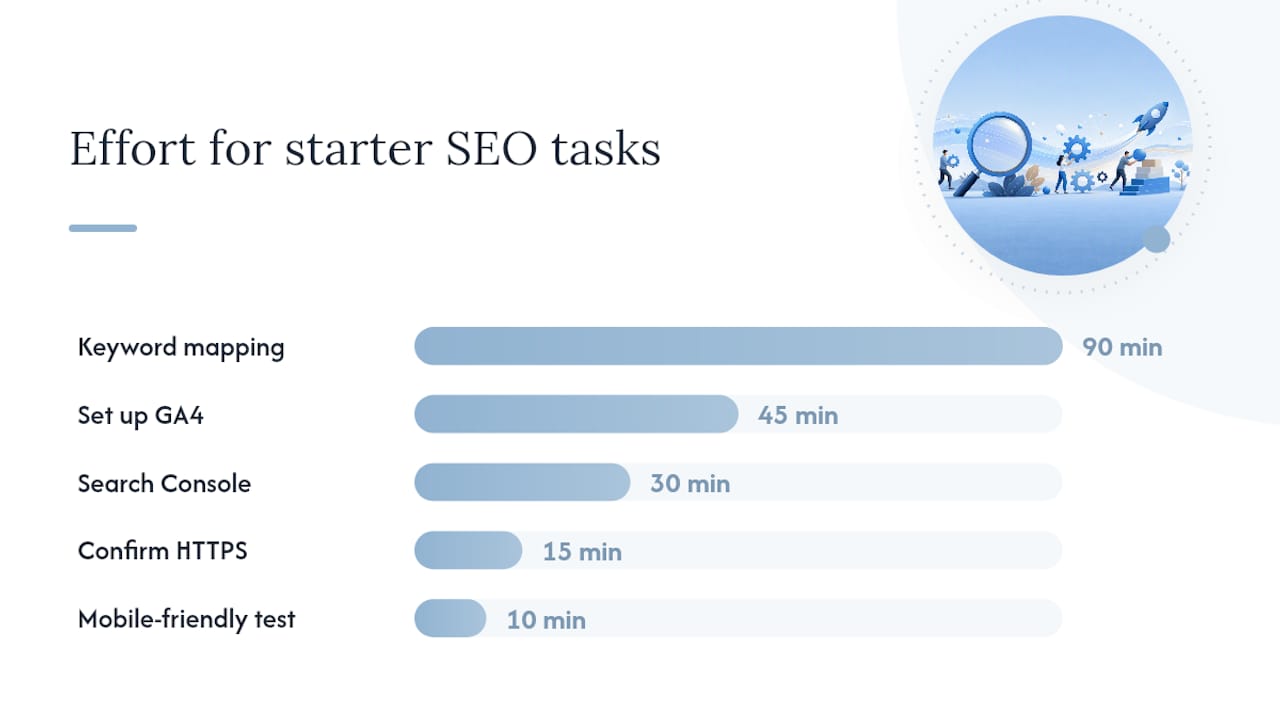
TaskEffortToolFirst Metric to WatchClaim Google Business ProfileLowGoogle Business ProfileDirection requests, callsSet up Search ConsoleLowGoogle Search ConsoleIndexed pages, coverage errorsSet up GA4LowGoogle Analytics (GA4)Organic sessionsConfirm HTTPSVery LowBrowser / host dashboardSecurity statusMobile-friendly testVery LowGoogle Mobile-Friendly TestMobile usability errorsPage speed auditLowPageSpeed InsightsCore Web Vitals scoresKeyword mappingMediumGoogle Keyword PlannerTarget keyword rankingsReview-request processLowGBP review linkReview count, star rating
Pro Tip: If you have fewer than five hours a week for SEO, do only items 1 through 4 in the first month. Depth beats breadth at this stage.
What technical SEO issues are actually blocking your rankings?
Technical SEO is the foundation. Content and links built on a broken site produce weak results. The good news: most small business sites have the same handful of fixable issues.
The core checklist
When to DIY vs. hire a developer
Non-technical owners can handle HTTPS confirmation, sitemap submission, robots.txt review, and image compression. Structured data markup, fixing crawl errors at scale, and Core Web Vitals optimization (especially Cumulative Layout Shift) are worth delegating to a developer or agency. A one-time technical audit from a qualified professional typically costs far less than months of lost rankings. Good website design practices also directly support technical SEO by keeping page structure clean and load times low.
Pro Tip: Use the URL Inspection tool in Search Console to check any individual page. It shows exactly what Google sees, including whether the page is indexed and what canonical URL Google chose.
How do you choose keywords and create content that actually ranks?
Keyword research for small businesses starts with customer language, not industry terminology. The phrase a customer types into Google is rarely the phrase you use to describe your own service.
Finding the right keywords
On-page optimization checklist
Content strategy for small teams
A focused approach beats high volume. Two to four well-researched, locally relevant pieces per month outperform ten thin posts. Prioritize these page types:
A content strategy built around local intent and topical depth, as outlined in Phenyx’s content marketing guide, tends to produce compounding results faster than chasing broad national terms.
How do you win local pack and Google Maps visibility?
Local SEO is where small businesses have a genuine structural advantage over national brands. A local bakery can outrank a national chain for “best bakery in [city]” because Google weights proximity, relevance, and local signals heavily. The playbook, per the Tocayo local SEO checklist, starts with data hygiene and GBP completeness.
Google Business Profile: the fields that matter most
Building review velocity
AI-powered local packs now appear on a significant share of local queries, and review signals are among the strongest inputs influencing which businesses appear. Ask customers for reviews within 24 hours of a positive interaction. Send a direct link to your GBP review page. Encourage them to mention the specific service and location in their review, because that language reinforces your relevance for location-specific queries.
Pro Tip: Create a short, shareable review link using Google’s “Share review form” option in your GBP dashboard. Put it in your email signature, on your receipts, and in your post-service follow-up texts.
Citation consistency and NAP
Your name, address, and phone number must match exactly across every directory: Yelp, Apple Maps, Bing Places, Facebook, and any industry-specific directories. Even minor inconsistencies (abbreviating “Street” as “St.” in one place) can dilute local ranking signals. Use a tool like Whitespark or BrightLocal to audit and correct citations systematically.
Location pages for multi-area businesses
If you serve multiple cities, build a dedicated page for each. Each page needs unique content: local landmarks, specific services offered in that area, and a LocalBusiness schema block with the correct address. Thin location pages with identical copy hurt more than they help. For multi-location context, the franchise SEO principles that apply to larger networks translate directly to service-area businesses.
What link-building tactics work on a small budget?
Links from other websites signal authority to Google. For small businesses, the goal is not volume. It is relevance and locality.
Where to find local links
How to pitch for a link
Keep outreach short. One paragraph: who you are, what you offer their audience, and what you are asking for. Attach a useful asset, a guide, a discount for their members, or a quote for their article. Relevance to their audience is the only thing that matters.
What not to do
How do you measure SEO progress and know what to fix next?
The minimum measurement stack for a small business is Google Search Console and GA4. Both are free, and together they cover the full picture from impressions to conversions.
Tool setup in three steps
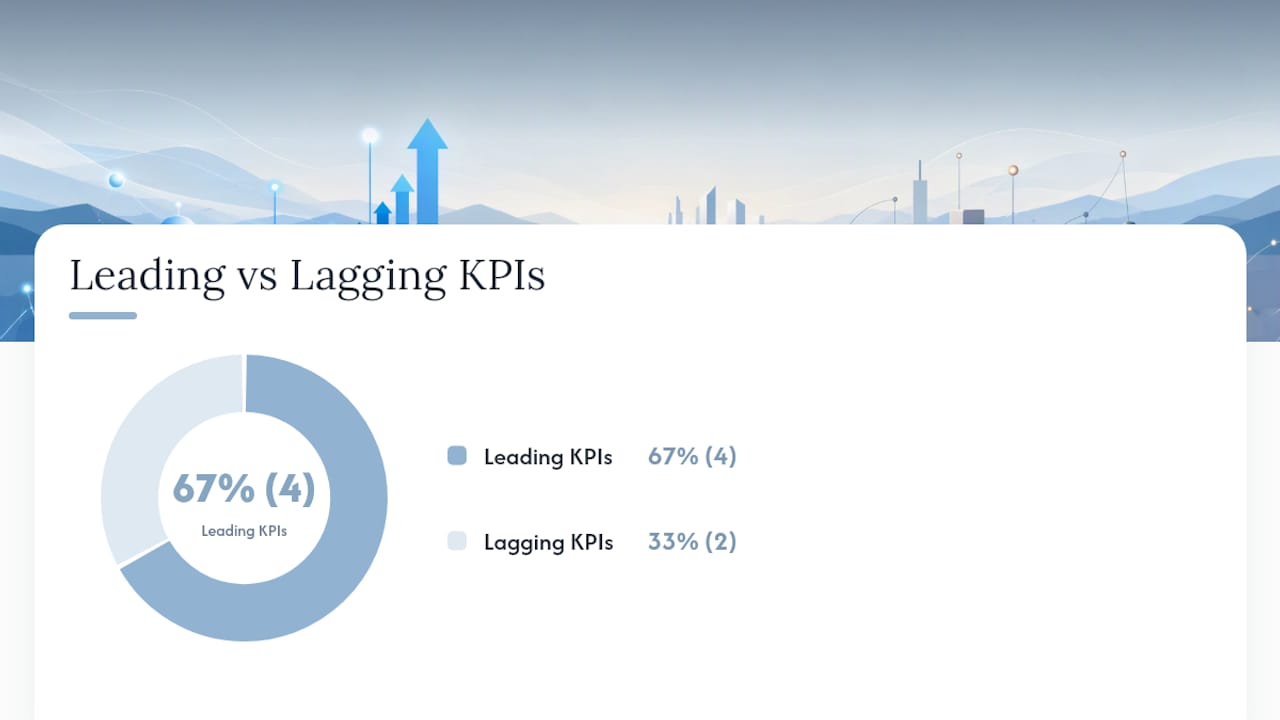
KPI table: leading vs. lagging indicators
KPITypeToolCheck FrequencyImpressions and average positionLeadingSearch ConsoleWeeklyClick-through rateLeadingSearch ConsoleWeeklyOrganic sessionsLeadingGA4WeeklyPhone calls from GBPLeadingGBP InsightsWeeklyForm submissions from organicLaggingGA4MonthlyRevenue from organicLaggingGA4Monthly
Weekly and monthly routines
Weekly: open Search Console, check for new coverage errors, review which queries gained or lost impressions. Monthly: compare organic sessions and conversions month-over-month in GA4, review GBP Insights for call and direction trends, and identify one underperforming page to update.
Your 30/90/180-day SEO roadmap
30 days: foundations
Owner: Founder or marketing lead. Time: 3–5 hours total.
90 days: content and links
Owner: Marketing lead or outsourced content writer. Time: 3–4 hours per week.
180 days: scale and refine
Owner: Marketing lead with agency support for technical and link work. Time: 4–6 hours per week.
Pro Tip: Pick one task from the 30-day list and complete it before you close this tab. Momentum matters more than a perfect plan.
When should you DIY vs. hire an agency?
DIY SEO is genuinely viable for small businesses with time, patience, and a willingness to learn. The tools are free, the fundamentals are learnable, and the seven-pillar approach (technical, keyword research, on-page, content, local SEO, backlinks, tracking) can be managed in three to five hours per week by a dedicated founder or marketing lead.
The calculus shifts when time becomes the constraint. If your hourly value as a founder exceeds what an agency charges per hour of output, delegation pays. Agency help also makes sense when you need technical work (structured data, Core Web Vitals fixes, site architecture), consistent content production, or a link-building program that requires ongoing relationship management.
What agencies handle well: technical audits, content strategy and production, local citation cleanup, link outreach, and reporting. What you must own internally: your brand voice, your customer knowledge, and your review-generation process. No agency can replicate the authenticity of a business owner asking a satisfied customer for a review.
When evaluating agency partners, look for transparency on deliverables, realistic timelines, and a clear reporting cadence. Understanding common complaints about local SEO companies before you sign a contract helps you ask the right questions and set appropriate expectations. The advantages of working with a local SEO company are real, but only when the agency is accountable to measurable outcomes.
Phenyx helps small businesses rank faster
Ranking on Google takes a clear strategy, consistent execution, and the technical depth to fix what is actually holding your site back. Phenyx is a full-service marketing agency built for exactly this: small and midsize businesses that need SEO, web design, and content working together as one system, not three separate vendor relationships.
Where most agencies hand you a report, Phenyx delivers execution. The in-house team handles technical audits, on-page optimization, local citation cleanup, structured data implementation, and content production under one roof, with a single point of accountability. If your site needs a rebuild alongside the SEO work, the website design services and SEO and AEO services are designed to work together from day one.
Ready to stop guessing and start ranking? Contact Phenyx for a no-pressure strategy conversation and find out what a structured SEO approach looks like for your business.
Sources
FAQ
How long does small business SEO take to show results?
Most sites see measurable progress within three to six months, with meaningful conversion improvements often appearing near month six, according to Shopify’s SEO timeline guidance. Timelines vary based on competition, domain history, and how consistently you execute.
What is the most important first step in local SEO?
Claiming and fully populating your Google Business Profile is the highest-impact first step. Complete profiles with accurate categories, photos, and consistent NAP data are far more likely to appear in the local pack and Google Maps results.
Do I need to hire an agency for small business SEO?
Not necessarily. The core tools (Google Search Console, GA4, Google Business Profile, and Keyword Planner) are free, and a focused owner can make meaningful progress in three to five hours per week. An agency like Phenyx makes sense when time, technical complexity, or the need for consistent content production exceeds what you can manage internally.
What free tools should every small business use for SEO?
The minimum stack is Google Search Console for indexing and query data, GA4 for traffic and conversion tracking, Google Business Profile for local visibility, and Google Keyword Planner for keyword research. All four are free and cover the most important signals at the start of any SEO program.
How does AI affect local search results for small businesses?
AI-powered local packs and AI Overviews now appear on a significant share of local queries, as WordStream’s local SEO research documents. This reduces the number of businesses shown in some results and increases the weight of GBP completeness, review volume, and structured data. Adding LocalBusiness schema and keeping your GBP fully populated are the most direct responses to this shift.