


Win Shortlists in 18–36 Months: Marketing for Oil & Gas Service Firms
Better marketing is the system that earns a buying committee’s trust months before an RFP lands, and that trust is what wins projects. Oil and gas service companies that treat marketing as a lead-generation afterthought lose work to competitors who showed up early with proof. The fix isn’t a bigger ad budget. It’s a trust-first approach built for buying cycles that run 18 to 36 months, not 18 to 36 days.
TL;DR:
- Building technical credibility with proof-based content and trusted experts is essential for shortlisting in long sales cycles.
- Focusing on one primary buyer tier allows companies to develop a strong pipeline before expanding efforts to other segments.
- Account-based marketing, technical case studies, and conference visibility drive trust and influence buying committees over distanced lead metrics.
- Content should be tailored to different decision-makers, such as engineers, operations, and finance, to address their specific proof needs.
- Long-term, discipline-focused marketing and integrated agency support are critical for success amid price volatility and extended buying timelines.
Table of Contents
- Improving Service Company Visibility Through Trust-First Marketing
- Quick Summary
- How Buying Committees Shape Marketing Needs in Oil and Gas
- The Marketing Challenges Holding Oil and Gas Companies Back
- Strategic Principles for Effective Oil and Gas Marketing Strategies
- Tactical Playbook: Content and Channels That Build Shortlist Inclusion
- Measuring Marketing ROI and Setting a Realistic Budget
- How Phenyx Approaches Marketing for Oil and Gas Service Companies
- A 90-Day Starting Checklist
- What the Data Actually Tells Us About Oil and Gas Marketing
- Get a Marketing Partner Built for Long Sales Cycles
- Sources
Improving Service Company Visibility Through Trust-First Marketing
Most oil and gas service companies don’t lose bids on price. They lose because the buying committee never trusted them before the RFP existed. Deals in this sector die quietly, months before anyone submits a proposal, because the vendor never built credibility with the technical evaluators who quietly narrow the field long before procurement gets involved.
That’s the real answer to why oil and gas service companies need better marketing: visibility and trust have to exist before the formal buying process starts. Shortlist inclusion often gets decided a year or more before a purchase order is signed. If your name isn’t already circulating among engineers and operations managers by then, you’re not being excluded. You were never in the running.
This is also why short-term lead metrics mislead marketing teams in this sector. A lead that converts in 30 days is common in retail or SaaS. In oilfield services, the sales cycle for major equipment or integrated projects can run years. Marketing that chases quick conversions optimizes for the wrong outcome and starves the long-cycle content that actually builds the trust buyers need.
Done right, marketing also reduces procurement friction. When technical evaluators already understand your reliability data and case history, procurement teams spend less time vetting and negotiating. That protects margin, especially when commodity price swings make every dollar of the deal matter more.
Quick Summary
- Trust-first evidence, not slogans, is what actually moves oil and gas buyers toward a shortlist.
- Pick one buyer tier (E&P, oilfield services, or equipment/chemical) and focus there before expanding.
- Combine account-based marketing, LinkedIn thought leadership, conference presence, and answer-engine optimization to control shortlist signals.
- Track shortlist inclusions and named-account meetings booked, not raw lead volume.
- Budget 2 to 4% of revenue for growth-stage service firms, trimming toward 1.5 to 2.5% in downturns.
- Start with one technical case study and one named-expert LinkedIn presence before scaling anything else.
- Sales and marketing need shared definitions of a qualified opportunity, or the whole system breaks down.
How Buying Committees Shape Marketing Needs in Oil and Gas
Oilfield purchases rarely have one decision-maker. A drilling equipment deal might involve an engineer evaluating specs, an operations manager weighing field reliability, a procurement lead comparing total cost, and a finance director signing off on capital exposure. Each of these people wants different proof, and generic marketing that speaks to none of them specifically speaks to no one.
Buying horizons also scale with ticket size:
- Consumables and routine parts: short periods, often driven by existing vendor relationships.
- Mid-ticket services and repairs: several months, with procurement comparing multiple vendors.
- Major equipment purchases: many months, involving engineering review and budget cycles.
- Integrated projects and long-term contracts: extended cycles, requiring trust across the entire committee.
Marketing built for a single audience, usually the procurement contact, ignores the engineer who vetoes based on technical risk and the finance lead who kills deals over unclear ROI. Content has to map to each role: technical data sheets for engineers, uptime and reliability numbers for operations, total cost of ownership breakdowns for finance.
The Marketing Challenges Holding Oil and Gas Companies Back
Engineering-driven cultures often treat marketing as decoration rather than infrastructure. That mindset shows up as thin websites, outdated case studies, and a total absence from LinkedIn, even though the buyers doing early research are on it daily.
Sales and marketing misalignment compounds the problem. Marketing counts a form fill as a win. Sales knows that form fill will never convert because the person filling it out isn’t near a purchase decision. Without shared definitions of what counts as a qualified opportunity, both teams optimize for numbers that don’t matter.
Budget volatility tied to oil prices makes long-term planning harder still:
- Marketing spend gets cut first when commodity prices drop, even though that’s when compounding content matters most.
- Scenario-based budgeting, planning for both high and low price environments in advance, prevents panic cuts that erase months of authority-building work.
- Leadership teams that treat marketing as discretionary rather than structural rarely see it recover between cycles.
Strategic Principles for Effective Oil and Gas Marketing Strategies
Get the strategy right and the tactics follow. Get it wrong, and no amount of content volume will fix it. Four principles should govern every oil and gas marketing plan:
- Treat trust as a measurable system, not a vibe. Publish evidence. Align sales messaging with marketing messaging. Show up in front of technical buyers before they’ve started formally evaluating vendors.
- Prioritize generative and answer-engine optimization now. Senior technical buyers increasingly start research with tools like ChatGPT and Perplexity, which means your technical content needs to be structured so those tools can find and cite it during shortlist formation.
The common thread across all four: authority compounds. Named technical experts publishing under their own byline, original field data, conference visibility, and trade press coverage build credibility that takes multiple months to mature but keeps paying off long after that. That timeline is uncomfortable for teams used to quarterly reporting, but it matches how oil and gas buyers actually make decisions.
Pro Tip: Pick the one buyer tier where you already have the strongest reference customers, and build your first 90 days of content entirely around proving results for that tier. Trying to speak to E&P, OFS, and equipment buyers simultaneously with the same content dilutes all three.
Tactical Playbook: Content and Channels That Build Shortlist Inclusion
Strategy sets the direction. These are the specific moves that put it into practice.
Start with proof-driven content. Technical white papers built on original field data, pilot reports, MTBF and reliability data sheets, and procurement-ready evidence packets give engineers and procurement teams exactly what they need to advance you internally without a sales call. Oil and gas buyers are risk-first and proof-driven, which means generic marketing copy simply doesn’t move them.
Layer in visibility channels that match how buyers actually research:
- LinkedIn thought leadership published under named technical experts, not a faceless company account.
- Targeted account-based paid campaigns on LinkedIn aimed at named committee members.
- A steady conference cadence: speak, publish the talk as content, then amplify it across channels.
- Trade press placements that lend third-party credibility your own website can’t replicate alone.
On the operations side, set up account-based attribution so marketing can trace which content touches influenced a specific account’s movement through the pipeline. Build content templates with GEO/AEO structure in mind (clear headings, direct answers, structured data) and connect everything to your CRM so sales sees the same account history marketing does.
Pro Tip: Before you write a single new blog post, audit your last five closed deals and ask what content or conversation earned trust months before the RFP. That’s usually your best template for what to build next.
Measuring Marketing ROI and Setting a Realistic Budget
Raw lead counts are close to meaningless in this sector. What matters is shortlist inclusion and meeting bookings with named accounts, plus pipeline-influenced attribution and pilot-to-contract conversion rates.
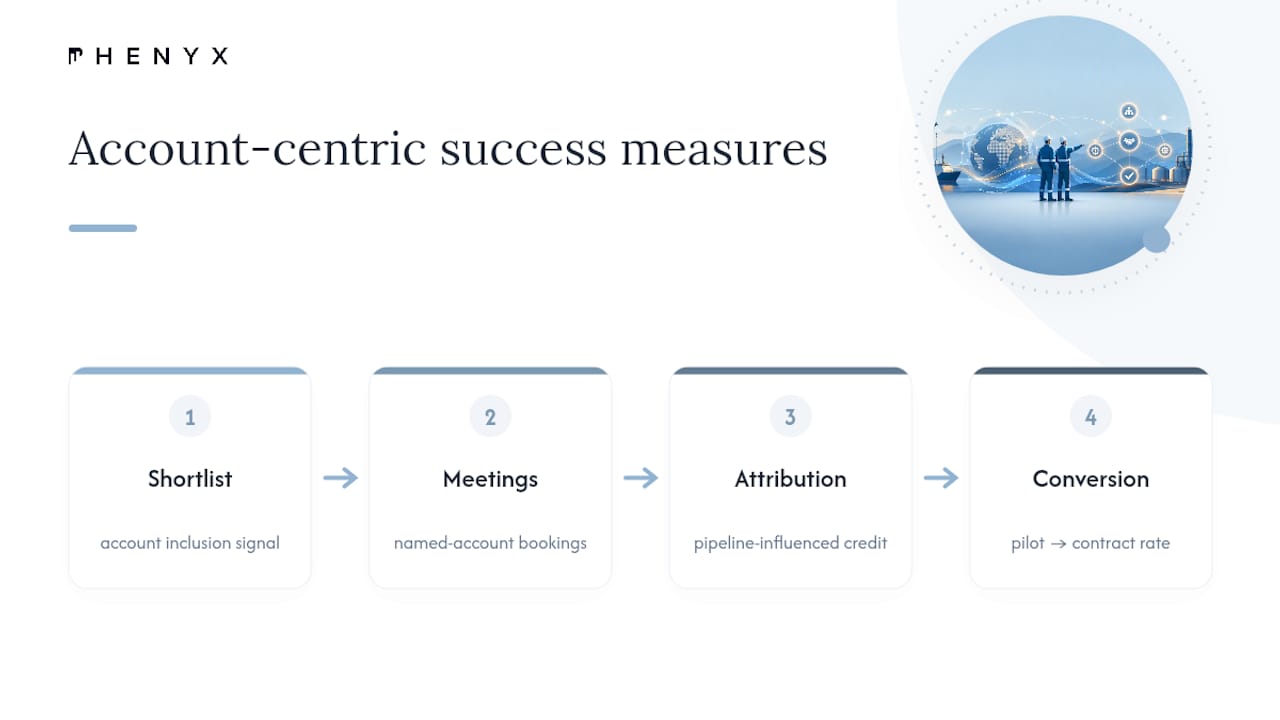
When commodity prices compress and budgets tighten, the smarter move is trimming toward 1.5 to 2.5% and shifting spend away from paid media and events toward compounding content assets like technical case studies and LinkedIn authority building, which keep paying off after the budget cut.
Measurement should be account-centric rather than campaign-centric. Connect every content touch to a specific account’s engagement history, and credit the long-form pieces and expert content that actually moved the account toward a meeting, not just the last click before a form fill. This is also where aligning sales and marketing around shared pipeline definitions makes the numbers meaningful to both teams instead of a point of ongoing disagreement.
How Phenyx Approaches Marketing for Oil and Gas Service Companies
An integrated agency structure fits this playbook better than piecing it together across five vendors. Website work, SEO and AEO, video production, and branding all need to point at the same trust-building goal, and that only happens when one team is accountable for the whole system instead of handing pieces off between agencies.
Video production turns pilot results and technical data into the kind of evidence engineers actually trust. Brand authority work ties your visual identity and messaging together so a procurement lead sees the same credible story whether they’re on your site, LinkedIn, or a conference booth. Structured SEO and AEO work makes sure your technical content actually surfaces when a buyer’s research starts with an AI search tool. An in-house team means fewer handoffs and faster execution on work that already takes 18 to 36 months to pay off.
A 90-Day Starting Checklist
You don’t need a full rebrand to start. You need a focused first move.
- Select your primary buyer tier (E&P, OFS, or equipment/chemical) and identify three named target accounts within it.
- Produce one technical case study with measurable outcomes and publish one LinkedIn post from a named technical expert on your team.
- Build a procurement-ready evidence packet (reliability data, pilot results, references) and set up shortlist tracking in your CRM.
Ninety days won’t finish the job. It will tell you fast whether your current content and channels are actually built for how this sector buys.
What the Data Actually Tells Us About Oil and Gas Marketing
The conventional advice in this sector treats marketing like a lighter version of general B2B marketing: more leads, better landing pages, a few more emails in the nurture sequence. That advice misses the actual mechanism at work. Trust in oil and gas isn’t built through funnel optimization. It’s built through 18 to 36 months of visible, technical, named-expert proof that reaches the right committee member at the right stage.
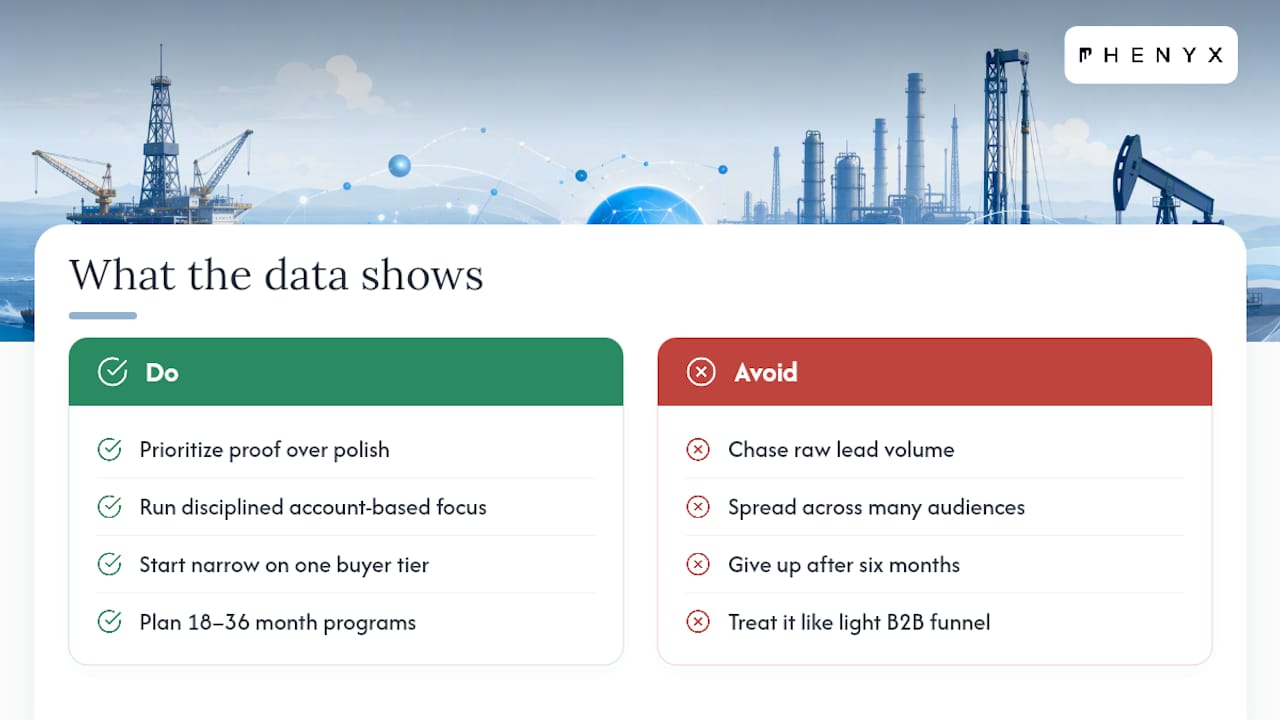
The biggest overrated tactic is chasing lead volume. The biggest underrated one is disciplined account-based focus on a single buyer tier long enough for authority to actually compound. Most service companies spread too thin across audiences and give up on content programs after six months, right before they’d have started working.
If you take one thing from this, prioritize proof over polish. A rough case study with real field numbers will out-perform a beautifully designed page with vague claims, every time, in this sector. Start narrow, measure the right things, and give it the time buying committees actually need.
— PHENYX
Get a Marketing Partner Built for Long Sales Cycles
Phenyx is the alternative to juggling separate SEO, video, and web vendors for a marketing program that needs 18 to 36 months of consistent execution to work. Instead of coordinating handoffs between agencies, you get one in-house team building your case studies, your website, and your search visibility around the same trust-building goal.
Our SEO and AEO services are built specifically to help technical content surface when buyers research with AI search tools, and our video production team turns pilot results into the evidence engineers actually trust. If your current site can’t carry the technical proof this sector’s buyers need, take a look at our website redesign work and reach out to talk through what a 90-day starting plan would look like for your team.
Sources
- Oil & Gas Doesn’t Have a Marketing Problem. It Has a Trust Problem. - OGGN
- Oil & Gas Marketing: How to Market to Energy Buyers | ModalPoint

