

6 Step Brand Messaging Framework Marketers Can Build With Voice Rules
A brand messaging framework is a concise structure that defines who you talk to, what you say, and how you prove it, so every team communicates consistently and converts better. It replaces guesswork with a shared reference point, turning scattered taglines and inconsistent pitches into one coherent story. The sections ahead walk through the components, a six-step build process, and templates you can put to work right away.
TL;DR:
- A messaging framework requires thorough audience research and a clear positioning statement to ensure consistency across all channels and campaigns.
- Building 3 to 5 tailored messaging pillars, along with voice and tone guidelines, helps align team communication with specific audience needs.
- Operationalizing the framework involves assigning ownership, embedding it into workflows, and regularly reviewing performance to adapt to market changes.
- A simple messaging matrix with audience segments, pillars, proof points, and adaptable examples enables teams to deliver coherent messages across website, email, and social media.
- Frequent mistakes include treating messaging solely as writing, skipping customer interviews, and neglecting ongoing updates, which undermine effectiveness and credibility.
Table of Contents
- Quick summary: key takeaways and first actions
- What brand messaging is and why a framework matters
- Key components every brand messaging framework must include
- A 6-step process to build your messaging framework
- Templates and examples you can adapt today
- How to operationalize the framework across teams
- Measuring messaging performance and knowing when to update
- How we put messaging frameworks to work
- Practitioner perspective: common pitfalls and quick fixes
- Ready to put a messaging framework to work
- FAQ
- Sources
Quick summary: key takeaways and first actions
- Start with focused audience research before writing a single line of messaging.
- Write a positioning statement that names your category, audience, and primary benefit.
- Build 3 to 5 messaging pillars, each tied to a specific audience need.
- Set voice and tone rules that flex by channel without losing your core identity.
- Create a messaging matrix template so writers and sales reps apply the framework the same way.
- Assign an owner and an approver so messaging stays consistent as teams grow.
- Review performance quarterly and update the framework when the market or product shifts.
What brand messaging is and why a framework matters
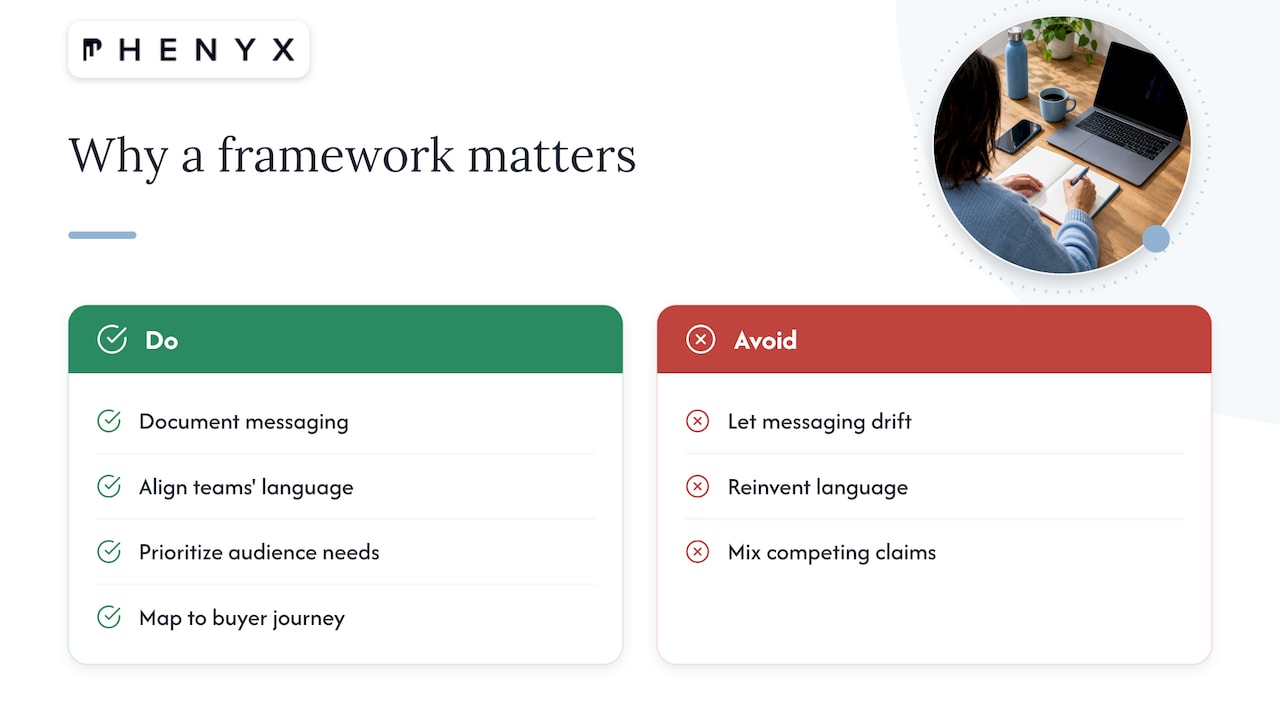
Brand messaging is the language you use to express who you are and what you offer. It sits downstream of positioning (your strategic place in the market) and identity (your visual and verbal personality), translating both into the words customers actually read and hear. Without a framework, messaging drifts: one team emphasizes speed, another emphasizes price, and customers get a blurred picture.
A documented framework prevents that drift and saves real time, since teams stop reinventing language for every campaign, email, and sales deck.
A high majority of top-performing B2B content marketers prioritize audience informational needs over promotional pitches, and 45% of B2B marketers say aligning content with the buyer’s journey is a primary challenge, according to Content Marketing Institute’s 2025 benchmark research. A messaging framework gives teams the shared structure needed to close that alignment gap.
Key components every brand messaging framework must include
A workable framework is not a mood board or a slogan. It is a working document with specific, reusable parts that content creators, salespeople, and partners can all pull from.
- Positioning statement and reasons to believe: a single paragraph naming your category, audience, and core benefit, backed by concrete proof points.
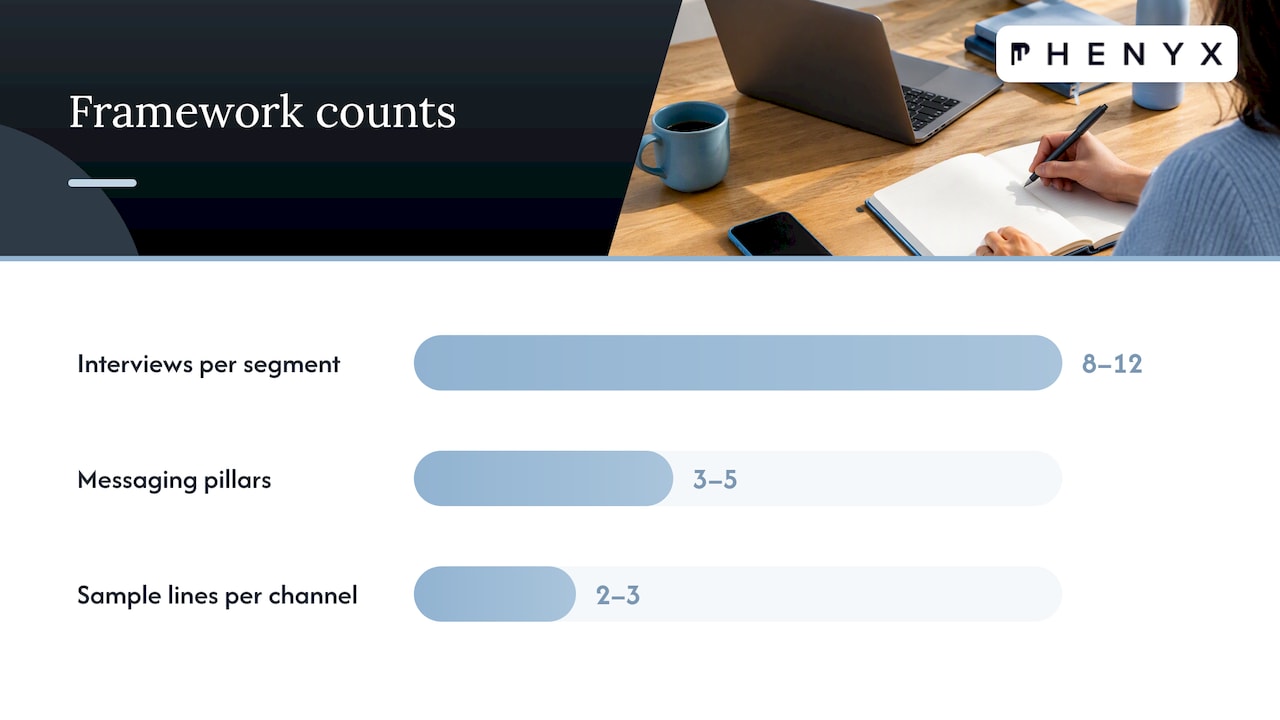
- Messaging pillars: 3 to 5 themes tied to major audience segments or jobs to be done, each defensible on its own.
- Audience definitions: prioritized personas with their own language, pain points, and priorities, so pillars map to real people rather than abstractions.
- Voice and tone guidelines: rules for how your brand sounds, with explicit modulation by channel.
- Proof points and usage guidance: data, case studies, and credentials mapped to the claims they support, plus notes on when to use each one.
Voice deserves special attention because it is more measurable than most teams assume. Research into the lexicogrammatical features of marketing-effective brands shows that pronoun choice, sentence complexity, and active versus passive construction are concrete levers, and that brands which adjust these features by channel see stronger engagement. That means your tone guide should specify, in plain terms, how a social post differs from a sales email, not just that both should sound “friendly.”
A 6-step process to build your messaging framework
Building a framework is a sequence, not a single workshop. Each step produces a deliverable the next step depends on.
- Conduct audience research. Interview 8 to 12 customers and prospects per major segment, asking what problem they were solving, what almost stopped them from buying, and how they would describe you to a colleague.
- Draft a positioning statement. Use a simple format: for [audience], [brand] is the [category] that [key benefit], because [reason to believe]. Keep it to one paragraph.
- Define 3 to 5 messaging pillars. For each pillar, write a one-line summary customized to the audience it serves, so a pillar about reliability reads differently for an enterprise buyer than for a small business owner.
- Create voice and tone examples for priority channels. Write two or three sample lines each for your website, a sales email, and social media, showing the same idea adjusted in formality and sentence length.
- Produce template assets. Build a messaging matrix and share it with content creators and sales so everyone pulls from the same source instead of improvising.
- Roll out, train, and set up feedback loops. Introduce the framework in a working session, embed it in content briefs, and schedule a short review after 90 days to see what is and is not landing.
Pro Tip: Pressure-test your positioning statement by reading it out loud to someone outside your industry. If they cannot repeat the core benefit back to you, it is not sharp enough yet.
Our internal marketing strategy playbook covers how this sequence fits into broader planning if you are building messaging alongside a full strategy refresh rather than on its own.
Templates and examples you can adapt today
The fastest way to operationalize a framework is a single reference table that writers and sales reps check before producing anything new.
A basic messaging matrix includes four columns: audience segment, the pillar that applies, a one-line elevator pitch, and the proof point that backs it up. This structure turns a positioning statement into a repeatable decision layer that teams can apply without reinventing language each time.
A few short examples show how one pillar flexes across channels:
- Website headline: “Built for teams that can’t afford downtime.”
- Sales email opener: “Most teams we work with switched after one too many outages cost them a client.”
- Social post: “Downtime is expensive. Here’s how we help teams avoid it.”
- Elevator pitch: “We help operations teams keep systems running so outages stop costing them customers.”
To adapt these across multiple product lines, keep the pillar constant and swap only the proof point and the specific pain referenced, so the underlying promise never contradicts itself from one line of business to the next.
How to operationalize the framework across teams
A framework that lives in a slide deck gets ignored within a quarter. Operationalizing it means assigning clear roles and building it into daily workflows.
- Owner: typically a brand or marketing lead who maintains the document and approves major changes.
- Approver: a senior marketing or communications leader who signs off on new pillars or positioning shifts.
- Content steward: whoever reviews briefs and drafts for consistency before publication.
Train new hires on the framework during onboarding, not as an afterthought months later. Embed the messaging matrix directly into content brief templates in your CMS so writers see the relevant pillar and proof point before they start drafting, and run a quarterly audit of published content to catch drift early.
Measuring messaging performance and knowing when to update
Track a small set of indicators rather than everything at once: message recall in customer surveys, click-through rate on messaging-led headlines, conversion lift after a pillar-led page update, and qualitative sales feedback on which lines actually land in conversation.
Run simple A/B tests, such as swapping a formal tone for a conversational one on a landing page headline, or testing a benefit-led CTA against a feature-led one, and give each test enough traffic to reach a clear result before calling it.
Content marketing remains a primary driver of brand awareness and demand generation, so messaging performance should be reviewed alongside content and demand metrics rather than in isolation. Review the framework quarterly, and treat a product launch, a new competitor claim, or a shift in buyer language as a trigger for an earlier rewrite.
How we put messaging frameworks to work
Messaging frameworks are often built as part of branding engagements, pairing positioning and pillar work with the website design, content, and campaigns that put that language in front of customers. Because research, writing, and design are integrated, the framework handed off tends to get used consistently instead of sitting in a shared drive.
- The process starts with audience research and positioning work, scaled to the client’s market.
- Voice and tone guidelines are incorporated directly into content briefs used by writers and designers.
- Messaging performance is tracked alongside broader campaign metrics reported to clients.
A small business testing its own voice internally can often run steps 1 through 4 without outside help. Once a framework needs to be rolled out across a website, paid campaigns, and ongoing content at the same time, bringing in a team that handles all of those pieces together tends to save the back-and-forth that comes with juggling separate vendors.
Practitioner perspective: common pitfalls and quick fixes
The most common failure is treating messaging as a writing exercise instead of a research-backed decision tool, which enterprise content marketing research points to as a recurring gap. Other frequent missteps: skipping customer interviews, writing pillars with no audience attached, and letting the framework sit unused after launch.
Pro Tip: In the first 30 days, finish research and draft positioning. In the next 30, build pillars, voice examples, and the matrix, then train your team before calling the rollout done.
— PHENYX
Ready to put a messaging framework to work
If your team needs a messaging framework built and actually implemented, not just written and filed away, our branding team handles positioning, pillars, and voice guidelines as part of a full brand engagement. We also fold that messaging directly into website design projects so it shows up where customers actually read it, and into ongoing content and campaigns through our MODS marketing subscription for teams that want continuous execution rather than a one-time handoff.
A discovery call can help determine whether a standalone branding project or an ongoing marketing engagement fits your timeline and budget better. Reach out and we will walk through what a framework build would look like for your team.
For teams that want to keep content moving at scale once the framework is live, BabyLoveGrowth’s guide on brand consistency covers tools for maintaining that consistency across a high volume of published content.
FAQ
What are the three C’s of brand messaging?
Definitions vary, but a common version refers to clarity, consistency, and credibility: messaging that is easy to understand, repeated the same way across channels, and backed by real proof points. These three qualities show up throughout the components covered above, particularly in positioning statements and reasons to believe.
How is brand messaging different from brand positioning?
Positioning is the strategic place you claim in the market relative to competitors, while messaging is the actual language you use to communicate that position to customers. A framework translates positioning into pillars, voice rules, and copy that teams can use every day.
How often should we update our messaging framework?
Review performance quarterly and treat major triggers, such as a product launch, a new competitive claim, or a shift in how customers describe their problems, as reasons to update sooner. Messaging works best as a living document rather than a one-time deliverable.
Who should own the messaging framework inside a company?
A brand or marketing lead typically owns the document and keeps it current, with a senior marketing leader approving major changes like new pillars or a repositioned value proposition. A content steward usually reviews day-to-day drafts to catch drift before publication.
Do small businesses need a formal messaging framework?
Yes, even a simple one-page version helps a small team stay consistent across a website, social posts, and sales conversations. The research, positioning, and pillar steps scale down easily for a smaller audience base without losing their value.
Sources
- B2B Content Marketing: 2025 Benchmarks & Trends
- Dimensions of Language in Marketing-Effective Brands: A Lexicogrammatical Exploration