


Marketing Strategy Frameworks: A Practical Playbook
A marketing strategy framework is a repeatable structure that converts business goals into prioritized marketing decisions. Think of it as the scaffolding before the building: the American Marketing Association describes it as the blueprint for planning, executing, and analyzing marketing activity, distinct from the strategy itself, which is the specific execution inside that blueprint. The fastest way to start: run a diagnostic (SWOT or Porter’s Five Forces), feed those findings into a GSTIC-style plan (Goal, Strategy, Tactics, Implementation, Controls), and commit to a 90-day sprint with named owners and measurable KPIs. Your immediate next step is a 90-minute workshop where you document a one-page strategy before touching any channel.
Key Takeaways
The most effective marketing strategy framework approach pairs a diagnostic model with an execution framework, then locks in Controls before any campaign goes live.
| Point | Details |
|---|---|
| Framework before strategy | Agree on the organizing structure (e.g., STP, GSTIC) before making channel or budget decisions. |
| Design Controls first | Write if/then reallocation rules in the same session where you set Goals, not after results disappoint. |
| 90-day sprint cadence | Assign named owners to three to five bets; review weekly signals, make monthly decisions, check strategy quarterly. |
| Match framework to goal | Use Porter/SWOT for diagnosis, STP for targeting, GSTIC for execution, AARRR/CLV for growth optimization. |
| Phenyx as execution partner | Phenyx delivers strategy workshops, web design, SEO/AEO, and video production as a unified in-house team. |
Table of Contents
- Quick Summary
- What is a marketing framework, and how does it differ from a strategy?
- The top marketing frameworks you should know
- How do you choose the right framework for your situation?
- How to run a framework workshop inside your organization
- Which KPIs should you track, and how often?
- Common mistakes teams make when adopting a framework
- One-page templates and three micro-examples you can use now
- How Phenyx applies marketing frameworks in practice
- When does hiring an agency make more sense than doing it in-house?
- Phenyx can help you go from framework to execution
- Sources
Quick Summary
- A marketing strategy framework provides structure; the strategy is what you decide inside that structure.
- The recommended starter sequence: diagnostic framework (SWOT, Porter’s Five Forces, or 5 Cs) followed by GSTIC for execution planning.
- Forrester’s 1-2-3 model layers business, brand, and growth strategy and includes workshop tools to close a strategy deficit.
- A complete strategy connects objectives, audience segmentation, positioning, channels, budget, and KPIs, per HubSpot’s research.
- Design your Controls (decision rules for reallocation) before you launch any campaign, not after.
- A 90-day sprint with weekly signals, monthly decisions, and quarterly strategy checks keeps execution honest.
- Phenyx offers strategy workshops, SEO/AEO, web design, and video production as a unified in-house service for growing businesses.
What is a marketing framework, and how does it differ from a strategy?
A marketing framework is a structured set of decision rules and organizing principles that a team applies repeatedly across planning cycles. It is not a campaign, a channel mix, or a content calendar. The framework tells you how to think; the strategy tells you what you decided.
The American Marketing Association puts it plainly: the framework is the blueprint, and the strategy is the execution inside that blueprint. STP (Segmentation, Targeting, Positioning) is a framework. Deciding to target mid-market SaaS companies in the Southeast with a product-led growth motion and a $400K annual budget is a strategy built using STP.
| Dimension | Framework | Strategy |
|---|---|---|
| What it is | Repeatable structure and decision rules | Specific choices made within that structure |
| Time horizon | Durable across planning cycles | Tied to a defined period (quarter, year) |
| Output | Organizing principles and prompts | Audience, positioning, channels, budget, KPIs |
| Example | STP framework | Six-month acquisition plan targeting mid-market SaaS |
| Who owns it | Marketing leadership | Cross-functional team with named owners |
The confusion between the two is where most planning sessions stall. Teams debate tactics when they have not yet agreed on the framework guiding those decisions. Settling the framework first, even in 30 minutes, saves hours downstream.
The top marketing frameworks you should know
Each framework below serves a different job. Match the job to the model, not the other way around.
1. 4Ps / 7Ps (Marketing Mix)
The original marketing mix covers Product, Price, Place, and Promotion. The extended 7Ps adds People, Process, and Physical Evidence, making it more useful for service businesses. Apply it by auditing each P against your current offer, identifying the weakest variable, and redesigning that element first.
Best for: New product launches and pricing reviews. Pro: Forces cross-functional alignment across product, sales, and marketing. Con: Static by nature; it does not model competitive dynamics or customer psychology.
2. AIDA (Awareness, Interest, Desire, Action)
AIDA maps the cognitive stages a buyer moves through before purchasing. Use it to audit whether your content and channel mix actually covers each stage or whether you are over-investing in one phase (usually Awareness) while starving the others.
Best for: Content planning and campaign sequencing. Pro: Simple enough to communicate to non-marketers. Con: Treats the funnel as linear, which rarely matches real buyer behavior.
3. STP (Segmentation, Targeting, Positioning)
Segment your market, select the segment worth winning, and define a positioning statement that makes your offer the obvious choice for that segment. STP is the most common framework for annual planning because it forces explicit trade-offs about who you are not serving.
Best for: Annual planning and brand repositioning. Pro: Creates clarity that cascades into messaging, channel, and budget decisions. Con: Requires solid customer data to segment meaningfully.
4. Ansoff Matrix
Four growth options plotted on a 2x2: Market Penetration (existing product, existing market), Product Development, Market Development, and Diversification. Run through all four quadrants, score each by risk and resource requirement, and select the one that fits your current risk tolerance.
Best for: Growth planning and board-level strategy conversations. Pro: Makes risk explicit and comparable. Con: Does not tell you how to execute the chosen quadrant.
5. Porter’s Five Forces
Harvard Business School’s Five Forces analyzes competitive pressure from five directions: rivalry among existing competitors, threat of new entrants, bargaining power of buyers, bargaining power of suppliers, and threat of substitutes. Run this analysis before selecting any framework, because the competitive structure of your industry should shape every downstream decision.

Best for: Competitive diagnosis before strategy selection. Pro: Reveals structural threats that internal SWOT analysis misses. Con: Time-intensive; requires market-level data, not just internal knowledge.
6. SWOT Analysis
Strengths, Weaknesses, Opportunities, Threats. SWOT is most useful when it feeds directly into another framework rather than sitting as a standalone slide. Pair it with Porter’s Five Forces for external context, then use the combined output to inform your GSTIC decisions.
Best for: Rapid internal diagnosis. Pro: Fast and inclusive; works in a 60-minute workshop. Con: Produces lists, not decisions, unless you force a “so what” step after each quadrant.
7. GSTIC (Goal, Strategy, Tactics, Implementation, Controls)
GSTIC is an execution-first framework that chains five linked decisions: what you are trying to achieve (Goal), how you will compete (Strategy), the specific levers you will pull (Tactics), how you will deliver (Implementation), and the decision rules for reallocation (Controls). The critical, often skipped step is Controls: design the rules for pausing or reallocating budget before you launch, not after results disappoint.
Best for: Translating diagnostic outputs into an executable plan. Pro: Forces specificity at every level; misalignment becomes visible immediately. Con: Requires prior diagnostic work to populate the Goal and Strategy layers meaningfully.
8. AARRR (Pirate Metrics)
Acquisition, Activation, Retention, Referral, Revenue. Dave McClure’s growth framework maps the full customer lifecycle and assigns a metric to each stage. Run a conversion audit across all five stages, identify the stage with the worst drop-off, and direct your next 90-day sprint at that bottleneck.
Best for: Growth-stage companies and product-led growth motions. Pro: Immediately reveals where growth is leaking. Con: Requires instrumented analytics; useless without clean funnel data.
9. Customer Lifetime Value (CLV) Framework
CLV modeling shifts marketing investment decisions from cost-per-acquisition to long-run customer value. Segment customers by predicted CLV, allocate acquisition spend proportionally, and design retention programs for the top segment. This reframes the budget conversation from “how much does a lead cost?” to “how much is a customer worth?”
Best for: Subscription businesses and ecommerce brands with repeat purchase potential. Pro: Aligns marketing spend with actual business economics. Con: Requires transaction history and a reliable predictive model.
10. Value Proposition Canvas
Developed by Alexander Osterwalder, the canvas maps customer jobs, pains, and gains against your product’s features, pain relievers, and gain creators. Use it to stress-test whether your positioning actually addresses what customers care about, or whether it reflects what your team thinks they care about.
Best for: Messaging development and product-market fit validation. Pro: Grounds positioning in customer language. Con: Only as good as the customer research feeding it; skip the interviews and it becomes a guessing exercise.
11. Customer Journey Mapping
A visual representation of every touchpoint a customer has with your brand, from first awareness through post-purchase advocacy. Map the journey in a workshop, mark the moments of highest friction, and prioritize fixes there first. Applying marketing thinking to cross-functional processes like recruiting shows how broadly journey mapping can be used beyond traditional marketing.
Best for: CX improvement and content gap analysis. Pro: Builds empathy across teams and surfaces non-obvious friction points. Con: Can become a large, unwieldy artifact if not scoped tightly.
Combining frameworks: Use Porter’s Five Forces or SWOT for diagnosis, feed those outputs into STP for targeting and positioning decisions, then run GSTIC to convert the strategy into an executable plan with Controls. AARRR and CLV sit alongside GSTIC as measurement lenses, not separate planning exercises.
How do you choose the right framework for your situation?
The right framework depends on four variables: your primary business goal, your time horizon, the data you have available, and your internal execution capacity.
Selection checklist:
- Goal: Are you diagnosing a problem, planning growth, or executing a known strategy? Diagnosis calls for Porter, SWOT, or 5 Cs. Execution calls for GSTIC. Growth optimization calls for AARRR or CLV.
- Time horizon: Quarterly sprints favor GSTIC and AARRR. Annual planning favors STP and Ansoff. Multi-year competitive positioning favors Porter’s Five Forces.
- Available data: Value Proposition Canvas and CLV require customer research and transaction data. SWOT and AIDA work with qualitative inputs alone.
- Internal capability: A two-person marketing team should not attempt Porter’s Five Forces and STP simultaneously. Pick one diagnostic and one execution framework per cycle.
- Risk tolerance: Ansoff’s Diversification quadrant is high-risk; Market Penetration is low-risk. Match the quadrant to your organization’s appetite.
A simple decision flow: if you need to understand your competitive position, start with Porter’s Five Forces. If you need to align your team on who you are targeting and why, use STP. If you have a strategy and need to execute it, use GSTIC. If you need to find where growth is leaking, use AARRR.
Backlinko’s seven-step planning approach reinforces this sequence: start with the primary business goal, work through research and audience definition, then assign owners, channels, and KPIs at the end, not the beginning.
How to run a framework workshop inside your organization
A structured workshop converts framework theory into a one-page strategy your team can act on within a week. Here is a timed agenda that works for teams of four to twelve people.
- Pre-work (sent 48 hours before): Each participant completes a one-page diagnostic: top three business goals, biggest perceived competitive threat, and one customer insight they believe is underweighted in current planning.
- 0:00 to 0:20 — Diagnostic alignment: Share pre-work outputs. Identify the two or three points of genuine disagreement. These are the decisions the workshop must resolve.
- 0:20 to 0:50 — Framework selection: Using the selection checklist above, agree on one diagnostic framework and one execution framework for the current cycle. Document the rationale in one sentence.
- 0:50 to 1:20 — Strategy inputs: Run the chosen diagnostic (e.g., SWOT) as a group. Force a “so what” statement after each quadrant: “Because of this strength, we will…” or “Because of this threat, we will not…”
- 1:20 to 1:50 — GSTIC population: Fill in Goal, Strategy, and Tactics using the diagnostic outputs. Leave Implementation and Controls for the next step.
- 1:50 to 2:10 — Controls design: Agree on the specific signals that will trigger a budget reallocation or a tactical pause. Write these as “if/then” rules before the session ends. This is the step most teams skip, and it is the reason most plans drift.
- 2:10 to 2:30 — 90-day bets and owners: Identify three to five tactical bets for the first 90 days. Assign a named owner and a success metric to each. No owner, no bet.
Deliverables from the workshop: a one-page strategy document, a message hierarchy, a 90-day bet list with owners, and a Controls document.
Pilot timeline: At 30 days, review leading indicators only (traffic, pipeline velocity, engagement rates). At 90 days, make the first resource reallocation decision using the Controls rules. At 180 days, run a full strategy check against the original Goal and decide whether the framework itself needs updating.
Phenyx’s quarterly marketing meeting guide covers operating cadence and agenda design in more detail for teams running recurring strategy reviews.
Which KPIs should you track, and how often?
KPI selection follows framework selection. The framework determines what you are optimizing for; the KPI tells you whether it is working.
- Awareness frameworks (AIDA top-of-funnel): Branded search volume, share of voice, organic impressions, and content engagement rate.
- Acquisition frameworks (AARRR): Cost per acquisition, channel-level conversion rate, and qualified lead volume by source.
- Activation and retention (AARRR, CLV): Onboarding completion rate, 30/60/90-day retention, and net revenue retention.
- Revenue frameworks (CLV, GSTIC): Customer lifetime value by segment, average contract value, and payback period.
Reporting cadence: Weekly signals catch execution problems early (ad spend pacing, content publishing rate, lead volume). Monthly decisions use those signals to reallocate budget or pause underperforming tactics. Quarterly strategy checks compare actual outcomes against the original Goal and update the Controls rules if the market has shifted.
Experiment template: State a hypothesis (“Increasing email frequency from one to two sends per week will raise click-through rate by X% without increasing unsubscribes”), define the minimum detectable effect, set a two-to-four-week runtime, and assign a decision owner who will act on the result regardless of outcome. HubSpot’s marketing strategy research identifies KPIs and measurement cadence as core components of a complete strategy, not optional add-ons.
Forrester’s 1-2-3 model adds a useful lens here: measurement should span all three layers (business, brand, and growth), not just the channel metrics that are easiest to pull from a dashboard.
Common mistakes teams make when adopting a framework
Pitfall 1: Choosing a framework before diagnosing the problem. Teams reach for AARRR because it sounds modern, when their actual problem is a positioning issue that STP would surface in an afternoon. Fix: run a 20-minute diagnostic before selecting any framework.
Pitfall 2: Skipping Controls. GSTIC’s core argument is that most marketing failures stem from misalignment between goals and execution, and that Controls are the mechanism for catching drift early. Designing Controls after a campaign underperforms is too late.
Pitfall 3: Treating the framework as the deliverable. A completed SWOT grid is not a strategy. The “so what” statements and the decisions they produce are the deliverable.
Pitfall 4: No named owner for each bet. A 90-day plan with shared ownership is a plan with no ownership. Every bet needs one person accountable for the result.
Pitfall 5: Measuring too many things. Three to five KPIs per framework cycle is a ceiling, not a floor. More metrics create noise and slow decisions.
Pro Tip: Design your Controls document in the same workshop session where you set your Goals. Write each Control as a specific if/then rule: “If cost per acquisition exceeds $X for two consecutive weeks, we pause paid search and reallocate to content.” Vague rules get ignored under pressure.
Pro Tip: Pick one compounding channel as your primary bet in the first 90 days. SEO and content compound over time; paid media stops the moment you stop spending. A compounding channel builds an asset; a non-compounding channel rents attention. Phenyx’s SEO/AEO services are built around this principle.
Pro Tip: Run 8 to 12 customer interviews before populating any framework. Decision-grade insights require direct customer input, not assumptions. Analytics tell you what happened; interviews tell you why.
Getting stakeholder buy-in is a sequencing problem, not a persuasion problem. Present the diagnostic findings first, let the data surface the problem, and then introduce the framework as the tool for solving the problem the data revealed. Stakeholders resist frameworks presented as solutions in search of a problem.
One-page templates and three micro-examples you can use now
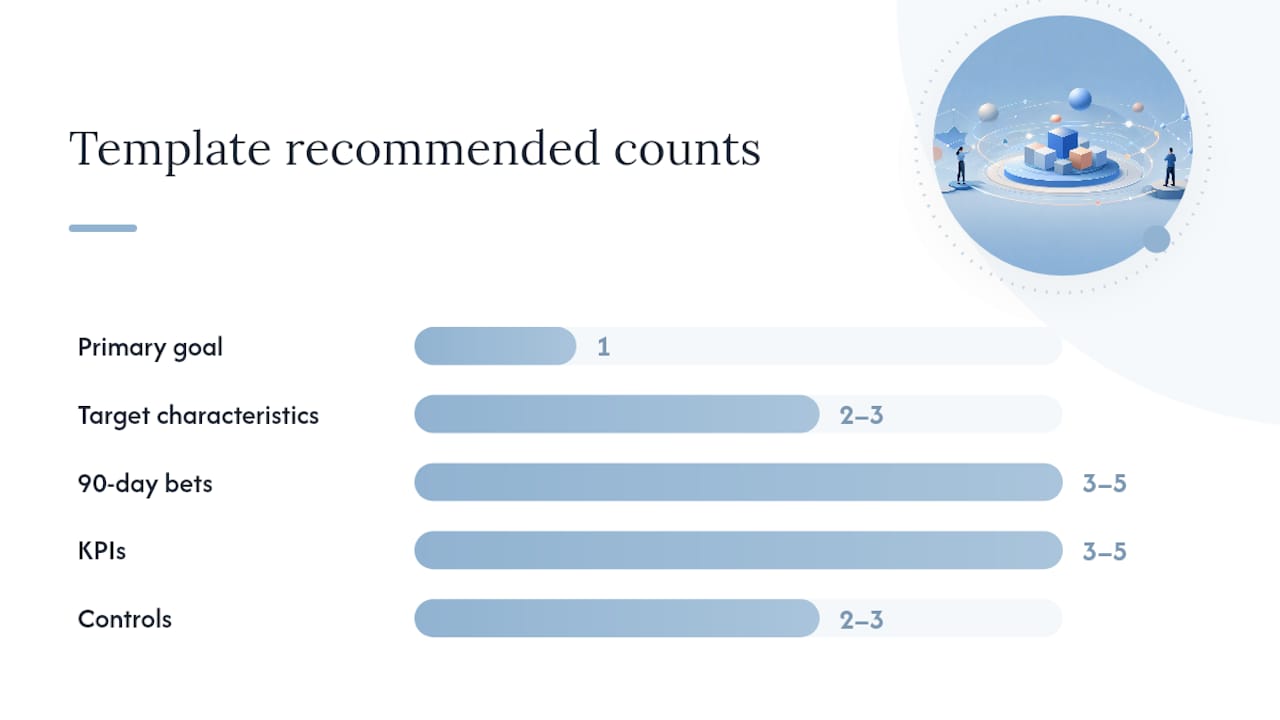
One-page strategy template:
| Element | What to write |
|---|---|
| Primary goal | One measurable business outcome with a deadline |
| Target segment | Named segment with two to three defining characteristics |
| Positioning statement | “For [segment], [brand] is the [category] that [key benefit] because [proof]” |
| 90-day bets | Three to five tactics, each with a named owner and a success metric |
| KPIs | Three to five metrics mapped to the chosen framework |
| Controls | Two to three if/then reallocation rules |
Micro-example 1: B2B SaaS company using STP and GSTIC. A 40-person SaaS company targeting mid-market HR teams runs STP to identify their highest-value segment, writes a positioning statement around compliance automation, and feeds that into GSTIC. Their 90-day bets: a LinkedIn thought leadership series (owner: content lead), a case study program targeting three named accounts (owner: sales), and a website redesign to align the homepage with the new positioning (owner: marketing ops).
Micro-example 2: Local services business using SWOT and AIDA. A Denver-area home services company runs a 60-minute SWOT workshop, identifies that their strongest asset is a five-star review base that is not visible in their digital presence, and maps an AIDA content plan to surface those reviews at the Awareness and Interest stages. First three steps: audit all review platforms, create a video testimonial series, and update the Google Business Profile with fresh photo and video content.
Micro-example 3: Ecommerce brand using AARRR and CLV. An ecommerce brand selling specialty outdoor gear runs an AARRR audit and finds that Activation (first purchase within 14 days of signup) is their worst-performing stage. They model CLV by product category, find that buyers of a specific product line have three times the lifetime value of average customers, and redirect their welcome email sequence to feature that product line prominently. The 90-day bet: a/b test two welcome sequences and measure 14-day purchase rate as the primary metric.
For teams adapting these templates, scale the complexity to your internal capacity. A two-person team should run a 90-minute workshop and produce a one-page strategy. A 20-person marketing department can run a two-day offsite with pre-work, breakout sessions, and a formal Controls document.
How Phenyx applies marketing frameworks in practice
Phenyx uses a structured approach that mirrors the diagnostic-to-execution sequence described throughout this article. The process moves through four stages: diagnose the client’s current position using a combination of competitive analysis and customer insight work, translate those findings into a one-page strategy with clear positioning and a 90-day bet list, assign execution across Phenyx’s in-house team (web design, SEO/AEO, video production, branding), and run a recurring cadence of weekly signals and monthly decisions to keep execution aligned with the original goal.
Clients who go through this process typically report clearer internal alignment on who they are targeting and why, faster decision-making on channel allocation, and a more consistent brand message across digital touchpoints. The Phenyx full-service model eliminates the coordination overhead of managing multiple vendors, which is itself a source of strategic drift for growing businesses.
If your team has a framework but lacks the execution capacity to act on it, or if you need help running the initial workshop, Phenyx offers both.
When does hiring an agency make more sense than doing it in-house?
The honest answer depends on three variables: internal capability, time-to-market pressure, and the breadth of execution required.
Agency-led implementation makes sense when:
- Your strategy requires cross-discipline delivery (web, SEO, video, paid media) that your internal team cannot staff without hiring.
- You need to move faster than your current team can realistically execute.
- You are entering a new market or repositioning and need outside perspective to avoid internal blind spots.
- Your internal team has strong strategic capability but limited production bandwidth.
Keep it in-house when:
- You have existing specialists in the required disciplines and the coordination cost of an agency outweighs the benefit.
- The strategic change is minimal and execution is well within your team’s current capacity.
- Learning the execution process is itself a strategic priority (building internal capability for the long term).
The middle path, which many mid-market companies use effectively, is a hybrid model: internal team owns strategy and measurement, agency handles production and channel execution. This keeps strategic knowledge inside the organization while accessing agency-level production quality and speed.
Building a marketing strategy during constrained conditions is a related consideration: when budgets tighten, the case for a unified agency partner often strengthens because it reduces the overhead of managing multiple vendors against a smaller budget.
Phenyx can help you go from framework to execution
Phenyx is a full-service marketing agency with in-house teams covering website design, SEO and AEO, video production, branding, and strategy. For growing businesses that have a framework but need help executing it, or that need both, Phenyx delivers the full sequence under one roof: workshop facilitation, one-page strategy development, 90-day execution planning, and ongoing channel management. No vendor coordination, no message fragmentation, no gaps between strategy and production.
The concrete advantage over assembling a vendor stack yourself is speed and consistency. A single in-house team moves from strategy to live assets faster, and the brand message stays coherent across every channel because the same team owns all of them. To start, contact Phenyx to book a strategy workshop or discuss which services fit your current stage.
Sources
- The 1-2-3 Of Marketing Strategy | Forrester
- Ultimate guide to marketing frameworks — American Marketing Association
- How to create a complete marketing strategy data + expert tips — HubSpot
- 7 Steps to Build a Marketing Strategy That Actually Works in 2026 — Backlinko
- The Five Forces — Harvard Business School (ISC)
Recommended
- How to Prepare a Strong Marketing Campaign for 2026: Ideas and Tips Every Business Can Use | PHENYX
- Importance of Building a Marketing Strategy In Economic Downturns | PHENYX
- 10 Website Design Best Practices for Marketing Agencies in 2025 | PHENYX
- How to Prepare for a Quarterly Marketing Meeting and Set Your Brand Up for Success | PHENYX