

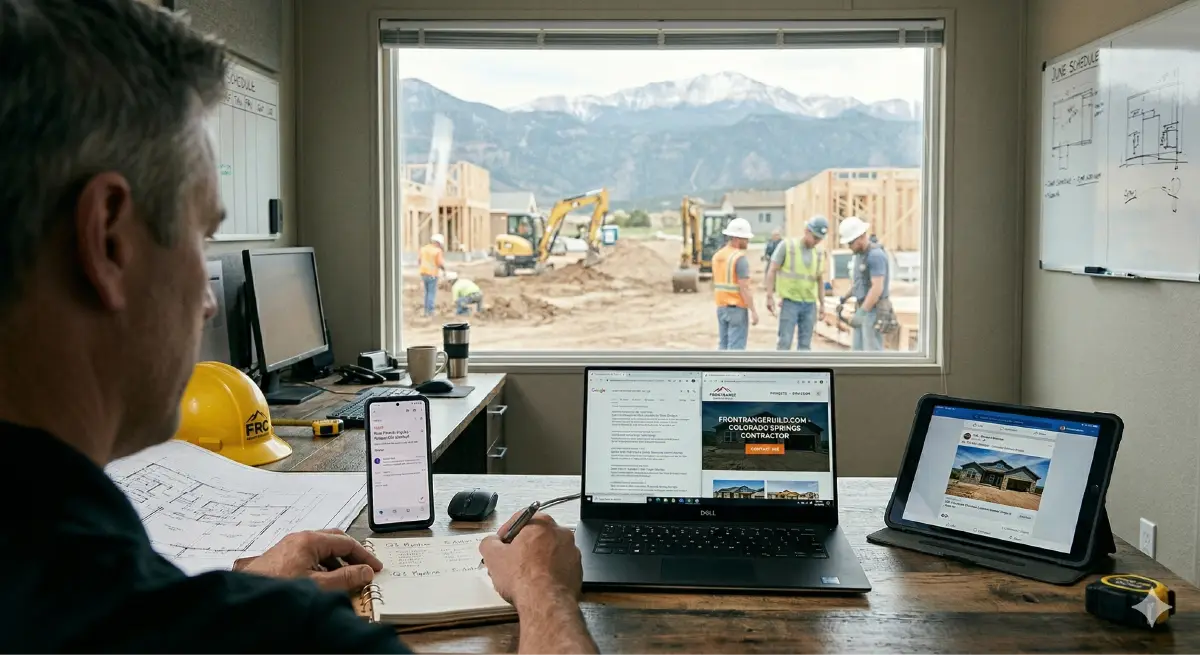
TL;DR: Colorado Springs construction companies that rely exclusively on referrals are missing a larger pool of qualified buyers actively searching online. Digital marketing—specifically local search ads, targeted social campaigns, and email outreach to past clients and referral partners—can consistently fill a project pipeline without waiting for the phone to ring on its own. The construction companies growing fastest in this market are combining paid and organic tactics into a single, trackable system.
The Colorado Springs construction market has been active for years—new residential development in the northeast, commercial build-outs near the Powers Boulevard corridor, and steady remodel work driven by an aging housing stock and a population that keeps growing. The problem most construction companies face isn't a shortage of potential projects. It's visibility. The contractor who lands the call is often the one who showed up at the right moment—online, in front of the right person—not necessarily the most qualified crew available.
Referrals still work, but they're unpredictable. A strong referral network sustains a crew; it rarely scales a business. The construction companies in Colorado Springs adding $2M to $5M in annual revenue are doing it with intentional digital marketing: showing up in Google searches, running targeted paid campaigns to homeowners and commercial property owners, and staying consistently visible to past clients and referral partners through email and social content.
Why Digital Marketing for Construction Companies Requires a System
Construction digital marketing is the use of online channels—search engines, paid advertising, social media, and email—to generate qualified project inquiries from homeowners, property managers, developers, and commercial clients. For Colorado Springs contractors, "qualified" means someone with a real project scope, a realistic budget, and a timeline that aligns with your schedule.
The buying cycle in construction is longer than most industries. A homeowner planning a whole-home addition might research contractors for three to six months before requesting a quote. A commercial developer evaluating general contractors might gather bids across several weeks. Digital marketing for construction has to account for this longer runway—the goal isn't only to capture the client ready to sign today, but to stay visible and credible throughout their entire decision process.
This is why a single tactic—running Google ads alone, posting sporadically on Instagram—rarely produces consistent results. A functioning digital marketing system connects paid search for ready-to-buy leads, organic content for research-phase traffic, and email or social retargeting for nurturing prospects who aren't ready yet. Each component does different work; together, they fill the pipeline at multiple stages simultaneously.
Google Ads and Local Search for Immediate High-Intent Leads
When a property owner in Colorado Springs is ready to start a project, their first move is almost always a Google search. "General contractor Colorado Springs," "commercial construction near me," "home addition contractor 80920"—these are high-intent searches from people actively trying to hire. Google Search ads put your business in front of them immediately, before any organic SEO work has time to mature.
Effective Google Ads campaigns for construction companies focus on tight, specific terms rather than broad category keywords. "Custom home builder Colorado Springs" produces better-qualified clicks than "contractor near me." "Commercial tenant improvement Colorado Springs" reaches a different buyer than "construction company." Tighter targeting costs more per click but generates leads actually worth answering—which is the only metric that matters in the long run.
Local Service Ads (LSAs) are a separate Google product worth exploring for qualifying contractors. They appear above traditional paid search results, display a Google Guaranteed badge, and charge per lead rather than per click. For Colorado Springs construction companies that meet the eligibility requirements, LSAs can reduce cost per lead while adding a credibility signal that influences call-through rates from homeowners comparing multiple options.
Social Media Content That Moves Prospects Off the Fence
Construction companies have a natural content advantage most industries don't: visible, dramatic transformations that photograph and film well. A before-and-after kitchen remodel or a commercial ground-up build in a Colorado Springs neighborhood is genuinely compelling content. The problem is that most contractors post inconsistently and without strategy—one photo here, a job site update there—and then wonder why social media doesn't generate leads.
Effective social content for construction companies follows a clear structure. Project posts should tell a story: the problem the client had, the solution your team designed, obstacles encountered during the build, and the finished result. That narrative creates meaningful engagement and positions your company as a thoughtful problem-solver, not just a crew with equipment. It also gives prospective clients a realistic sense of what working with you actually looks like.
Facebook and Instagram remain the most effective platforms for residential construction lead generation in Colorado Springs, primarily because both allow targeting by homeownership status, household income, and geographic radius. A campaign showing a recent deck or addition to homeowners aged 35 to 65 within 20 miles of Colorado Springs, with a project-focused call-to-action, regularly produces qualified inquiries for contractors running it with consistency. Companies not running these campaigns are leaving that audience to competitors who are.
Email Marketing and the Referral Network Most Contractors Underuse
Email marketing consistently delivers the highest return on investment of any digital channel—research regularly shows returns in the range of $36 to $42 for every dollar spent. For construction companies, the existing contact database of past clients, subcontractors, architects, real estate agents, and commercial property managers is a significant and largely underused marketing asset.
A quarterly email to past clients featuring a project spotlight and a reminder of your current services keeps your company top-of-mind for the moment they—or someone they know—needs a contractor. Referral partners receive different content: case studies with project scope and outcomes, your current capacity, and the types of projects you're actively pursuing. These two audiences need different messages but can be managed through the same simple email platform at modest cost.
For Colorado Springs construction companies pursuing commercial work, a targeted email campaign to property managers, HOA boards, facilities directors, and commercial real estate professionals—combined with a consistent LinkedIn presence—opens doors that cold outreach rarely does. The upfront investment is modest; the compounding effect over 12 to 24 months, as relationships develop and referrals accumulate, is substantial.
Tracking Which Channels Are Actually Generating Revenue
The most common mistake construction companies make with digital marketing isn't choosing the wrong channel—it's not tracking which channels are producing revenue. Without attribution data, marketing decisions become guesses, and budget ends up spread thin across channels producing nothing measurable.
Basic tracking requires three things: a unique phone number per marketing channel via call tracking software, UTM parameters on all links in paid and email campaigns, and a CRM or spreadsheet where every lead source is recorded at intake. This setup takes less than a day to implement and produces data that transforms how budget gets allocated within 90 days.
Monthly reporting should focus on cost per qualified lead by channel, total pipeline value attributed to marketing sources, and conversion rate from lead to signed contract. Most Colorado Springs construction companies find after one quarter of tracking that one or two channels are producing the majority of qualified leads. The Construction Marketing Association publishes industry benchmarks that provide useful context for evaluating your numbers against sector averages. That clarity is what makes ongoing marketing investment defensible and scalable year over year.
Common Questions
What digital marketing channels work best for construction companies?
The most effective digital marketing channels for construction companies are Google Search ads for immediate high-intent leads, a well-optimized Google Business Profile for local organic visibility, and Facebook and Instagram for project-based social content and targeted paid campaigns. Email marketing delivers the highest ROI for nurturing past clients and referral partners over time. The most successful construction companies combine all of these into a coordinated system rather than relying on any single channel in isolation.
How long does digital marketing take to generate leads for a construction company?
Google Search ads can generate construction leads within the first week of a campaign launching. Social media campaigns targeting homeowners by location and demographic typically show lead flow within two to four weeks as targeting is refined. Organic search results require three to six months to build meaningfully for competitive terms in Colorado Springs. Email marketing to an existing list produces results immediately. A realistic expectation for a new digital marketing program is meaningful paid lead flow within 30 days, with organic and social channels maturing over a three to six-month window.
How much should a Colorado Springs construction company spend on digital marketing?
Colorado Springs construction companies typically allocate 3% to 8% of gross revenue to marketing, with the digital portion depending on business type and growth goals. A company targeting $2M in annual revenue might spend $3,000 to $6,000 per month across paid search, social ads, and agency management. Residential remodelers often see a cost per qualified lead of $80 to $200 from Google Ads; commercial contractors typically see higher costs per lead but substantially larger per-project revenue. Any marketing budget is best evaluated against average project value and close rate—a single signed contract frequently justifies several months of total spend.
The Colorado Springs construction market rewards companies that stay visible, build trust online, and maintain consistent lead flow. PHENYX helps construction companies across Colorado build digital marketing systems that generate qualified project inquiries month after month. Contact PHENYX to talk about what a structured campaign strategy could do for your pipeline in 2026.








%20(2).svg)
%20(1).svg)
