

Corporate Video Cost: What You'll Really Pay in 2026
Most corporate videos run between $3,000 and $50,000, and the single biggest factor isn’t runtime, it’s scope. A 90-second talking-head video with one location and no animation can cost less than a 45-second brand spot shot on location with a drone, a voice actor, and custom motion graphics. Once you accept that deliverables and complexity drive corporate video cost far more than length does, budgeting gets a lot easier.
Quick Summary:
- Basic corporate videos (simple explainer, one-person interview) generally cost a few thousand dollars
- Mid-range projects (brand story, product demo, testimonial) generally cost several thousand to tens of thousands of dollars
- Premium and enterprise productions (multi-location, cinematic, animation-heavy) generally involve significantly higher budgets
- A typical mid-tier project usually includes a script, one shoot day, two rounds of edits, and basic motion graphics
- Real-world production pricing breakdowns confirm this $3,000 to $50,000 range holds across most industries
- Build your deliverables list before requesting quotes. It’s the fastest way to get an accurate number instead of a guess
- Budget 10% to 15% on top of your quote for contingency. Revisions and licensing surprises are common
- Scope, not runtime, is the rule that governs almost every corporate video cost conversation
Key Takeaways
Corporate video cost is driven primarily by scope and deliverables, not runtime, and most projects fall between $3,000 and $50,000 depending on complexity.
| Point | Details |
|---|---|
| Scope beats runtime | A short, complex video can cost more than a longer, simple one. Budget by deliverables, not minutes. |
| Know your tier | Basic runs $1,500 to $8,000, mid-range $8,000 to $25,000, and premium $25,000 to $50,000+. |
| Watch the phase split | Expect roughly 10 to 20% pre-production, 40 to 55% production, and 25 to 35% post-production. |
| Budget for contingency | Add 10% to 15% on top of any quote to cover revisions, licensing, and rush fees. |
| Consider PHENYX for integrated needs | PHENYX offers in-house video production tied to SEO, web design, and paid media for measurable, multi-format campaigns. |
How much does a corporate video cost on average?
Most corporate videos cost between $3,000 and $50,000, with mid-range projects (professional testimonials, product demos) typically landing between $8,000 and $25,000 depending on crew size and post-production needs.
How much for a corporate video with professional actors?
Adding professional or union talent raises costs significantly. If SAG-AFTRA jurisdiction applies, minimum rates and usage fees kick in on top of standard production costs, so confirm talent status before finalizing your budget.
What’s a realistic corporate video budget for a small business?
A small business can produce a solid basic-to-mid-tier video for $3,000 to $10,000, covering one shoot day, a written script, and one or two revision rounds. This works well for testimonials, simple explainers, or internal training.
Is per-minute pricing a reliable way to estimate cost?
Per-minute pricing works as a rough comparison tool but can mislead you on its own, since a short cinematic spot often costs more than a longer, simply shot interview. Always pair it with a deliverables-based quote.
Should I choose a retainer or pay per project for corporate videos?
Choose per-project pricing for a single, standalone video. Choose a retainer if you need four or more videos a year, since it typically lowers your per-video rate and locks in crew availability for faster turnarounds.
Table of Contents
- How Much Does a Corporate Video Cost by Budget Tier?
- Where Does the Money Actually Go?
- What’s the Cost Per Finished Minute for a Corporate Video?
- What Drives Corporate Video Production Pricing the Most?
- What Type of Corporate Video Do You Actually Need?
- What Hidden Costs Should You Budget For?
- How Do You Lower Corporate Video Budget Costs Without Cutting Quality?
- How Long Does a Corporate Video Take, and Which Pricing Model Fits?
- What the Industry Gets Wrong About Corporate Video Pricing
- Why PHENYX Is a Direct Option for Corporate Video Production
- Sources
How Much Does a Corporate Video Cost by Budget Tier?
Production companies generally sort projects into four tiers, and knowing which one fits your goal keeps you from overpaying for polish you don’t need or underpaying for a video that needs to carry real weight.
-
Basic: A project with one camera operator, one location, minimal lighting, and a straightforward edit suited for internal training clips and simple videos. Expect limited revisions and simple graphics.
-
Mid-range: Projects that include scripting, a full shoot day with a small crew, moderate editing, and basic animation. Fits testimonials, product demos, and brand stories.
-
Premium: More complex productions with multiple shoot days, professional talent, advanced graphics, drone footage, and specialized crew.
-
Enterprise: High-end productions with multiple locations, union crews, complex animation or visual effects, and comprehensive post-production teams. Large companies often produce videos at this level.
Projects move between tiers fast once you add a second location, hire union talent, or ask for heavy motion graphics. Each of those decisions can push a $10,000 quote past $20,000 before the shoot even starts.
Where Does the Money Actually Go?
Corporate video budgets follow a fairly consistent phase split. Industry pricing guides put pre-production at roughly 10% to 20% of the total, production at 40% to 55%, and post-production at 25% to 35%.
- Pre-production (10 to 20%): Scriptwriting, storyboarding, location scouting, and casting. On a $15,000 budget, that’s roughly $1,500 to $3,000.
- Production (40 to 55%): Crew day rates, camera and lighting rental, talent fees, and location costs. This is where most of your money lives.
- Post-production (25 to 35%): Editing, color correction, sound mixing, motion graphics, and revision rounds.
A $20,000 mid-tier project might break down as $3,000 for pre-production, $10,000 for a two-day shoot with a small crew, and $7,000 for editing and graphics. Skimping on pre-production is the most common mistake we see. A weak script or an unscouted location almost always costs more to fix on set than it would have cost to plan properly.
What’s the Cost Per Finished Minute for a Corporate Video?
Per-minute pricing is a useful shorthand for comparing quotes, but it can mislead you if you use it alone. A 30-second cinematic spot with a hired actor can cost more than a five-minute unscripted interview.
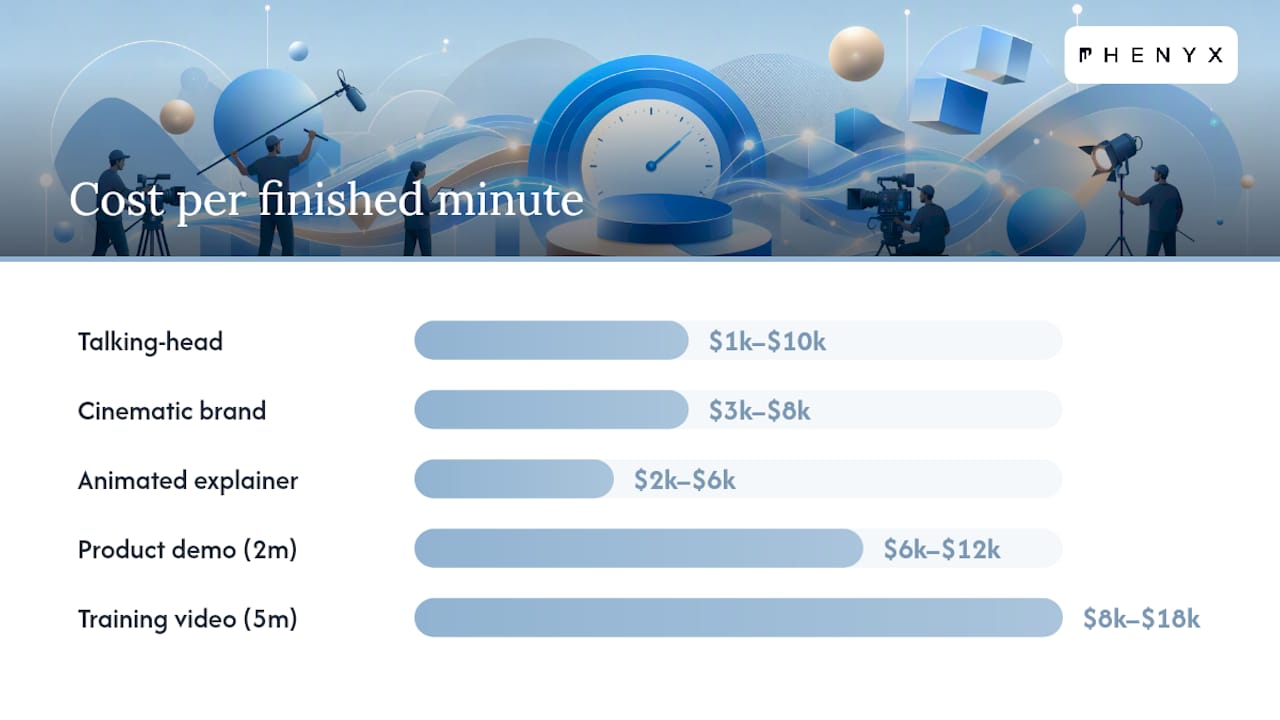
Vendor data puts typical ranges at $1,000 to $10,000 per finished minute, depending heavily on production style.
| Video type | Cost per finished minute | Best for |
|---|---|---|
| Talking-head interview | $1,000 to $10,000 | Testimonials, internal comms |
| Cinematic brand video | $3,000 to $8,000 | Flagship campaigns, brand launches |
| Animated explainer | $2,000 to $6,000 | Product education, complex concepts |
A 1-minute social clip built from existing footage might run $1,500 to $3,000. A 2-minute product demo with a scripted voiceover and light graphics often lands between $6,000 and $12,000. A 5-minute training video with multiple interview subjects and basic editing typically costs $8,000 to $18,000, since length adds editing hours even when the shoot itself is simple.
What Drives Corporate Video Production Pricing the Most?
A handful of decisions swing your final number more than anything else on the call sheet.
- Crew size and days: A basic two-person crew might run $1,500 to $3,000 per day. A full crew with a director, DP, gaffer, and sound engineer can hit $5,000 to $10,000 per day. Add a second shoot day and you’re not just doubling the day rate, you’re adding a second round of setup, travel, and equipment rental.
- Union talent: If your video uses SAG-AFTRA talent or falls under union jurisdiction for its intended use, SAG-AFTRA rate sheets set minimum pay scales and usage fees that non-union productions don’t carry. Confirm early whether your distribution plan triggers union rules, because it changes your budget before a single frame is shot.
- Locations and permits: Multiple locations mean more travel, more permits, and more setup time. Drone footage often adds $500 to $2,000 for licensed operation.
- Post-production complexity: Custom animation, original music, and VFX all add cost, and so does every revision round beyond what’s in your contract.
Pro Tip: Ask your production partner to quote crew days and revision rounds as separate line items, not a bundled flat fee. That’s the only way to see exactly what an extra shoot day or a third revision round will actually cost you.
What Type of Corporate Video Do You Actually Need?
Matching the video type to the budget tier keeps you from overspending on internal content or underspending on anything customer-facing.
- Training videos: $1,500 to $8,000. Simple production values are fine since the goal is clarity, not polish.
- Testimonials: $3,000 to $12,000. Authenticity matters more than cinematic lighting.
- Product demos: $6,000 to $20,000. Needs clean visuals and a tight script since it often sits on a landing page.
- Brand videos: $15,000 to $50,000+. This is where premium production earns its cost, since high-quality video production correlates with stronger audience engagement.
- Social clips: $500 to $5,000, often repurposed from a larger shoot.
If you’re only distributing internally, a basic tier video usually does the job. Anything running as a paid ad deserves at least mid-tier production. One well-planned shoot day can generate a brand video, three social cuts, and a testimonial, cutting your effective cost per asset significantly.
What Hidden Costs Should You Budget For?
Music and stock licensing, especially for multi-platform use, can add unexpected fees after the shoot wraps. Extra revision rounds beyond your contract and rush turnaround fees are two of the most common budget-busters. Localization, closed captioning, hosting, and ongoing maintenance rarely make it into the first quote. Build in a 10% to 15% contingency line from the start, since detailed budgeting guides consistently recommend it to absorb these surprises without a change order fight mid-project.
How Do You Lower Corporate Video Budget Costs Without Cutting Quality?
- Request a line-item quote up front. Ask for crew days, deliverables, and revision counts listed separately, not folded into one number. This is the fastest way to see where your money is actually going and where you can trim.
- Bundle shoots and repurpose footage. One well-planned shoot day can produce a hero video, several social cuts, and B-roll for future projects.
- Negotiate a multi-video retainer if you need four or more videos a year. Volume pricing consistently beats one-off project rates.
- Use AI tools strategically. AI video platforms cut marginal costs significantly for large-volume training and localization libraries, but they’re the wrong tool for a brand film where human craft and cinematography carry the message.
Pro Tip: Set your revision-round limit and contingency percentage in the contract before the first shoot, not after the first invoice.
How Long Does a Corporate Video Take, and Which Pricing Model Fits?
A standard corporate video runs four to eight weeks from brief to delivery. Rush schedules under two weeks typically add 20% to 50% in expedite fees.
- Per-project pricing works best for a single video with a defined scope and no expectation of repeat work.
- Retainer pricing makes sense once you need four or more videos a year, since it locks in crew availability and lowers your per-video rate over time.
- Subscription models fit companies producing high volumes of shorter content, like weekly social clips or ongoing training modules, where predictable monthly output matters more than any single hero piece.
Choose based on volume and strategic weight. A flagship brand film usually justifies a one-off project budget. A steady stream of training or social content almost always costs less per video under a retainer.
What the Industry Gets Wrong About Corporate Video Pricing
Most pricing guides fixate on runtime, and that’s backward. We’ve seen 30-second spots cost more than five-minute interviews, because scope, not seconds, sets the price. The conventional advice to “get three quotes and pick the middle one” also falls short. It ignores that quotes built on wildly different deliverables lists aren’t comparable at all.
What actually matters is asking every vendor for the same line-item breakdown before comparing a single number. A freelancer might beat an agency’s day rate but lack the crew, equipment, and post-production bench to hit a tight deadline without subcontracting, which often erases the savings. An agency with in-house production removes that guesswork, since the same team scopes, shoots, and edits under one contract.
The reader’s real priority should be building an accurate deliverables list first. Everything else, tier, timeline, contract model, follows from that one document.
Why PHENYX Is a Direct Option for Corporate Video Production
Choosing a production partner usually means picking between a freelancer who’s fast but limited, and a traditional agency that’s polished but slow to move. Phenyx runs video production in-house alongside SEO, web design, and paid media, so your video isn’t a standalone deliverable, it’s built to plug straight into a campaign that gets tracked and measured.
That matters most if you need multiple video formats from one shoot, want a retainer instead of renegotiating scope every quarter, or need production tied to actual marketing goals rather than a one-off file delivery. Before you shoot anything, our guide to preparing for a video production walks through what to have ready for a discovery call. If you want a scoped estimate, request one, and expect the first conversation to focus on your deliverables list, timeline, and how the video fits your broader marketing plan.
Sources
- SAG-AFTRA rate sheets
- How Much Does Corporate Video Production Cost in 2026 — a realistic pricing breakdown
- Video Production Costs: 2026 Pricing Guide | Colossyan
- Corporate Video Cost: Pricing Guide for 2026