

Draft Your One Page Small Business Marketing Plan in 30 to 60 Minutes
A small business marketing plan is a short document that ties your marketing activities to a measurable business goal, and the fastest path to a usable one is a single page. Start today by drafting a one-page executive summary built around one SMART objective, such as a specific revenue or lead target for the next quarter. The sample template later in this article gives you a format to copy directly.
TL;DR:
- Small business marketing plans should focus on a single SMART objective, a defined target, a realistic budget, and key metrics, revisited monthly.
- Selecting two to four channels based on audience behavior and pairing owned, earned, and paid tactics helps optimize resource use and avoid broad, ineffective campaigns.
- A budget generally ranges from 1% to 12% of revenue, with startups spending toward the higher end to build awareness and established businesses prioritizing ROI through owned channels.
- Assigning clear ownership and setting a recurring review cadence ensures the plan remains actionable and aligned with market changes, preventing it from becoming obsolete.
- Most small business plans benefit from outside assistance in website, SEO, and paid advertising, with subscription services offering coordinated execution around the existing strategy.
Table of Contents
- Quick summary: what your plan needs before you start spending
- What a marketing plan is and why it matters more than strategy alone
- The core elements every plan needs
- How to build your plan in 30 to 60 minutes
- Setting a realistic marketing budget
- Choosing channels and tactics that fit your budget
- Tracking KPIs without building a complicated dashboard
- A one-page plan template you can copy today
- Turning a plan into an executed program
- Why most plans fail at the handoff, not the drafting
- Getting your plan off the page and into results
- FAQ
- Sources
Quick summary: what your plan needs before you start spending
A working plan does not need to be long. It needs six pieces in place and a habit of revisiting them.
- One SMART objective (a number, a deadline, and a way to measure it)
- A defined target customer or persona you can describe in two sentences
- A budget expressed as a dollar figure or percent of revenue
- Two to four channels chosen for fit, not popularity
- KPIs tied directly to the objective, not vanity metrics
- A 90-day milestone list with named owners
- A review date already on the calendar
Treat this as a living document rather than something you file away. Revisit it monthly at minimum, since markets, budgets, and customer behavior shift faster than annual plans can track. The sample one-page plan further down gives you a format to fill in within an hour.
What a marketing plan is and why it matters more than strategy alone
A marketing strategy is the thinking: who you serve, what makes you different, and how you intend to win attention. A marketing plan is the execution layer: specific tactics, dollars, dates, and names attached to that thinking. Many small business owners have a strategy in their head and nothing written down, which is where plans tend to fall apart.
Documentation matters because it forces alignment. When a plan lives only in conversation, priorities shift with whoever spoke last. A written plan gives your team, contractors, or agency the same reference point.
The U.S. Small Business Administration’s marketing and sales guidance frames this directly: effective plans start with research, move to clear objectives and defined audiences, and end with a budget and measurable KPIs, reviewed at least once a year and connected back to the broader business plan. The point is not the document itself. It is the discipline of connecting every dollar spent to something you can measure.
The core elements every plan needs
A complete plan has a short list of required sections. Skipping any of them is usually where plans lose their usefulness.
- Executive summary: one sentence combining your value proposition, your target customer, and your primary objective.
- Target market or persona: who buys from you, what problem you solve for them, and where they spend attention.
- Situation analysis: a quick SWOT, your strengths, weaknesses, opportunities, and threats, kept to one line each.
- SMART objectives and KPIs: a specific, measurable, achievable, relevant, time-bound goal paired with the metric that proves progress.
- Strategy and channels: the two to four channels you will use and why they fit your audience.
- Budget: a dollar amount or percent-of-revenue figure, broken out by channel.
- Action calendar: what happens by week or month, with an owner attached to each item.
SCORE’s outline for marketing plan components lists situation analysis, research, short-term objectives, longer-term strategy, and budgeting as the backbone of any plan, regardless of business size. The order matters less than making sure nothing on this list is left blank. A plan missing a budget or a KPI is not a plan, it is a wish list.
How to build your plan in 30 to 60 minutes
You can draft a working plan in one sitting using a rapid-build sequence, or stretch the same steps into a longer workshop if you want more input from a team.
- Write your one-liner (5 minutes). State your value proposition, your target customer, and the single outcome you want in the next 90 days.
- Define your audience (10 minutes). Answer three prompts: who buys from you, what triggers their purchase decision, and where they look for solutions like yours.
- Run a quick SWOT (10 minutes). List one strength, one weakness, one opportunity, and one threat. Resist the urge to write more than one line per box.
- Set your SMART objective (10 minutes). Convert a general goal like “grow sales” into something specific: “generate 40 qualified leads by the end of Q2 through email and local search.” Attach the KPI that proves it, such as lead count or cost per lead.
- Choose your channels and budget (10 minutes). Pick two to four channels that match where your audience already spends time, then assign a dollar figure to each.
- Build your 90-day calendar (10 minutes). Break the objective into monthly milestones with one owner named per task, even if that owner is you.
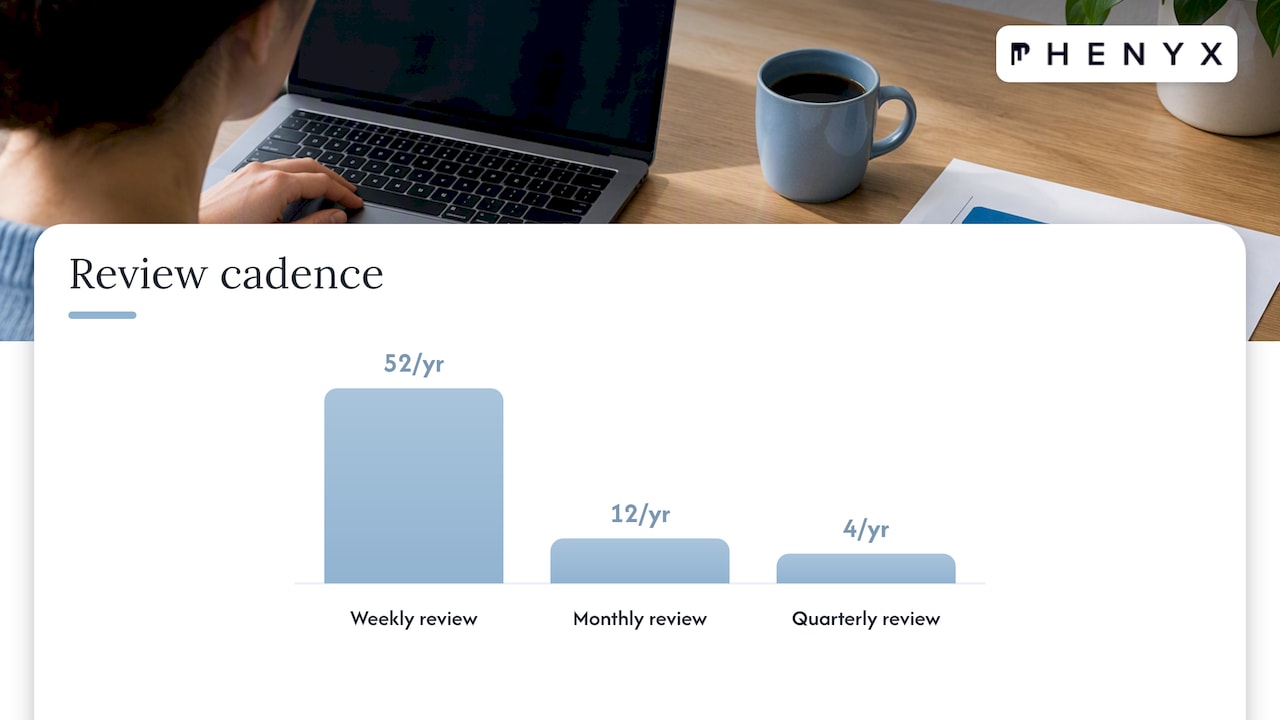
- Schedule your review (5 minutes). Put a recurring date on the calendar, monthly for tactics and quarterly for the full plan, so the document stays current instead of becoming shelfware.
The SBA’s Marketing 101 guidance recommends linking every tactic back to an objective and using customer feedback to adjust the plan, rather than setting it once and leaving it untouched. If you have a team, extend each step into a 10 to 15 minute discussion instead of a solo exercise. The output is the same: a one-page document with a clear owner for every line.
Setting a realistic marketing budget
Budget questions stall more small business plans than any other section, mostly because owners look for a single right number that does not exist.
- General benchmark range: the SBA’s guidance on marketing budgets points to spend that varies by industry and business stage, generally falling somewhere between roughly 1% and 8 to 12% of revenue depending on sector and growth phase.
- Startups typically need to spend toward the higher end of that range to build awareness from a standing start, since there is no existing customer base to draw repeat revenue from.
- Steady-state businesses can often spend less and should prioritize return on investment and owned channels like email and search over broad awareness campaigns.
- Phase spend across the year rather than committing it all upfront. Front-load testing dollars in the first quarter, then shift budget toward whatever channel shows the lowest cost per lead.
- Use a structured template to plan categories. SCORE’s Annual Marketing Budget template breaks spend into categories like digital advertising, content, events, and design, which makes it easier to see where dollars are concentrated and where they are missing entirely.
Adapt the SCORE template to your own categories rather than filling in every line it offers. A service business and a retail shop will not spend the same way, even at the same revenue size.
Choosing channels and tactics that fit your budget
Pick channels by working backward from your objective and audience, not forward from what competitors happen to be doing. Start with the objective, define who needs to see it, then match that audience to the channel where they already pay attention.
- Owned channels (your website, email list, blog) cost time more than money and compound over time, making them a strong first investment for steady-state businesses.
- Earned channels (reviews, referrals, local press) require relationship-building rather than ad spend and tend to carry more trust with new customers.
- Paid channels (search ads, social ads) deliver faster results but need a tested budget before scaling, since early campaigns are rarely optimized out of the gate.
- Low-cost, high-impact tactics worth prioritizing include email newsletters to your existing list, actively requesting customer reviews, local business partnerships, and simple referral incentives.
- Test paid channels in small batches. Run a limited budget test with a clear cost-per-lead target before committing a full monthly spend, then scale only the campaigns that hit your target.
Pro Tip: Run one owned-channel effort and one small paid test every month during your first 90 days, so you are building long-term assets while gathering data on what paid spend actually returns.
Tracking KPIs without building a complicated dashboard
Every objective needs a KPI that proves whether it happened, and most small businesses only need a handful of metrics to know if their plan is working.
- Awareness objectives pair with reach or website traffic.
- Acquisition objectives pair with lead count or cost per lead.
- Activation objectives (first purchase, signup, trial start) pair with conversion rate.
- Revenue objectives pair with revenue per customer and overall return on marketing spend.
A simple ROI check works without complex software: divide total marketing spend by leads generated to get cost per lead, then track what percentage of those leads convert to paying customers. That combination tells you more than impressions or follower counts ever will.
Review tactical metrics weekly, review channel performance monthly, and review the full plan quarterly against your original objective. For tracking, use UTM parameters on every link you share, add a simple “how did you hear about us” question at checkout or intake, and keep a basic analytics setup running on your website. Our marketing dashboard guide walks through which numbers to pull at each of these review points.
A one-page plan template you can copy today
A one-page plan works best as a single table you can fill in during your planning session and pin somewhere visible. Here is a filled example for a hypothetical local bakery, with inputs clearly illustrative rather than figures from any source.
| Section | Example entry |
|---|---|
| Objective | Generate 30 new catering leads by end of Q2 |
| Target customer | Local businesses booking office events, 10 employees |
| Key tactics | Email to past customers, local business partnerships, Google Business Profile updates |
| Budget | $500, split across email tool and local sponsorship |
| 90-day milestones | Month 1: launch email series. Month 2: secure 2 partnerships. Month 3: review and adjust |
| KPIs | Leads generated, cost per lead, partnership referrals |
Copy this structure into a blank document, swap in your own numbers, and treat the finished page as your working reference rather than something you revisit once a year.
Turning a plan into an executed program
Writing the plan is the easy half. The harder half is keeping website updates, search visibility, paid campaigns, and content moving at the same time without each piece landing with a different vendor on a different timeline. That coordination gap is where plans stall after the first 90 days.
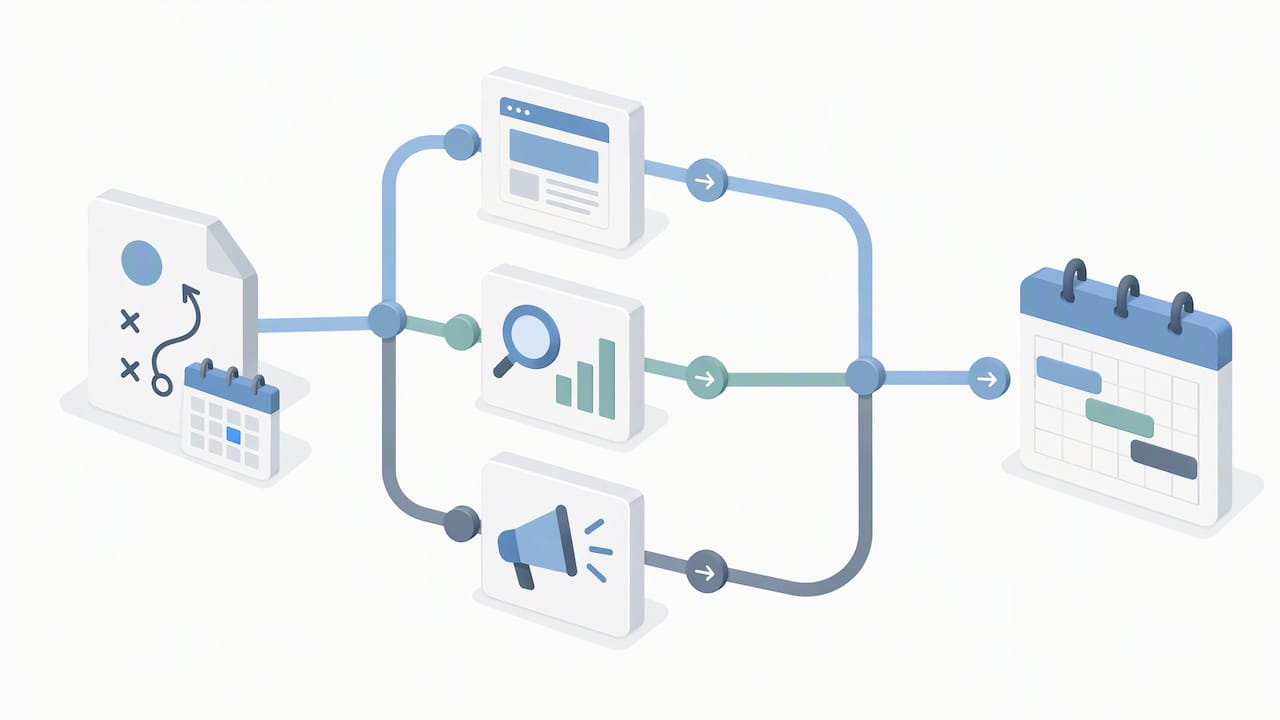
Execution tends to move faster when the people building your site, running your search strategy, and managing paid campaigns are working from the same plan and the same calendar. Our practical framework for small business marketing covers how research, messaging, and measurement connect in execution, and our small business SEO playbook goes deeper on owned-channel tactics referenced in your channel selection.
Why most plans fail at the handoff, not the drafting
The planning advice in most guides is solid: set objectives, pick channels, track KPIs. Where it falls short is the assumption that writing the plan is the hard part. It is not. The hard part is the week after, when the objective sits in a document and nobody has moved a task forward because no single person owns it.
A plan with five channels and no named owner per tactic is functionally the same as no plan. A rough one-page document with two channels, a real budget, and one accountable person per task will outperform a polished twenty-page strategy every time, because it actually gets worked.
If you take one thing from this article, let it be this: spend less time perfecting the SWOT analysis and more time assigning deadlines and reviewing cost per lead every month. Budgets matter, channel selection matters, but the review cadence is what separates a plan that drives revenue from one that sits in a drawer until next year’s planning session.
— PHENYX
Getting your plan off the page and into results
Once your one-page plan is drafted, the sections that usually need outside hands are the website, search visibility, and paid campaigns, since those take specialized time most owners do not have free. We offer a subscription designed to cover common gaps in marketing execution, including website design, SEO and AEO, branding, video, graphic design, and paid ads delivered by one in-house team to simplify coordination.
| Plan task | Where we can help |
|---|---|
| Website and conversion updates | Website Design |
| Search visibility (KPIs, organic leads) | SEO & AEO Services |
| Paid channel testing and scaling | Paid Ads & PPC |
| Brand messaging and consistency | Branding |
If your plan calls for ongoing execution across several of these areas, our MODS subscription starts at $4,000 per month and covers the work as one coordinated program rather than separate contracts. Reach out through our site to talk through which parts of your plan we can take off your plate first.
FAQ
What is a small business marketing plan?
A small business marketing plan is a written document connecting your target audience, chosen channels, budget, and KPIs to a specific, measurable goal. The SBA’s guidance on marketing and sales frames it as a tool reviewed at least annually and tied back to your overall business plan, not a one-time document.
How much should a small business spend on marketing?
Spend typically falls somewhere between roughly 1% and 8 to 12% of revenue, according to SBA guidance on marketing budgets, with the range depending on your industry and growth stage. Startups building awareness from scratch usually need to spend toward the higher end, while established businesses can often spend less and focus on ROI.
What should be included in a one-page marketing plan?
A one-page plan needs an objective, a target customer description, your chosen channels and tactics, a budget figure, a 90-day milestone list, and the KPIs tied to your objective. SCORE’s outline of marketing plan components lists situation analysis and budgeting among the core sections a complete plan needs.
How often should I update my marketing plan?
Review tactical performance monthly and revisit the full plan at least quarterly, adjusting objectives or channels based on what the data shows. The SBA recommends an annual review at minimum, tied back to your business plan, though a plan tracking fast-moving channels like paid ads benefits from more frequent check-ins.
Can an agency help execute a marketing plan once it’s written?
Yes, an agency can take on specific pieces of your plan such as website work, search optimization, or paid campaign management, or manage the full program under one team. We offer this through our MODS subscription, which starts at $4,000 per month and covers website, SEO, branding, and paid ads as one coordinated service.
Sources
- Marketing and sales | U.S. Small Business Administration
- Annual Marketing Budget Template - SCORE
- How to get the most from your marketing budget | U.S. Small Business Administration