

90 Day Pilot That Wins Contracts for Oilfield Service Firms
The fastest way to make an Oil and Gas service company standout in today’s market is to stop selling hours and start selling a measurable outcome. Productize one service around a metric operators already track, back it with operator-facing proof, and prove it in a 90-day pilot. That combination shortens procurement cycles, raises win rates against larger competitors, and turns a services pitch into a data conversation buyers can act on immediately.
TL;DR:
- Productize a service around a measurable outcome with a clear, operator-facing proof to accelerate procurement cycles and improve win rates.
- Focus on outcome-based, metric-driven value propositions tailored to each stakeholder group within an operator’s organization.
- Build technical content such as briefs, case studies, and demo videos rooted in pilot results to demonstrate credibility and reduce perceived risk.
- Structure pilots with baseline, intervention, and validation phases, and link fees to performance improvements like reduced downtime or emissions.
- Use an integrated, in-house marketing approach to ensure message consistency and faster execution, shortening the path from proof to contract.
Table of Contents
- Quick Summary
- Why Differentiation Matters Now in the Oilfield Services Market
- Positioning and Messaging That Wins Technical Buyers
- Productize Services With Data and AI: Building a Sellable Offer
- Operational Credibility: The Evidence Operators Actually Trust
- Channels and Content That Generate Technical Leads
- KPIs and Pilot Frameworks That Reduce Buyer Risk
- Implementation Checklist and 6 to 12 Month Roadmap
- Why Integrated, In-House Marketing Shortens Procurement Cycles
- Tactical Priorities for Marketing Leaders
- Scope Your Pilot With an Integrated Marketing Team
- Sources
- FAQ
Quick Summary
- Segment buyers by role: procurement wants price certainty, engineering wants data, HSE wants safety proof.
- Pick one service and productize it around a single defensible metric.
- Run a 90 to 180 day pilot with clear success criteria before asking for a full contract.
- Rebuild your website into a technical resource, not a brochure.
- Record a real demo or case walkthrough instead of relying on generic testimonials.
- Publish safety and reliability numbers operators can verify.
- Structure at least one offer around performance-based or subscription pricing.
Why Differentiation Matters Now in the Oilfield Services Market
Capital discipline is reshaping how operators buy. The IEA’s World Energy Investment 2025 summary shows operators leaning toward flexible, scalable service models instead of long-term fixed contracts, which means vendors who can prove a result get chosen over vendors who promise one. At the same time, Deloitte’s 2026 Oil and Gas Industry Outlook names digital transformation and AI adoption as the strategic differentiators separating resilient service companies from commoditized ones.
Regional activity adds another layer. EIA data shows natural gas production concentrating in basins like the Permian and Haynesville in 2026, and operators working those plays want lower-cost, faster-mobilizing service partners, not just the cheapest bid. Buyers now weigh risk, scalability, and ESG metrics alongside price. A vendor that only competes on rate card is competing on the one variable that guarantees a margin squeeze.
Positioning and Messaging That Wins Technical Buyers
Different stakeholders in an operator’s org chart care about different things, and generic marketing copy fails because it tries to speak to all of them at once. Procurement wants predictable cost and contract flexibility. Engineering wants data integrity and integration compatibility. HSE wants documented risk reduction. Your messaging needs to hit each one specifically, not blend them into vague language about “value” or “partnership.”
A workable template for operator-facing value propositions follows one structure: outcome, metric, proof. For example: “Reduce non-productive time on frac operations through closed-loop sensing, validated across [X] wells.” That structure works because it gives the buyer something to check, not just something to believe.
Quick content pieces validate this positioning before you commit budget to a full rebrand:
- A one-page technical brief per service line, written for an engineer, not a marketer.
- A data sheet showing inputs, outputs, and integration requirements.
- A short case summary (half a page) with a before/after metric and no fluff.
- A LinkedIn post series translating one technical brief into three digestible insights.
If your current site reads like a corporate brochure, that’s the first fix. Our guide on why oil and gas service companies need better marketing walks through how positioning failures show up in lost shortlists.
Productize Services With Data and AI: Building a Sellable Offer
Turning a service into a product means packaging it so the buyer can evaluate it before they ever talk to your sales team. IBM’s Institute for Business Value treats AI as a business-model disrupter for oil and gas vendors, recommending that ESG metrics get built directly into digital workflows rather than reported separately. That’s the model to follow: don’t sell “AI-powered monitoring.” Sell “20% fewer unplanned pump failures, tracked and reported monthly.”
Three productized offer types are gaining traction right now:
- Digital energy monitoring — subscription-based dashboards tracking emissions, throughput, or equipment health against a baseline.
- Predictive maintenance packages — priced per asset or per well, using slip-to-slip segmentation techniques to flag failure modes like pump wear or rod fatigue before they cause downtime.
- Closed-loop automation add-ons — reducing manual, high-risk tasks through the kind of automated sensing and execution logic described in JPT’s coverage of closed-loop frac systems.
Pricing works best in three tiers: a low-cost pilot to prove the model, a subscription for ongoing monitoring, and a performance-based option where fees scale with avoided downtime or emissions reductions.
None of this works without governance. IBM’s Cost of a Data Breach Report found that a large share of organizations lack proper access controls on their AI systems, a governance gap operators will ask about directly.
Pro Tip: Build your access control and data governance documentation before you pitch the pilot, not after the operator asks for it. A security question you can’t answer on the spot kills more deals than a missing feature.

Operational Credibility: The Evidence Operators Actually Trust
Operators buy from vendors who reduce their risk, and risk reduction has to be provable, not asserted. Publish safety and reliability numbers directly, including TRIR figures and non-productive-time statistics, rather than burying them in a sales deck only shown after the first call.
- Share third-party certifications and audit results instead of referencing them vaguely.
- Build operator-style case studies that name the metric moved, not just “improved efficiency.”
- Offer a limited-scope pilot or site visit before asking for a signature on a full contract.
- Provide reference checks from comparable operations, ideally in the same basin or well type.
Workforce credibility matters here too. The Energy Workforce and Advisory Board’s special report points to aging institutional knowledge as a real risk for service companies, and buyers increasingly ask how a vendor retains and transfers technical expertise, not just how many certifications the company holds.
Channels and Content That Generate Technical Leads
Your website needs to function as a technical resource an engineer would actually bookmark, not a list of services with a contact form at the bottom. Build dedicated technical pages for each productized offer, with a conversion path that leads to a gated pilot brief rather than a generic “request a quote” button.
Search visibility matters more in long-tail, operational language than in broad industry terms. Someone searching “reduce NPT frac operations Permian” is closer to a buying decision than someone searching “oilfield services company.” That’s the AEO and SEO opportunity: target the technical problem, not the category label.
Beyond search, prioritize:
- Short video demos showing the actual system or dashboard in action, not a talking-head overview.
- White papers built from real pilot data, even a small dataset.
- LinkedIn outreach aimed at engineering and operations titles, not general “energy professionals.”
- Trade-show follow-up sequences that reference the specific conversation, not a generic post-event blast.
AI tools can help scale this content production without losing technical accuracy, a topic covered in more depth in this breakdown of AI in marketing strategy.
KPIs and Pilot Frameworks That Reduce Buyer Risk
A pilot only proves your value if it’s structured to produce a clean before-and-after comparison. Track NPT, uptime, emissions figures, and cost per avoided incident throughout, and agree on the baseline numbers before the pilot starts, not after.
- Baseline phase (30 to 45 days): measure current performance with no intervention, establishing the numbers you’ll compare against.
- Intervention phase (45 to 90 days): deploy the productized service and log the same metrics under the new process.
- Validation and reporting phase (30 days): compile the comparison into a report the operator’s engineering and procurement teams can both sign off on.
Draft performance-based contract terms that tie a portion of fees to the metrics you tracked, which the IEA’s investment analysis shows is increasingly what capital-disciplined operators expect from vendors willing to share risk.
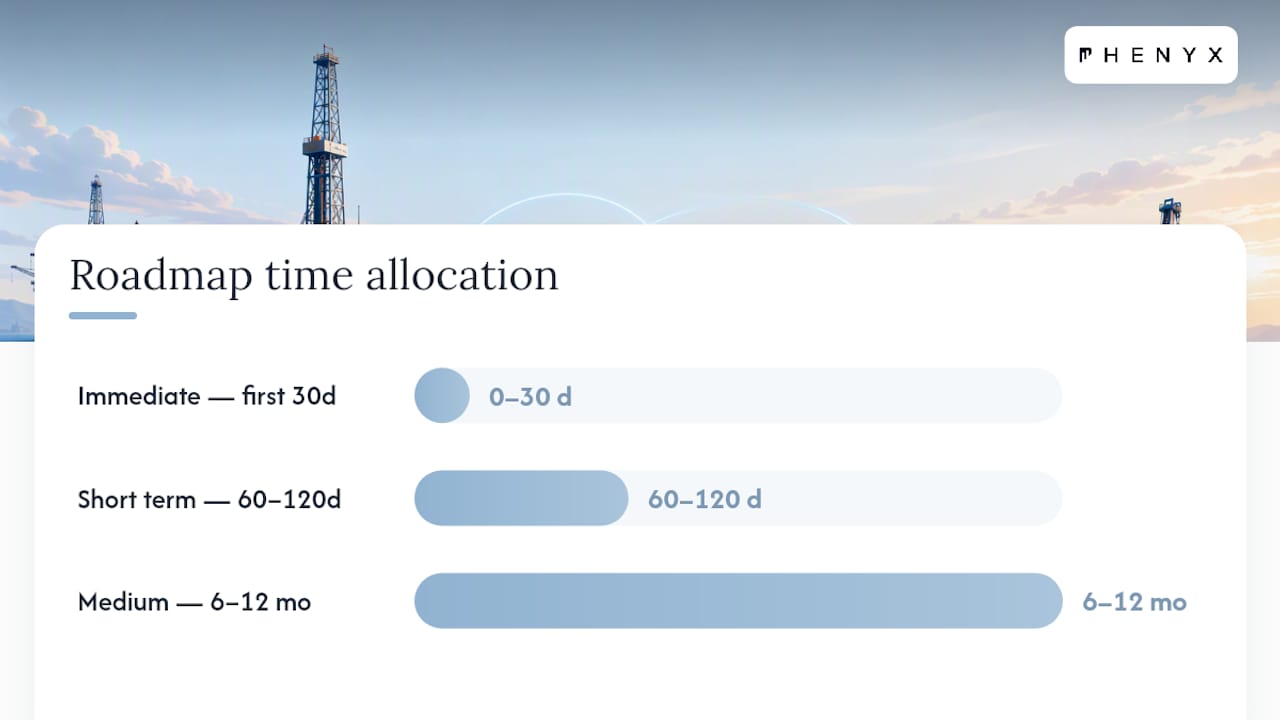
Implementation Checklist and 6 to 12 Month Roadmap
Standing out isn’t a one-time campaign. It’s a sequence of proof points stacked over roughly a year.
Immediate (first 30 days):
- Segment your buyer audience by role and map messaging to each.
- Audit your website for technical credibility gaps and conversion path clarity.
- Scope one pilot around a single, measurable service.
Short term (60 to 120 days): 4. Launch the pilot with baseline metrics locked in advance. 5. Produce at least one technical brief and one case summary from early results. 6. Record a video demo of the actual system or process in action.
Medium term (6 to 12 months): 7. Scale the productized service to additional accounts based on pilot proof. 8. Update commercial terms to include performance-based or subscription options. 9. Build sales enablement materials that let your team pitch the metric, not the feature list.
Pro Tip: Assign one person to own the pilot’s data integrity from day one. Pilots fail to convert most often not because the results are bad, but because nobody can defend the numbers when procurement asks how they were measured.
Why Integrated, In-House Marketing Shortens Procurement Cycles
Every section above assumes your marketing, technical content, and sales proof are telling the same story. That’s harder than it sounds when your website is built by one vendor, your video is outsourced to another, and your case studies get written by whoever has time. Message drift creeps in, and operators notice inconsistency fast, especially when they’re comparing your one-pager against your website against your sales deck.
An in-house, integrated model closes that gap. When web design, SEO, video, and branding come from one coordinated team instead of five disconnected vendors, the technical story stays consistent from the first search result to the final pilot proposal.
- One team means one set of facts about your pilot results, not three slightly different versions.
- Faster execution on time-sensitive proof points, like turning pilot data into a case summary before the next sales cycle.
- Brand consistency across every touchpoint an operator’s procurement and engineering teams will see.
If you’re weighing whether to brief an outside partner or build this in-house, start by evaluating how many vendors currently touch your marketing output. Phenyx’s work with oil and gas service companies centers on exactly this consolidation problem.
Tactical Priorities for Marketing Leaders
Most service companies default to a broad rebrand when they feel commoditized. That’s usually the wrong move. A rebrand doesn’t shorten a procurement cycle. A measurable pilot does.
Prioritize engineering-marketing alignment before visual identity work, and get data governance right before you pitch any AI-driven offer. Pick one service to productize and prove before trying to scale three at once. Proof beats polish in this buying cycle, every time.
— PHENYX
Scope Your Pilot With an Integrated Marketing Team
Phenyx is the alternative to juggling five different vendors for your positioning, website, and proof content. As a full-service, in-house team, we handle website design, SEO and AEO, video production, and branding under one roof, so your pilot data, your technical pages, and your sales materials all say the same thing at the same time.
If you’re scoping a pilot right now, that consistency is what actually gets an operator’s procurement team to sign faster. Our Website Design team can turn your site into a technical resource that supports conversion, while SEO & AEO Services makes sure engineers searching for your exact problem find you first. For companies ready for ongoing execution across all of it, our MODS plan starts at $4,000 per month and covers the full marketing function without hiring five separate freelancers.
Reach out through Phenyx to schedule a scoping call and map out what a 90-day pilot could look like for your service line.
Sources
- Breaking down the sensing logic and execution of the closed-loop frac system (JPT / SPE)
- World Energy Investment 2025 — executive summary (IEA)
- U.S. marketed natural gas production and regional insights (EIA Today in Energy)
- 2026 Oil and Gas Industry Outlook (Deloitte Insights)
FAQ
What Are the Latest Trends in the Oil and Gas Industry?
Capital discipline, AI adoption, and ESG-linked digital workflows are the biggest shifts shaping vendor selection right now, according to Deloitte’s 2026 outlook. Operators are also favoring flexible, performance-based contracts over long-term fixed pricing, per IEA’s 2025 investment data.
What Is the 3-3-3 Rule for Marketing?
Definitions of this rule vary across marketing sources, and there’s no single agreed-upon version specific to the oil and gas sector. Rather than force-fit a generic framework, focus on the structure that does work for this industry: segment your buyer by role, productize one measurable service, and prove it in a defined pilot window.
Is the Oil Business Booming Right Now?
Activity is regionally concentrated rather than uniformly booming, with production rising in basins like the Permian and Haynesville according to EIA data. That regional concentration means demand is strong for agile, lower-cost service providers in those specific plays, even amid broader capital discipline elsewhere.
What Are Some Innovative Ideas for the Oil and Gas Industry?
Closed-loop automated systems that reduce manual high-risk tasks are one proven direction, as detailed in JPT’s coverage of frac system automation. Predictive maintenance built on techniques like slip-to-slip segmentation, along with subscription-based emissions monitoring, are also gaining traction as productized, sellable offers.
How Can Phenyx Help an Oil and Gas Service Company Stand Out?
Phenyx delivers website design, SEO and AEO, video production, and branding from one in-house team, which keeps your technical messaging and proof points consistent across every channel. Pricing for ongoing support through the MODS plan starts at $4,000 per month, with individual services like Website Design and SEO & AEO available separately.