


HVAC companies in Colorado Springs that invest in local SEO consistently generate three to five times more inbound calls than those relying on referrals alone. The most important ranking factors are an active Google Business Profile, location-specific service pages, and a steady stream of new reviews. PHENYX helps HVAC and contractor businesses turn their websites into lead generation assets that work around the clock.
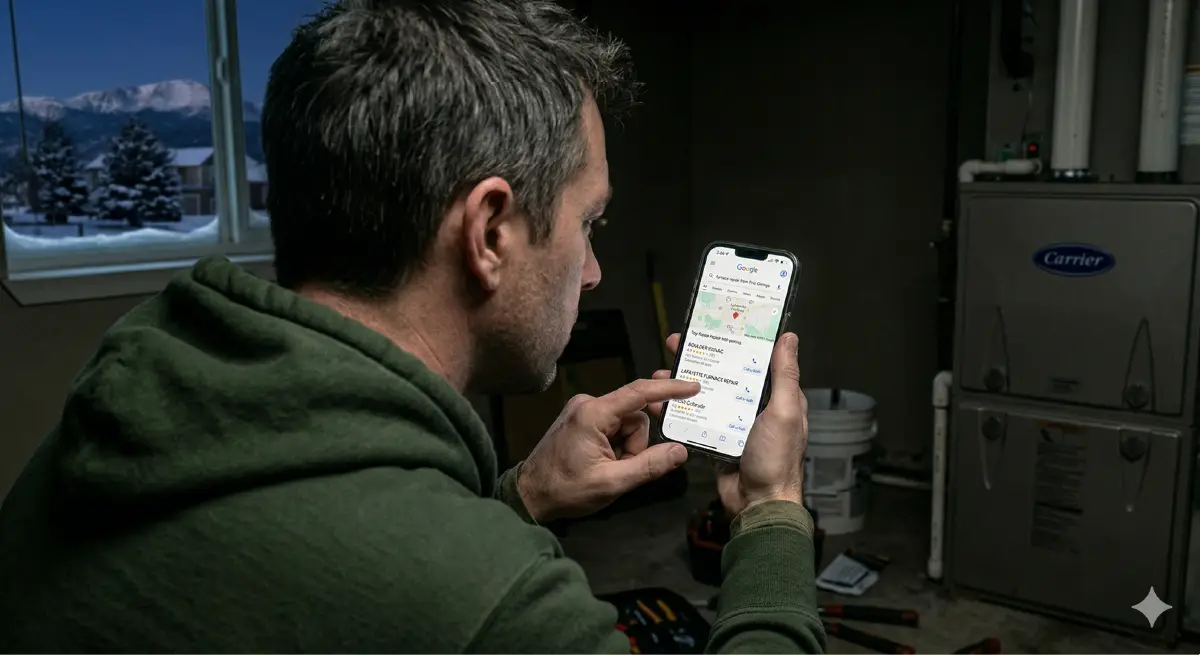
You run a solid HVAC operation in Colorado Springs. Your crews show up on time, your pricing is fair, and customers regularly send their neighbors your way. But when a homeowner types "furnace repair Colorado Springs" into Google at 9 p.m. on a cold October night, the company on the first page books that job — and it probably isn't you. The contractor ranking there may not be more skilled or more affordable. They invested in SEO before you did.
This is the defining competitive gap in the local HVAC market right now. Seasonal demand is intense, homeowners search before they call, and search visibility determines who gets the work. This guide breaks down what HVAC SEO actually requires in 2026 — not vague theory, but the specific actions that separate busy contractors from slow ones.
Why HVAC Companies Lose Business to Better-Ranked Competitors
The local HVAC market is crowded. National chains run large paid search campaigns. Regional players invest in content teams and link-building programs. Dozens of independent contractors compete for the same pool of homeowners. In that environment, a basic website with a phone number and a generic services page generates almost no organic traffic.
Google's algorithm for local results weighs three signals: relevance, distance, and prominence. Relevance means your content matches what the searcher is looking for. Distance is straightforward — Google favors businesses close to the searcher. Prominence is where most HVAC contractors fall short. It reflects how established and credible your business appears online, measured through review volume, backlinks, and how consistently your business information appears across the web.
The contractors dominating local search have built prominence deliberately. They post to their Google Business Profile weekly, respond to every review within 24 hours, and maintain separate website pages for furnace replacement, AC installation, heat pump service, and duct cleaning. Those pages target specific neighborhoods — Briargate, Broadmoor, Fountain, Manitou Springs — because geographic specificity signals relevance to Google in ways a generic services page cannot. This intentionality compounds over time and creates a lead generation advantage that competitors struggle to close quickly.
What Local SEO Actually Means for an HVAC Business
Local SEO is the practice of optimizing a business's online presence to appear prominently in geographically relevant search results. For an HVAC company, that means ranking when a nearby homeowner searches for emergency AC repair, furnace installation, or heat pump maintenance — not when someone two states away searches the same terms.
The tactics differ from general SEO. Local SEO centers on your Google Business Profile, consistent NAP citations (your name, address, and phone number) across directories like Yelp, Angi, and the Better Business Bureau, and on-page content that ties your services to specific zip codes and communities. Google cross-references your business data across the web — inconsistencies, even minor ones like "Blvd." versus "Boulevard," reduce trust and cost rankings.
Seasonality matters in ways it doesn't in most markets. Searches for "furnace repair" spike in October as Front Range temperatures drop sharply. "Air conditioner installation" surges in May before summer heat arrives. A contractor who publishes a furnace tune-up guide in September captures searches that a company publishing the same content in December simply misses. Aligning your content calendar with seasonal search patterns is one of the highest-return activities in HVAC marketing.
The Local Pack and Why It Outranks Standard Organic Results
When someone searches "HVAC companies near me," the first results they typically see are a map pack — three business listings with star ratings, phone numbers, and directions. This local pack appears above standard organic results and includes immediate action buttons on mobile. Ranking in it consistently is often more valuable than a standard first-page organic position. Earning a local pack slot requires an optimized, regularly updated Google Business Profile and a sustained review acquisition program.
The Keywords Homeowners Search Before They Call an HVAC Company
High-intent HVAC searches follow a predictable structure: service plus location. "Furnace replacement Colorado Springs," "AC repair near me," "heat pump installation 80920," and "24-hour HVAC service" are the searches that generate calls. Each of these deserves its own dedicated page on your website — not a catch-all services page trying to rank for everything at once.
Equipment-specific searches convert at high rates because those homeowners have already done their research. "Carrier furnace repair," "Lennox AC service," and "Daikin mini split installation" indicate buyers close to scheduling service. Ranking for these terms requires content that mentions brand names, equipment types, and your service area explicitly and naturally.
Informational searches build pipeline over time. Questions like "why is my furnace short cycling" or "what SEER rating do I need at high altitude" bring in homeowners who are not ready to book yet — but many return when urgency hits. According to BrightLocal's Local Consumer Review Survey, 98 percent of consumers used the internet to find a local business in the past year. Showing up during informational searches keeps you in the consideration set when the need becomes urgent.
The city sits at 6,035 feet above sea level, which affects HVAC equipment efficiency ratings, sizing requirements, and performance expectations. Content addressing high-altitude HVAC conditions signals genuine local expertise and differentiates you from contractors using generic national templates.
How Your Google Business Profile Generates HVAC Calls
Your Google Business Profile is the most important single asset in a local SEO strategy. It populates the local pack, the knowledge panel when someone searches your company name directly, and map results on mobile. A neglected or incomplete profile costs you inbound calls every week.
Start with the non-negotiables: your business name, address, phone number, and website URL must be identical across your Google Business Profile and every directory where your business is listed. Set your service area to cover all of Colorado Springs and the surrounding communities your trucks actually reach — Fountain, Security-Widefield, Peyton, Monument, and Manitou Springs are all worth including.
List every service you offer as individual line items. Upload genuine photos — trucks, technicians at job sites, completed installations — not stock images. Businesses with more than 100 photos receive significantly more website visits and direction requests than those with fewer than ten.
Reviews are the single most valuable activity in local HVAC marketing. A contractor with 175 four-and-a-half-star reviews will consistently outrank a competitor with 20 reviews, even if that competitor has a technically stronger website. Build a review request into your post-service workflow: text a direct Google review link to each customer within 30 minutes of job completion, while satisfaction is still fresh.
Building an HVAC Website That Ranks and Converts
A website that ranks is only valuable if it converts visitors into booked appointments. For HVAC contractors, conversion depends on three things: fast load times, clear paths to contact, and trust signals that make a homeowner confident enough to pick up the phone.
Page speed is a direct Google ranking factor. A site that loads slowly on mobile — where most local searches happen — loses both positions and visitors. Your site should load in under three seconds on a standard 4G connection. That requires compressed images, minimal third-party scripts, and a hosting environment built for performance. Most contractor websites built five or more years ago fail this test without significant intervention.
Every service page needs a phone number visible in the header without scrolling, a contact form above the fold, and a clear statement of your service area. If you offer 24/7 emergency service, make it prominent. "Emergency HVAC Available Now — Call Us" consistently outperforms clever headlines in conversion testing.
Trust signals reduce friction. Certifications like NATE and EPA 608, years in business, manufacturer partnerships, and real photos of your technicians lower uncertainty and raise the likelihood a visitor calls. The PHENYX SEO program addresses both ranking and conversion for HVAC businesses — because traffic that doesn't convert is a cost, not a result.
Common Questions
How long does it take for HVAC SEO to show results?
Most HVAC companies see measurable local ranking improvements within 90 to 120 days of implementing a structured SEO strategy. Google Business Profile optimizations and review acquisition often produce visible results faster — sometimes within 30 days. Content-driven improvements to organic rankings typically take three to six months to compound into consistent lead flow. Unlike paid advertising, the authority you earn through SEO continues working even if you reduce activity temporarily.
Is Google Ads or SEO a better investment for HVAC marketing?
Google Ads and SEO serve different functions and work best together. Ads produce immediate visibility at a cost-per-click that stops the moment you pause campaigns. SEO builds organic ranking authority that doesn't require ongoing ad spend to maintain once established. The most effective HVAC marketing approaches run paid search for immediate call volume while building SEO equity that progressively reduces cost-per-lead over 12 to 18 months.
Does an HVAC company need a blog to rank well on Google?
A blog is not required to rank for high-intent HVAC service keywords, but it substantially accelerates the process. Strong, location-specific service pages can rank on their own. However, a regularly updated blog answering homeowner questions — seasonal maintenance schedules, high-altitude HVAC performance, energy efficiency tips — builds topical authority that helps core service pages rank faster. It also captures potential customers earlier in the buying process, before they've chosen a contractor.
If you're ready to stop losing work to competitors who outrank you online, contact PHENYX today to learn what a focused SEO strategy can do for your HVAC business this year.




%20(2).svg)
%20(1).svg)
