

6 Steps to Convert Engineers: Industrial Marketing for Technical B2B Teams
Industrial marketing is B2B marketing for manufacturers and suppliers, and it runs on trust and proof rather than volume. The core imperative is technical clarity: buying committees need evidence, not slogans, before they’ll move a purchase order forward. The single highest-leverage action is redirecting budget toward high-intent content and sales enablement assets that shorten the evaluation stage, since that’s where long, multi-stakeholder deals stall.
TL;DR:
- Prioritize high-intent content such as application pages and ROI tools to shorten the slow evaluation stage where deals tend to stall.
- Focus heavily on technical validation channels like search and content, trade shows and referrals, and LinkedIn targeted ads, aligning each with different buying stages.
- Measure success by pipeline influence, conversion rates on technical pages, and sales cycle velocity rather than surface metrics like impressions.
- Ensure messaging is outcome-driven and role-specific, with sales assets tailored to each buyer stage to build trust and reduce uncertainty.
- Fix vague messaging and weak follow-up to improve deal progress, rather than relying solely on increasing traffic or impressions.
Table of Contents
- Quick Summary
- What Is Industrial Marketing?
- How Industrial Marketing Differs From Consumer Marketing
- Which Channels Actually Move Industrial Deals?
- What KPIs Actually Matter in Industrial Marketing?
- A Step-by-Step Playbook for Building Your Program
- Common Pitfalls and Fast Fixes
- Why the Real Bottleneck Isn’t Awareness
- How PHENYX Helps You Execute This Playbook
- Sources
- FAQ
Quick Summary
- Industrial marketing is B2B marketing built for long sales cycles and technical buying committees.
- Prioritize three channels: search and technical content, trade shows and referrals, and LinkedIn with targeted paid.
- Track qualified pipeline, marketing-influenced pipeline, and conversion on high-intent pages instead of impressions.
- Build a message stack that leads with business outcome, then operational impact, then proof.
- Segment by application and role, not just company size or SIC code.
- Give sales enablement assets (ROI tools, checklists, case studies) the same production budget as top-of-funnel content.
- Fix vague messaging and weak follow-up before adding new channels.
What Is Industrial Marketing?
Cambridge’s dictionary defines industrial marketing as trade in products and services between companies, particularly goods used in manufacturing, where suppliers often work directly with buying organizations to solve technical problems. Wikipedia frames it more broadly as the marketing of goods and services from one business to another, where industrial goods are inputs used to produce something else, not finished products sold to consumers. Both definitions point at the same reality: this is B2B marketing, but with technical stakes attached.
Several traits separate it from other B2B categories. Sales cycles routinely stretch across months or quarters because equipment, materials, or components get scrutinized by engineers, procurement, finance, and plant operations before anyone signs. Buyers are technical and skeptical of marketing language they can’t verify. Decisions involve multiple people with competing priorities, which means a single persuasive pitch rarely closes a deal alone. And because switching suppliers often means requalifying a process or retooling a line, solution selling, not transactional selling, wins.
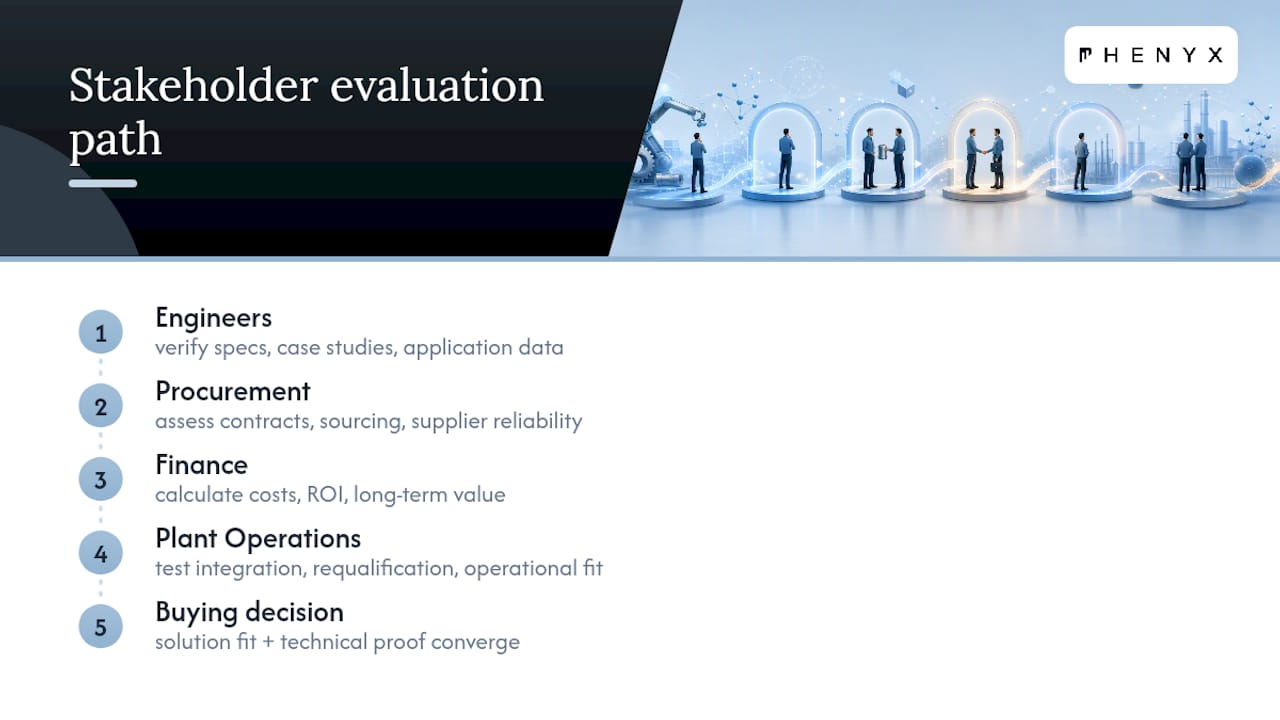
That combination makes proof the primary conversion driver. Specs, case studies, and application data do the work that emotional branding does in consumer markets.
How Industrial Marketing Differs From Consumer Marketing
Consumer marketing sells to individuals who often decide in minutes and switch products on a whim. Industrial marketing sells to committees who spend months evaluating a decision that could affect production uptime for years.
- Sales cycles: days or weeks in B2C versus months or quarters in industrial deals.
- Buyer psychology: emotional and impulse-driven in consumer purchases versus risk-averse and evidence-driven in industrial buying.
- Decision complexity: one buyer in most B2C transactions versus five or more stakeholders (engineering, procurement, operations, finance) in a typical industrial sale.
- Switching cost: low for consumer goods versus high when a new supplier means requalifying a process or retraining a crew.
That’s why a lifestyle ad works for a consumer brand but falls flat for a valve manufacturer. Industrial buyers respond better to an application page that shows the part solving their exact problem, with tolerances and material specs listed plainly.
Which Channels Actually Move Industrial Deals?
Different channels do different jobs across the buying journey, and the mistake most teams make is treating every channel as a demand-generation tool. Some channels build relationships. Others confirm decisions people already lean toward.
- Search and technical content handle discovery and validation. Buyers search for spec sheets, application guides, and comparison pages long before they contact sales, and a modern industrial marketing playbook treats this content as the backbone of the whole program.
- Trade shows, referrals, and partner channels build the relationship and reputation that industrial buyers rely on more than any ad. Research on industrial B2B marketing for manufacturers points to these relationship channels as consistent top performers because they transfer trust directly, person to person.
- LinkedIn and targeted paid work for account awareness once your message is sharp enough to earn attention from a specific title at a specific company, not a broad audience.
- Sales enablement assets, meaning application pages, ROI calculators, implementation checklists, and case studies, give your sales team something concrete to hand a skeptical engineer.
Map each channel to a stage: search and content for early research, events, and referrals for relationship-building, LinkedIn for account-level awareness, and enablement assets for the final evaluation push.
Pro Tip: Audit your best-converting sales enablement asset today. If it doesn’t answer “will this work in my specific application,” rewrite it before you spend another dollar on new-channel testing.
What KPIs Actually Matter in Industrial Marketing?
Impressions and page views tell you almost nothing about whether marketing is moving deals. The metrics that matter connect activity to pipeline and revenue.
- Qualified pipeline generated, segmented by product line or application.
- Marketing-influenced pipeline, tracking every touch a deal had before it closed.
- Win rates by segment, which reveal where your messaging resonates and where it doesn’t.
- Sales-cycle velocity, since a shorter cycle usually means your content is doing its job earlier.
- Conversion rate on high-intent pages like application guides and comparison pages.
Keep a second layer of operational metrics running underneath: follow-up response time on inbound leads, CRM data hygiene, and how long it takes to produce a new piece of technical content. None of this happens in a vacuum. B2B digital ad spend in the U.S. continues to represent a meaningful share of overall marketing budgets, which means the channels you’re measuring are competing for real dollars against companies that already track this rigorously. Attribution for events and technical content works best when you tag every touchpoint in your CRM and review win rates quarterly by source, not just by total lead count.
A Step-by-Step Playbook for Building Your Program
Most industrial marketing programs fail not from lack of effort but from skipping sequence. Segmentation, message architecture, and channel mapping need to happen in order, not all at once.
- Segment by application and role, not just firmographics. A plant engineer and a procurement director need different proof points even at the same company.
- Build your message stack in order: business outcome first, then operational impact, then commercial impact, then risk reduction, then supporting proof. This sequence, outlined in the Prose industrial marketing playbook, reduces buyer uncertainty faster than leading with features.
- Assign each channel a specific job in the funnel instead of asking every channel to generate leads.
- Create sales-facing assets for each buying stage, from an early-stage application page to a late-stage ROI worksheet.
- Set a resourcing model that puts real budget behind enablement content, not just top-of-funnel campaigns.
- Build a minimal measurement dashboard covering pipeline influence, win rates, and cycle velocity so you can see what’s working within a quarter.
| Playbook Step | Primary Owner | Output |
|---|---|---|
| Segmentation | Marketing + Sales | Buyer/application profiles |
| Message architecture | Marketing | Outcome-led messaging stack |
| Channel mapping | Marketing | Stage-to-channel assignments |
| Enablement assets | Marketing + Sales | ROI tools, checklists, case studies |
| Measurement | Marketing + RevOps | Pipeline and velocity dashboard |
Strong relationship marketing plays a role here too. Trust-based, loyalty-driven strategies tend to outperform one-off lead generation pushes in markets where the buyer expects a long-term supplier relationship, which describes most industrial purchasing.
Common Pitfalls and Fast Fixes
The most common mistake is vague messaging that could describe any supplier in the category. A close second is leaning on impression counts to prove marketing value when nobody in the boardroom cares about impressions. Third is weak sales enablement, where reps get generic brochures instead of application-specific tools.
Fast fixes: rewrite one high-intent page this week to name the exact application and outcome. Build one role-based nurture flow for procurement versus engineering. Ship one implementation checklist your sales team can hand a prospect tomorrow. A structured framework with in-house teams keeps execution consistent instead of fragmented across vendors.
Why the Real Bottleneck Isn’t Awareness
Most industrial marketing advice still treats this like a demand-generation problem, and that’s the gap worth naming. Awareness rarely kills industrial deals. A stalled evaluation kills them, usually because the buying committee couldn’t find the proof they needed fast enough, or because the follow-up after a trade show conversation went cold.
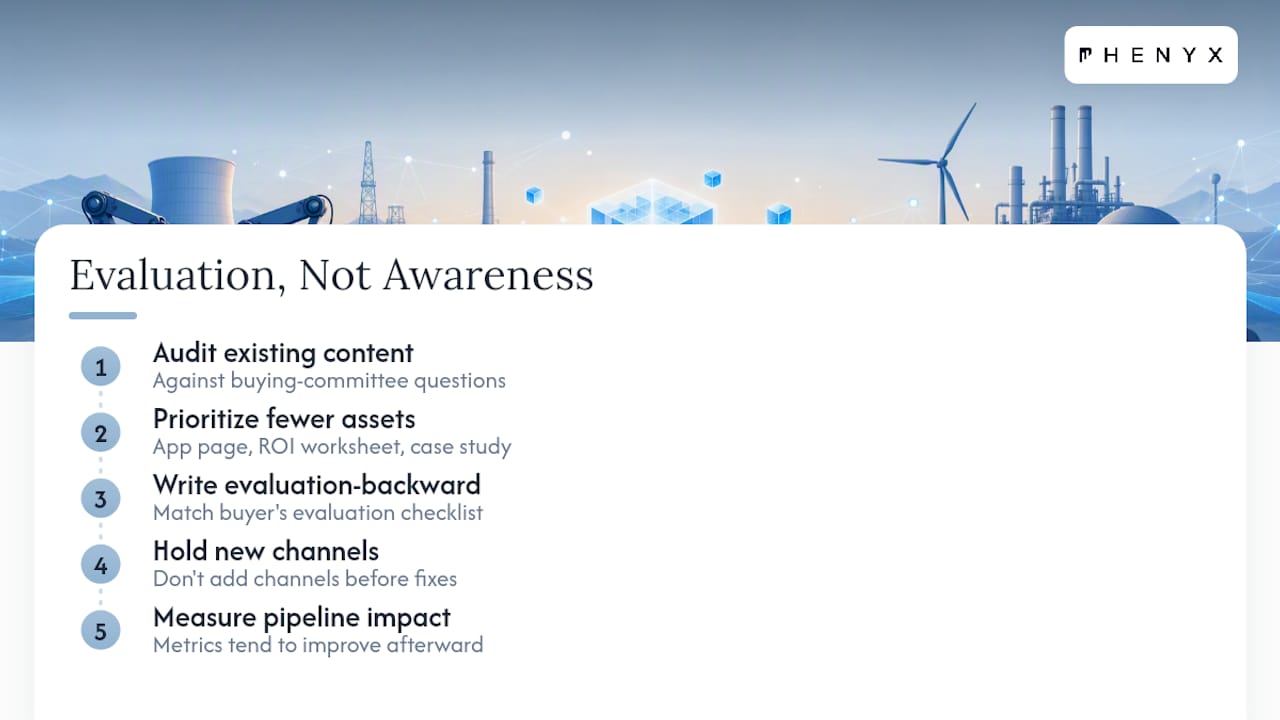
The conventional wisdom pushes teams toward more traffic, more leads, more impressions. What actually moves revenue is fewer, better assets: one application page that answers the exact question an engineer types into Google, one ROI worksheet a procurement lead can forward internally, one case study that mirrors the prospect’s own industry closely enough to matter.
If there’s one thing to prioritize first, it’s auditing your existing content against the buying committee’s actual questions, not your product catalog. Most industrial marketers have plenty of content. Very little of it is written from the buyer’s evaluation checklist backward. Fix that sequencing problem before adding a single new channel, and the pipeline metrics tend to follow on their own.
— PHENYX
How PHENYX Helps You Execute This Playbook
Running this playbook well usually means juggling website changes, technical content, video, and paid campaigns across separate vendors, which is exactly the friction that slows industrial marketing teams down. Website redesign, SEO and AEO, video production, and branding can be coordinated under one in-house team, so application pages, technical explainers, and case study videos reinforce the same message stack instead of pulling in different directions.
That matters most for manufacturers and suppliers who need their site to convert technical buyers on the first visit, not just rank for keywords. A redesigned site built around buyer-stage content, paired with SEO and AEO work tuned to how engineers and procurement teams actually search, gives you a measurable line from content to qualified pipeline instead of a vague traffic report. If your current site or content program can’t show that connection, consider requesting a site and content review to identify gaps.
Sources
- Industrial & manufacturing marketing playbook for 2026: channels, messaging, and metrics | Prose
- Industrial B2B Marketing for Manufacturers | Vx Group
- Industrial marketing - Wikipedia
- INDUSTRIAL MARKETING definition | Cambridge English Dictionary
- B2B ad spend in the U.S. (Statista)
FAQ
What Do You Mean by Industrial Marketing?
Industrial marketing means B2B marketing between businesses, usually involving goods or components used in manufacturing, where technical proof and long evaluation cycles shape every decision.
What Is the 40-40-20 Rule in Marketing?
The rule most associated with direct marketing emphasizes that campaign success depends heavily on audience targeting and the offer. It applies to industrial marketing mainly as a reminder that segmentation and message fit outweigh polish.
Can You Give Me Some Examples of Industrial Markets?
Common industrial markets include manufacturing equipment and machinery, industrial components and materials, chemical processing, construction supply, and industrial automation systems, all of which involve business-to-business transactions rather than consumer sales.
What Is the 3-3-3 Rule in Marketing?
Definitions of the 3-3-3 rule vary across marketing disciplines, and no single standard version applies specifically to industrial marketing, so it’s best treated as a general content or prospecting heuristic rather than an industrial marketing standard.
How Long Does an Industrial Marketing Sales Cycle Usually Take?
Industrial sales cycles typically run months rather than days, since multiple stakeholders, technical validation, and procurement approval all add time before a purchase order gets signed.