

Reserve 5–15%: Finance Ready Marketing Budget Allocation for Marketers
Allocate marketing budget by protecting your highest-performing capture channels first, funding demand creation second, and reserving 5 to 15% for testing new bets before scaling them. Defend every allocation with incrementality, LTV:CAC, and payback period, not platform-reported ROAS alone. That single shift, measuring true contribution instead of self-reported clicks, is what separates budgets that survive a tough quarter from ones that get slashed in a finance review.
TL;DR:
- Allocate most of the budget to proven channels like search and retargeting, reserving 5 to 15 percent for testing new opportunities before scaling.
- Use true contribution metrics such as incrementality, lifetime value to customer acquisition cost ratio, and payback period rather than platform-reported ROAS to defend funding decisions.
- Adjust channel roles and spend based on business stage, emphasizing brand and demand capture during launch, expanding nurture during growth, and increasing brand focus at scale.
- Reallocate spend monthly based on performance triggers, avoiding reactionary cuts from short-term fluctuations and conducting biannual incrementality tests for validation.
- Build a flexible, scenario-planned budget model with input from finance to ensure continuous alignment with market shifts and business goals.
Table of Contents
- What Is Marketing Budget Allocation?
- Quick Summary
- How Do You Decide Your Total Marketing Budget?
- How Should You Split Budget Across Channels?
- What Metrics Prove Marketing ROI to Finance?
- When Should You Reallocate Marketing Spend?
- Common Marketing Budget Mistakes (and Quick Fixes)
- How Does Customer Segmentation Change Budget Allocation?
- How Should the Product Lifecycle Shape Your Budget?
- How Do You Build Flexibility Into Your Marketing Budget?
- What Tools Help With Marketing Budget Planning?
- How Should You Budget for Influencer and Content Marketing?
- Practitioner Perspective: Budgeting as an Operating Model
- Get Help Building and Running Your Allocation Model
- Sources
- FAQ
What Is Marketing Budget Allocation?
Marketing budget allocation is the process of deciding how much total revenue or capital goes toward marketing, then splitting that total across channels, campaigns, and functions based on the role each one plays in growth. It’s a distinct discipline from marketing planning. Planning asks what you’ll do. Allocation asks how much each activity deserves relative to its proven or expected return.
Most companies get this backwards. They start with a wish list of tactics, add up the costs, and call that the budget. A defensible allocation works the other way: start with a total spend figure tied to revenue or business goals, then push that number down into channels ranked by measured contribution, not by which team shouts loudest in the planning meeting.
Quick Summary
- Set total spend using one of three defensible methods: revenue percentage, CAC-driven, or contribution margin.
- Benchmark ranges vary by stage: launch-phase companies often spend a higher percentage of revenue than mature, scale-stage ones, per HubSpot’s marketing budget data.
- Protect capture channels (search, retargeting) first, then fund demand creation, then brand.
- Reserve a modest percentage of total budget for testing and new-channel experiments before committing bigger dollars.
- Review performance weekly at the tactical level, and make real reallocation decisions monthly.
- Lead with incrementality and LTV:CAC in finance conversations, not raw ROAS, since Bain’s research shows this is what earns budget trust.
- Our in-house teams use integrated allocation and tracking systems across paid, organic, and creative channels to shorten the feedback loop between spend and results.
- We start every retainer engagement with a baseline audit before recommending any reallocation, a discipline that keeps early decisions grounded in actual account data rather than assumptions.
How Do You Decide Your Total Marketing Budget?
There are three defensible ways to land on a total marketing budget, and each fits a different business situation.
- Revenue percentage. You set marketing spend as a fixed share of revenue, often within a range depending on industry and growth stage, according to HubSpot’s benchmark data. This works well for established companies with predictable revenue, but it can starve a fast-growing product line that needs disproportionate investment early.
- CAC-driven targets. You calculate what you can afford to spend to acquire a customer profitably, then build total budget from your acquisition goals upward. This method suits subscription and e-commerce businesses with clear unit economics, since you’re working backward from a number finance already trusts.
- Contribution margin approach. You fund marketing as a percentage of gross contribution margin rather than top-line revenue, which protects profitability in low-margin categories. Retail and manufacturing businesses often lean on this method because it prevents marketing from outspending what the product can actually support.
Forrester’s B2B marketing budget benchmarks show that B2B companies typically allocate a lower percentage of revenue to marketing than B2C companies, and service businesses tend to spend more proportionally than product businesses, per HubSpot’s data. That split shows up consistently enough that if your B2B budget mirrors a consumer brand’s percentage, something in your model needs a second look.
Once you have a total, assign every channel a role. Capture channels (branded search, retargeting) harvest demand that already exists. Nurture channels (email, SMS, retention content) extend customer value after the first purchase. Brand channels (video, sponsorships, upper-funnel content) build awareness that pays off over quarters, not days. Expansion channels are the new bets: emerging platforms, influencer partnerships, untested audiences.
Here’s how that typically breaks down by stage:
Launch stage: Heavier weighting toward brand and capture, lighter on nurture since the customer base is still small.
Growth stage: Capture still leads, but nurture grows fast as the customer list matures.
Scale stage: Brand often claims a larger share here because diminishing returns on paid capture push companies to build durable demand.
These percentages are starting points, not laws. Adjust them against your own CAC trends and the Gartner benchmark guidance on protecting catalytic, long-term brand investment even when budgets tighten.
How Should You Split Budget Across Channels?
Once the totals are set by role, the next decision is how much each specific channel gets and how you split spend within it.
- Search (branded and nonbrand): Branded search should get a modest, protected share since it converts existing demand cheaply. Nonbrand search usually absorbs a larger portion of the paid budget because it’s where new customer volume comes from, but watch CPA trends closely here since costs escalate quickly in competitive categories.
- Paid social: Split spend between prospecting (finding new audiences) and retargeting (converting warm audiences). Retargeting usually costs less per conversion, but a budget that’s all retargeting eventually runs out of prospects to warm up.
- Content and SEO: This is a compounding asset, not a campaign. Treat it as a steady percentage of the brand and nurture buckets rather than a line item you cut when the quarter gets tight.
- Email and SMS: Typically the smallest dollar line but often the highest return per dollar spent, since it’s reaching people who already know you.
- Marketplaces: If you sell through Amazon, Etsy, or similar platforms, budget separately for marketplace advertising since its economics (and its data visibility) differ sharply from your owned channels.
- Events and sponsorships: Best reserved for B2B and high-consideration purchases where relationship building drives the sale.
- Tools, technology, and staff/agency fees: Forrester’s benchmarks note that B2B marketers commonly dedicate a meaningful slice of budget to technology and personnel, not just media, and that split is worth tracking separately from your media spend.
Tilt these ranges based on your situation. A B2B software company with a long sales cycle should weight events and content higher than a direct-to-consumer skincare brand, which likely leans harder into paid social and influencer spend. Seasonal businesses need to front-load capture budget ahead of demand spikes rather than spreading it evenly across the year. Rising platform costs are also reshaping these splits. If you haven’t revisited your paid media pacing lately, this piece on managing the surge in digital advertising costs walks through practical adjustments. And for a partner perspective on trimming waste before a new quarter starts, Monstrous Media Group’s guide to maximizing ad budget before Q2 covers tactical moves worth reviewing.
What Metrics Prove Marketing ROI to Finance?
Finance teams don’t trust ROAS the way marketers do, and for good reason: platform-reported ROAS counts conversions that would have happened anyway. Incrementality measures what actually changed because of the spend. That distinction is the entire basis of the CMO-CFO trust gap, and closing it starts with using the right numbers in the room.
Bain’s research on the marketing-finance divide found that companies with strong CMO-CFO collaboration are roughly 1.5 times more likely to lead their sector, largely because finance increasingly expects proof through incrementality, contribution margin, LTV:CAC, and payback period, not attribution dashboards alone.
Here’s what belongs in a CFO-facing report:
- LTV:CAC ratio. A ratio around 3:1 or higher generally signals healthy unit economics, though the right target varies by margin structure.
- Payback period. How many months it takes to recover acquisition cost. Shorter is better for cash flow, especially for smaller businesses without deep reserves.
- Blended MER (marketing efficiency ratio). Total revenue divided by total marketing spend, useful as a sanity check across all channels combined rather than platform by platform.
- Contributed pipeline or revenue. What marketing can credibly claim influenced, tracked against a baseline.
When full incrementality testing isn’t feasible, Gartner’s guidance suggests triangulating with blended MER, pipeline share, and comparative lift across matched time windows rather than trusting raw platform attribution. Package these into a monthly one-page narrative dashboard rather than a slide deck full of channel-by-channel screenshots. If your current reporting is scattered across platform logins, this breakdown of marketing dashboard metrics that actually drive decisions is worth a look, as is a refresher on ad tracking fundamentals if attribution gaps are part of the problem.
Pro Tip: Bring finance into the model before you build it, not after you need approval. A CFO who helped set the incrementality assumptions is far more likely to defend the budget when a board member questions it.
When Should You Reallocate Marketing Spend?
Reallocation without rules turns into panic. A bad week shouldn’t trigger a budget cut, and a good week shouldn’t trigger a doubling down. Set the review cadence and the triggers in advance, before performance data gives anyone a reason to react emotionally.
- Weekly reviews cover tactical health: CPA trends, pacing against budget, creative fatigue signals. No reallocation decisions happen here, only flagging.
- Monthly reviews are where real reallocation happens. Compare channel performance against the metrics from the previous section, not just spend versus plan.
- Trigger-based rules remove emotion from the decision. For example: if CPA rises more than 20% for two consecutive weeks, cut that channel’s spend by a set percentage and shift it to the next-best performer. If blended MER falls below your threshold, pause new spend increases and audit the channel before adding more.
- Run holdout or incrementality tests on your top two or three channels at least twice a year. This is where the 5 to 15% experimentation reserve mentioned in industry guidance on marketing budget allocation earns its keep. Test before you scale a new channel with real dollars.
| Review type | Frequency | Owner | Action taken |
|---|---|---|---|
| Tactical pacing | Weekly | Channel manager | Flag anomalies, no budget moves |
| Reallocation decision | Monthly | Marketing lead + finance | Shift spend based on trigger rules |
| Incrementality/holdout test | Quarterly or semi-annually | Marketing lead | Validate or reject channel scaling |
| Full budget reset | Annually | Leadership | Reset totals and role percentages |
Common Marketing Budget Mistakes (and Quick Fixes)
- Overreliance on platform ROAS. Fix: require incrementality or blended MER alongside any platform-reported number before approving a scale-up.
- Cutting brand spend first when budgets tighten. Fix: treat brand as capital with a depreciating value, not a discretionary line, and model the cost of pulling back before you approve the cut.
- No dedicated testing budget. Fix: carve out the 5 to 15% reserve at the start of the planning cycle, not as leftovers after every other channel is funded.
- Inconsistent measurement across channels. Fix: standardize on one attribution window and one reporting cadence across every channel before comparing performance between them.
- Approving cuts without checking the trigger rules first. Fix: require a one-line answer to “which trigger justifies this cut?” before any reallocation gets approved.
How Does Customer Segmentation Change Budget Allocation?
Budgets that ignore segmentation end up funding your loudest customer segment instead of your most valuable one. Start by ranking segments on lifetime value and acquisition cost, then weight channel investment toward where your highest-value segments actually spend attention.
A business with two customer types, a high-frequency low-margin buyer and an infrequent high-margin buyer, shouldn’t split marketing spend evenly between them just because both convert. The high-margin segment might justify a higher acquisition cost and a longer nurture sequence through email or retargeting, while the high-frequency segment might respond better to lightweight, high-volume capture spend.
This also affects channel selection, not just budget size. A B2B segment researching a long sales cycle needs content and events funded ahead of the sale. A transactional consumer segment needs capture budget concentrated at the point of intent. Layering segmentation onto your allocation model means some channels get funded not because they perform best overall, but because they reach the segment worth the most to you specifically. That distinction gets lost when allocation decisions are made purely on blended channel-level ROAS.
How Should the Product Lifecycle Shape Your Budget?
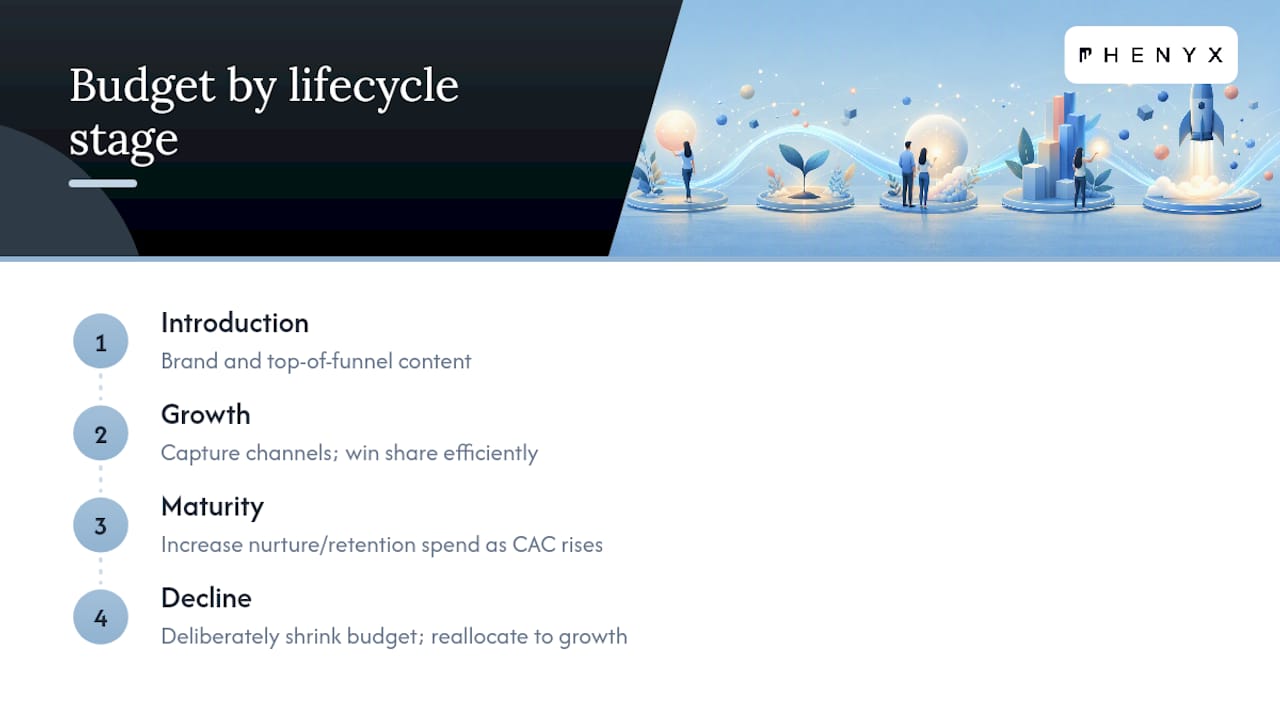
A new product needs awareness spend before it needs conversion spend, and a mature product needs the opposite. Mapping budget against the lifecycle stage of each product line prevents the common error of applying one blended allocation formula across an entire portfolio.
In the introduction stage, budget should skew toward brand and top-of-funnel content since the goal is category education, not immediate conversion. As a product enters growth, capture channels deserve a bigger share since demand now exists and the job is winning share of it efficiently. In maturity, nurture and retention spend should climb since new customer acquisition costs rise as the easy demand gets captured. In decline, budget should shrink deliberately rather than linger out of habit, freeing dollars for whatever product is entering growth next.
This lifecycle lens also protects against a subtle trap: funding your most mature, best-measured product line simply because its ROAS looks the cleanest on a dashboard, while a newer product that needs investment gets starved because its early-stage numbers look worse by comparison. Budget allocation tied to business goals means asking what each product needs to reach its next stage, not just which one reports the highest return today.
How Do You Build Flexibility Into Your Marketing Budget?
Rigid annual budgets break the moment a competitor cuts prices, a platform changes its algorithm, or a market shifts faster than your planning cycle. Scenario planning means building two or three alternate budget models before you need them, not scrambling to build one after the disruption hits.
A practical approach is to define a base case, an upside case, and a downside case for the year. The base case reflects your standard allocation. The upside case identifies where you’d add spend fastest if performance beat expectations (usually your best-proven capture channel). The downside case identifies which channels get cut first and by how much if revenue softens, ideally using the trigger rules already built into your reallocation process.
Keep a portion of budget genuinely uncommitted, beyond the experimentation reserve, so you have room to respond to a competitor’s move or a sudden market shift without pulling money from a channel that’s currently working. Quarterly reviews of your scenario assumptions against actual market conditions keep this from becoming a document nobody looks at again after January.
What Tools Help With Marketing Budget Planning?
Spreadsheets still handle a lot of budget planning, and there’s nothing wrong with that for smaller teams, provided the model is structured around roles and triggers rather than just line items. Google Sheets or Excel templates that map spend against the capture, nurture, brand, and expansion framework work fine at a modest scale.
As complexity grows, marketing resource management platforms and budget-tracking software help centralize spend across multiple channels and prevent the version-control chaos of five people editing the same spreadsheet. Analytics platforms tied to your ad accounts and CRM give you the raw performance data the model needs. Dashboard and reporting tools then translate that data into the monthly narrative finance actually wants to see, rather than raw exports.
The tool matters less than the discipline behind it. A basic spreadsheet with clear trigger rules and monthly review habits will outperform an expensive platform used inconsistently. Choose the simplest tool that your team will actually maintain every month, then invest in something more sophisticated once the manual process starts to strain.
How Should You Budget for Influencer and Content Marketing?
Emerging channels like influencer marketing don’t fit neatly into the capture, nurture, brand framework because they can play multiple roles depending on execution. A single influencer campaign might drive brand awareness and direct conversions simultaneously, which makes it harder to attribute cleanly.
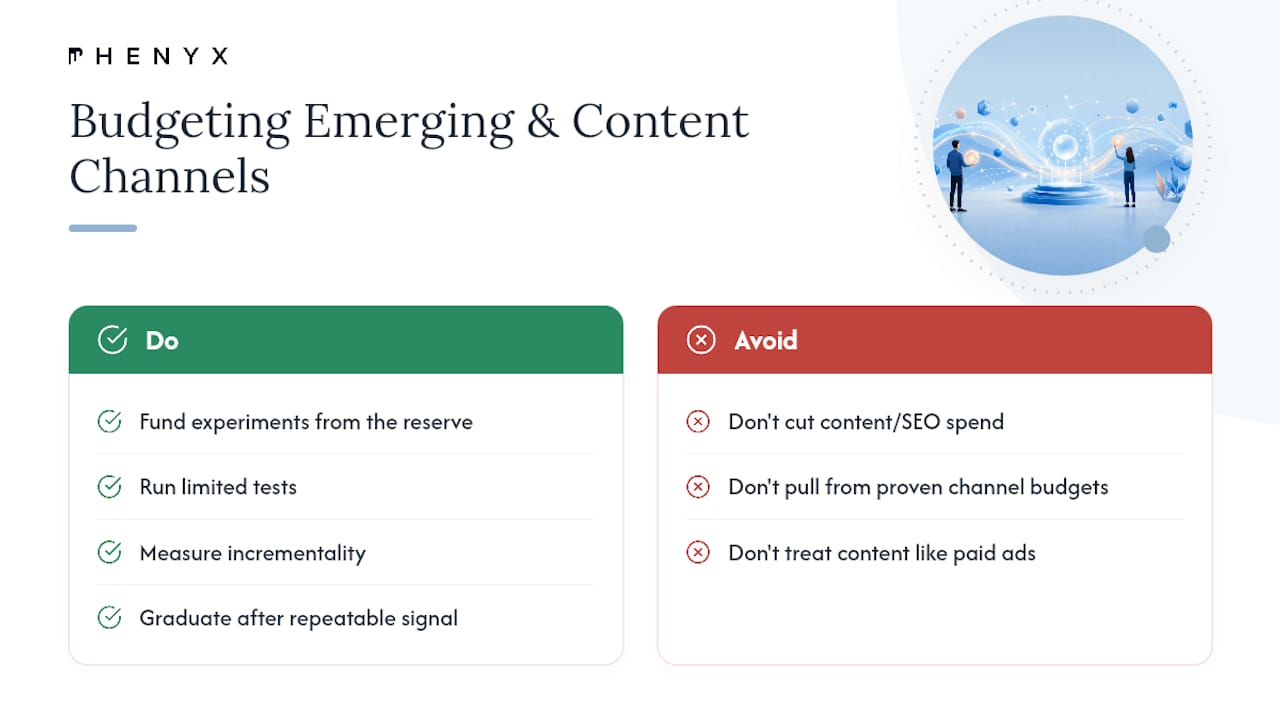
The safest approach is to fund emerging channels out of the expansion or experimentation reserve first, not out of an already-proven channel’s budget. Run a limited test, measure incrementality as closely as you can even if it’s imperfect, and only graduate a channel into a protected, ongoing budget line once it shows a repeatable signal over more than one campaign cycle.
Content marketing and SEO deserve a different lens because their payoff compounds over months rather than showing up in a single campaign window. Treat content budget as a fixed, protected percentage of the brand and nurture allocation rather than something that gets evaluated campaign by campaign like a paid channel would. Cutting content spend the moment a quarter gets tight is one of the more common ways companies undermine their own long-term organic growth, since the traffic and rankings built over the prior year don’t disappear instantly, but they do erode without continued investment.
Practitioner Perspective: Budgeting as an Operating Model
Most marketing budgets fail not because the percentages are wrong, but because nobody treats the model as something to defend over time. A spreadsheet built in January and forgotten until next January isn’t a budget strategy, it’s a placeholder.
The real shift happens when finance helps design the model instead of just approving it after the fact. Bringing a CFO into the incrementality and payback assumptions early changes the entire conversation from “please approve this spend” to “here’s the investment plan we built together.” That’s a fundamentally different negotiation, and it’s why the companies with strong CMO-CFO collaboration keep winning the budget fights that sink less prepared competitors.
Brand spend deserves the same rigor. Treat it as capital with a real cost of deferral, not a line item to trim when a quarter looks soft. Document the rules, defend the long-horizon bets with the same seriousness as the short-term ones, and revisit both every month, not once a year.
— PHENYX
Get Help Building and Running Your Allocation Model
Building the framework is one thing. Running it every month, tracking incrementality, adjusting creative, and reporting results in language finance trusts, is where most internal teams run out of bandwidth. Paid ads and PPC management, ad tracking and measurement setup, and website conversion improvements can be managed under one in-house team to ensure allocation decisions are backed by real tracking data instead of guesswork spread across multiple vendors.
That in-house structure matters more than it sounds. When your paid media, your analytics setup, and your website’s conversion path are handled by separate vendors, reallocation decisions get delayed while everyone points to someone else’s dashboard. When these functions are connected under one team, a channel that’s underperforming can be flagged and adjusted faster, rather than being delayed by coordination across multiple agencies.
If your current budget model needs sharper measurement before you can defend it to finance, start with a look at PHENYX’s paid ads and PPC services to see how allocation, tracking, and reporting come together under one roof.
Sources
- Marketing budget: How much should your team spend in 2026? By industry | HubSpot
- The marketing–finance divide is about proof of performance, not priorities | Bain & Company
- 2026 B2B marketing budget benchmarks | Forrester
- Marketing budget benchmarks and guidance | Gartner
FAQ
What Is the 70-20-10 Rule for Marketing Budget?
The 70-20-10 rule allocates 70% of budget to proven channels and tactics, 20% to newer channels showing early promise, and 10% to experimental, unproven ideas. It is a simplified version of the capture, brand, and expansion framework covered above, useful as a quick mental model rather than a precise formula.
What Is Budget Allocation in Marketing?
Marketing budget allocation is the process of dividing total marketing spend across channels, campaigns, and functions based on their role in growth and their measured contribution to revenue. It’s distinct from simply listing planned activities, since allocation requires ranking and justifying how much each one deserves.
What Is the Ideal Marketing Budget Percentage?
There’s no single ideal percentage since it depends on industry, business stage, and margin structure, but HubSpot’s benchmark data shows ranges commonly falling between 5% and 15% of revenue, with B2B companies generally allocating less than B2C companies.
How Often Should You Review Marketing Budget Allocation?
Review tactical performance weekly to catch pacing and cost issues early, but reserve actual reallocation decisions for a monthly cycle using pre-set trigger rules rather than reacting to short-term noise.