

Up to 287% Higher Purchases: One Team Integrated Marketing Benefits
Integrated marketing delivers three measurable payoffs: stronger brand consistency, higher conversion rates, and lower cost per acquisition through shared assets and coordinated spend. Campaigns that combine three or more channels can generate up to 287% higher purchase rates than single-channel efforts. The rest of this guide breaks down which metrics to track, how to build the strategy, and where most teams get stuck.
TL;DR:
- Campaigns involving three or more channels can achieve purchase rate increases of up to 287% compared to single-channel efforts.
- Consistent messaging across channels fosters brand trust and reduces customer decision friction, leading to higher loyalty and lifetime value.
- Measuring success requires unified dashboards and multi-touch attribution models to accurately credit all touchpoints and assess ROI.
- Clear role definitions using the PESO model, connected systems, and shared KPIs are crucial for effective integration.
- A single in-house agency team streamlines execution, communication, and measurement, especially when scaling integrated marketing initiatives.
Table of Contents
- Quick Summary
- What Are the Main Benefits of Integrated Marketing?
- How Do You Measure Integrated Marketing ROI?
- What Are the Key Components of an Integrated Marketing Strategy?
- How Do You Build an Integrated Marketing Strategy?
- What Barriers Stop Integrated Marketing From Working?
- Which Channels and Tactics Work Best Together?
- What Should You Expect From an Integrated Marketing Partner?
- When Should Integrated Marketing Become a Priority?
- A Single Team Behind Every Channel
- Sources
- FAQ
Quick Summary
- Multi-channel campaigns can drive 287% higher purchase rates than single-channel efforts.
- Consistent messaging strengthens brand trust and loyalty across touchpoints.
- Shared creative assets cut production costs and speed up campaign launches.
- Unified dashboards give you one version of the truth for attribution.
- Cross-functional governance, not more tools, is what fixes most integration failures.
- A single in-house agency model, the approach Phenyx uses, removes vendor handoff delays.
- Start with a pilot across three channels before scaling company-wide.
What Are the Main Benefits of Integrated Marketing?
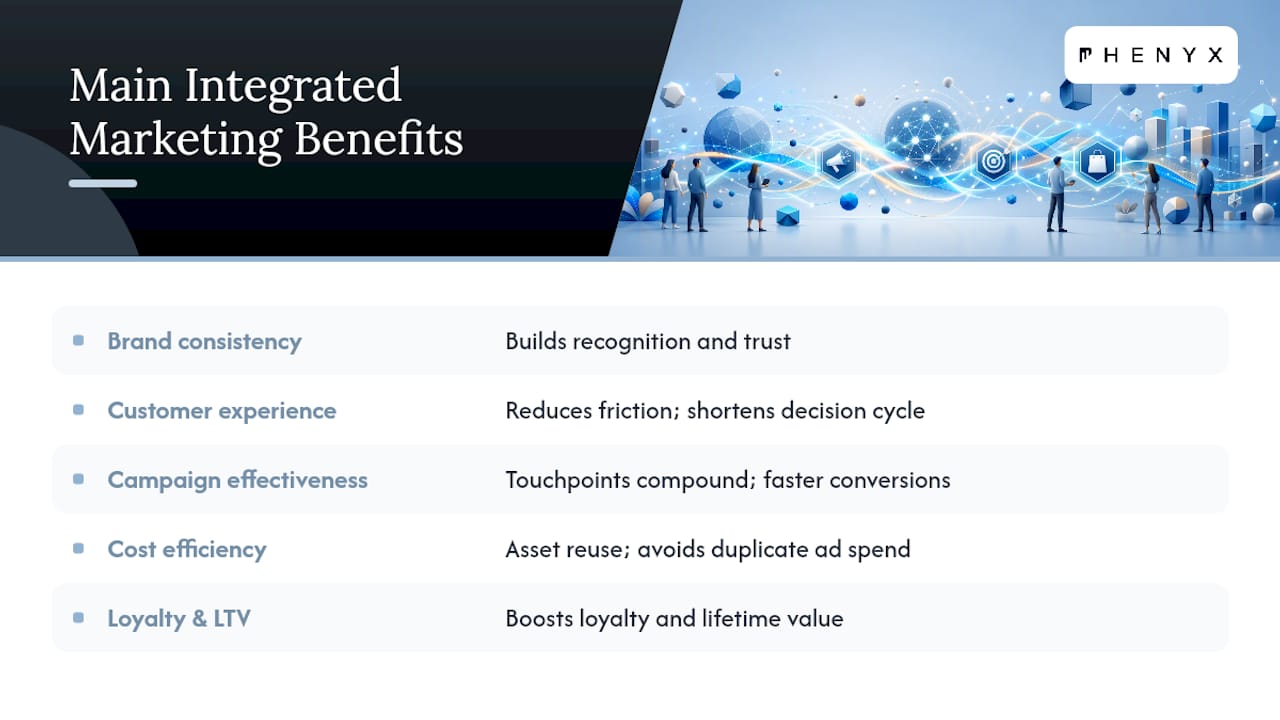
Integrated marketing works because it stops treating each channel as its own project. Email, social, paid search, and your website all reinforce the same message instead of competing for attention with different tones, offers, or visuals. That coordination produces five business outcomes decision-makers actually track.
Brand consistency builds recognition and trust. When a customer sees the same voice and visual identity on your site, in an ad, and in an email, that repetition builds familiarity fast. A study of 452 hospitality consumers found that perceived communication consistency has a strong, statistically significant impact on brand trust and loyalty. Trust is the input; loyalty is the output.
Customer experience improves because friction drops. A prospect who reads one offer in an ad, a different one on the landing page, and a third at checkout hesitates. Aligning that path shortens the decision cycle.
Campaign effectiveness compounds. Each touchpoint reinforces the last, so the cumulative effect shortens time to conversion and improves retention rather than each channel starting from zero.
Statistic Callout: Consumers weigh authenticity heavily in purchase decisions. 97% say brand authenticity influences what they buy, and consistent integrated messaging is one of the clearest signals of authenticity a brand can send.
Cost efficiency comes from reuse, not cutting corners. A hero video shot for a launch campaign becomes a paid social clip, a landing page background, and an email header. Coordinated ad spend across channels also avoids the waste of two teams bidding against each other for the same audience.
Loyalty and lifetime value rise with repeated consistency. Academic literature ties consistency to perceived quality, which in turn supports brand image and loyalty outcomes, though the effect on emotional attachment is more gradual than the effect on trust.
How Do You Measure Integrated Marketing ROI?
The benefits above only matter if you can prove them. That means tracking the right KPIs and resisting the urge to credit the last channel a customer touched before buying.
- Conversion rate by channel and blended across the funnel
- Purchase rate lift when campaigns run on three or more coordinated channels
- Cost per acquisition (CPA) compared before and after integration
- Customer lifetime value (LTV) segmented by acquisition channel mix
- Brand recall and Net Promoter Score (NPS) as consistency proxies
Unified dashboards pull these numbers into one view instead of five separate platform reports, which is where most attribution arguments start. Multi-touch attribution models split credit across every touchpoint a customer engaged with, giving a more honest picture than last-click reporting alone.
Statistic Callout: Coordinated campaigns spanning three-plus channels have shown purchase rate gains of up to 287% over single-channel runs. Treat that as a benchmark to test against, not a guarantee, since attribution models vary and results depend heavily on execution quality.
For a deeper look at which numbers actually belong on your reporting dashboard, this breakdown of marketing dashboard metrics covers the ones that hold up under scrutiny.
What Are the Key Components of an Integrated Marketing Strategy?
Four building blocks separate real integration from a scattered channel list.
- Message architecture and brand standards. One document defining your core value proposition, tone, and visual rules that every channel pulls from.
- Channel role definitions using the PESO model. Paid, earned, shared, and owned media each play a distinct role in the customer journey rather than duplicating the same message.
- Connected systems. A CRM, analytics platform, tag manager, and identity resolution tool that let you follow one customer across channels instead of five disconnected profiles.
- Governance with shared KPIs. A cross-functional team structure and a shared campaign calendar so marketing, sales, and creative aren’t discovering each other’s plans after launch.
A strong brand identity guide is a good place to start building that message architecture if you don’t have one documented yet.
How Do You Build an Integrated Marketing Strategy?
Most teams that struggle with integration didn’t skip strategy, they skipped sequencing. Here’s the order that actually works.
- Set unified business goals and success metrics first. Revenue targets, not vanity channel metrics, should drive the plan.
- Map the customer journey and assign channel roles. Decide which channel handles awareness, which drives consideration, and which closes the sale.
- Build a message architecture and reusable asset library. This is where creative assets get built once and adapted everywhere, cutting production time and cost.
- Implement unified measurement before you launch. Set up your dashboard and attribution model before the first ad runs, not after.
- Pilot across three or more channels, measure, then iterate. Practitioners consistently find the highest initial ROI by testing at this scale before scaling company-wide.
Pro Tip: Build your creative asset library around your three most-used formats first (hero video, static ad, email header) before trying to cover every channel at once. Trying to integrate everything in one quarter is how most pilots stall.
For more on why reusable creative saves both time and budget, this piece on ad campaign creative assets covers the mechanics in more depth.
What Barriers Stop Integrated Marketing From Working?
Two problems account for most failed integration attempts, and neither requires a big budget to fix.
- Organizational silos. Fix them with cross-functional governance and shared KPIs so no team optimizes for a metric that hurts another team’s goal.
- Disjointed measurement. Practitioners report silos and fragmented measurement as the two most common obstacles. Unify your data sources and commit to one attribution model before debating results.
- Process friction. Shared templates, a central asset library, and one campaign calendar eliminate most of the back-and-forth that slows launches.
- Misallocated budget. Reallocate spend toward coordinated experiments across channels rather than funding each channel’s budget in isolation.
Which Channels and Tactics Work Best Together?
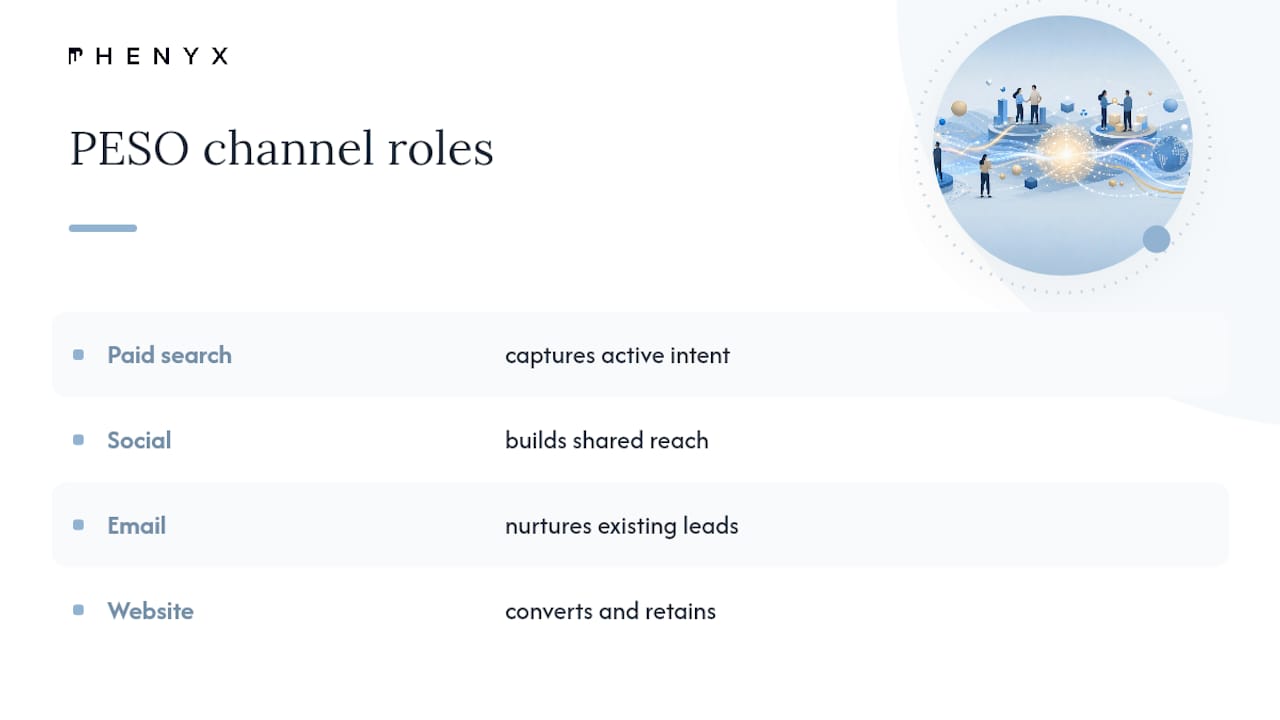
The PESO model (paid, earned, shared, owned) gives you a framework for assigning each channel a job instead of running all of them the same way. A common orchestration looks like: email nurtures existing leads, social builds shared reach, paid search captures active intent, and your website converts and retains.
Sequence matters. Awareness-stage tactics like social and video should run before consideration-stage content like email nurture sequences and retargeting ads, which then hand off to your website for the final conversion. Coca-Cola’s “Share a Coke” campaign is a well-known example of this sequencing done well, correlating with double-digit sales uplifts and stronger teen engagement during its rollout window. Repurpose creative across the sequence rather than building fresh assets for each stage, and set a cadence (weekly, biweekly) so channels stay in sync instead of drifting out of step.
What Should You Expect From an Integrated Marketing Partner?
An agency that actually delivers on integration should have web design, SEO, video, and branding under one roof, not farmed out to subcontractors who never talk to each other. An in-house model can help coordination happen faster by having one team, one brand standard, and one calendar. When evaluating any partner, ask who touches your brand assets, how often teams communicate, and whether reporting comes from one dashboard or five separate invoices.
When Should Integrated Marketing Become a Priority?
Growth-stage businesses in competitive categories benefit the most, since fragmented messaging costs them the most in that phase. If you’re still testing which channel works at all, channel experimentation comes first. Once you know your channels, integration is what turns isolated wins into compounding growth. Phase the budget: prove the pilot, then scale spend behind what works.
— PHENYX
A Single Team Behind Every Channel
Phenyx is the alternative to juggling five vendors for one campaign. Our in-house team handles website design, SEO and AEO, branding, video production, and paid ads under one roof, which is exactly the structure this article just described as the fix for organizational silos and disjointed measurement.
That structure is also why our MODS plan, starting at $4,000 per month, exists: one monthly engagement covers your ongoing marketing execution instead of separate contracts with separate timelines. If you’re weighing a website refresh alongside a branding update, our website design and branding teams work from the same message architecture, not competing briefs. The agency works with businesses in various regions including Colorado, Florida, Texas, and nationwide clients. Reach out through Phenyx to talk through what a pilot integrated campaign could look like for your business.
Sources
- Why integrated marketing delivers cohesive, predictable growth (Reasonate Studio)
- Brand authenticity playbook — consumer data (Clutch)
- How perceived consistency in marketing communications influences customer–brand relationship outcomes (European Management Journal, 2020)
FAQ
What Is Integrated Marketing and Its Benefits?
Integrated marketing coordinates every channel, email, social, paid ads, and your website, around one consistent message. The main benefits are stronger brand trust, purchase rate gains of up to 287% versus single-channel campaigns, and lower costs through shared creative assets.
Which Is an Advantage of Using Integrated Marketing Communications?
The clearest advantage is consistency driving trust. Research on 452 consumers found perceived consistency strongly affects brand trust and loyalty, which then supports repeat purchases over time.
What Are the Four P’s of Integrated Marketing?
The four P’s, product, price, place, and promotion, describe what you’re marketing rather than how you coordinate the message. Integrated marketing applies consistent messaging across all four, so promotion and place work together instead of sending conflicting signals to the same customer.
What Are the Four Pillars of IMC?
The four pillars most practitioners reference are message architecture, channel role definition (often mapped through the PESO model), unified measurement, and cross-functional governance. Each pillar supports the others; skipping governance, for example, tends to undo consistent messaging over time.
Does Phenyx Offer Integrated Marketing Services?
Yes, Phenyx delivers website design, SEO and AEO, branding, video production, graphic design, and paid ads through one in-house team. Ongoing support is available through the MODS plan, starting at $4,000 per month, with individual service pricing available on request.