

5 Factors That Decide Agency or In House for Growing Businesses
Most companies don’t need to pick a side in the marketing agency vs in-house debate. The strongest approach for most growing businesses is a hybrid model: a lean internal lead who owns strategy and brand knowledge, paired with agency partners for specialized execution and surge capacity. Which way you lean depends on five factors: how core marketing is to your competitive edge, your volume of work, how fast you need to move, whether you can find and keep the right talent, and what you can actually afford. The sections below walk through the math, the trade-offs, and a framework for scoring your own situation.
TL;DR:
- Companies spending less than $500,000 annually on marketing typically find agency support more cost-effective than hiring a full-time team.
- Fully loaded in-house costs, including benefits and overhead, often exceed salaries, making agency retainers cheaper at lower spend levels.
- For sensitive or fast-changing business needs, in-house teams offer faster response times, direct control, and better management of proprietary data.
- Hybrid models usually keep strategy and brand ownership internal while outsourcing specialized execution like paid media and production.
- A clear onboarding plan and defined governance are crucial in the first 90 days to ensure hybrid arrangements operate smoothly and meet expectations.
Table of Contents
- What Is the Difference Between an In-House Team and a Marketing Agency?
- When Does In-House Marketing Make Sense?
- When Does Hiring a Marketing Agency Make Sense?
- How Do You Calculate the Real Cost of In-House vs Agency?
- How Do You Decide Between an Agency and an In-House Team?
- What Does a Hybrid Marketing Model Actually Look Like?
- What Should the First 90 Days Look Like?
- How PHENYX Approaches Build vs Buy for Clients
- A Practical Middle Path: PHENYX’s MODS Model
- Sources
- FAQ
What Is the Difference Between an In-House Team and a Marketing Agency?
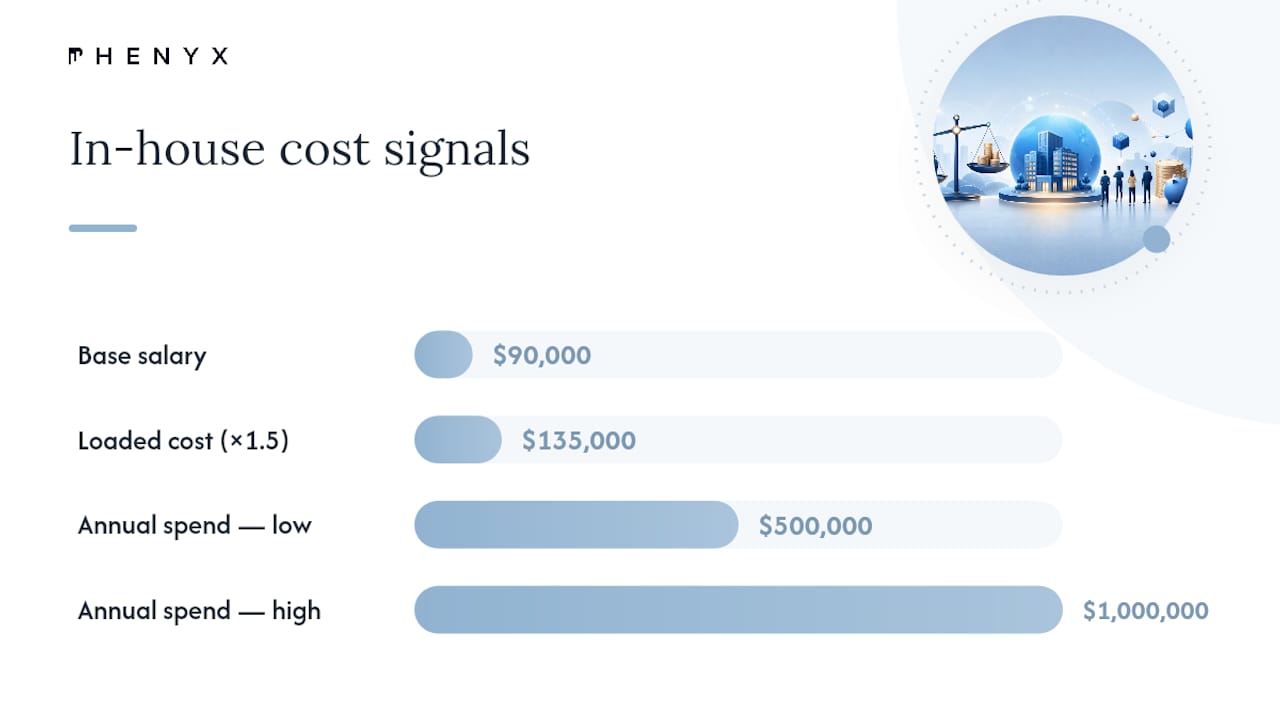
- Cost signal: Agencies usually win on cost until your annual marketing spend crosses roughly $500,000 to $1 million, according to guidance from National Marketing Awards.
- Control: In-house teams carry deeper brand context and faster internal turnaround; agencies trade some of that control for breadth of skill.
- Speed: A good agency can often start optimizing existing campaigns within weeks, while a senior in-house hire may take months to reach full output, per Forbes.
- Scalability: Agencies flex up and down with demand; in-house teams scale only as fast as you can hire.
- Talent risk: Hiring digital marketing talent can take around 90 days on average, and attrition resets that clock.
- Next step: Score your situation against the four decision axes below, then decide whether to trial an agency, hire an internal lead, or build both into a hybrid plan.
When Does In-House Marketing Make Sense?
An internal team wins when marketing sits at the center of what makes your company competitive. If your product story, community relationships, or proprietary data are the thing customers actually buy into, that knowledge is hard to hand off to an outside partner every quarter.
In-house teams also carry real structural advantages:
- Direct ownership of customer data and campaign history, with no handoff lag
- Faster response to internal shifts (a pricing change, a product recall, a leadership statement) because there’s no briefing cycle
- Institutional memory that compounds over years instead of resetting with every new vendor relationship
- Tighter control over regulated or sensitive messaging where legal review has to happen fast
In-house tends to make the most financial sense when your marketing volume is sustained and high, not seasonal or project-based. A company running content, paid media, and lifecycle campaigns every week of the year gets more value from a full-time team than one that needs a burst of activity twice a year.
Fully loaded headcount costs more than the salary line. MarketingProfs recommends multiplying base salary by at least 1.5 to capture benefits, payroll taxes, tools, recruiting, and management overhead. A $90,000 marketing manager salary, once loaded, often runs closer to $135,000 in true annual cost before you’ve bought a single ad platform seat.
The signals that point toward in-house: your annual marketing spend already exceeds the $500,000 to $1 million range cited by National Marketing Awards, you can realistically fill the role within a normal hiring window, and you’re prepared to wait out the 90 to 180 days it typically takes a senior hire to reach full productivity.
When Does Hiring a Marketing Agency Make Sense?
Agencies earn their fee by solving a different problem than headcount solves: variable, specialized work that doesn’t justify a full-time salary line. A five-person business that needs a website rebuild, a paid media launch, and a rebrand in the same quarter isn’t going to hire three specialists for that. It hires one team that already has them.
The core benefits of hiring a marketing agency show up in three places:
- A deeper specialist bench than most internal teams can afford, spanning paid media, SEO, video, and design
- Cross-account pattern recognition, since agencies see what works across dozens of clients and industries, according to Forbes
- Faster channel launches, because the team, tools, and process already exist before you sign
Agencies also tend to get better rates on ad tech and software licenses through volume pricing that individual companies can’t access on their own, per MarketingProfs. That’s a real, if often invisible, part of the value.
The trade-offs are real too. You give up some day-to-day control, onboarding takes real time and documentation, your account gets shared attention alongside other clients, and switching agencies later carries its own transition risk.
Typical agency pricing shapes: monthly retainers commonly range from a few thousand dollars for a narrow scope (SEO only, or paid media management) up to five figures a month for full-service coverage across strategy, creative, and paid channels. Project fees apply to one-time work like a website rebuild or brand refresh. Always confirm what’s excluded, since reporting, ad spend, and stock assets are frequently billed separately.
How Do You Calculate the Real Cost of In-House vs Agency?
Run the math before you run the decision. Here’s the sequence:
- Calculate fully loaded headcount cost. Take base salary and multiply by at least 1.5 to cover benefits, payroll taxes, software, training, and a share of management time, following the MarketingProfs model.
- Map agency fee shapes to your actual need. A narrow retainer covers one channel; a full-service retainer covers strategy, execution, and reporting across several.
- Run a worked scenario. A small business spending under $300,000 a year on marketing usually finds an agency retainer cheaper than one senior hire, since that hire alone can eat the entire budget once loaded. A mid-market company spending near the $500,000 to $1 million mark that National Marketing Awards flags as a common break-even point starts finding that a small internal core, paired with agency support for specific channels, beats either extreme.
- Add the hidden costs both models carry. Onboarding time, documentation, agency technology fees layered on top of the retainer, and the opportunity cost of slow ramp all belong in the math, not just the headline number.
Statistic Callout: Time to fill a top digital marketing role averages around 90 days, according to MarketingProfs, a delay that rarely shows up in a simple salary comparison but changes the real cost of going in-house.
Neither model is cheap when you count everything. The honest comparison isn’t retainer versus salary. It’s fully loaded internal cost against fully scoped agency cost, run against your actual volume of work.
How Do You Decide Between an Agency and an In-House Team?
Score your situation across four axes drawn from the decision framework MarketingProfs lays out: core, economics, resource scarcity, and leverage.
- Core. How central is this capability to your competitive advantage? High centrality points toward in-house.
- Economics. Does the math favor a fully loaded hire or a retainer at your current spend level? Run the numbers from the section above.
- Resource scarcity. Can you actually find and retain the talent you need within a normal hiring window, or is that skill set rare in your market?
- Leverage. Would an outside team’s existing tools, relationships, and volume pricing get you further, faster, than building the same thing from scratch?
Score each axis low, medium, or high toward in-house. Three or more highs point toward building internally. Three or more lows point toward an agency. A mixed scorecard, which is the most common outcome, points toward a hybrid split.
Before signing anything, settle governance questions: who owns platform admin access, who approves creative before it goes live, and who’s accountable for SLAs and OKRs. If you’re vetting agency partners specifically, our guide on choosing the right marketing agency for your business walks through the interview checklist, including case studies, bench depth, and reporting cadence you should ask for upfront.
Pro Tip: Ask any agency finalist to show you a reporting dashboard from an existing client relationship, not a sales deck. It tells you more about how they actually communicate than any pitch will.
What Does a Hybrid Marketing Model Actually Look Like?
The most common hybrid split keeps strategy and brand ownership in-house while outsourcing paid media, production, and technical execution to specialists. Smaller companies often flip that, keeping one generalist internally and outsourcing almost everything else. Larger organizations tend to build bigger internal cores and use agencies for overflow and specialized channels.
A simple RACI split for a campaign launch might look like this: the internal marketing lead is Accountable for strategy and budget, the agency is Responsible for creative production and paid execution, both are Consulted during planning, and leadership is Informed at launch and results review.
Technical SEO and platform administration deserve special attention here. Retaining internal control over these areas, following the technical ownership practices in Google’s SEO starter guide, reduces handoff risk if you ever switch agencies.
- Document playbooks and naming conventions before an agency engagement starts, not after it ends
- Keep an experiment log so campaign history survives staff and vendor turnover
- Store platform access and credentials somewhere your team controls, not the agency’s
What Should the First 90 Days Look Like?
Realistic timelines matter more than most companies plan for. An agency typically needs 30 to 90 days to reach steady state on a new account. A senior in-house hire usually needs 90 to 180 days to reach full productivity, per Forbes.
- Grant access to analytics, ad accounts, and CMS platforms on day one, not week three.
- Share brand guidelines, past campaign results, and a KPI dashboard before any strategy work begins.
- Set a 30-day check-in to confirm scope, cadence, and reporting format actually match what was promised.
The most common failure isn’t a bad hire or a bad agency. It’s underscoping the role, skipping the playbook, or leaving approvals undefined until something goes live wrong.
Pro Tip: Build the experiment log before the first campaign launches, not after the second one underperforms. It’s the cheapest insurance you’ll buy this quarter.
How PHENYX Approaches Build vs Buy for Clients
We treat this as a capability question first, not a budget question. If a function is core to a client’s competitive edge, we push for internal ownership with our support layered around it. If it’s specialized or seasonal, our MODS subscription model often fits better than a full internal build. We’d rather help a client score their own situation honestly, using the same framework above, than sell them a model that doesn’t match their stage.
— PHENYX
A Practical Middle Path: PHENYX’s MODS Model
If your scorecard came back mixed, which happens more often than not, you don’t have to choose between hiring three specialists and signing a scattered set of freelance contracts. PHENYX’s MODS subscription provides a comprehensive marketing service covering website design, SEO & AEO, branding, video production, and paid ads and PPC, without the complexities of fully loaded headcount costs. Current pricing details are available on their website.
Because the same team handles strategy, creative, and technical execution, you skip the handoff friction that usually slows hybrid arrangements down. That matters whether you’re based near our Denver and Lafayette, Colorado studio, our Tampa, Florida team, or our Dallas-Fort Worth, Texas office, since all three work from the same playbook.
An initial discovery call typically covers your current spend, your team’s gaps, and which functions genuinely need to stay internal. If you’re weighing a website rebuild as part of that decision, our website design team can walk you through what a rebuild actually requires before you commit either way. Reach out through Phenyx to schedule that first conversation.
Sources
- Marketing/Advertising: In-House vs. Agency | MarketingProfs
- Should You Hire An Agency Or An In-House Marketer? How To Make The Right Choice | Forbes
- In-House Marketing vs Agency: Cost, Control, and When Each Wins | National Marketing Awards
FAQ
What Is the Difference Between In-House and a Marketing Agency?
An in-house team is full-time staff dedicated to one company’s marketing, while an agency is an external firm serving multiple clients and offering specialized skills on a retainer or project basis.
Is It Cheaper to Hire an Agency or Build a Team In-House?
Below roughly $500,000 to $1 million in annual marketing spend, agencies are usually more cost-effective; above that range, a lean internal core paired with agency support often wins.
How Long Does It Take to Hire a Marketing Team?
Time to fill a senior digital marketing role averages around 90 days, and reaching full productivity after hire typically takes another 90 to 180 days.
Can You Combine an Agency and an In-House Team?
Yes. The most common structure keeps strategy and brand ownership in-house while outsourcing paid media, production, and technical execution to an agency partner.
What Should I Ask a Marketing Agency Before Hiring Them?
Ask for client case studies, details on who specifically works your account, their reporting cadence, and how they handle platform access and data ownership if you ever part ways.