
LinkedIn Strategy for B2B: 30/60/90 Plan That Builds Pipeline
The highest-leverage LinkedIn strategy for B2B is a coordinated engine of content, executive personal branding, targeted outreach, and selective paid amplification, all measured against pipeline-qualified leads rather than vanity metrics. No single tactic carries the weight alone. Tight targeting and disciplined measurement decide whether the engine produces meetings or just impressions.
TL;DR:
- Building a successful LinkedIn B2B engine requires a coordinated approach of content, personal branding, outreach, and paid amplification targeted at pipeline-qualified leads.
- Defining a specific ideal customer profile and aligning profiles, content, and goals around it is essential to avoid wasting effort on unqualified audiences.
- Employee and executive profiles outperform company pages in organic reach by 5 to 12 times, making employee advocacy a crucial component of visibility.
- A comment-first outreach sequence leveraging Sales Navigator significantly improves connection and reply rates over cold requests, especially when combined with targeted account searches.
- Paid LinkedIn ads are most effective when layered on proven organic content, with narrow targeting and small budgets, focusing on boosting content that has already shown engagement.
Table of Contents
- What Is a LinkedIn Strategy for B2B, and Why Does It Need All Four Pillars?
- How Do You Define Your ICP and Set LinkedIn Goals?
- Which Content Formats and Posting Cadence Drive B2B Engagement?
- Why Do Employee and Executive Profiles Outperform the Company Page?
- What Outreach Sequence and Sales Navigator Setup Convert Connections Into Meetings?
- Which LinkedIn Ad Formats Actually Support B2B Lead Generation?
- How Do You Measure LinkedIn’s Contribution to Pipeline?
- What Does a 30/60/90-Day LinkedIn Execution Plan Look Like?
- Why a Unified Approach Shortens Time to Pipeline
- LinkedIn Strategy Perspective: Where Most B2B Teams Get It Backwards
- Ready to Turn LinkedIn Into a Pipeline Channel, Not Just a Feed?
- Sources
- FAQ
What Is a LinkedIn Strategy for B2B, and Why Does It Need All Four Pillars?
A LinkedIn strategy for B2B is the combination of content, personal branding, outreach, and paid media working together to move a defined buyer through awareness to a booked meeting. Treat any one pillar as the whole plan and the results plateau fast. Posting without outreach builds an audience that never gets a follow-up message. Outreach without content means every cold connection request lands on a profile that says nothing memorable. Paid spend without proven organic content just amplifies something nobody has validated yet.
Industry playbooks consistently frame LinkedIn lead generation as a system where the pillars reinforce each other rather than compete for budget. That framing matters because most B2B marketers still treat LinkedIn as an awareness channel first and a pipeline channel second. Flip that order. Every post, every connection request, and every dollar of ad spend should trace back to a qualified lead or a meeting on a calendar.
How Do You Define Your ICP and Set LinkedIn Goals?
Before touching a content calendar or a Sales Navigator seat, nail down who you are actually selling to. Vague targeting is the single most common reason B2B LinkedIn efforts stall.
Start by translating business goals into platform-specific objectives. Awareness goals point toward reach and follower growth. Pipeline goals point toward form fills, booked meetings, and sales-accepted leads. Mixing the two without separating them makes it impossible to judge whether the strategy is working.
Your ideal customer profile (ICP) needs specific fields, not a general description:
- Job titles and seniority — decision-makers versus influencers versus end users
- Industry and vertical — where your product solves the sharpest pain
- Company size — by employee count or revenue band
- Buying triggers — funding rounds, leadership changes, tech stack shifts, hiring surges
- Geography — relevant if you sell regionally or have field sales coverage
Once the ICP is written down, optimize the profile and company page around it:
- Headline states who you help and the outcome, not just a job title
- About section leads with the buyer’s problem, not a company history lesson
- Featured section pins case studies, a demo video, or a lead magnet
- Company page uses ICP keywords naturally in the tagline and About copy for LinkedIn SEO
- Banner image and CTA button point to a specific next step, not a generic “Visit Website”
Skipping this step is the most common reason later content and outreach underperform. A perfectly targeted message sent to the wrong title wastes both to send and the reader’s attention.
Which Content Formats and Posting Cadence Drive B2B Engagement?
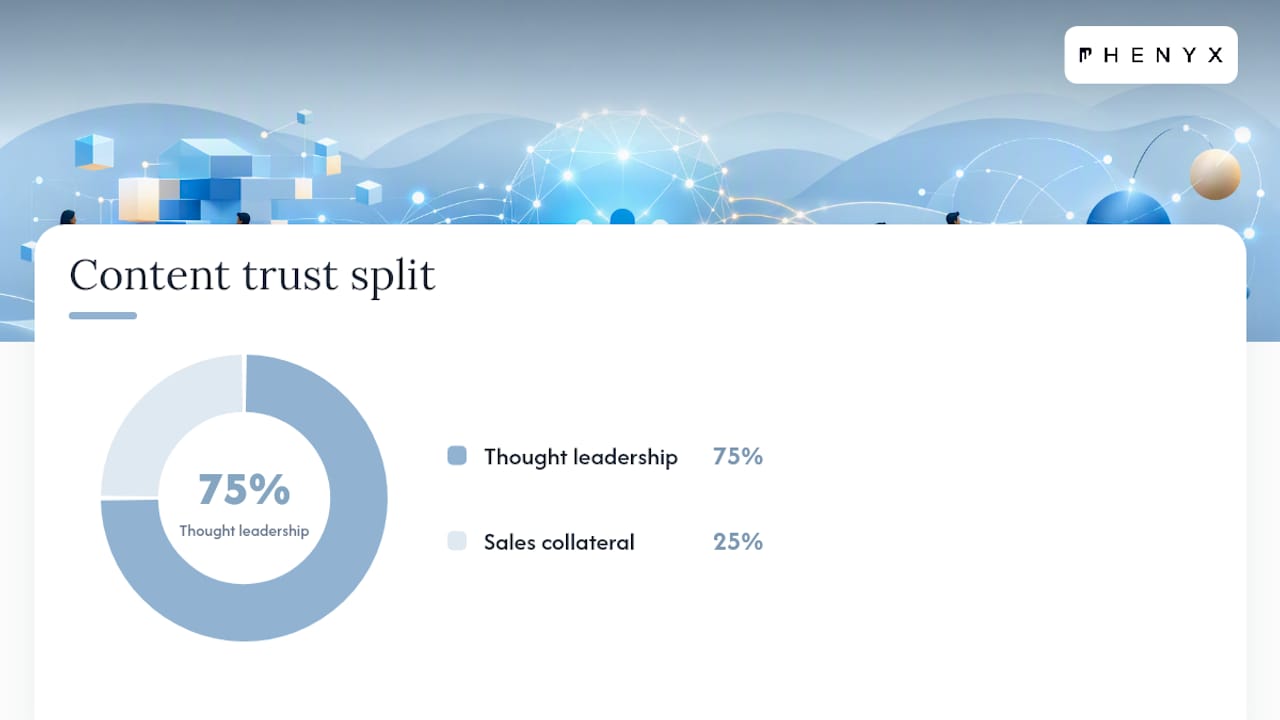
Content is where trust gets built before a single outreach message goes out. LinkedIn research shows 75% of decision-makers find thought leadership more trustworthy than a product sheet, which means your feed content is doing sales work long before a rep ever sends a connection request.
Pick 3 to 5 content pillars
Anchor every post to one of these:
- Customer problems — the specific pain your ICP feels before they know your solution exists
- Point of view — a contrarian or nuanced take on an industry trend
- Behind the work — process, frameworks, or a peek at how projects actually get done
- Proof — case studies, results, before-and-after outcomes
- Culture and team — the people behind the brand, used sparingly
Match the format to the job
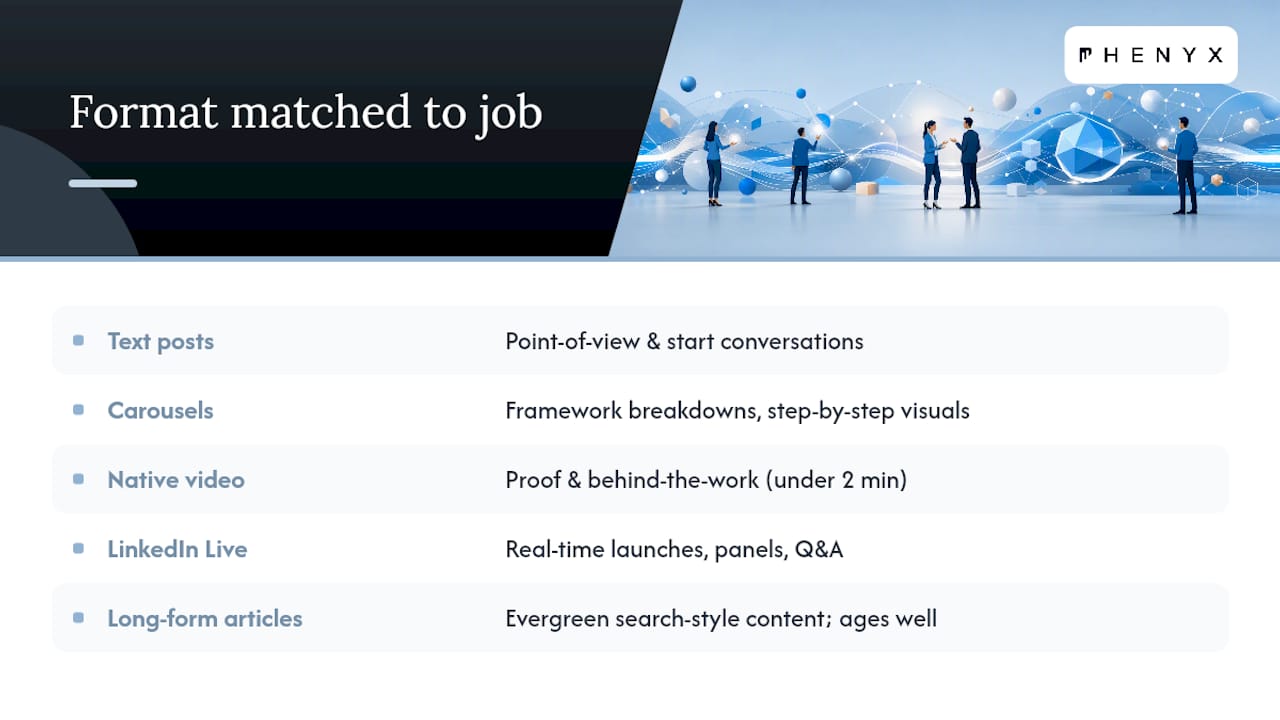
Text posts with a strong hook line work best for point-of-view content and starting conversations in the comments. Carousels break down frameworks or step-by-step processes visually and tend to hold attention longer than a single image. Native video, especially under two minutes, performs well for proof and behind-the-work content because LinkedIn’s algorithm favors watch time. LinkedIn Live suits product launches, panel discussions, or Q&A sessions where real-time engagement compounds reach. Long-form articles work for evergreen, search-style content that ages well but rarely drives immediate engagement the way a native post does.
Build engagement into the post itself
A question buried at the end of a caption rarely gets answered. Put the question in the first line, or structure the whole post as a build-up to it. Ask something specific enough that a reader can answer in one sentence in the comments, and reply to every comment within the first hour. That early engagement window matters more than people think.
Pro Tip: The LinkedIn algorithm rewards meaningful comments, saves, and time spent on a post far more than likes, and the first 60 to 90 minutes after publishing predict whether a post gets wider distribution. Schedule posts for a time when your team can seed a few early comments and reply fast.
A sample weekly mix
Five posts a week is a reasonable ceiling for most B2B teams, as discussed in the detailed content planning and publishing workflow guide at the Apppricer blog. Research on LinkedIn posting frequency generally lands between three and five posts weekly as the sweet spot, enough to stay visible without flooding a feed and burning out the person writing the posts.
Why Do Employee and Executive Profiles Outperform the Company Page?
Company pages have their place, but they are not where the reach lives. Personal profiles typically outperform company page posts by 5 to 10 times in organic reach, and the combined networks of a company’s employees run roughly 12 times larger than the company page’s own following.
That gap alone should shift budget and time away from the company page and toward equipping people to post as themselves.
A workable employee advocacy program does not require a heavy platform or a mandate. It needs:
- A shared content bank with 3 to 4 repurposed angles per company post, written for a personal voice
- A simple weekly ask (one post or one thoughtful comment), never a quota that feels like homework
- Light governance: a one-page style guide covering what not to say, not a 20-point approval chain
- Recognition, whether that’s a shout-out, a small incentive, or simply crediting results back to the team
Executives get the same repurposing treatment. A company case-study post becomes a founder’s LinkedIn post about the lesson learned, framed in first person. A product update becomes a sales leader’s take on what customers actually asked for.
Pro Tip: Don’t ask employees to just reshare the company’s post. A reshare with no added comment barely registers with the algorithm. Ask for one original sentence of personal reaction, even if it is a single line, before they hit share.
What Outreach Sequence and Sales Navigator Setup Convert Connections Into Meetings?
Cold, generic connection requests get ignored. A sequence that references genuine engagement performs meaningfully better, and Sales Navigator gives you the targeting precision to make that engagement worth the time.
Sales Navigator setup that actually prioritizes accounts:
- Build saved searches using ICP filters: title, seniority, company headcount, and industry together, not just one field
- Set alerts for job changes among past customers or engaged leads, since a champion changing companies is one of the highest-converting triggers in B2B
- Track posting activity filters to find prospects who are already active on the platform, since they’re more likely to see and respond to outreach
- Use TeamLink or shared connections to warm an introduction before a cold message
A sequence that works better than a cold ask:
- Comment thoughtfully on the prospect’s recent post
- Wait 24 to 48 hours, then send a connection request referencing that comment specifically
- After acceptance, send a short message that asks a genuine question rather than pitching
- Follow up once, a week later, with a relevant resource, not a demo request
This comment-first approach is a known lever in outreach playbooks for raising acceptance and reply rates compared to jumping straight to a pitch. Sales Navigator users also report making roughly 3.6 times more connections with decision-makers than reps working without it, and InMail through Navigator tends to outperform cold email on response rate.
Acceptance and reply rates vary widely by industry, but a sequence built on genuine engagement consistently beats a cold, unpersonalized request. Treat a low reply rate as a signal to revisit targeting or messaging, not a reason to send more volume.
Which LinkedIn Ad Formats Actually Support B2B Lead Generation?
Paid spend should amplify what organic content has already proven works, not guess at a message from scratch. Layering budget on top of a post that already earned strong comments and saves is far more efficient than launching a cold ad concept.
Matching format to goal:
- Sponsored Content — boosts an organic post that already has engagement momentum; best for awareness and mid-funnel nurture
- Lead Gen Forms — attached to Sponsored Content when the goal is a direct conversion, since the form auto-fills with the prospect’s LinkedIn profile data
- Message Ads — direct one-to-one message in the inbox, useful for event invites or high-value offers to a narrow, well-defined list
- Thought Leader Ads — promotes an executive’s personal post rather than a company post, borrowing the trust advantage of personal profiles
Targeting mistakes to avoid:
- Audiences under 30,000 people often struggle to spend budget efficiently or gather enough data to optimize
- Stacking too many filters (title plus industry plus company size plus skills) can shrink reach to almost nothing
- Broad, unfiltered campaigns waste spend on the wrong seniority level
Narrower, precision-built audiences in the 30,000 to 100,000 range tend to reduce wasted spend and lower cost per lead compared to broad campaigns. Account-based marketing, where ads target named accounts rather than open demographic filters, often delivers better ROI than broad-audience campaigns for B2B specifically.
Budget hygiene for early tests: start with a small daily budget against one ad format and one proven organic post, run it for at least a week before judging results, and resist the urge to change targeting and creative at the same time. Change one variable, measure, then adjust the next.
Lead Gen Forms deserve a specific note. They commonly increase submit rates and can lower cost per lead by around 20% compared to sending traffic to an external landing page, largely because the form is pre-filled. The tradeoff is data quality. A frictionless form fills faster but can pull in less-qualified submissions than a landing page with a few extra questions. Keep the form to 4 to 6 fields and route every submission into a scheduled follow-up task immediately, since speed to lead has a direct effect on qualification rates.
How Do You Measure LinkedIn’s Contribution to Pipeline?
Follower count and impressions tell you almost nothing about revenue impact. The metrics that matter connect directly to your CRM.
Primary metrics to report:
- Marketing-qualified leads sourced from LinkedIn
- Meetings booked from LinkedIn-sourced leads
- Pipeline value attributed to LinkedIn as a channel
- Cost per qualified lead (not cost per click or cost per form fill)
Engagement signals worth watching, even though they’re not revenue metrics themselves:
- Meaningful comments (not emoji reactions) on executive and company posts
- Saves, which signal a post is being treated as a reference
- Engagement velocity in the first 60 to 90 minutes after publishing
By the numbers: LinkedIn’s own data shows decision-makers rank thought leadership as more trustworthy than product-focused content by a wide margin, 75% versus standard sales collateral, which is a strong argument for weighting your content mix toward point-of-view posts over product pitches.
Tracking setup that keeps attribution clean:
- Standardize UTM parameters across every LinkedIn link, tagging source, campaign, and content type consistently
- Create a dedicated CRM source field for “LinkedIn organic” versus “LinkedIn paid” instead of lumping both under “social”
- Connect Lead Gen Forms directly to your CRM or marketing automation platform so submissions create records automatically instead of sitting in a CSV export
A simple dashboard cadence: review engagement and content performance weekly, review lead volume and quality biweekly, and review pipeline value and cost per qualified lead monthly alongside the rest of your demand generation reporting.
What Does a 30/60/90-Day LinkedIn Execution Plan Look Like?
A written strategy means nothing without a sequence for actually shipping it. Here is a realistic build-out.
- Days 1 to 30: Finalize the ICP, rebuild personal and company profiles around it, choose 3 to 5 content pillars, and publish the first two weeks of posts consistently
- Days 31 to 60: Launch the employee advocacy content bank, start a comment-first outreach sequence with Sales Navigator, and run one small paid test against your best-performing organic post
- Days 61 to 90: Scale whatever content and ad combinations are producing qualified leads, tighten the outreach sequence based on reply-rate data, and build the full CRM-connected reporting dashboard
Common pitfalls and quick fixes:
- Posting inconsistently, then quitting after low early engagement. Fix: commit to 90 days minimum before judging content performance.
- Treating outreach as a numbers game. Fix: prioritize the comment-first sequence over volume-based connection blasts.
- Boosting untested content. Fix: only put paid budget behind organic posts with proven engagement first.
Pro Tip: Resist the urge to launch every pillar at once in week one. Start with two content pillars and one outreach sequence, prove they work, then add the rest. Trying to run the full engine on day one is how most in-house teams burn out by day 45.
Why a Unified Approach Shortens Time to Pipeline
Most B2B teams run LinkedIn content through one vendor, ad campaigns through another, and outreach through whoever has time that week. That fragmentation is the real reason strategies stall, not a lack of tactics. These pillars work best when managed under one roof to eliminate handoff delays that happen when separate teams do not coordinate.
Consistent messaging across a LinkedIn profile, a company page, and a website matters more than most marketers assume, since a prospect who clicks through from a post to a site that looks and reads differently loses trust fast. Phenyx’s approach ties content, video, and paid work back to measurable outcomes like conversion rate and search visibility, so a LinkedIn campaign and a company’s SEO and AEO performance reinforce each other instead of running as separate efforts.
The pillars in this playbook, content, personal branding, outreach, and paid, work best when one team owns the full picture and can shift budget between them based on what’s actually converting.
LinkedIn Strategy Perspective: Where Most B2B Teams Get It Backwards
Most advice on this topic treats LinkedIn as a content problem: post more, post better, post consistently. That’s incomplete. The research behind this playbook points to a different priority order. Personal profiles and employee networks carry far more organic reach than any company page will ever generate on its own, which means the biggest lever isn’t a better content calendar. It’s getting more real humans inside the company posting and commenting under their own names.
The second miscalculation is treating paid media as a starting point instead of an amplifier. Ad budget spent on unproven creative is close to wasted money. Ad budget spent boosting a post that already earned strong comments and saves organically is a different bet entirely, and a much safer one.
If you take one thing from this playbook, prioritize getting five to ten employees posting consistently before you spend a single dollar on Sponsored Content. The engine works in that order for a reason.
— PHENYX
Ready to Turn LinkedIn Into a Pipeline Channel, Not Just a Feed?
Building this engine takes a content team, an ads specialist, an outreach process, and a way to tie all three back to your CRM, usually spread across three or four vendors who rarely coordinate. Running content, video, paid media, and web strategy from a single in-house team helps ensure your LinkedIn presence and website tell the same story instead of contradicting each other.
If your company page and website currently look like they belong to two different businesses, that’s often the first fix that unlocks better LinkedIn conversion. A website redesign that matches the tone and proof points of your LinkedIn content gives every click somewhere credible to land. Whether you’re a growing company in the Denver and Lafayette, Colorado area, Tampa, Florida, or Dallas-Fort Worth, Texas, or working with Phenyx remotely, the next step is the same: request a strategy conversation and find out which pillar of this playbook will move your pipeline fastest.
Sources
- LinkedIn shares key trends in B2B marketing | Social Media Today
- LinkedIn algorithm: marketing strategy insights | Content Marketing Institute
FAQ
What is the 3/2/1 rule on LinkedIn?
The 3/2/1 rule suggests posting a mix where roughly three posts focus on educational or thought-leadership content, two highlight social proof or customer stories, and one is a direct offer or promotional post, keeping the feed weighted toward value over pitching.
Is LinkedIn good for B2B marketing?
Yes. LinkedIn’s own data shows decision-makers trust thought leadership content more than product sheets by a wide margin, and it remains the primary professional network where B2B buyers research vendors and engage with executives directly.
What is the rule of 7 in B2B?
The rule of several touchpoints is a marketing principle stating that a prospect typically needs multiple interactions with a brand before they’re ready to buy, which is why a single LinkedIn post or one outreach message rarely converts on its own and needs to be part of a repeated sequence.
What is the 4-1-1 rule on LinkedIn?
The 4-1-1 rule recommends that for every one self-promotional post, you should share four pieces of content from others or educational content, and one soft promotion of your own work, keeping the ratio heavily weighted toward value rather than sales messaging.
How often should a B2B company post on LinkedIn?
Most B2B teams see solid results posting between three and five times per week, a cadence that keeps the brand visible in the feed without overwhelming the team producing the content or fatiguing the audience.