

SMB Marketing Performance Scorecard: 5–8 KPIs That Tie to Revenue
Measure your marketing agency by a small set of business linked KPIs, assign a named owner to each one, and run a quarterly audit tied to real outcomes rather than vanity metrics. Demand read access to every platform touching your data, and agree on a measurement plan before results ever get reported. If your agency resists either request, that itself is the clearest signal you need.
TL;DR:
- Agencies should be evaluated based on a focused set of five to eight clear company KPIs, each with a designated owner and regular review schedule.
- Attribution models should be supplemented with measurement plans that include controlled experiments and raw data exports to ensure accuracy.
- Performance reports must include actual versus target KPI data, variance explanations, and actionable next steps, with full platform access for verification.
- Conduct audits four to eight weeks before renewal to assess six dimensions, including performance, strategy alignment, and technology, using a structured scoring system.
- Frequent meetings should occur weekly for operational issues, monthly for performance reviews, and quarterly for strategic decisions to maintain transparency and course correction.
Table of Contents
- How Do You Measure Marketing Agency Performance?
- Which KPIs Should a Marketing Agency Actually Report On?
- Why Attribution Models Mislead You (And What to Ask For Instead)
- What Should Weekly, Monthly, and Quarterly Reports Include?
- How Do You Audit a Marketing Agency Before Renewal?
- How Often Should You Meet With Your Agency?
- What Are the Warning Signs of a Struggling Marketing Agency?
- What’s a Good Benchmark for Marketing Agency Performance?
- How Do You Connect Agency KPIs to Business Goals?
- What Does Successful Performance Measurement Look Like in Practice?
- PHENYX Perspective: Why a Unified Team Simplifies Measurement
- Want an Honest Read on Your Agency’s Numbers?
- Sources
- FAQ
How Do You Measure Marketing Agency Performance?
Most owners judge an agency by gut feeling. That’s the wrong instrument. Marketing agency performance should be measured against 5 to 8 company level KPIs (revenue, qualified leads, customer acquisition cost against lifetime value, contribution margin, retention) plus a few functional KPIs per channel your agency runs.
Here’s what to check in the next few days:
- Confirm you have read access to GA4, Google Ads, Search Console, your CRM, and any ad managers in use.
- Pick your 5 to 8 company level KPIs and a few functional KPIs per channel, and assign a named owner to each.
- Set a reporting cadence and build a shared dashboard, using something like Google Looker Studio or Databox.
- Put a 30-60-90 day check on the calendar, plus a quarterly audit ahead of renewal.
- Write down what happens if you spot a variance or an access gap: who gets notified, and by when.
Which KPIs Should a Marketing Agency Actually Report On?
Small businesses do best tracking 5 to 8 company level KPIs, not 20. More metrics don’t mean more clarity. They mean more places for a weak result to hide behind a strong one.
Your company level set should include revenue attributable to marketing, qualified lead volume (not raw form fills), customer acquisition cost measured against a lifetime value proxy, contribution margin, and retention or repeat purchase rate. These tie directly to whether the business is healthier this quarter than last. Traffic, impressions, and social reach are useful context, but they’re secondary. A campaign can drive record traffic and lose money at the same time.
Below the company level, each channel needs its own scorecard:
- SEO: organic conversions and keyword visibility movement, not just rankings for vanity terms.
- Paid media: cost per acquisition and return on ad spend, tracked against a real margin, not gross revenue.
- Email: revenue per email sent, which exposes list fatigue faster than open rate does.
- Social: qualified follower growth and referral conversions, not raw follower counts.
None of this works without ownership. A KPI with no name attached to it becomes decoration within a quarter, tracked in a report nobody actually reviews.
KPI discipline callout: Small businesses that track a focused set of 5 to 8 company KPIs with a weekly review cadence and a named owner on each one are far more likely to catch a problem before it shows up in the bank account. Regular review at the company level, with channel specific KPIs reviewed less frequently depending on volume.
Why Attribution Models Mislead You (And What to Ask For Instead)
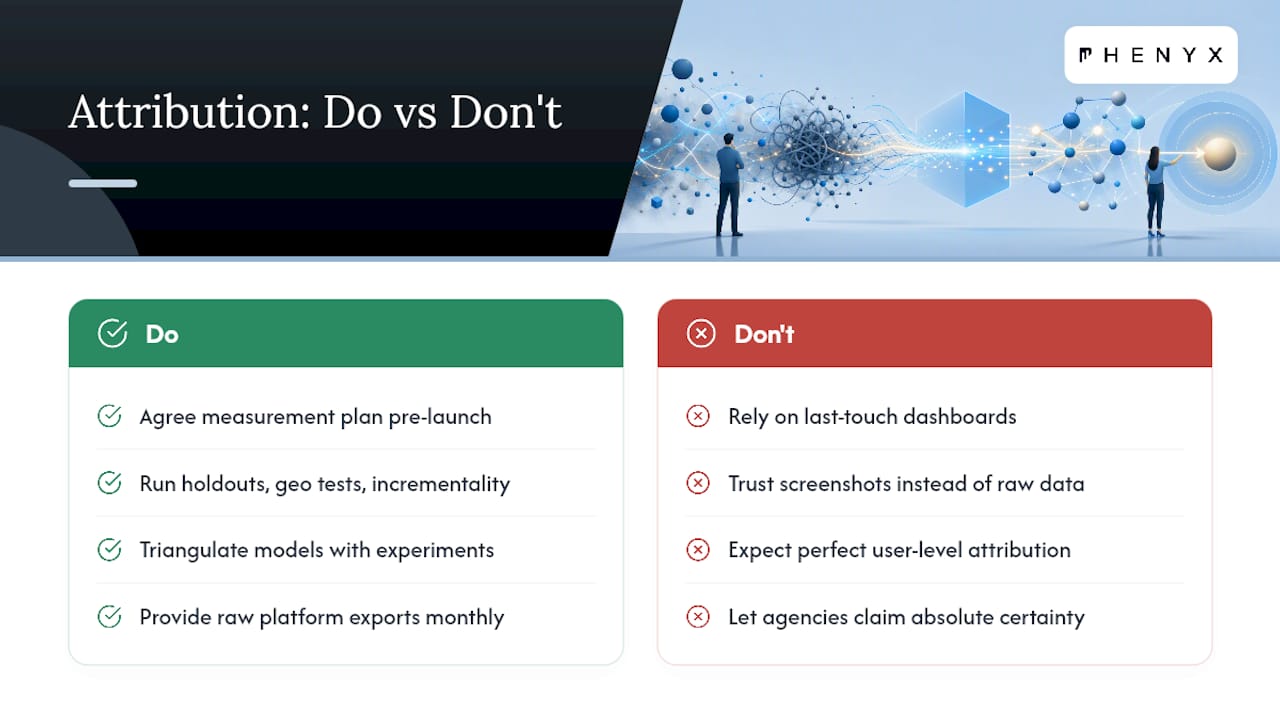
Most agencies default to last touch or simple time decay attribution because it’s easy to build into a dashboard. It’s also frequently wrong. Rules-based attribution models can understate the value of some marketing interventions by roughly one-third, which means a channel that’s actually working well can appear less effective on paper, and a channel coasting on brand demand can look like a hero.
The fix isn’t a fancier dashboard. It’s a measurement plan agreed on before the campaign runs, not reverse engineered after. That plan should include quasi-experimental checks where feasible (holdout regions, geo tests, incrementality tests), triangulation between model outputs and real experiments, and a financial bridge that converts marketing outcomes into contribution margin or attributable revenue your finance team would actually sign off on.
Privacy limits make perfect attribution impossible, and any agency that claims otherwise is overselling. Work around it with aggregate and cohort level analysis, or ask for a defined experiment window on a specific channel before committing more budget to it.
Pro Tip: Ask your agency for raw, platform level exports (not screenshotted dashboards) on a monthly basis. Raw exports let you or a third party independently verify spend, conversions, and attribution assumptions instead of trusting a summary slide.
Explore how deeper ad tracking closes this gap in Beyond Clicks and Impressions.
What Should Weekly, Monthly, and Quarterly Reports Include?
Reporting cadence should match decision speed, not agency convenience. Weekly reports are operational: what ran, what spent, and any anomaly that needs eyes on it now. Monthly reports are about performance: KPI results against target, variance explained, and what changes next month. Quarterly reports are strategic: a full scorecard, root cause analysis on anything off track, completed initiatives, and next quarter’s plan.
Each report level needs specific data, not a recycled slide deck:
- A KPI scorecard showing actual versus target for every metric you agreed to track.
- Variance explanation, in plain language, for anything more than 10 to 15% off target.
- Completed activities tied to the plan, not a generic list of tasks.
- Clear next steps with owners and dates attached.
None of this is verifiable without access. Your checklist should include GA4 read access, Ads manager access at the account level, Search Console verification, and CRM pipeline visibility so you can see leads moving (or not) through your funnel. For dashboard setup, Marketing Dashboard Metrics That Actually Drive Decisions walks through what belongs on the screen and what’s just noise.
How Do You Audit a Marketing Agency Before Renewal?
Run a structured audit 4 to 8 weeks before your contract is up for renewal, not the week before. A useful framework evaluates six dimensions: Investment, Marketing operations, Performance metrics, Alignment, Communication, and Technology, a structure the IMPACT Audit Method is built around.
- Week 1 to 2: Gather data. Pull spend records, deliverables, and every report sent over the contract period.
- Week 3: Collect stakeholder feedback internally, starting with a quick SWOT pulse check before you go deeper.
- Week 4 to 5: Deep dive each IMPACT dimension against the evidence you gathered.
- Week 6: Benchmark results against industry norms and your own targets.
- Week 7 to 8: Synthesize findings into a renewal, renegotiation, or replacement decision.
Score each dimension exceeds, meets, below, or critical:
| Dimension | Evidence to Collect | Score Trigger |
|---|---|---|
| Investment | Spend vs. invoice, budget pacing | Below: unexplained variance over 10% |
| Operations | Deliverable timeliness, process notes | Critical: missed deadlines repeatedly |
| Performance | KPI scorecard vs. target | Below: 2+ quarters missing target |
| Alignment | Strategy tied to business goals | Critical: no connection to revenue |
| Communication | Response time, meeting notes | Below: unanswered escalations |
| Technology | Tooling, tracking accuracy | Critical: broken tracking unresolved |
Two or more “critical” scores is a replacement conversation, not a renegotiation.
How Often Should You Meet With Your Agency?
A weekly KPI huddle keeps small issues small: 15 minutes, agency account manager and your analytics owner, reviewing the scorecard and flagging anything off track. Monthly operations reviews go deeper into completed work and next month’s plan. Quarterly strategy meetings are where the real decisions happen, tied to the audit above.
- Weekly: KPI huddle, agency AM plus your internal owner, produces a short action list.
- Monthly: Ops review with decision-makers present, produces updated priorities.
- Quarterly: Strategy session using the scorecard, produces a renew, renegotiate, or replace decision.
Pro Tip: Set a decision deadline before the meeting, not during it. Sunk-cost bias is real: agencies you’ve worked with for years get an emotional pass that performance doesn’t justify. A pre-set deadline forces the numbers to make the call, not the relationship.
What Are the Warning Signs of a Struggling Marketing Agency?
A few red flags are easy to spot once you know to look:
- No account access, or access that’s revoked and re-granted around reporting time.
- Reports full of impressions and reach with no revenue or lead tie-in.
- Spend on invoices that doesn’t match platform level records.
- KPIs with no name attached to them, or KPIs that change every quarter.
- Slow response times on questions that should take a day, not a week.
Verify fast: compare platform spend against invoices line by line, request raw exports directly, and check production logs against what was actually delivered. Confirm even one red flag, and it’s time to document it, escalate internally, and schedule an audit rather than wait for the next renewal date.
What’s a Good Benchmark for Marketing Agency Performance?
Benchmarks only mean something when they’re matched to channel and timeline, and this is where a lot of owners judge too early or too late. Paid media can show meaningful indicators in 2 to 6 weeks since spend and conversion data are immediate. SEO needs 4 to 6 months for visible ranking or traffic movement and 6 to 12 months before ROI is clear, because search engines take time to trust new content and links. Social and content marketing typically need 3 to 6 months to show a real trend line.
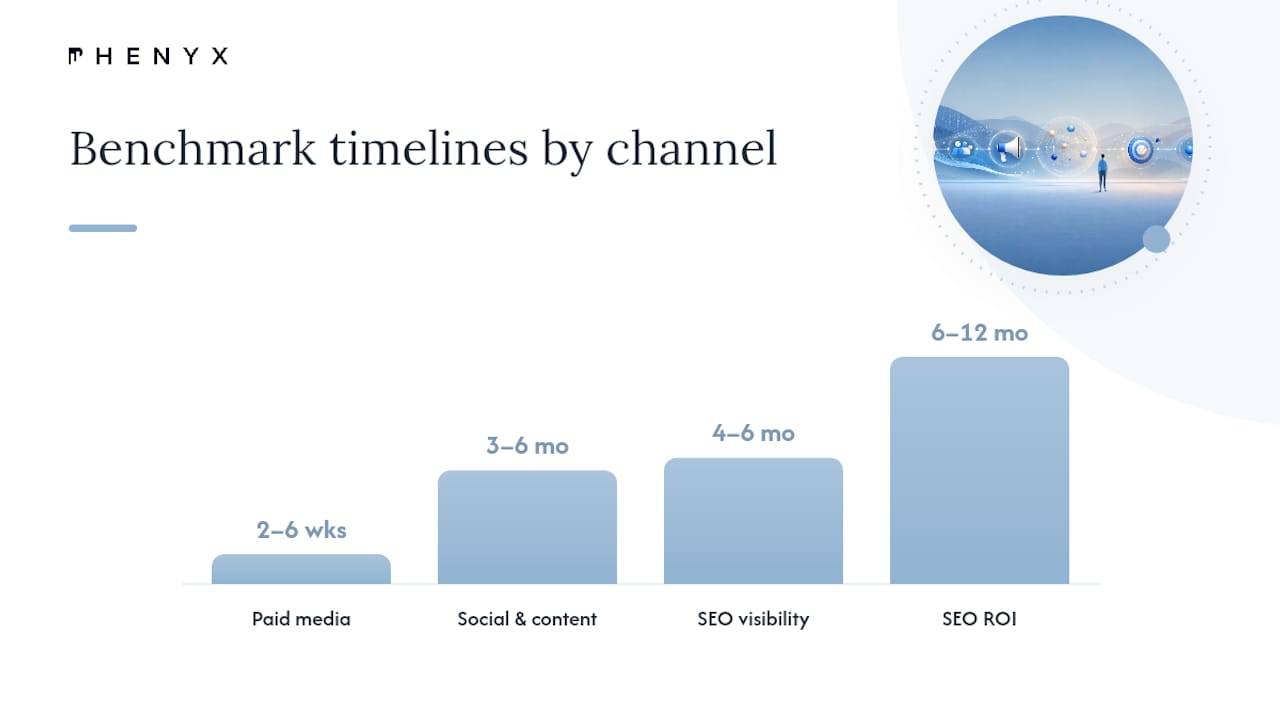
Judging your SEO agency on month 2 results, or your paid media agency on month 6 patience, both miss the point. The timeline is the benchmark as much as the number itself.
Beyond timeline, benchmark the reporting practice itself. Agencies with strong track records tend to show strategic goal synchronization, meaning their recommendations tie back to your specific growth constraints, not a generic playbook applied to every client. If your reports read like they could belong to any business in your industry, that’s a benchmark failure even if the numbers look fine.
Industry standard also means the audit itself: many agencies report metrics that look positive while carrying weak correlation to actual business results, which is exactly why grading KPI relevance against contribution margin matters more than grading the KPI in isolation.
How Do You Connect Agency KPIs to Business Goals?
The disconnect between marketing metrics and business outcomes is usually a translation failure, not a performance failure. Your agency reports leads. Your finance team cares about margin. Somewhere between those two, the connection gets lost.
Fix this by working backward from your actual business goal. That math becomes your KPI targets, not a generic industry average pulled from a blog post.
Every KPI should trace a line to a dollar figure your CFO recognizes. Qualified leads matter because they convert at a known rate into revenue. Customer acquisition cost matters because it’s compared against lifetime value to determine whether growth is profitable or just expensive. Retention matters because it’s often cheaper to keep a customer than acquire a new one, and that math shows up directly in contribution margin.
This is also where the financial bridge from your attribution protocol earns its keep: it’s the mechanism that converts marketing activity into a number finance actually trusts, rather than a marketing-only metric that lives in its own silo. Analytics-driven reporting done well is a real ROI lever, not a reporting nicety, a point echoed in broader research on analytics driven marketing performance.
What Does Successful Performance Measurement Look Like in Practice?
Consider a common scenario: a business owner hires an agency, gets monthly reports full of impressions and click-through rates, and after two quarters still can’t answer whether marketing is profitable. The fix rarely starts with switching agencies. It starts with switching what’s measured.
Once that business owner sets 6 company level KPIs, assigns an internal owner to review them weekly, and asks the agency for a transparent bridge between campaign activity and contribution margin, two things tend to happen. First, underperforming channels surface faster because they can’t hide behind good looking impressions. Second, the agency relationship often improves, because mutual transparency reduces avoidable disappointment on both sides. The agency knows exactly what’s being judged, and the client stops moving the goalposts every quarter.
The pattern holds across channels. An SEO engagement judged only on rankings can look stagnant for months while organic conversions are climbing steadily underneath. A paid campaign judged only on cost per click can look efficient while actual qualified leads dry up. In both cases, the measurement framework, not the channel, was the real problem. Getting the KPI list and the review cadence right tends to matter more than which agency is running the campaigns.
PHENYX Perspective: Why a Unified Team Simplifies Measurement
Here’s an angle most audits miss: a lot of “attribution problems” are actually handoff problems. When SEO, paid, web design, and video sit inside four different vendor relationships, KPI ownership gets fuzzy fast, because no single team can see the whole funnel.
Some full-service marketing agencies run SEO, AEO, web design, video, and paid media under one in-house team, which can mean the person fixing a tracking gap on your site is the same team reporting your KPI scorecard. That’s fewer handoffs, faster data fixes, and one clear owner instead of three vendors pointing at each other. For an SMB without a dedicated analytics hire, that clarity is often worth more than any single tactic.
— PHENYX
Want an Honest Read on Your Agency’s Numbers?
If your current reports raise more questions than answers, or you’re evaluating agencies for the first time, a structured performance audit gives you a clear before and after picture, not just a gut feeling. Some agencies offer SEO & AEO services, website redesigns, and ad tracking setup delivered by one in-house team rather than a rotating cast of subcontractors, which can make KPI ownership and reporting cadence more workable.
If tracking gaps or a weak site are muddying your numbers, a website redesign can close the measurement gap at the source rather than layering another dashboard on top of a broken funnel. If organic performance is the price you’re trying to judge fairly, start with SEO & AEO services built around the same KPI discipline covered above. Request a performance audit conversation with Phenyx and get a scorecard built around your business goals, not a generic template.
Sources
- Methods and approaches to prove ROI of marketing consulting engagements: An empirical attribution protocol
- How To Do An Agency Performance Audit Before Contract Renewal | The Agency Auditor
- How to Monitor Your Marketing Agency’s Performance After Hiring: A Practical Guide with KPIs and Checklists
FAQ
How Many KPIs Should I Track With My Agency?
Stick to 5 to 8 company level KPIs plus a few functional KPIs per channel, each with a named owner and a set review cadence.
How Soon Should I Judge Paid Ads Versus SEO Results?
Paid media can show meaningful signals in 2 to 6 weeks, while SEO typically needs 4 to 6 months for visible movement and 6 to 12 months for ROI clarity.
What If My Agency Won’t Give Me Account Access?
Treat it as a red flag, document the request in writing, and escalate immediately since restricted access is one of the clearest signs of a measurement problem.
How Often Should I Meet With My Marketing Agency?
Run a weekly KPI huddle, a monthly operations review, and a quarterly strategy session that uses a full scorecard to decide on renewal or renegotiation.
What’s the Fastest Way to Verify an Agency’s Reported Results?
Compare platform level spend against your invoices, request raw data exports directly, and cross check production logs against what was actually delivered.