


The Marketing Audit Checklist That Drives Real Results
A marketing audit is a structured review of every channel, asset, and data flow your business runs, and it ends with one deliverable: a prioritized action plan that tells you exactly where to fix, cut, or invest. Not a long report that sits in a shared drive. A ranked list of moves with owners and timelines.
A complete audit covers five core areas:
- Strategy and goals alignment (are your marketing objectives tied to revenue targets?)
- Channel performance (SEO, paid, email, social, CRO)
- Brand and messaging consistency across touchpoints
- Martech and data tracking (tool overlap, UTM coverage, attribution accuracy)
- Competitive and market positioning
Time-wise, a focused single-channel audit can produce results in a few days to two weeks. A full-program audit covering all channels, tech stack, and attribution typically runs four to six weeks for a mid-sized team.
Key Takeaways
A marketing audit produces a prioritized action plan only when it starts with clean data, covers all nine core components, and converts findings into a scored roadmap with owners and timelines.
| Point | Details |
|---|---|
| Fix data before analyzing | Broken UTMs and misfiring events corrupt channel conclusions; resolve tracking gaps first. |
| Use a staged process | Follow the seven-step sequence: scope, assign, gather, analyze, attribute, score, plan. |
| Score every finding | Classify findings by impact and effort to separate quick wins from strategic investments. |
| Run audits on a cadence | Annual or biannual full audits, with focused channel audits triggered by major changes. |
| Build a 6–12 week roadmap | Sequence fixes: tracking first, quick wins next, major fixes and strategic investments after. |
Table of Contents
- What you’ll get from this guide
- What does a marketing audit actually review?
- When should you schedule a marketing audit?
- What core components does every audit need to cover?
- Channel-by-channel checks: what to look for
- Does your brand messaging hold up across channels?
- How do you audit your martech stack and data tracking?
- How do you benchmark against competitors?
- What KPIs and attribution checks matter most?
- Step-by-step: how to conduct a marketing audit
- Printable marketing audit checklist
- Which tools make the audit practical?
- How do you turn audit findings into a 6–12 week roadmap?
- Common audit mistakes that invalidate your findings
- An agency perspective on what audits actually reveal
- Sources
What you’ll get from this guide
This article gives you a practical marketing assessment guide you can use immediately. Here’s what’s inside:
- A printable, condensed audit checklist (see the “Printable Checklist” section)
- A step-by-step audit process with a scoring rubric
- Channel-by-channel diagnostic checks (SEO, content, paid, email, social, CRO)
- A martech and data tracking validation framework
- A prioritization method and a 6–12 week roadmap outline
- Tool and template recommendations by category
- Common mistakes and how to avoid them
If you’re an in-house marketing lead, you can run most of this yourself. If your team lacks analytics access or cross-functional bandwidth, an agency brings the external perspective and speed that internal teams often can’t replicate.
Jump straight to the “Printable Checklist” section if you need something to use today.
What does a marketing audit actually review?
A marketing audit is a systematic review of your strategy, channels, assets, data, and martech to identify what’s working, what’s wasting budget, and what’s missing. According to Mailchimp’s audit guidance, a complete audit should evaluate website and SEO, social, email, content, ad ROI, brand alignment, and the customer journey because these areas directly affect acquisition cost and lifetime value.
The typical deliverables from a well-run audit include:
- A findings document organized by channel and priority
- A prioritized action plan with owners and timelines
- KPI dashboard recommendations
- A 6–12 week roadmap
Who runs it depends on your resources. An internal marketing lead can own a focused audit. A cross-functional team (marketing, sales, ops) is better for a full-program review. Bringing in an agency makes sense when you lack internal analytics expertise or need an unbiased read on performance.
When should you schedule a marketing audit?
Recommended cadence for most teams is annual or biannual, with focused audits triggered by specific events. B2B teams at mid-sized businesses typically need several weeks for a thorough review.
Trigger events that should prompt an immediate audit:
- A new product launch or market expansion
- Worsening KPIs over two or more consecutive quarters
- A significant increase or reallocation of channel spend
- A website replatform or CRM migration
- A new leadership team inheriting an existing program
Audit cadence should match your business rhythm: fast-growth or experiment-heavy teams benefit from frequent focused audits, while stable programs often audit annually and run channel-specific checks between cycles. Tying your audit schedule to your quarterly marketing meeting keeps findings connected to planning decisions.
What core components does every audit need to cover?
A complete digital marketing review checklist covers nine areas. Skipping any one of them leaves a blind spot that can distort your conclusions:
- Strategy and goals alignment: Are marketing objectives tied to specific revenue or pipeline targets?
- SWOT analysis: Internal strengths and weaknesses, external opportunities and threats
- Channel performance: Traffic, conversion, and cost data by channel
- Brand and messaging: Consistency, clarity, and differentiation across touchpoints
- Content: Asset inventory, performance data, and buyer-stage coverage
- Martech and workflows: Tool purpose, integration health, and automation coverage
- Data and attribution: UTM coverage, event tracking accuracy, and attribution model validity
- Competitive and market research: Share of voice, positioning gaps, and channel investment benchmarks
- Reporting and KPIs: Dashboard accuracy, metric definitions, and revenue tie-in
Channel-by-channel checks: what to look for
The RACE framework (Plan, Reach, Act, Convert, Engage) gives a useful structure for mapping channel checks to funnel stages. Here’s what to examine in each channel:
SEO: Confirm indexation status, check crawl errors in Google Search Console, review keyword coverage for high-intent queries, and track organic traffic trends over 12 months.
Content: Identify your top 10 performing assets by traffic and conversion. Map content gaps against buyer stages. Flag repurposing opportunities for high-performing pieces.
Paid: Pull ROAS by campaign and audience segment. Review creative performance (CTR, conversion rate by ad variant). Check budget pacing and frequency caps.
Email: Check deliverability rates and spam complaint rates. Review segmentation logic and automation trigger coverage. Confirm lifecycle sequences exist for acquisition, onboarding, and re-engagement.
Social: Separate engagement metrics from vanity metrics. Look for community signals (comments, shares, saves) versus passive impressions. Measure social’s actual contribution to pipeline, not just reach.
CRO: Pull funnel conversion rates at each stage. Review active and completed A/B tests. Identify the top three UX friction points using session replay or heatmap data.
Does your brand messaging hold up across channels?
Inconsistent messaging is one of the most common and most costly problems an audit surfaces. Run these checks:
- Is your core value proposition stated the same way on your homepage, ads, and sales collateral?
- Does your messaging address the specific pain points of each buyer persona?
- Are tone and visual identity consistent across email, social, and paid?
- Does content map clearly to awareness, consideration, and decision stages?
- Are authority signals (case studies, credentials, reviews) present at the right points in the funnel?
Pro Tip: Run a five-second homepage test with five people outside your marketing team. Ask them to describe what your company does after a five-second view. If the answers vary widely, your headline and hero copy need work before any channel spend increases.
For B2B teams, brand identity alignment often breaks down between marketing and sales materials, not just across digital channels.
How do you audit your martech stack and data tracking?
Your analysis is only as reliable as your data. Validate the tech stack and data flows before drawing any conclusions from channel performance numbers.
| Audit Area | What to Check |
|---|---|
| Tool inventory | List every tool, its primary purpose, and its owner |
| Integration health | Confirm data flows between CRM, ad platforms, and analytics |
| License overlap | Identify tools with redundant functionality |
| UTM coverage | Verify UTM parameters on all paid and email links |
| Event tracking | Confirm key conversion events fire correctly in your analytics platform |
| Duplicate records | Check CRM for duplicate contacts that inflate lead counts |
| Lead handoff | Confirm MQL-to-SQL handoff criteria and SLA are documented |
| Automation coverage | Map which lifecycle stages have active automation sequences |
Missing UTMs on even a fraction of paid links can materially undercount channel contribution. Fix tracking gaps before you finalize any channel performance conclusions.
How do you benchmark against competitors?
Competitive analysis in an audit uses public signals, not proprietary data. Focus on what you can observe:
- Share of voice: Compare organic search visibility using SEO tools for your top 10 keywords
- Channel investment map: Review where competitors publish content and run ads (search, social, display)
- Content topic overlap: Identify topics where competitors rank and you don’t
- Differentiation gaps: Note positioning angles competitors aren’t using that align with your strengths
- Job listings: Competitor hiring patterns reveal where they’re investing (a spike in paid media roles signals a channel push)
What KPIs and attribution checks matter most?
| Metric | What to Validate |
|---|---|
| Cost per lead (CPL) | Consistent definition across channels; exclude internal leads |
| Qualified lead rate | Percentage of leads that meet MQL or SQL criteria |
| Customer acquisition cost (CAC) | Total marketing spend divided by new customers in the period |
| Pipeline contribution | Marketing-sourced and marketing-influenced pipeline as a percentage of total |
| Lifetime value (LTV) | Average revenue per customer over the relationship |
For attribution, manually map 20–30 recent customer journeys and compare the path to what your last-click reporting shows. If customers consistently touch four or five channels before converting but your dashboard credits only the last one, upper-funnel channels are being materially undercounted. Pair last-click data with a multi-touch view to get an honest read. For deeper context on ad tracking best practices, the measurement principles apply directly to attribution audits.
Dashboard checklist: confirm consistent lookback windows across all reports, establish a single source of truth for revenue data, and remove any dashboard that shows only vanity metrics without a revenue tie-in.
Step-by-step: how to conduct a marketing audit
A staged audit approach reduces analysis paralysis and produces implementable outcomes. Follow these steps in order:
- Set objectives and scope. Define what you’re auditing (one channel, one campaign, or the full program) and what a successful outcome looks like.
- Assign owners. Each audit area needs one person responsible for data gathering and analysis.
- Gather and normalize data. Pull reports from your analytics platform, ad accounts, CRM, and email tool. Standardize date ranges and metric definitions.
- Run channel deep dives. Use the channel checks above. Document findings, not just observations.
- Run the attribution check. Map 20–30 customer journeys manually and compare to your dashboard.
- Score findings. Rate each finding by impact (revenue effect) and effort (time and resources to fix). Classify as quick win, major fix, or strategic investment.
- Build the prioritized action plan. Convert scored findings into a ranked list with owners, timelines, and success metrics.
Scoring rubric: High impact + low effort = quick win. High impact + high effort = major fix (schedule with resources). Low impact + low effort = backlog. Low impact + high effort = deprioritize or drop.
Printable marketing audit checklist
Use this condensed checklist for a one-day focused audit. For a four-week full audit, add the channel deep dives and attribution mapping steps above.
Strategy
- Marketing goals are tied to specific revenue or pipeline targets
- SWOT is documented and current
Channels
- Organic traffic trend is positive or stable over 12 months
- Top 10 keywords by intent are tracked and ranked
- Email deliverability rate is above 95%
- Paid ROAS is positive and benchmarked by campaign
- Social engagement rate is tracked separately from impressions
Brand and content
- Core value proposition is consistent across homepage, ads, and sales materials
- Content covers all three buyer stages (awareness, consideration, decision)
Martech and data
- All paid and email links carry UTM parameters
- Key conversion events fire correctly in analytics
- CRM has no significant duplicate contact records
Reporting
- Dashboards use consistent lookback windows
- Revenue data has a single source of truth
- CPL, CAC, and pipeline contribution are tracked
Long-form reference checklists with 40–95 questions are useful for deep follow-ups on problem areas once the condensed version surfaces your priorities.
Which tools make the audit practical?
Pair the right tool category with each audit area:
- Web analytics: Google Analytics 4, or your existing analytics platform, for traffic, behavior, and conversion data
- SEO diagnostics: Crawl and keyword tools (Screaming Frog, Ahrefs, Semrush) for technical health and keyword coverage
- Ad platform exports: Native dashboards from Google Ads, Meta Ads Manager, and LinkedIn Campaign Manager for paid performance
- CRM: HubSpot, Salesforce, or your CRM of record for lead quality, pipeline, and lifecycle data
- Marketing data pipeline: A centralized reporting layer that pulls cross-channel data into one view
- A/B testing and session replay: Tools like Optimizely, VWO, or Hotjar for CRO and UX friction analysis
Template suggestions: a data inventory spreadsheet (tool, owner, data source, integration status), a scoring rubric sheet (finding, impact score, effort score, classification), and a slide layout with one slide per audit area summarizing findings and recommended actions.
AI and automation tools are increasingly relevant to martech audits, particularly for identifying workflow gaps and automation coverage.
How do you turn audit findings into a 6–12 week roadmap?
A 2026-focused audit should produce a roadmap, not just a report. Here’s a practical prioritization and sequencing approach:
- Classify every finding as quick win, major fix, or strategic investment using the impact-effort rubric.
- Weeks 1–2: Fix tracking and data issues first. Broken UTMs and misfiring events corrupt every other analysis.
- Weeks 3–4: Execute quick wins. These are high-impact, low-effort fixes: updating meta descriptions, refreshing top-performing content, tightening email segmentation.
- Weeks 5–8: Begin major fixes. Assign dedicated owners. Examples: rebuilding a paid audience structure, launching a new lifecycle email sequence, or addressing a technical SEO issue.
- Weeks 9–12: Initiate strategic investments. These require planning and resources: a website redesign, a new content program, or a channel expansion.
Balance matters. A roadmap that’s all quick wins loses momentum when the easy gains run out. One that’s all strategic investments stalls before showing results. Mix both from the start.
Common audit mistakes that invalidate your findings
- Relying solely on last-click attribution. It systematically undercounts upper-funnel channels. Always cross-check with a multi-touch view.
- Pulling data with inconsistent date ranges. Comparing Q1 to Q4 without accounting for seasonality produces misleading conclusions.
- Treating vanity metrics as business metrics. Impressions and follower counts are not revenue signals. Tie every metric to pipeline or conversion.
- Skipping stakeholder buy-in. An audit without executive sponsorship produces a report nobody acts on. Align on scope and expected outputs before you start.
- Incomplete data. Missing conversion tracking, inconsistent UTMs, or siloed reporting make findings unreliable. Fix data gaps before finalizing any conclusions.
Red flag: if you can’t answer “what percentage of our pipeline came from marketing last quarter” with a single number from a single source, your reporting infrastructure needs work before the audit can produce reliable results.
An agency perspective on what audits actually reveal
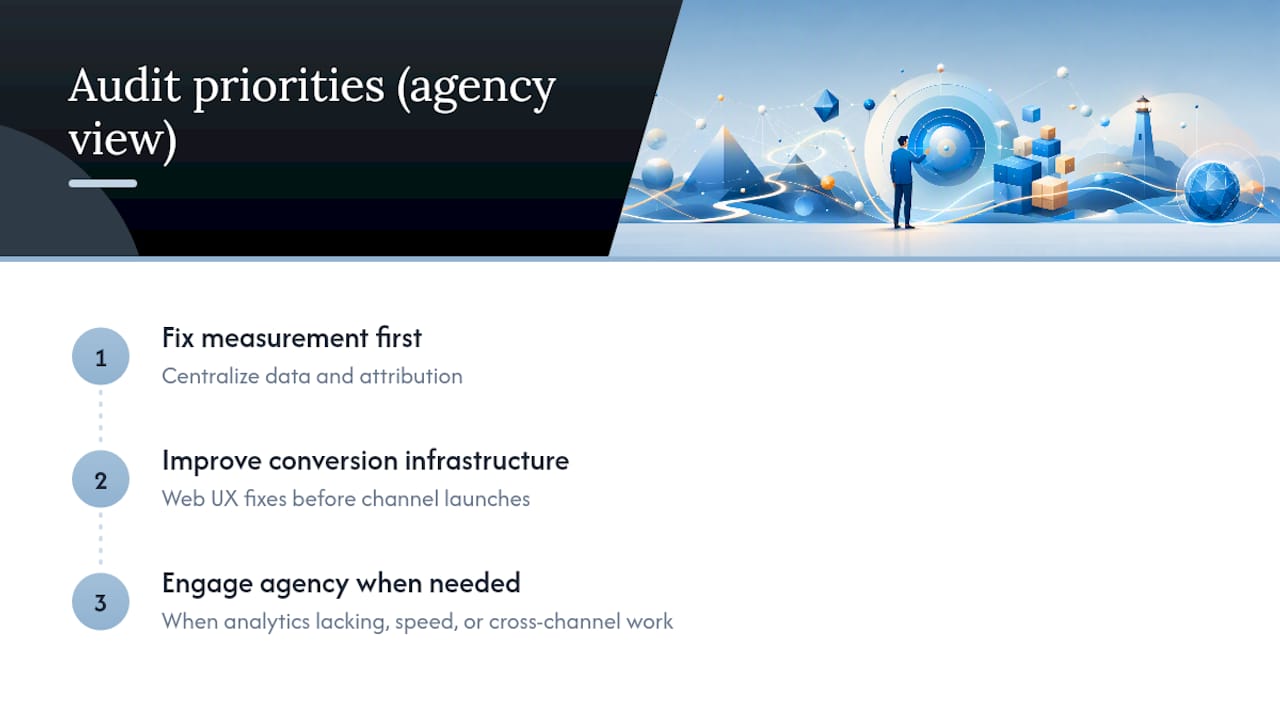
Most audits surface the same categories of problems: data you can’t trust, messaging that doesn’t differentiate, and channel spend that outpaces the infrastructure needed to convert it. The order of those problems matters more than most teams realize.
At Phenyx, the structured approach we use consistently finds that data centralization is the highest-leverage starting point. You can’t make confident decisions about creative, channel mix, or budget allocation when your attribution is broken or your dashboards pull from three different sources of truth. Fixing the measurement layer first means every subsequent decision is grounded in something real.
The second pattern we see repeatedly: teams invest in channel expansion before their conversion infrastructure is ready. A web audit that identifies the top friction points, followed by targeted website design improvements, typically delivers faster ROI than any new channel launch.
Agency involvement makes the most sense when the internal team lacks analytics depth, when the audit needs to be completed in weeks rather than months, or when findings require execution across web, SEO, and creative simultaneously. An internal team can absolutely run a focused audit. A full-program audit with attribution mapping, competitive benchmarking, and a cross-channel roadmap is where external expertise pays for itself.
Sources
The following references informed this guide and offer additional depth for specific audit areas:
- Marketing Audit Guide 2026: How to Run an Effective Audit
- What’s included in a marketing audit checklist? | Mailchimp
- The B2B guide to doing a marketing audit
- How To Audit Your Marketing In 2026 (Without Guesswork)
Recommended
- How to Prepare for a Quarterly Marketing Meeting and Set Your Brand Up for Success | PHENYX
- How to Prepare a Strong Marketing Campaign for 2026: Ideas and Tips Every Business Can Use | PHENYX
- 2026 Marketing Tips and Trends Every Local Business Should Know | PHENYX
- Why Your Denver Business Website Is Not Generating Leads (And How to Fix It) | PHENYX