

Win Shortlists: Oil and Gas Marketing for Operators, OFS & Suppliers
Oil and gas marketing is the strategic practice of building technical credibility and generating procurement-ready demand for operators, service firms, and suppliers. Its primary objective is not brand awareness for its own sake but moving accounts through long, technical sales cycles toward a shortlist decision. This guide covers audience segmentation, tactical execution, and the KPIs that keep both marketing and commercial teams honest.
TL;DR:
- Differentiated messaging is crucial; operators focus on reserves and regulations, while service firms prioritize uptime and safety, and suppliers on costs and contracts.
- Long sales cycles demand procurement-ready assets like ROI calculators and comparison guides, rather than generic marketing materials.
- AI adoption accelerates in the sector, mainly for lead scoring and content speed, but all AI-generated technical content requires human verification.
- Measuring success requires tracking stakeholder engagement, opportunity progression, and final deal metrics over 6 to 18 months, with multi-touch attribution preferred.
- In-house teams improve technical accuracy, speed, and consistency by handling strategy, content, and design within a unified structure.
Table of Contents
- Quick summary: what this guide covers and why it matters
- Why operators, service firms, and suppliers need different messages
- The core components of an oil and gas marketing program
- Building demand across an 18-month sales cycle
- Where AI and analytics actually help, and where they don’t
- Measuring what matters across a long deal cycle
- Managing reputation, regulation, and price swings
- What an in-house team changes about execution
- What actually moves the needle in this sector
- How PHENYX supports oil and gas marketing teams
- Sources
- FAQ
Quick summary: what this guide covers and why it matters
- Oil and gas marketing succeeds or fails on segmentation: operators, oilfield services firms, and suppliers each need distinct messaging.
- Long sales cycles reward procurement-ready assets over polished brochures.
- EIA production forecasts point to where account intelligence and field presence pay off fastest.
- Deloitte’s industry outlook flags digital transformation and AI as priorities shaping budgets.
- Reputational and regulatory risk require marketing to work closely with legal and operations, not around them.
- Measurement needs leading, mid-funnel, and lagging indicators built for 6 to 18 month deal cycles.
- Getting the fundamentals right early shortens time to shortlist and protects margin on every deal that follows.
Why operators, service firms, and suppliers need different messages
Oil and gas marketing fails when it treats the sector as one audience. Exploration and production companies, known as E&P or operators, oilfield services firms (OFS), and equipment or chemical suppliers occupy different positions in the value chain, and their buyers think in different terms entirely. This distinction shapes everything downstream, from channel selection to the words on a landing page, and it is defined this way in industry glossaries that describe marketing’s role in building awareness and credibility toward a sale.
An operator’s buying team weighs reserves, production economics, and regulatory exposure. An oilfield services buyer cares about uptime, safety records, and integration with existing equipment. A supplier’s buyer often sits in procurement and answers to cost-per-unit targets and contract terms rather than technical specification alone. Sending the same case study to all three wastes the budget and the reader’s attention.
What each tier actually needs from your content:
- Operators respond to reserve-based economics, regulatory readiness, and long-term partnership proof points.
- OFS buyers want field performance data, safety certifications, and integration specifics.
- Suppliers and their procurement teams want total cost of ownership, lead times, and contract flexibility.
Pro Tip: Build one core narrative, then translate it into three distinct asset sets rather than writing three separate campaigns from scratch.
The core components of an oil and gas marketing program
A working program breaks into five accountable pieces, each with its own owner and its own success measure.
- Market research and account intelligence. Track basin activity, permitting trends, and competitor positioning so sales conversations start from informed ground.
- Brand and reputation management. Under regulatory scrutiny, every public claim needs a paper trail; brand work here means consistency and defensibility, not just visual polish.
- Digital marketing and technical content. Whitepapers, spec sheets, and webinars aimed at engineers convert better than generic blog posts aimed at generalists.
- Events, trade shows, and field demonstrations. In-person technical demonstrations remain one of the highest-value touchpoints for OFS and equipment buyers because they let engineers see performance firsthand.
- PR and stakeholder communications. Coordinated messaging to investors, regulators, and communities protects the brand when commodity prices or incidents put the company in the news.
Each of these workstreams needs a named owner and a measurable goal tied to pipeline, not just impressions. A market research function that never feeds sales, or a PR function disconnected from investor relations, becomes a cost center instead of a growth lever. The strongest programs treat these five pieces as one connected system, with research informing content, content feeding events, and PR protecting the reputation that makes all the other work land.
Building demand across an 18-month sales cycle
Long B2B cycles in oil and gas demand a different playbook than transactional marketing. Account-based marketing (ABM) starts with picking the right accounts: prioritize by production growth, contract renewal timing, and known pain points rather than firmographic size alone.
Procurement-ready assets do the heaviest lifting once an account is engaged. Practitioner reporting on the sector recommends battle cards, ROI calculators, and side-by-side comparison guides as the assets that actually move deals through committee review, because they give internal champions something concrete to carry into a purchasing meeting.
Multi-stakeholder nurture sequences should map to the buying-stage artifacts each cohort needs to sign off:
- Engineering stakeholders need technical validation and performance data before they will endorse a vendor.
- Operations stakeholders need proof of implementation ease and minimal downtime.
- Procurement stakeholders need pricing structure, contract terms, and total cost comparisons.
Pro Tip: Ask your internal champion directly what document they need for their next internal review, then build exactly that instead of guessing.
Marketing’s job here is less about generating a lead and more about arming the person inside the account who already believes in you. For more on tailoring this to oilfield service firms specifically, see this guide on winning shortlists in 18 to 36 months.
Where AI and analytics actually help, and where they don’t
Digital transformation is no longer optional. Deloitte’s outlook points to AI adoption accelerating across the sector, with spending concentrated on process optimization and scaling analytics rather than novelty features. For marketing teams, that translates into a few practical applications.
- Predictive lead scoring can flag which accounts are approaching a renewal or expansion window.
- AI-assisted content drafting can speed up first drafts of technical explainers, provided an engineer reviews every fact before publication.
- Analytics platforms can connect marketing engagement data to CRM records, showing which content touches actually preceded a proposal request.
Governance is the limiting factor, not capability. Every AI-assisted piece touching technical claims, safety data, or regulatory language needs a human review step before it goes out. For a broader look at how AI fits into marketing operations generally, this overview of AI in marketing strategy covers the underlying use cases in more detail.
Measuring what matters across a long deal cycle
A 6 to 18 month sales cycle breaks reporting into three distinct layers, and mixing them up is the fastest way to lose executive confidence in the marketing function.
- Leading indicators track technical stakeholder engagement and how deep marketing has penetrated an account, meaning how many distinct roles inside the buying committee have interacted with content.
- Mid-funnel metrics track qualified opportunities, proposal requests, and confirmed shortlist placements, which tell you whether early interest is converting into real commercial motion.
- Lagging outcomes track closed deal value, win rate, and total cycle length, the numbers that ultimately justify the budget.
Attribution in this environment should favor multi-touch models over last-click credit, since a typical deal involves dozens of touches across engineering, operations, and procurement before a signature. A content piece that influenced an early technical conversation deserves credit even if it never appeared in the final proposal meeting. For teams building this reporting structure from scratch, this piece on moving pipeline with B2B content walks through practical tracking setups.
Managing reputation, regulation, and price swings
Marketing in this sector carries risk that most other industries don’t face at the same intensity, and each risk needs its own defensible response rather than a generic crisis plan.
- Community and environmental scrutiny mean every public claim about sustainability or safety needs to be verifiable, not aspirational.
- Regulatory compliance requires a legal review step built into the content calendar, not bolted on after a draft is finished.
- Commodity price volatility means budgets need built-in flexibility to shift spend between demand generation and brand defense as prices swing.
- Cross-functional alignment with legal and operations prevents marketing from making a claim that a technical team later has to walk back publicly.
None of these are solved by a single campaign. They are solved by process, and the process has to be repeatable every time a new piece of content goes out the door.
What an in-house team changes about execution
Technical accuracy degrades every time a project passes between disconnected vendors. An in-house team that handles strategy, content, design, and web execution together keeps the same people accountable from research through publication, which matters most when a single wrong spec sheet claim can undermine a whole campaign.
- Fewer handoffs mean fewer chances for a technical fact to get lost in translation.
- Faster turnaround matters when a trade show deadline or a proposal window is fixed.
- Consistency across a website, a sales deck, and a trade show booth builds the credibility that technical buyers scrutinize closely.
A structured, repeatable approach to segmentation and asset development matters more than any single tactic.
Choosing between building this in-house or hiring an integrated partner usually comes down to speed and bandwidth. Teams without a dedicated content or design function tend to benefit most from bringing in a partner that can move as one unit rather than as a chain of freelancers. More on how this looks in practice is on the PHENYX oil and gas marketing page.
What actually moves the needle in this sector
The conventional advice in oil and gas marketing spends too much time on brand storytelling and not enough on the unglamorous mechanics of procurement. A compelling narrative rarely wins a deal on its own. What wins is the ROI calculator an engineer can defend in a budget meeting, and the battle card a champion can hand to a skeptical vice president without embarrassment.
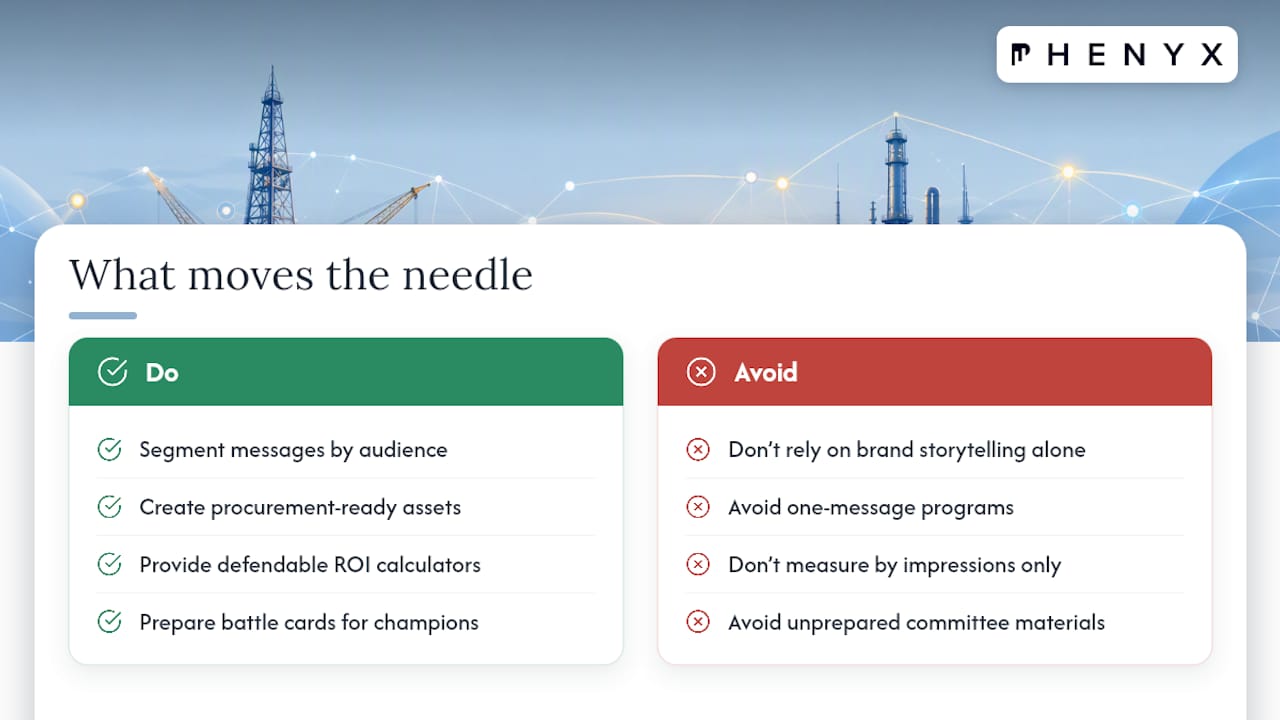
The sector’s production growth, tracked by the EIA, and its shift toward digital tools, tracked by Deloitte, both point the same direction: budgets are growing more disciplined, and marketing has to prove its contribution in commercial terms, not impressions or clicks.
If there is one place to start, it is segmentation. Most programs still write one message and hope it lands with operators, service firms, and suppliers alike. It doesn’t. Fix that first, then build the procurement-ready assets that carry a champion through committee review. Everything else, including the KPIs and the AI tooling, works better once that foundation is in place.
— PHENYX
How PHENYX supports oil and gas marketing teams
Getting technical marketing right takes coordination between strategy, design, and content that most teams struggle to keep aligned across vendors. PHENYX runs website design, SEO and AEO services, video production, and branding under one in-house team, which means the same people who build your technical content also build the site that hosts it and the search visibility that gets it found.
For teams that want ongoing execution rather than a single project, our MODS plan bundles this work into a monthly engagement, with current prices available on the PHENYX site. If your current site struggles to communicate technical credibility to engineers and procurement alike, our website design team can help you fix that starting point. Reach out to talk through what your program needs first.
Sources
- United States on track for record crude oil production in 2026 - U.S. EIA
- 2026 Oil and Gas Industry Outlook | Deloitte Insights
- Oil and gas marketing — Cognizant glossary
FAQ
What is oil and gas marketing exactly?
Oil and gas marketing is the set of methods companies use to build awareness, establish technical credibility, and move prospects toward a purchase decision, as described in industry glossary definitions. It spans market research, branding, digital content, events, and lead generation aimed at operators, service firms, and suppliers.
How is marketing different for E&P versus oilfield services companies?
E&P (operator) buyers focus on reserve economics and regulatory readiness, while oilfield services buyers care more about uptime, safety records, and equipment integration. Messaging, content format, and even the events each group attends differ enough that a shared campaign usually underperforms for both.
What KPIs matter most for long oil and gas sales cycles?
Leading indicators like technical stakeholder engagement, mid-funnel metrics like qualified opportunities and shortlist placements, and lagging outcomes like win rate and cycle length together give a complete picture. Multi-touch attribution works better than last-click credit given how many stakeholders touch a typical deal before it closes.
How does AI fit into oil and gas marketing today?
AI is mainly used for predictive lead scoring, content drafting support, and connecting engagement data to CRM records, with adoption accelerating according to Deloitte’s industry outlook. Every AI-assisted piece touching technical or regulatory claims still needs human review before publication.
What does PHENYX charge for ongoing marketing support?
PHENYX offers a monthly managed marketing plan called MODS covering website, SEO and AEO, branding, and content work under one in-house team, with current pricing available on the PHENYX site. Individual services like website design or video production are also available and priced on request.