

Know What Funds Loans in 30 Days: Lender Marketing Puts Borrowers First
The most effective marketing for lenders combines a conversion-ready digital presence with the human relationship borrowers still expect. That means a fast, mobile-friendly website, targeted paid and organic content, automated CRM follow-up, and referral partnerships, all built around compliance rules and measured against funded loans rather than clicks. Loan officers who treat these pillars as one connected system, not separate projects, see steadier lead flow and fewer wasted ad dollars.
TL;DR:
- Ensuring website load times are under a few seconds on mobile is critical, as delays cause leads to abandon the application process.
- Simplify lead forms to only essential information to improve completion rates and integrate scheduling tools for immediate call booking.
- Brand clarity should focus on either the company or individual loan officer, with consistent messaging and visuals across all channels.
- Content should answer common borrower questions, with explainer pages, calculators, and stories, while distribution must be aligned with search and social platforms for maximum reach.
- Tracking performance with true conversion metrics like funded loans, not just clicks, helps optimize campaigns effectively.
Table of Contents
- Quick summary: what to fix this quarter
- How lenders should define brand and messaging
- Building a digital stack that turns visitors into applicants
- Content and education that turn browsers into leads
- Using CRM and nurture sequences without losing the human touch
- Building referral pipelines and protecting your reputation
- Compliance rules every lender marketing team must design around
- Measuring what actually funds loans
- Practical tools and automation that keep loan officers in the room
- Why this playbook holds up for lending teams
- The gap most lenders never close
- A done-for-you option when you would rather not build this alone
- Sources
- FAQ
Quick summary: what to fix this quarter
Before diving into strategy, here are the moves that produce the fastest, most measurable wins for a lending team.
- Test your website’s mobile load speed and fix anything slower than a few seconds, since slow pages lose borrowers before they see your rates.
- Simplify your lead form to name, phone, loan purpose, and property type. Every extra field costs you completed applications.
- Add self-service calendar scheduling so a borrower can book a call without waiting on a returned voicemail.
- Run one paid search test this month pairing intent-based keywords with a lead-form ad extension.
- Set an auto-assign rule in your CRM so new leads route to an available loan officer within minutes, not hours.
- Build a same-day follow-up SLA and track how often your team actually hits it.
- Review every current lead-gen and co-marketing partnership against RESPA steering rules before renewing it.
How lenders should define brand and messaging
Brand clarity is the difference between an ad that gets ignored and one that gets clicked. Lenders need to decide early whether they are marketing the institution, the individual loan officer, or both, because each drives different content.

Company branding works best for building broad trust: consistent name recognition, licensing credentials, and community presence. Individual loan-officer branding works better for referral conversion and social proof, since borrowers buy from people they feel they know. Most lending teams need both, with the company brand as the umbrella and each loan officer given a consistent personal presence underneath it.
A few brand assets are worth locking down before any campaign launch:
- A one-sentence value proposition that says what makes your process faster, clearer, or more personal than a competitor’s.
- Current, professional headshots and short bios for every loan officer appearing in ads and on the website.
- A visible, real system for collecting and displaying borrower reviews.
- One consistent tone and visual style across the website, social profiles, and print material.
Brand decisions shape everything downstream. A landing page built around “close in 21 days” needs different creative than one built around “your local advisor for life.” Once the brand message is set, ad copy and page headlines should echo it word for word rather than reinventing the pitch on every channel.
Pro Tip: Update your loan officer bios and photos twice a year. Stale headshots and old titles quietly undercut the trust your ads are trying to build.
Building a digital stack that turns visitors into applicants
Your website is the hub every other channel points to, so it needs to convert before anything else gets built on top of it.
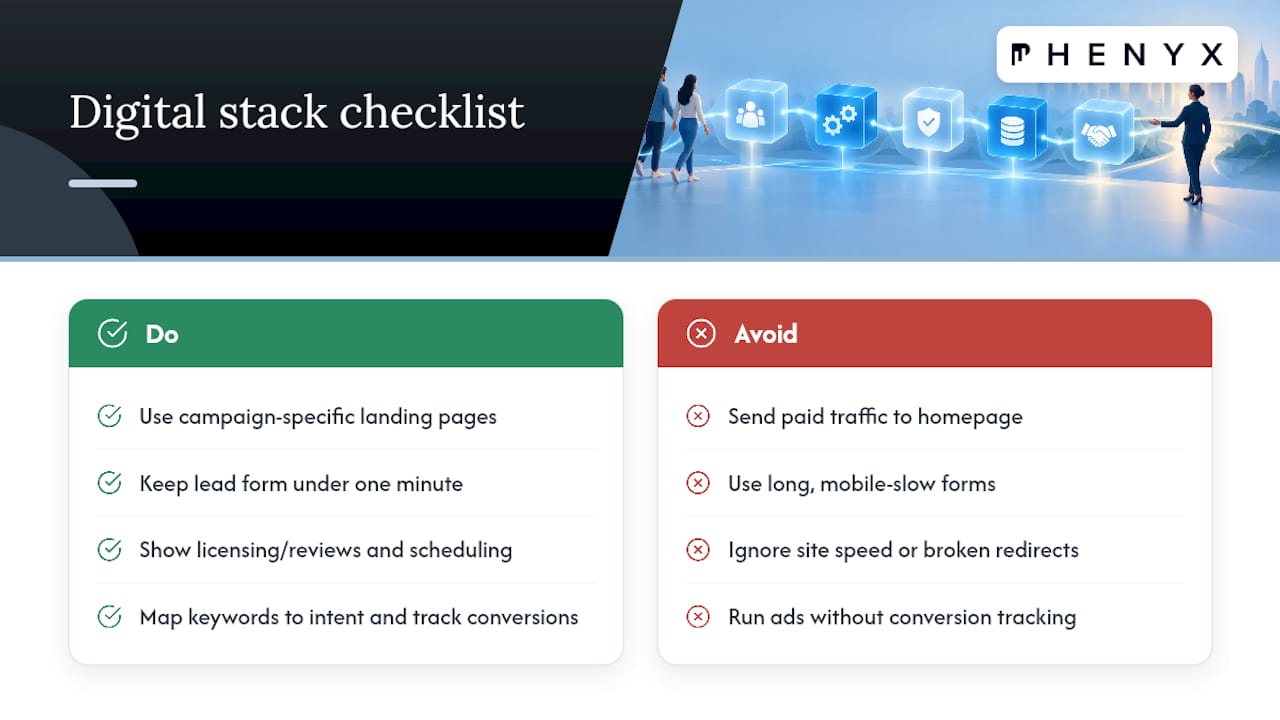
Every active campaign should land on its own dedicated page, not the homepage. A refinance ad should land on a refinance page with refinance-specific copy, not a general “contact us” form. That page needs a lead form short enough to finish in under a minute, visible licensing and review badges, and a scheduling widget that lets a borrower pick a time without a phone call. Site speed matters here too: a page that lags on mobile loses visitors before the form ever loads.
Search visibility and answer-engine visibility both depend on the same foundation: clear, accurate content that answers the questions borrowers actually type, like “how much down payment do I need” or “what credit score gets the best rate.” Technical health, meaning fast load times, working redirects, and clean site structure, keeps that content eligible to rank at all.
For paid search, map keywords to intent rather than volume. “Mortgage rates today” signals research, while “apply for FHA loan near me” signals readiness. Build negative keyword lists to filter out jobseekers and unrelated searches, add lead-form extensions so a click can convert on the search results page itself, and set up conversion tracking before spending a dollar so you know which keywords actually produce applications, not just clicks.
Social and short-form video work best as education, not sales pitches. A 30-second clip explaining how rate locks work earns more trust than a rate-quote graphic, and testing a handful of hooks weekly reveals what borrowers actually stop scrolling for.
Retargeting sequences should move a visitor step by step: someone who viewed a calculator gets a follow-up ad about pre-approval, someone who started an application but did not finish gets a reminder with a direct scheduling link.
One data point worth building strategy around: 59% of homebuyers cite convenience as the top benefit of mortgage technology, and 62% have used eSigning during their loan process. Convenience features are not a nice-to-have anymore, they are a selection factor.
Content and education that turn browsers into leads
Borrowers research heavily before they ever fill out a form, and the lenders who answer their questions first tend to earn the application later.
Priority content includes:
- Plain-language explainer pages for each loan type, written at the reading level of someone buying their first home.
- Interactive calculators for payment estimates, affordability, and refinance break-even points.
- Step-by-step checklists covering documents needed and what happens at each stage of underwriting.
- Short video explainers that walk through confusing steps like appraisal contingencies or rate locks.
- Borrower stories that show a real path from application to closing, told without over-promising outcomes.
Gating content should depend on how much commitment the content demands from the reader. A quick rate calculator should stay open, since friction there just loses visitors. A detailed first-time-buyer guide or a webinar registration is a reasonable place to ask for an email in exchange for real depth.
Distribution matters as much as the content itself. Publish explainer content optimized for search and answer engines, feed it into email nurture sequences, clip video content for social, and share relevant guides with referral partners like real estate agents who can pass them along to their own clients. Teams handling this at scale sometimes lean on partners like Yonderly’s financial services content operations to keep distribution consistent across channels.
A sample campaign: pair a “first-time buyer education” guide with a co-hosted webinar alongside a local real estate agent, then follow attendees with a three-email sequence offering a free rate consultation.
Pro Tip: Repurpose one long guide into five smaller pieces, an infographic, a short video, three social posts, and an email, before writing anything new.
Using CRM and nurture sequences without losing the human touch
A CRM only earns its keep when it is set up to route leads to the right person fast and keep everyone else warm automatically.
At minimum, your CRM needs lead capture tied directly to your website and ad forms, tagging by loan type and source, a scoring model that flags ready-to-talk leads, and routing rules that assign new leads instantly rather than sitting in a shared inbox.
- Purchase leads typically need faster, more frequent touches early, since they are often shopping multiple lenders at once.
- Refinance leads can tolerate a slower cadence with more educational content, since urgency is usually lower.
- Every new lead should get a first-contact attempt within minutes during business hours, not hours later.
- Follow-up cadence should escalate from call to text to email over the first week, then settle into a monthly nurture touch.
Integration with your calendar tool, loan origination system, and e-signature platform matters more than any single automation trick. When those systems talk to each other, a borrower can book a call, get a pre-filled application, and sign disclosures without your team manually chasing paperwork between tools.
Building referral pipelines and protecting your reputation
Referral relationships and reviews still drive a meaningful share of lending business, but they need structure to stay both effective and compliant.
- Structure co-marketing agreements with real estate agents and builders around actual marketing services performed and documented, never a straight payment for referrals.
- Ask for reviews at the moment of closing, when satisfaction is highest, and route requests through a simple, automated ask rather than an occasional manual one.
- Display verified reviews prominently on your website and loan officer profile pages, not buried on a separate page.
- Use local sponsorships, first-time buyer seminars, and targeted direct mail to build name recognition in specific neighborhoods.
- Track referral sources in your CRM with a dedicated tag so you know which partners and events actually produce funded loans.
Partner outreach needs a compliance filter before it needs a creative one. A marketing services agreement that pays for referral volume, rather than for services actually delivered, creates real legal exposure.
Compliance rules every lender marketing team must design around
Marketing that works but breaks the rules is not a strategy, it is a liability. A few regulatory guardrails shape almost every channel above.
- The CFPB’s advisory on digital mortgage comparison-shopping platforms warns that non-neutral placement or paying for preferential positioning can violate RESPA.
- The FCC’s one-to-one consent rule under the TCPA requires marketers to get prior express written consent per seller before sending automated texts or calls, which changes how lead sources should be vetted.
- Federal advertising rules require truthful, clearly disclosed mortgage advertising with proper recordkeeping.
- Marketing services agreements with referral partners must reflect actual services delivered, not disguised payment for leads.
- Any comparison-shopping tool or co-branded platform your lending team uses should be checked for neutral, unpaid placement of options.
- Every campaign launch should pass a short internal checklist covering consent capture, ad claim accuracy, and partner agreement scope before it goes live.
Worth noting: CFPB guidance treats paying for preferential placement on comparison sites as a legal risk, which is one more reason to invest in owned channels and direct relationships instead.
Measuring what actually funds loans
Traffic and clicks are vanity numbers unless they are tied back to originations. A few formulas keep budgets honest.
- Cost per lead: total campaign spend divided by number of leads generated.
- Lead-to-application rate: applications started divided by total leads.
- Application-to-funded rate: loans funded divided by applications started.
- Cost per funded loan: total spend divided by loans funded, the number that actually matters to the business.
Say a campaign spends $3,000 and generates 60 leads, a $50 cost per lead. That single calculation should guide whether a channel gets more budget or gets cut.
| Metric | Example value |
|---|---|
| Ad spend | $3,000 |
| Leads generated | 60 |
| Cost per lead | $50 |
| Applications started | 12 |
| Loans funded | 6 |
| Cost per funded loan | $500 |
Review this math weekly for paid channels and monthly for organic and referral channels. Optimization should focus on the stage with the biggest drop-off, whether that means rewriting ad creative, simplifying a landing page, or tightening audience targeting, rather than spreading effort evenly across a campaign that is already working in most places.
Practical tools and automation that keep loan officers in the room
The right stack removes friction without removing the loan officer from the parts of the process where trust actually gets built.
- CRM for lead capture, tagging, scoring, and routing.
- Loan origination system (LOS) for application processing and status tracking.
- Scheduling software so borrowers can book time directly.
- E-signature tools to move disclosures and documents without delay.
- Analytics and call-tracking tools to connect marketing spend to funded loans.
Chatbots and AI tools can handle basic questions and scheduling, but they should always offer a clear, fast path to a human loan officer rather than trapping a borrower in an automated loop. Simple automation runbooks, like auto-texting a borrower who abandons an application halfway through, or reminding a loan officer when a lead has gone untouched for a day, tend to produce more value than complex AI features borrowers never notice.
When evaluating vendors, watch for black-box lead routing that cannot explain how leads are prioritized, and tools that do not integrate cleanly with your existing CRM or LOS.
Pro Tip: Ask any vendor to show you exactly how a lead moves from form submission to loan officer inbox before you sign anything.
Why this playbook holds up for lending teams
A full-service marketing agency built around an in-house team can handle website design, SEO and AEO, branding, video production, and paid ads under one roof rather than splitting the work across separate vendors. That structure is relevant here because lender marketing depends on every channel above working together: a website that does not match the brand, or ad tracking that does not feed the CRM, quietly drains budget.
Work specifically on lender-adjacent lead generation, including a case study on SBA lender lead generation and an approach to CDC borrower outreach shows hybrid, human-plus-tech thinking applied to related lending audiences.
The gap most lenders never close
Most lending teams do not have a marketing problem, they have a follow-up problem. Ad spend and content get plenty of attention, while the minutes after a lead comes in, when a fast human response converts far better than a delayed one, get almost none. A hybrid approach only works if the human half actually shows up on time.
If you want one place to start, spend the next 30 days on three things: your website’s lead form, your CRM’s routing rules, and one paid campaign test. Measure all three against funded loans, not clicks, and you will know more about your marketing in a month than most lenders learn in a year.
— PHENYX
A done-for-you option when you would rather not build this alone
Building and maintaining a full lender marketing stack, website, SEO, paid ads, branding, and video, takes real time most loan officers do not have. PHENYX runs all of it under one in-house team instead of juggling separate vendors, which keeps your brand consistent and your campaigns connected to the same data.
For lenders who want this handled directly, PHENYX offers:
- MODS, a monthly marketing subscription starting from $4,000 per month that covers ongoing website, SEO, and paid ad management.
- Website design built around conversion-ready landing pages and fast mobile performance.
- SEO and AEO services to improve organic visibility for loan-related searches.
- Paid ads and PPC management for search and social campaigns tied to real conversion tracking.
If your team has the bandwidth and expertise to run this in-house, the playbook above will get you most of the way there. If you would rather have a single team execute and measure it for you, book a consultation with PHENYX to see what a coordinated setup looks like for your lending business.
Sources
- CFPB: Real-Estate Settlement Procedures Act (Regulation X) — Digital mortgage comparison-shopping platforms advisory
- FCC: Second Report and Order / TCPA one-to-one consent / related rule text
- MBA Newslink: Lenders Take Note — The Technology Buyers Want to See
FAQ
How much commission do loan officers make on a $500,000 loan?
Loan officer commission structures vary widely by employer, loan type, and state, and no single published rate applies to every lender. Rather than approximate a figure, check your own compensation plan or state licensing disclosures for the exact structure that applies to you.
How do I attract more customers as a lender?
Attracting borrowers works best through a combination of a fast, trustworthy website, targeted paid and organic content answering common loan questions, and consistent referral relationships with real estate agents and builders. Layering automated CRM follow-up on top ensures no lead goes cold while you focus on the conversations that need a human touch.
What is the 3-7-3 rule for a mortgage?
The “3-7-3 rule” is an informal industry reference tied to old disclosure timing requirements under the Truth in Lending Act and RESPA, generally describing a three-day initial disclosure window, a seven-day waiting period, and a three-day re-disclosure window after certain changes. Definitions and enforcement of these timing rules have shifted since TRID took effect, so confirm current requirements with your compliance team or legal counsel rather than relying on the shorthand alone.
How do I market myself as an individual loan officer?
Start with a clear, consistent personal brand: a professional photo, a short bio highlighting your specialty, and visible client reviews on your website and social profiles. Pair that with regular educational content, like short videos explaining loan steps, and active referral relationships with local agents who can vouch for you directly.
Why does a hybrid digital and human approach outperform fully automated marketing for lenders?
Industry reporting indicates many borrowers prefer a hybrid experience that blends digital convenience with real human contact rather than a fully automated process. Marketing that offers fast digital tools alongside a responsive loan officer tends to build more trust than either approach used alone.