


Your Outsourced Marketing Department: A Decision Guide
An outsourced marketing department is a subscription-style, senior-led external team that owns both strategy and execution for your business, functioning exactly like an in-house department without the overhead of full-time hires. It suits funded startups needing fast pipeline, SMBs scaling past what one generalist can handle, and established companies that want specialist depth without the cost of building it internally. The practical first step is a 2–4 week scoping exercise: map your current marketing gaps, define the channels that matter most, and run a short vendor discovery process before signing any retainer.
Key Takeaways
An outsourced marketing department delivers the fastest path to a full marketing function when you lack the internal headcount to build one, provided you maintain internal ownership of strategy and governance.
PointDetailsStart with a scoping exerciseRun a 2–4 week discovery before signing any retainer to map gaps and define scope.Match the model to your stageFully outsourced departments suit startups and SMBs; hybrid models work better when you already have an internal marketing lead.Budget for full-department retainersFull outsourced department engagements typically run $10,000+ per month depending on scope and seniority.Protect your data and IPRequire IP ownership clauses, role-based platform access, and a documented offboarding checklist before signing.Phenyx as a unified optionPhenyx delivers strategy through execution under one roof, with structured onboarding and measurable outcomes for growing U.S. businesses.
Table of Contents
Quick Summary
What is an outsourced marketing department, exactly?
The term gets used loosely, so the distinction matters. An outsourced marketing department is a single external provider that takes on the full scope of a marketing function: leadership, strategy, channel execution, creative, and reporting. It is not a project agency hired for a campaign, and it is not a freelancer covering one channel. The provider owns the road map and is accountable for outcomes across the whole function.
Compare that to the alternatives:
The delivery model typically includes a CMO-level account lead, a bench of specialists (content, SEO, paid media, design), shared tooling access, and a unified dashboard so you can see performance without chasing status updates.
Pro Tip: Ask any vendor you evaluate to show you a sample dashboard from an active client. If they cannot produce one within 24 hours, that is a signal about their reporting culture.
Which outsourcing model fits your situation?
Outsourcing is not a single choice. The right model depends on your stage, budget, and how much internal capacity you already have.
ModelSpeed to startTypical monthly costStrategy coverageExecution coverageBest fitFreelancer networkSlow (coordination overhead)LowNoneNarrowSolopreneur, single channelSpecialist agencyMediumLow–MidPartialDeep in one channelCompanies with internal strategyFractional CMOFastMidFullNoneTeams needing leadership onlyFully outsourced departmentFastMid–HighFullFullSMBs, funded startups, scale-upsHybrid (in-house strategy + outsourced execution)MediumVariableInternalBroadMature SMBs with a marketing lead
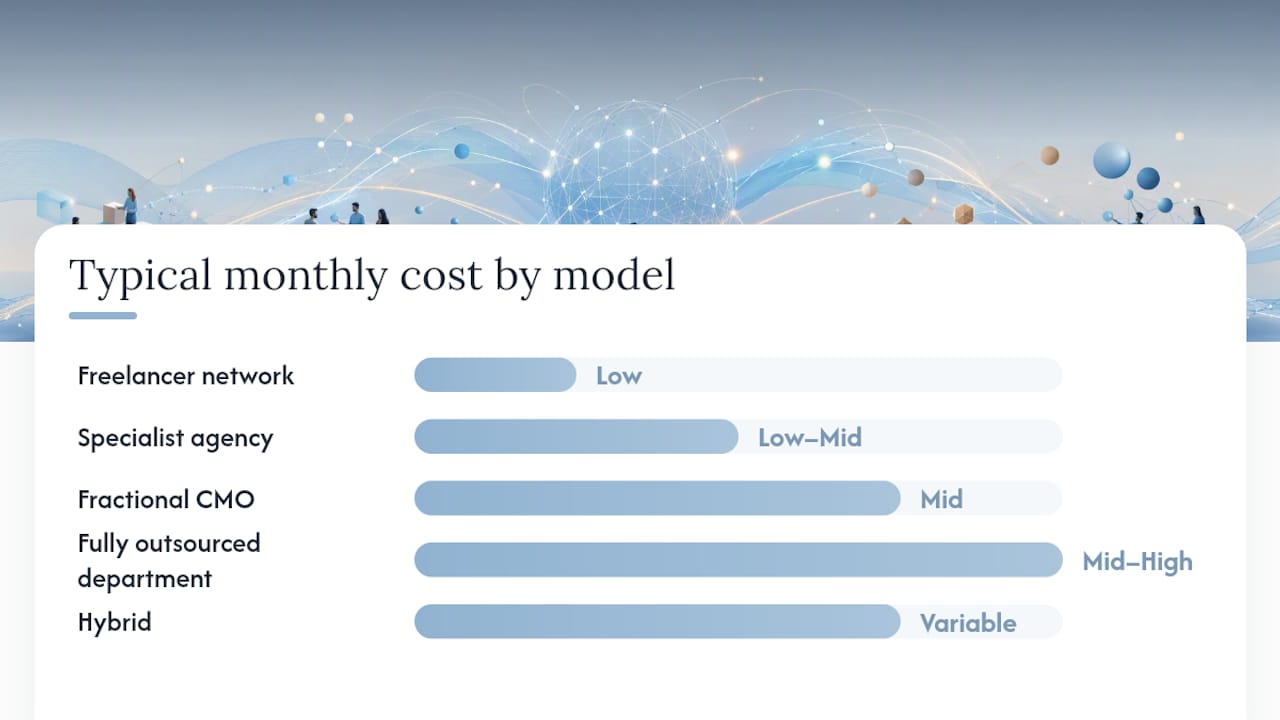
The function-by-function decision framework is the most practical lens: ask which tasks are execution-heavy and repeatable (outsource-friendly) versus which require deep institutional knowledge of your brand (keep internal). For most B2B companies, the hybrid model gives the best balance of control and cost.
A Series A founder with no marketing hire yet benefits most from a fully outsourced department: one vendor, one contract, fast ramp. A mature SMB that already has a marketing manager tends to do better with a hybrid, outsourcing paid media and SEO execution while the internal lead owns positioning and messaging.

Pro Tip: If you are debating between a fractional CMO and a full outsourced department, ask yourself whether you have the internal bandwidth to manage an execution team. If the answer is no, the fractional model will stall.
What services does a full outsourced marketing team typically cover?
A well-structured outsourced department covers the same roles you would staff internally. The HubSpot Marketing Mix report shows that integrated channel strategies consistently outperform single-channel investments, which is exactly why a full-department model matters: coverage across channels compounds.
RoleTypical responsibilitiesMaps to internal titleFractional CMO / Account LeadStrategy, road map, client governanceVP Marketing / CMOContent Strategist / WriterBlog, case studies, email copyContent ManagerSEO SpecialistTechnical SEO, keyword strategy, link buildingSEO ManagerPaid Media ManagerGoogle Ads, Meta, LinkedIn campaignsPaid Media SpecialistDesignerBrand assets, landing pages, ad creativeGraphic DesignerWeb DeveloperCMS updates, landing page builds, conversion optimizationWeb DeveloperAnalytics ManagerDashboard setup, attribution, reportingMarketing AnalystProject ManagerBacklog, timelines, stakeholder communicationMarketing Ops / PM
Tasks that outsource well include execution-heavy, repeatable work: content production, paid campaign management, SEO audits, and email sequences. Tasks that typically stay in-house include core brand positioning, executive thought leadership, and product-level messaging that requires deep internal knowledge.
On tooling: expect the vendor to work inside your existing stack (Google Analytics 4, HubSpot, Salesforce, or similar) rather than forcing a migration. Account ownership for ad platforms and CMS should stay with you from day one.
How does onboarding and the first 90 days actually work?
A structured phased approach separates vendors who deliver from those who drift. Here is what a well-run engagement looks like:
Your onboarding checklist should include:
Measurable pipeline impact typically takes 60–90 days. Anyone promising significant organic results in 30 days is overstating what is possible. For quarterly governance and meeting cadence, assign one internal owner who attends every weekly sync and owns the relationship on your side.
Pro Tip: Document your baseline metrics before the engagement starts. Without a pre-engagement snapshot, you cannot attribute results accurately, and neither can your vendor.
How much does an outsourced marketing department cost?
Pricing follows a few common structures: fixed monthly retainer (the most common for department-style engagements), project fees for defined deliverables, hourly or statement-of-work billing for ad hoc needs, and performance incentives layered on top of a base retainer.
The main cost drivers are:
According to Acadia’s outsourced marketing guide, a full outsourced marketing department can often be delivered for a monthly cost that is substantially lower than the fully loaded salary cost of equivalent in-house hires, particularly when you factor in benefits, recruiting, and management overhead.
Typical cost bands in 2026:
Engagement typeTypical monthly rangeWhat you getSingle-channel managed servicefew thousand dollarsOne channel, one specialistFractional CMO onlyfew thousand dollarsStrategy leadership, no execution benchFull outsourced department$10,000+Strategy + multi-channel execution
Watch for these line items in proposals: platform access fees, stock asset licensing, ad spend minimums, and overage clauses for deliverables beyond the agreed monthly volume.
How do you evaluate and choose the right vendor?
The selection process deserves as much rigor as any senior hire. Use a scored RFP that weights these criteria:
Must-ask interview questions:
Red flags: vague SLA language, no named account lead, resistance to sharing past client references, and contracts that assign IP to the vendor rather than the client.
Pro Tip: Request a sample deliverable, such as a content brief or a paid media audit, before signing. The quality of that document tells you more about their process than any sales call.
What are the real risks, and how do you reduce them?
Every outsourcing model carries trade-offs. The most common risks in practice:
Outsourcing works best when there is internal governance, clear briefs, and when companies outsource execution-heavy and specialist tasks rather than strategic brand ownership.
Pro Tip: Assign one internal “marketing owner” who is not the CEO. This person attends every vendor sync, approves briefs, and owns the relationship. Without this role, vendor engagements drift.
How a single-vendor outsourced department actually operates
The model that most closely replicates an internal team is the single-vendor, fully integrated outsourced department. One provider supplies the senior account lead, the execution bench, and the tooling, all working from a unified backlog. You get one invoice, one point of contact, and one dashboard.
Operationally, it looks like this: the account lead runs a weekly sprint review with your internal owner, the team works from a shared project management tool (Asana, Monday.com, or similar), and all performance data flows into a live dashboard you can access at any time. Creative reviews happen asynchronously with a defined approval window, typically 48 hours, so production does not stall.
A mid-market B2B software company engaged a fully outsourced department after a failed attempt to hire three separate specialists. Within 60 days, the vendor had launched a content program, rebuilt the paid media account structure, and delivered the first monthly performance report against agreed KPIs. By month four, inbound pipeline had grown measurably, and the internal team had shifted from managing vendors to reviewing strategy.
Trust signals to look for in a vendor: a phased onboarding process with documented milestones, a standard reporting cadence with shared dashboards, and references from clients at a comparable stage.
Pro Tip: Keep brand positioning and messaging owned internally. Outsource the execution of that strategy, not the thinking behind it.
Scenarios where outsourced marketing solves a real problem
Three situations where the model consistently delivers:
Results attribution matters. Require UTM tagging on all campaigns, a defined attribution model agreed before launch, and a baseline snapshot taken before any work begins. Without those three elements, you cannot verify what the engagement actually produced.
Legal and contractual considerations you should not skip
Before signing any outsourced marketing agreement, these contract elements need to be explicit:
These are not boilerplate concerns. IP disputes and data access issues after a vendor relationship ends are among the most common and costly problems in outsourced marketing engagements.
What actually matters when working with an outsourced marketing team
The conventional wisdom says “pick the agency with the best case studies.” That is necessary but not sufficient. The vendors with the strongest portfolios are not always the ones who perform best for your specific business, because performance depends as much on the governance structure you create as on the vendor’s capabilities.
Three rules that matter more than most guides acknowledge:
Do: assign an internal owner who attends every sync. Do: document your brand voice before onboarding. Do: review performance against baseline monthly, not quarterly.
Don’t: let the vendor own your strategy. Don’t: approve work you haven’t read. Don’t: skip the offboarding checklist when the engagement ends.
For governance cadence, a weekly 30-minute sync, a monthly performance review, and a quarterly road map session cover most engagements well.
Phenyx builds marketing departments that work like an in-house team
Growing businesses in Denver, Tampa, and Dallas-Fort Worth have a concrete alternative to assembling a patchwork of freelancers and agencies: Phenyx delivers a full-service marketing function under one roof, with a single team covering SEO and AEO, website design, video production, paid media, branding, and content, all coordinated by one account lead who owns your results.
The difference is integration. Every channel informs the others, every asset is built to a consistent brand standard, and you get one dashboard, one invoice, and one point of contact instead of five vendor relationships to manage. Phenyx uses a structured onboarding process with defined 30/60/90-day milestones, so you know exactly what gets built and when. To start a conversation, visit Phenyx and request a scoping call. The first step is a discovery session where Phenyx maps your current gaps to a proposed scope, with no obligation to proceed.
Sources
The following sources informed the cost ranges, model definitions, and vendor-vetting guidance in this guide: