



SBA Lenders: Win More Loans in 90 Days Without Buying Lists
To win more SBA originations, prioritize signal-driven prospecting over purchased lists, then pair it with conversion-ready onboarding. Lenders who track expansion signals like new leases, hiring surges, and ownership changes reach borrowers before competitors do. Combine that with referral partnerships and a low-friction intake process, and close rates rise while time-to-fund shrinks.
TL;DR:
- Tracking signals like new leases, hiring surges, and ownership changes enables lenders to reach expansion-stage businesses weeks before they appear on generic lists.
- Building referral partnerships with local SBDCs, SCORE chapters, and professionals increases high-converting, pre-qualifiable leads significantly.
- Creating localized SEO content around SBA-related queries captures actively researching borrowers at their decision-making point.
- Streamlining digital onboarding with guided flows and visual timelines reduces dropout rates and speeds up application completion.
- Measuring full funnel metrics such as cost-per-funded-loan and time-to-fund improves campaign focus and overall origination efficiency.
Table of Contents
- SBA Lenders Need to Drive Their Own Leads for Help With Business Owners
- Quick Summary
- Where High-Intent SBA Borrower Leads Actually Come From
- Designing Onboarding That Doesn’t Lose the Borrower You Just Won
- Keeping Borrower Intent Warm With Smart Nurture Workflows
- Measuring What Actually Moves the Needle
- Compliance Notes Every SBA Outreach Program Needs
- How an Integrated Marketing Approach Executes This Playbook
- A multi-month pilot any SBA lender can run
- How PHENYX Helps Lenders Build This Pipeline
- Sources
SBA Lenders Need to Drive Their Own Leads for Help With Business Owners
Waiting on a purchased list or a slow referral trickle costs lenders the deals that matter most. Generic small-business databases don’t capture financing intent, which means most of the names on them aren’t actually shopping for a loan. Signal-driven prospecting flips that: it surfaces companies showing real expansion activity right now, not businesses that technically qualify on paper.
This is the core shift SBA-approved lenders need to make. Instead of hoping SCORE or an SBDC sends a warm referral this quarter, build a pipeline that actively hunts for business owners who are already signaling they need capital. That means combining outreach, content, and technology into one connected system rather than treating marketing as an afterthought to underwriting.
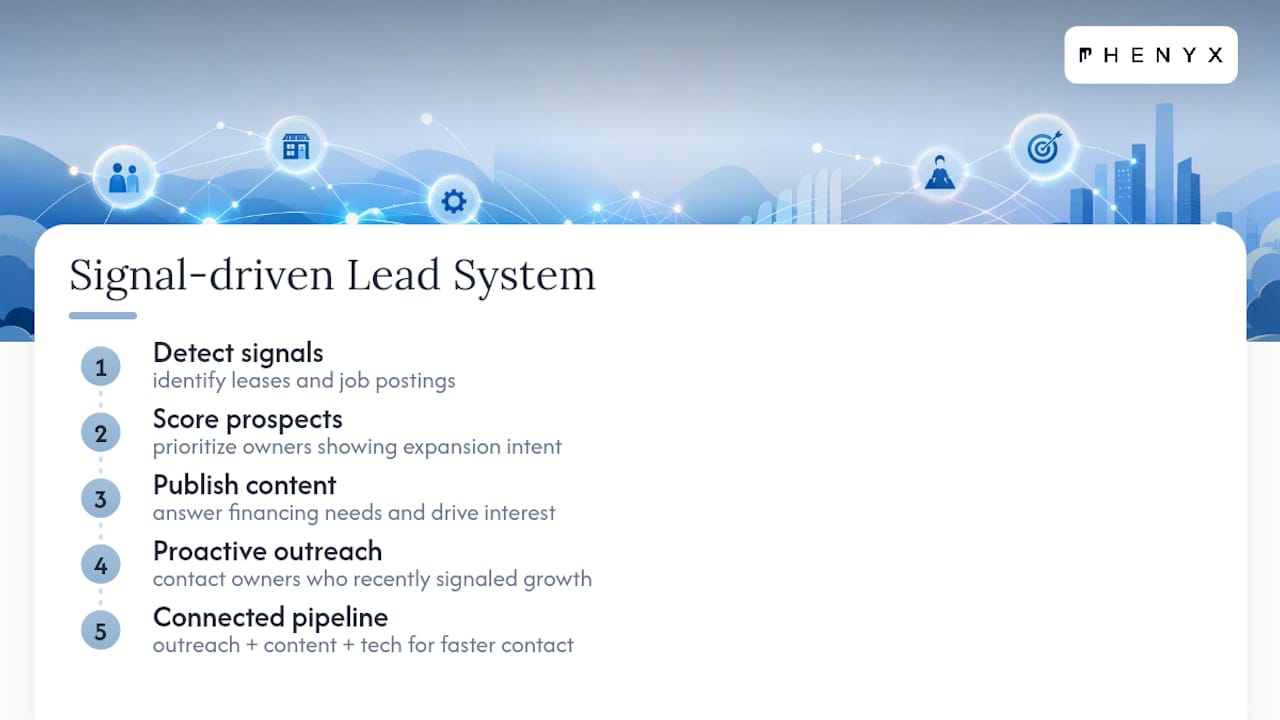
The payoff shows up twice: faster speed-to-contact, and higher-quality conversations once you get someone on the phone. A business owner who just signed a new lease or posted five job openings is a different prospect than one cold-called off a static list.
Quick Summary
- Subscribe to a signal feed that flags new leases, hiring spikes, and ownership changes in your target industries
- Contact one local SBDC or SCORE chapter this week to establish a referral relationship
- Launch a single conversion-focused landing page for your top SBA loan use case
- Set up a lead-scoring rule that flags “engaged” contacts for same-day follow-up
- Draft a three-email nurture sequence for prospects who aren’t ready yet
Week 1 pilot: pick one industry vertical, one signal source, and one landing page test. Expect your first measurable signal (click-through or form completion) within 7 to 10 days.
Where High-Intent SBA Borrower Leads Actually Come From
Not every channel deserves equal attention. Some sources produce names; others produce borrowers who are ready to talk numbers this month. Prioritizing correctly saves your team from chasing the wrong conversations.
- Signal-driven prospecting. Expansion signals like new commercial leases, leadership changes, recent hiring, and public filings indicate a business is scaling and likely needs capital. RelPro’s research shows lenders who track these signals engage expansion-stage companies before competitors even know they exist. Job postings and new locations are two of the strongest indicators, because both usually precede a capital need by weeks, not months.
- Referral partnerships. SBDCs, SCORE chapters, CPAs, commercial real estate brokers, and business attorneys all talk to business owners before those owners ever contact a lender. Becoming the “funding specialist” that these organizations refer to consistently, rather than occasionally, is one of the highest-converting channels available to community lenders. Ask your CDC contacts, too. A structured local outreach program can put you in front of borrowers before they’ve started shopping banks.
- Content and SEO for SBA-intent queries. Business owners search specific phrases before they call anyone: “SBA loan eligibility requirements,” “SBA 7(a) vs 504,” “how long does SBA loan approval take.” Building landing pages and articles around these exact questions, including localized versions for your service area, captures people at the exact moment they’re deciding whether to apply.
- Paid acquisition. PPC and LinkedIn ads work best when paired with a dedicated landing page, not your homepage. Test two or three variants; a page built around a single use case (equipment financing, franchise startup, working capital) typically outperforms a generic “apply for an SBA loan” page.
- Community and forum engagement. Industry-specific Facebook groups, local Chamber of Commerce events, and relevant subreddits where owners discuss financing questions are underused. A helpful, non-salesy answer in these spaces builds trust long before a formal outreach ever happens.
Some tactics work faster than others:
- Signal feeds produce the fastest speed-to-contact
- Referral partnerships produce the highest close rates
- SEO content produces the most consistent, lowest-cost volume over time
- Paid acquisition produces the fastest test-and-learn cycle for landing page optimization
Designing Onboarding That Doesn’t Lose the Borrower You Just Won
Getting a business owner to raise their hand is only half the job. SBA applications are paperwork-heavy, and every extra document request is a chance for a borrower to stall or walk. Guided digital onboarding and document assembly meaningfully reduce that drop-off.
The friction points are predictable: borrowers don’t know what documents they need, they don’t know how long the process takes, and they get discouraged after the third request for something they already sent. Fix all three and completion rates climb.
- Build a guided intake flow that asks for information in a logical sequence, not a giant form
- Pre-populate document checklists based on loan type and business structure
- Give every applicant a visual roadmap showing exactly where they are in the process
- Collect only the minimum needed to qualify and route the deal at first contact: entity type, time in business, revenue range, and loan purpose
- Communicate a realistic timeline up front, including likely delays tied to SBA processing volume
Pro Tip: Send a short video within 24 hours of application start that walks through what happens next. Borrowers who understand the timeline are far less likely to ghost you mid-process.
Keeping Borrower Intent Warm With Smart Nurture Workflows
Not every prospect is ready to apply today, and that’s fine as long as your CRM doesn’t let them go cold. High-intent leads (someone who requested a rate sheet or started an application) need same-day contact. Research-stage leads (someone who downloaded an eligibility guide) can handle a slower, educational cadence.
- Set cadence by intent level. High-intent leads get a call within hours; research-stage leads get a structured email sequence over two to three weeks.
- Build content around common friction, not just sales pitches. Short onboarding videos, document checklists, and “what to expect” guides reduce anxiety more effectively than another “apply now” email. This is where lead nurturing best practices from outside the lending world still apply directly.
- Score leads based on behavior, not just demographics. Someone who opens three emails and visits your rates page twice should outrank someone who filled out a form and went silent.
- Automate the handoff. Set clear triggers (form completion, page revisit, email click) that automatically tag a lead and route it to an originator, so nothing sits in a shared inbox for three days.
Measuring What Actually Moves the Needle
Track the full funnel, not just leads generated. The stages that matter are lead, engaged/contacted, prequalified, application started, application complete, and funded. Losing sight of any one of these hides where your pipeline is actually breaking.
- Calculate cost-per-funded-loan, not just cost-per-lead, since a cheap lead that never funds is expensive in disguise
- Track time-to-fund alongside conversion rate; a faster funnel often wins more deals than a slightly cheaper one
- Present credit and revenue teams with funded-loan volume and cost-per-funded-loan, since those numbers translate directly to institutional priorities, a point Colorado Bankers Association has raised in discussing why banks need to modernize SBA prospecting
- Build a dashboard in the first 30 days with these five fields: lead source, funnel stage, days-in-stage, assigned originator, and projected funding date
Signal-driven prospecting lets lenders reach expansion-stage businesses before competitors even identify them as prospects, which is exactly why speed-to-contact belongs on that dashboard from day one.
Compliance Notes Every SBA Outreach Program Needs
Marketing an SBA loan program isn’t the same as marketing a general business loan. Lender obligations, disclosure requirements, and recordkeeping rules all apply to outreach, not just underwriting.
- Review SBA’s lender guidance for program requirements, forms, and lender responsibilities before launching new outreach campaigns
- Consult Title 13 CFR Part 120 for regulatory language governing SBA program eligibility and lender operations
- Keep marketing materials free of guaranteed-approval language or misleading rate claims
- Maintain records of outreach campaigns, landing page versions, and lead sources for audit readiness, since regulators may ask how leads were sourced and qualified
How an Integrated Marketing Approach Executes This Playbook
The tactics above only work if the pieces connect. A signal feed is useless without a landing page built to convert that traffic. A referral relationship stalls if your intake process scares off the borrower it sends you.
- Site redesign work turns a generic loan page into a conversion-focused intake tool built around one use case at a time
- SEO and AEO work captures the exact SBA-intent queries borrowers type before they ever call a lender
- Short-form video explains documentation requirements and timelines, cutting the drop-off that kills paperwork-heavy applications
- A structured content approach ties signal data, landing pages, and nurture emails into one system instead of three disconnected tools
Pro Tip: Start with one vertical and one landing page. Proving the model on a narrow test is faster and cheaper than building five channels at once.
A multi-month pilot any SBA lender can run
In the first month, turn on a signal feed, reach out to a referral partner, and launch a single landing page test. In the following months, automate intake and nurture sequences, track key funnel metrics regularly, review conversion results, and focus budgets on the highest-performing channels.
— PHENYX
How PHENYX Helps Lenders Build This Pipeline
Phenyx is the alternative to hiring five separate vendors to build this pipeline: one team designs your landing pages, writes your SEO content, and produces your onboarding videos, all under one roof, so nothing gets lost in translation between agencies.
If your current site isn’t converting SBA-intent traffic into applications, a website redesign built around a single loan use case usually outperforms a generic “contact us” page within weeks. Pair that with SEO and AEO services to capture the exact questions borrowers search before calling a lender, and video production to walk applicants through documentation so fewer drop off mid-process. Phenyx works with lenders and local businesses out of its Denver/Lafayette, Tampa, and and Dallas-Fort Worth teams, building the same kind of connected marketing system described above instead of piecing it together vendor by vendor.
A practical starting point: a 90-day pilot covering one landing page, one content cluster targeting SBA-intent queries, and one onboarding video. Reach out through the website redesign page to scope what that pilot would look like for your lending team.
Sources
- SBA Lending in 2026: Find Expansion-Stage Businesses Before the Competition Does | RelPro
- SBA lenders - Small Business Administration
- Electronic Code of Federal Regulations — Title 13, Part 120
- SBA lead generation & originations via borrower readiness | SOLO

