Budget $1,500–$5,000/month: SEO Pricing Benchmarks 2026 for Businesses
Most businesses should budget between $1,500 and $5,000 a month for legitimate SEO work in 2026, with the overall market average landing near $2,917 a month. Local-only campaigns generally cost less, national campaigns cost more, and enterprise programs are priced higher than typical ranges. Whatever number you land on, don’t sign anything until you get an itemized quote broken out by strategy, production, tools, and management.
TL;DR:
- Local SEO campaigns typically cost around $1,557 per month, while national campaigns average approximately $3,474 monthly.
- The overall market average for SEO in 2026 is roughly $2,917 per month, with most small businesses paying between $1,500 and $3,000.
- High costs often stem from website complexity, keyword competitiveness, content volume, technical debt, and additional tools like AI and generative engine optimization.
- Providers should be asked to give itemized quotes breaking down strategy, content, technical work, and reporting to ensure realistic pricing and scope.
- Expect measurable SEO results within three to six months, with significant revenue impact typically visible after six to twelve months.
Table of Contents
- SEO Pricing Guide: What the 2026 Numbers Actually Look Like
- Common SEO Pricing Models Explained
- What Drives SEO Costs Up or Down
- What You Get at Different SEO Budget Tiers
- How to Evaluate an SEO Proposal (And Red Flags to Avoid)
- How Long Until SEO Shows Results?
- How PHENYX Thinks About Fair SEO Pricing
- Get an Itemized SEO Quote Built Around Your Actual Goals
- Sources
SEO Pricing Guide: What the 2026 Numbers Actually Look Like
Numbers without context are just noise, so here’s how the 2026 benchmarks actually break down by provider type and scope.
The average business paying for SEO in 2026 spends about $2,917 a month, and roughly 63% of companies fall somewhere between $500 and $5,000 monthly. That’s a wide band, and it’s wide for a reason: a five-page local service business and a 400-page ecommerce catalog have nothing in common when it comes to SEO cost breakdown, even if they’re both technically buying “SEO.”
Scope matters more than almost anything else in the quote. Local SEO campaigns average around $1,557 a month, while national campaigns average closer to $3,474. Small businesses generally land in the $1,500 to $3,000 range for work that actually moves rankings, not the $99-a-month packages that promise everything and deliver nothing measurable.
Here’s a quick reference for how the core seo service pricing figures stack up:
| Metric | Typical Range | Notes |
|---|---|---|
| Overall market average | ~$2,917/month | Across all provider types |
| Small business retainer | $1,500–$3,000/month | Legitimate, ongoing work |
| Local SEO campaigns | ~$1,557/month average | Single-market focus |
| National campaigns | ~$3,474/month average | Broader keyword competition |
| Average hourly rate | ~$111/hour | 78.2% of providers still prefer retainers |
Freelancers and solo consultants tend to sit at the bottom of these ranges. Agencies with in-house teams, dedicated content writers, and technical developers sit at the top, because they’re pricing in more than one person’s time.
Common SEO Pricing Models Explained
Before you compare quotes, you need to know what you’re actually comparing. Four seo pricing models dominate the market, and each one fits a different kind of buyer.
Monthly retainer. This is the default. About 78.2% of providers now bill this way, typically in the $1,500 to $5,000 range for small and midsize businesses. You’re paying for ongoing strategy, content, technical fixes, and link building as a continuous program rather than a one-time project. It works well when your competitive landscape shifts often and you need someone watching it every month.
Hourly billing. Average rates sit near $111 an hour in 2026. This model fits narrow, well-defined tasks, like a technical audit or a specific migration fix, where you don’t need an ongoing relationship. It’s a poor fit for competitive keyword campaigns, because SEO compounds over months and hourly billing punishes that kind of sustained effort.
Project-based pricing. You pay a flat fee for a defined deliverable, an audit, a content migration, a site restructure. This is the lowest-risk entry point for a business that’s never worked with an SEO provider before, and it’s often the smartest first move.
Hybrid or performance-based. Some providers blend a smaller base retainer with bonuses tied to ranking or traffic milestones. This sounds appealing on paper, but performance clauses are only as good as the metrics behind them. A provider chasing rankings for vanity keywords instead of revenue-driving terms can hit their bonus targets while your business sees zero commercial benefit.
How to choose:
- Pick a retainer if you need continuous work across content, technical, and links.
- Pick hourly for a single, well-scoped task with a clear endpoint.
- Pick project-based if you’re testing a provider before committing long-term.
- Pick hybrid only if you can verify the performance metrics tie to revenue, not just rankings.
One smart middle path: commission a diagnostic project first, an audit plus a roadmap, then convert to a 12-month retainer once you know exactly what needs fixing. This reduces the risk of overpaying for a program built on guesswork.
What Drives SEO Costs Up or Down
Two businesses can request nearly identical scopes and get quotes that differ by five or ten times. Here’s what actually explains that gap.
- Site complexity. A five-page brochure site costs far less to optimize than a 10,000-page ecommerce catalog with faceted navigation and duplicate content issues.
- Keyword competition. Ranking a local plumber for “emergency plumber near me” is a different animal than ranking a SaaS company for a term with a hundred well-funded competitors.
- Geographic scope. Local SEO campaigns cost less than national or multi-location campaigns because the keyword universe and competitive set are smaller.
- Content volume. Programs that require frequent, original content, blog posts, landing pages, product copy, cost more than programs focused mainly on technical fixes.
- Link building needs. Earning authoritative backlinks takes real outreach time, and that labor shows up directly in the price.
- Technical debt. A site with years of unresolved crawl errors, broken redirects, or a slow migration history needs more upfront cleanup before growth work even starts.
- Provider seniority. A senior strategist billing at agency rates costs more per hour than a junior specialist, but often delivers faster, more accurate diagnosis.
- Geographic cost differentials. Providers based in higher-cost markets, or agencies serving competitive metro areas like Denver, Tampa, or Dallas-Fort Worth, sometimes price differently than those in lower-cost regions.
- Tooling and setup fees. Most providers bill platform subscriptions separately, often $500 to $2,000 a month, plus setup or onboarding fees in month one that can range from $500 to $5,000 or more depending on scope.
- AEO and GEO add-ons. Answer engine optimization and generative engine optimization work, tailoring content so it gets pulled into AI-generated answers, has become its own line item in 2026 quotes, commonly priced between $900 and $3,000 a month because it requires specialized monitoring tools and a different content structure than traditional search.
Pro Tip: Ask every provider whether AEO or GEO work is included in the base retainer or billed as an add-on. In 2026, this distinction alone can swing a quote by a thousand dollars a month, and vague answers here are a warning sign about how the rest of the proposal was built.
Regulatory complexity adds another layer for certain industries. Healthcare, finance, and legal sites often need extra review cycles for compliance, which shows up as added strategy hours rather than a separate fee, so ask providers to break that time out explicitly rather than folding it into a generic “strategy” line.
What You Get at Different SEO Budget Tiers
Knowing the price is only half the picture. Here’s roughly what shows up in the deliverables at each tier, based on how 2026 retainers are typically scoped.
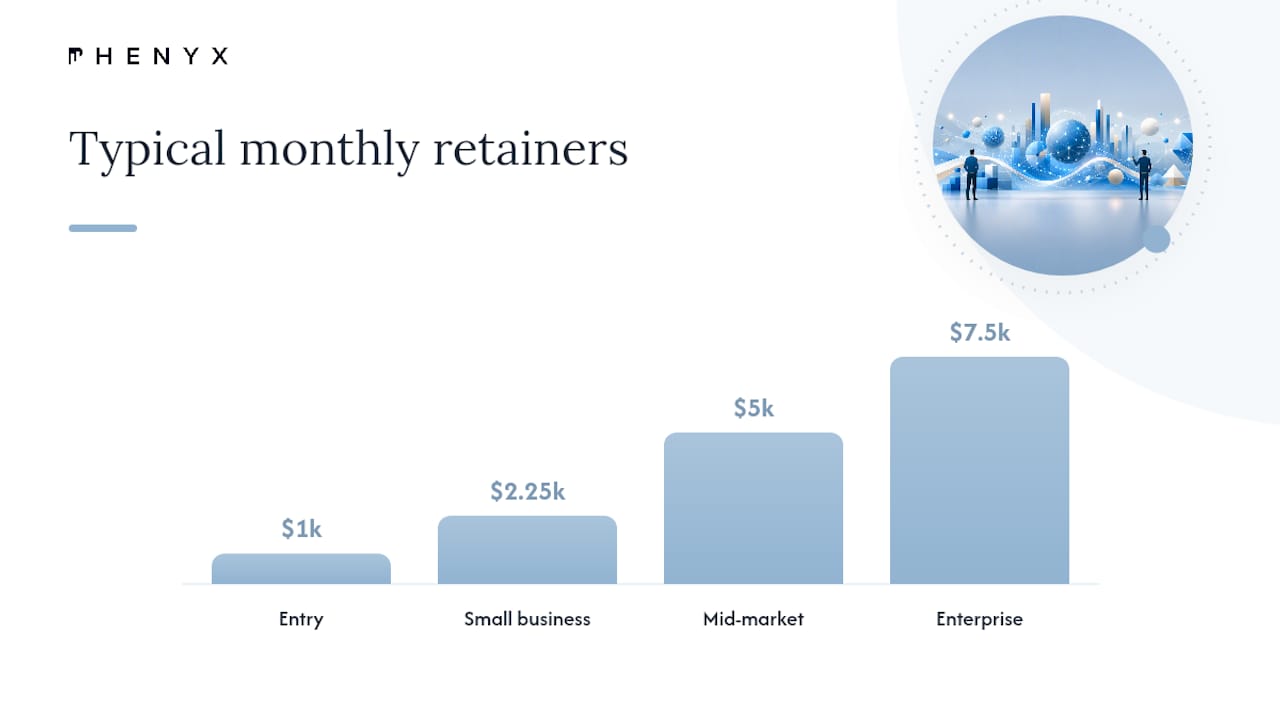
- Entry tier ($500–$1,500/month): A handful of technical fixes, minimal content production (maybe one piece a month), light reporting, and no meaningful link building. This tier suits a very small local business with a simple site and low competition.
- Small business tier ($1,500–$3,000/month): Ongoing technical monitoring, two to four content pieces monthly, modest link outreach, and monthly reporting calls. This matches the typical small business range and fits a local or regional service business.
- Mid-market tier ($3,000–$7,000/month): A dedicated strategist, four to eight content pieces monthly, active link building, technical SEO work across a larger site, and detailed monthly or biweekly reporting tied to revenue metrics, not just rankings.
- Enterprise tier ($7,500/month and up): Multiple specialists across content, technical, and links, custom reporting dashboards, ongoing AEO and GEO monitoring, and strategy sessions that touch product, PR, and paid media teams.
A useful exercise: divide the monthly retainer by the average hourly rate of roughly $111 to get an implied hours figure. A $2,500 retainer implies around 22 hours of work a month across the whole team, strategy, writing, technical, and reporting combined. If a proposal promises daily content and weekly link placements at that price point, the math doesn’t hold up.
If your business fits the small end of this range, our small business SEO playbook walks through what a realistic scope looks like at that budget level.
How to Evaluate an SEO Proposal (And Red Flags to Avoid)
Price alone tells you almost nothing about quality. Agencies quoting the same scope can differ by five to ten times in price, so the proposal itself needs scrutiny.
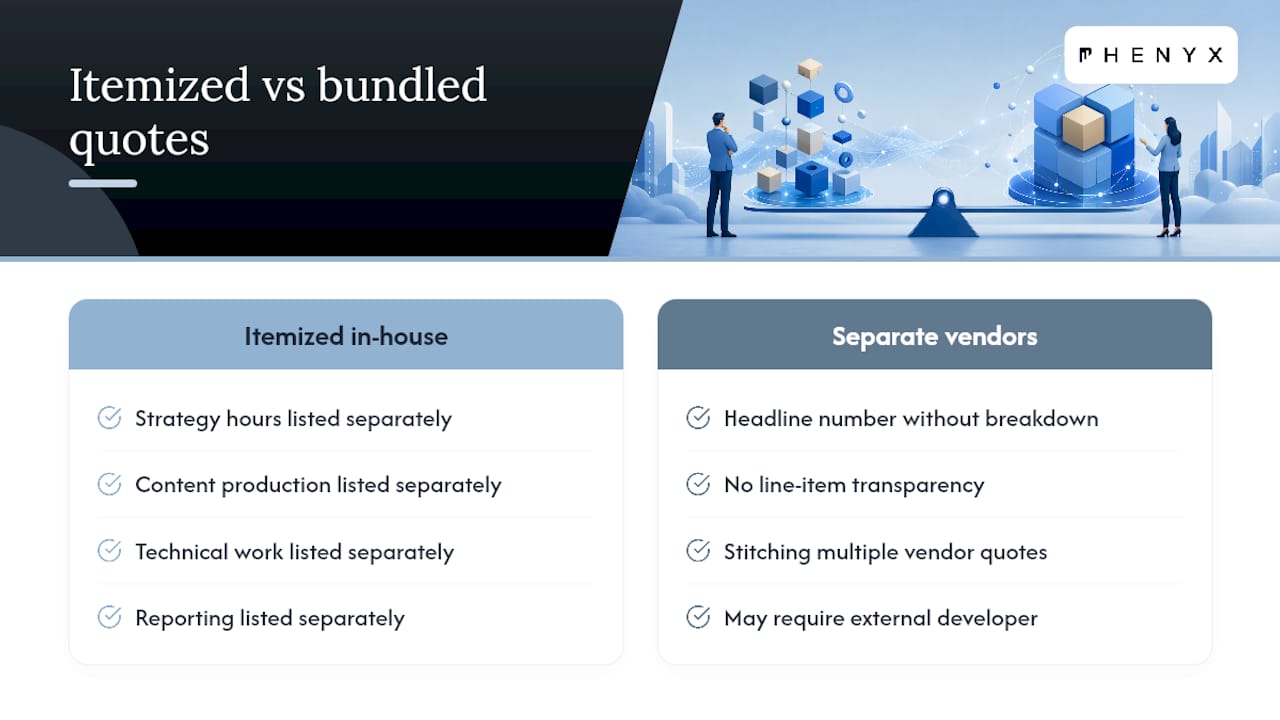
- Request an itemized quote. Every proposal should separate strategy hours, content production, link building, tool fees, and account management into distinct lines, not one bundled number.
- Run the implied hourly-rate test. Divide the monthly fee by the promised hours. If it comes out well below the roughly $111 average, ask what’s being cut to hit that price, usually it’s senior oversight or link quality.
- Check for AI-deliverable disclosure. If content is AI-assisted, ask whether that’s reflected in a discounted rate. Providers who quietly bill AI-generated drafts at full custom-writing rates are overcharging.
- Watch for guaranteed rankings. No legitimate provider guarantees a specific ranking position. Search algorithms change too often for that promise to be honest.
- Watch for missing reporting cadence. If a proposal doesn’t specify how often you’ll see data, and in what format, that’s a gap that tends to widen once the contract is signed.
- Watch for vague deliverables. “Ongoing optimization” with no defined output is a phrase that hides a lack of a real plan.
- Watch for opaque link sourcing. Ask specifically where backlinks will come from. If a provider doesn’t name the outreach process, the links may come from low-quality networks that risk a penalty later.
The true cost is usually higher than the headline number. Applying a 1.25x multiplier to the quoted monthly retainer gives a more honest annual estimate once tool subscriptions, setup fees, and mid-year scope additions are factored in. A $2,500-a-month retainer that looks like $30,000 a year often lands closer to $37,500 once those extras hit.
How Long Until SEO Shows Results?
SEO doesn’t work on a paid-media timeline, and any provider who implies otherwise is setting you up for disappointment.
Most retainer-based programs show measurable movement in rankings and traffic within three to six months, with material commercial impact, actual leads and revenue, typically visible around the six to twelve month mark. That timeline reflects how search engines crawl, index, and re-evaluate content, not a limitation of any particular provider.
Track these metrics to judge whether a program is working:
- Organic sessions landing on commercial pages, not just blog traffic
- Lead volume or form submissions attributed to organic search
- Conversion rate on organic landing pages compared to other channels
- Revenue attribution where analytics tracking allows it
Given that marketing budgets have flattened as a share of overall revenue according to Gartner’s 2025 CMO survey, every dollar spent on SEO needs to justify itself against other channels. Structuring an initial audit plus a 12-month plan, with checkpoints at month three, six, and twelve, gives you the data to make that comparison honestly. If you’re weighing SEO against paid channels for that budget, our comparison of SEO and paid advertising breaks down where each one earns its keep.
How PHENYX Thinks About Fair SEO Pricing
Most SEO pricing confusion comes from proposals that hide scope inside a single flat number. A retainer that doesn’t separate strategy, content, technical work, and reporting isn’t really a plan, it’s a guess dressed up as one.
At PHENYX, SEO and AEO retainers are built from the same in-house team that also handles content, technical development, and reporting, which means the itemization isn’t an afterthought bolted onto a sales pitch. We approach quoting by breaking scope into the actual work involved, strategy hours, production, technical fixes, and the tooling required to track AEO and GEO performance, rather than presenting a single bundled fee and asking a client to trust it.
We also don’t believe in guaranteeing rankings or promising overnight results, because the timeline data doesn’t support those claims. What we do believe in is tying every recommendation back to a measurable outcome, whether that’s organic leads, revenue, or visibility in AI-generated answers. For businesses that want to see how that translates into deliverables at a smaller scope, the small business SEO playbook is a good place to start.
— PHENYX
Get an Itemized SEO Quote Built Around Your Actual Goals
If you’ve read this far, you already know the real problem isn’t the headline number, it’s providers who won’t break that number down. Phenyx builds every SEO and AEO proposal as an itemized quote from the start: strategy hours, content production, technical work, and reporting listed separately, so you know exactly what you’re paying for before you sign anything.
Because this agency handles SEO, AEO, web design, and video production under one in-house team, you’re not stitching together quotes from multiple vendors and hoping they cooperate. That matters most when technical fixes require actual development work, something a pure SEO consultant often can’t deliver without bringing in a separate developer at an added cost. If your site’s technical debt is part of the problem, our website redesign service handles that directly, and it’s often cheaper than paying an SEO provider to work around a broken foundation.
We also rely on established platforms rather than reinventing basic infrastructure, which is part of why our scopes stay realistic. If you want a sense of what tools shape a serious SEO program, this overview of agency SEO tools covers the kind of platforms that typically show up as line items in a transparent quote.
Ready to see what a fair, itemized quote looks like for your business? Request a proposal through our SEO and AEO services page and get a breakdown built around your actual site, not a generic package.
Sources
The benchmark figures in this guide come from a handful of 2026 industry sources that track SEO spending patterns directly. The Digital Elevator’s SEO pricing guide supplied the overall market average and spending distribution. GoodFirms’ 2026 pricing breakdown provided the local-versus-national cost split. Vrid’s analysis of agency pricing models supplied the retainer adoption rate and hourly averages. Techradiant’s 2026 agency pricing report informed the annual-cost multiplier and the quote-evaluation framework. Indexed’s comparison of retainer versus project-based SEO shaped the timeline expectations, and Gartner’s 2025 CMO spend survey grounded the ROI-pressure context tying budgets to measurable results.
- SEO Pricing Guide: How Much Should You Actually Budget in 2026?
- SEO Pricing in the USA (2026): What Agencies, Freelancers & Consultants Actually Charge
- 2026 Agency Pricing Report: What You Should Actually Pay - Techradiant