

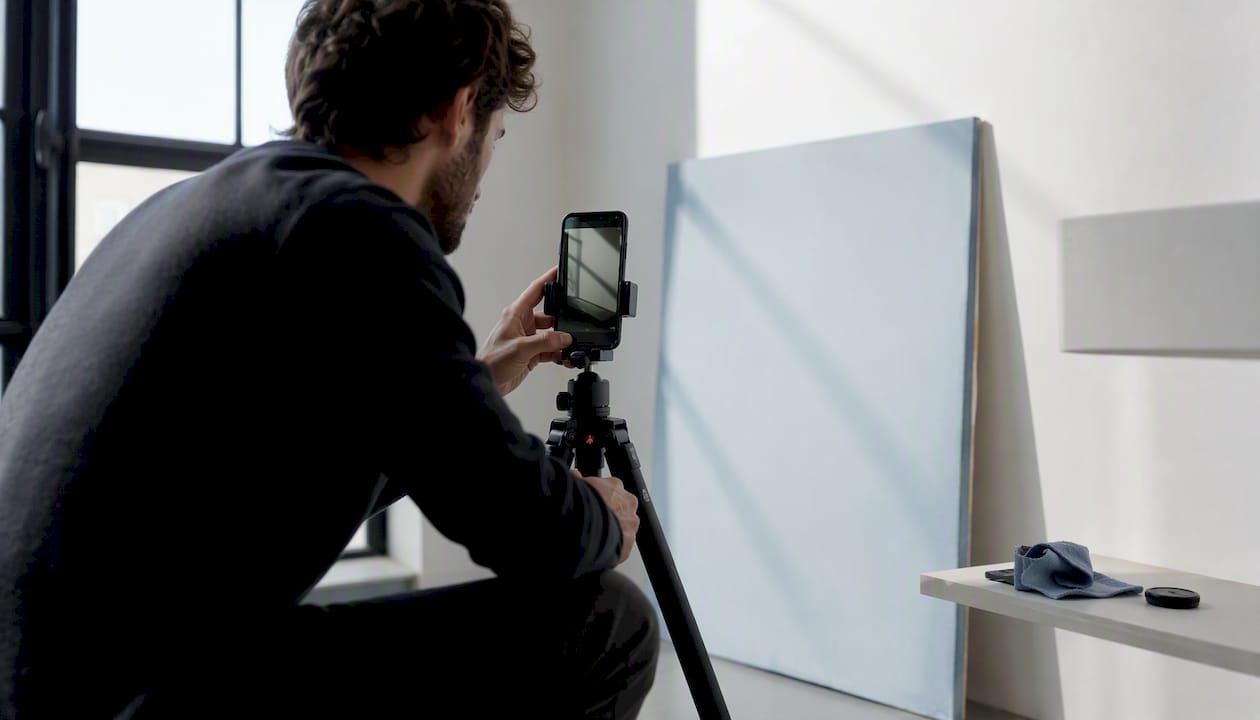
Vertical Video Ads: Platform Specs and Testing Framework
Vertical video ads are mobile-first, 9:16 portrait creatives that occupy the full screen on smartphones, and they run across every major social and commerce platform available today. If you’re building or refining a campaign, here’s where they perform:
The sections below cover platform specs and safe zones, creative rules, production steps, measurement, and a testing framework you can copy directly into your workflow.
Table of Contents
Why do vertical video ads outperform horizontal on mobile?
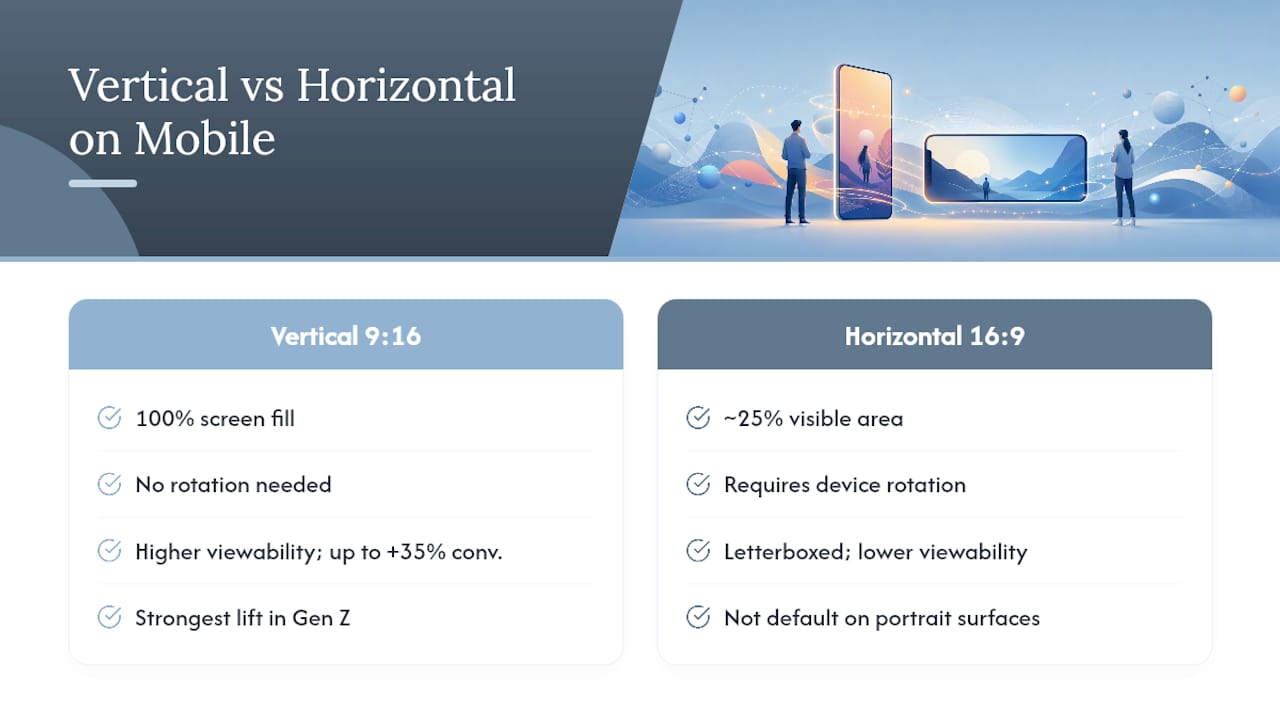
The answer starts with how people actually hold their phones. Research confirms that mobile users process vertical video with greater fluency than horizontal formats, producing stronger engagement, particularly among younger demographics who never developed the habit of rotating a device to watch content. Eliminating that rotation friction is not a minor convenience; it removes a cognitive interruption that costs attention.
The screen real estate argument is equally concrete. A 9:16 creative fills the entire display, while a horizontal asset letterboxed into a portrait feed occupies roughly 25% of the visible area. The IAB’s vertical video guidance frames this plainly: vertical format uses 100% of the phone’s screen, which raises both viewability and the probability that a viewer stays with the ad. Higher viewability translates directly into more opportunities for your message to register.
, adding vertical assets to Demand Gen campaigns on YouTube Shorts lifts conversions by up to 35% compared with campaigns running horizontal assets alone.
Audience skew matters too. Gen Z cohorts show the strongest lift for vertical formats, but the behavioral pattern extends well into millennial and Gen X audiences who consume short-form content daily on Reels, Shorts, and TikTok. The format is no longer a niche preference; it’s the default expectation on portrait-first surfaces.
Pro Tip: Don’t rely on platform-reported viewability alone to validate vertical performance. Pair it with a brand lift or conversion lift study at least once per quarter to confirm that higher viewability is translating into real business outcomes.
Platform specs, safe zones, and buying notes at a glance
The table below consolidates the critical specs and buying details for each major platform. Use it as a pre-launch checklist when preparing assets.
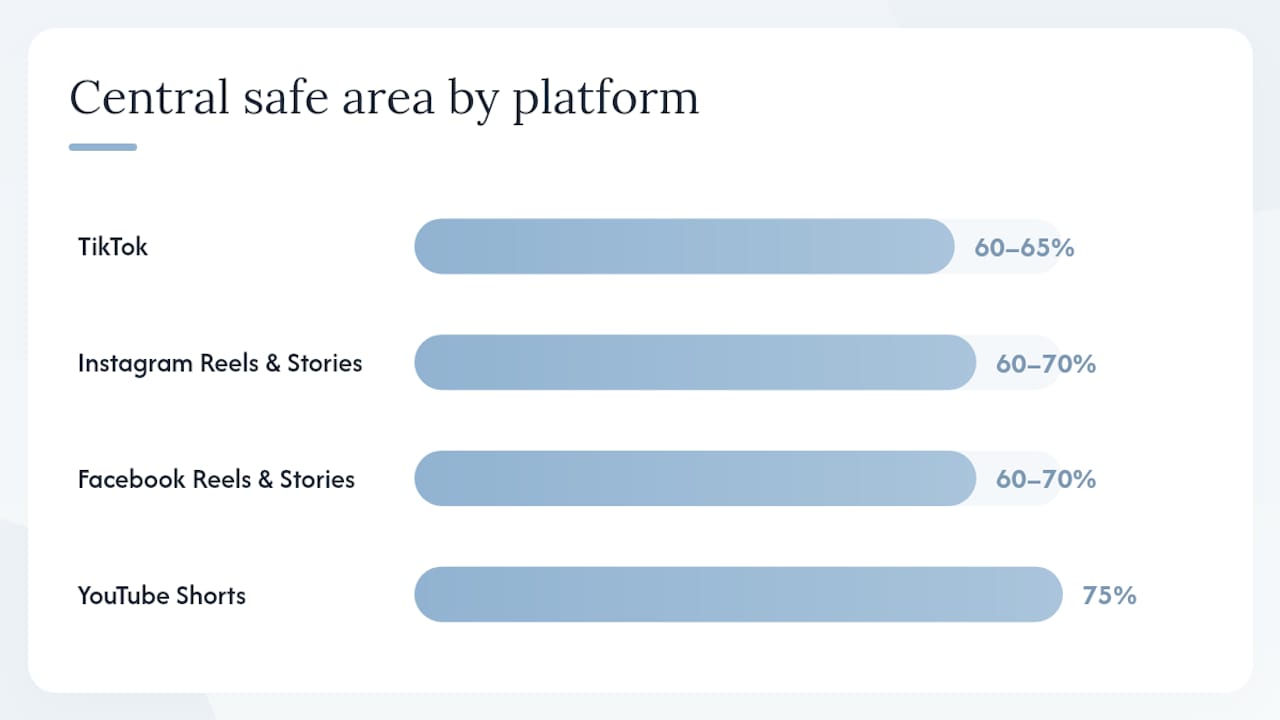
Platform / PlacementSupported PlacementsAspect Ratio & Safe ZoneSuggested LengthBest ObjectivesCTA / Landing OptionsFile / FormatBuying MethodTikTokIn-feed, TopView, Spark Ads9:16; keep critical elements in center 60–65% of frame15–60 sec (15 sec optimal)Awareness, app installs, conversionsIn-app CTA button; deep link, app store, websiteMP4/MOV, H.264Self-serve (TikTok Ads Manager)Instagram Reels & StoriesReels, Stories, Explore feed9:16; avoid top 10–15% and bottom 20–25% (UI overlays)—Awareness through conversions, shoppableShop Now, Learn More; product page, websiteMP4/MOV, up to 4 GBSelf-serve (Meta Ads Manager)Facebook Reels & StoriesReels, Stories9:16; same safe-zone rules as Instagram—Reach, retargeting, trafficWebsite URL, app installMP4/MOV, up to 4 GBSelf-serve (Meta Ads Manager)YouTube ShortsShorts in-feed, in-stream (Demand Gen)9:16; avoid bottom 25% (subscribe/like UI)15–60 secAwareness, views, conversionsSitelink, app install, store visitMP4Self-serve (Google Ads); programmatic via DV360X (Twitter/X)Vertical Video Ads (full-screen)9:16; center-safe for text and logo15–60 secBrand storytelling, reachWebsite card, app installMP4/MOV, up to 1 GBSelf-serve (X Ads); PMP availableSnapchatSnap Ads, Spotlight, Story Ads9:16; keep key elements above bottom 25%3–10 sec (Snap Ads); up to 60 sec (Story)Awareness, app installs, web trafficSwipe-up URL, app store, deep linkMP4/MOV, up to 1 GBSelf-serve (Snapchat Ads Manager)Amazon Sponsored BrandsSponsored Brands video (search results)9:16 (vertical creative option)6–15 secProduct page visits, brand awarenessStore page, product detail pageMP4Self-serve (Amazon Ads console)
A few platform-specific notes worth keeping close:
What makes a vertical video ad actually perform?
The hook is everything. Viewers decide whether to keep watching within the first one to three seconds, so your opening frame must communicate the core value proposition visually, before any voiceover or text has time to load. A product in action, a bold visual contrast, or a direct question on screen all work. A slow logo reveal does not.
Captions are non-negotiable. Approximately 65% of vertical video views occur with sound off, depending on the placement. Burned-in captions or precisely timed sidecar files protect your message regardless of audio state. Pair on-screen text with visual cues (arrows, product close-ups, reaction cuts) so the narrative holds even when the viewer is in a silent environment.
Branding placement requires discipline. Show the product or brand mark early, but keep it inside the center safe zone. Platform UI elements (usernames, action buttons, CTA overlays) occupy the top 10–15% and bottom 20–25% of the frame, so any logo or text placed there risks being hidden. Templates with safe-zone guides baked in save significant rework time.
End cards close the loop. Place an explicit, short CTA in the final two to three seconds of the creative and mirror it in the platform’s CTA button field. Redundancy here is intentional: some viewers tap the button, others respond to the on-screen prompt.
Pro Tip: Test a version of your creative with no voiceover at all, relying entirely on captions and visuals. On placements where sound-off rates are high, this variant often outperforms the sound-on version on completion rate.
How to produce vertical-first assets (and convert horizontal when you must)
Shooting vertical from the start is always the right call. Cropping a horizontal asset into 9:16 almost always sacrifices composition, and the IAB explicitly warns against simple cropping as a substitute for native capture.
Vertical production checklist:
When you must convert a horizontal asset:
Export checklist: Deliver at 1080×1920 (minimum), H.264 or H.265 codec, within each platform’s file-size limit. Burn captions into the video file or attach a precise sidecar (.SRT) file. Preview the final export on an actual mobile device, not just a desktop monitor, before uploading.
Pro Tip: Batch-produce three to five creative variants during a single shoot day. Varying the hook frame, caption style, and CTA wording costs almost nothing in production time but gives you the raw material for a full A/B testing cycle.
What KPIs and optimization steps actually move vertical campaigns forward?
Tracking the right metrics separates campaigns that improve from campaigns that just run. For vertical video, the primary KPIs are:
For A/B testing, start with the hook. It has the highest leverage of any creative element because it determines whether the rest of the ad gets seen at all. Test two hook variants with identical bodies before changing anything else. Once a winning hook is established, test caption style (burned-in vs. animated vs. none), then CTA copy. Run each test long enough to reach statistical confidence, typically at least 1,000 impressions per variant at minimum, though higher-volume campaigns should aim for meaningful sample sizes before drawing conclusions.
Budget allocation signals: when a placement’s completion rate and CTR both trend above your campaign benchmark, shift budget toward it. When VTR is high but conversions lag, the creative is working but the landing experience may be the bottleneck. Use ad tracking data alongside platform dashboards to catch attribution gaps before they distort your optimization decisions.
Pro Tip: Platform-reported view counts and third-party viewability tools often disagree. Reconcile them monthly rather than treating either as ground truth. The delta between the two usually reveals inventory quality issues worth addressing.
Where can you buy vertical video inventory?
Vertical inventory is available across three buying structures, and the right choice depends on your campaign objective and creative readiness.
A research-backed testing framework for vertical video
A structured experiment removes guesswork from creative iteration. Follow these steps in order:
Google Ads data shows that adding vertical assets to a campaign mix can lift conversions by up to 35% on Shorts placements. Use that figure as a directional ceiling when setting improvement targets for your own tests, not as a guaranteed baseline.
Pro Tip: Stitch platform signals with on-site conversion data using UTM parameters and a consistent attribution window (typically 7-day click, 1-day view). Without that connection, you’re optimizing platform metrics that may not correlate with actual revenue.
Key Takeaways
Vertical video ads deliver their strongest results when creative, specs, and measurement are treated as a unified system rather than separate tasks.
PointDetailsShoot vertical nativelyNative 9:16 production consistently outperforms cropped horizontal assets across every major platform.Respect safe zonesKeep critical text, logos, and CTAs in the center 60–65% of the frame to avoid UI occlusion on all placements.Caption every assetApproximately 65% of vertical views occur with sound off; burned-in or sidecar captions protect message delivery.Test the hook firstThe opening 1–3 seconds determine completion rate; test hook variants before changing any other creative element.Phenyx for full-cycle executionPhenyx handles vertical video production, platform-specific exports, paid media buying, and campaign optimization under one roof.
The case for being honest about vertical video’s real demands
Most articles on vertical video ads make the format sound like a simple checkbox: shoot portrait, upload, watch results improve. The reality is more demanding, and marketing teams that treat it as a checkbox tend to see mediocre results and blame the format.
The actual discipline is threefold. First, vertical production requires a genuine creative rethink, not just a crop. Compositions that work in 16:9 often fall apart in 9:16 because the visual hierarchy changes completely. Second, platform-specific tone is not optional. A polished Reels creative dropped into TikTok without adaptation will feel out of place to an audience that has developed a sharp instinct for native content. Third, measurement for vertical ads is genuinely harder than for standard display or pre-roll because completion rates, view-through windows, and attribution models vary by platform in ways that are not always transparent.
The teams that get the most from vertical format are the ones who treat it as a production and media discipline, not a format tweak. That means dedicated storyboards, safe-zone-tested exports, platform-specific creative variants, and a testing cadence that actually runs long enough to produce reliable data. For most growing marketing teams, that level of rigor is difficult to maintain in-house without either dedicated headcount or an agency partner who brings both production and media-buying capability together. The investment in cinematic, high-quality video production pays back most clearly when the creative is built for the placement from the first frame, not retrofitted after the fact.
Phenyx brings vertical video production and paid media together
Vertical video campaigns work best when the team producing the creative and the team buying the media share the same brief. Phenyx delivers both under one roof, which means your 9:16 assets are built to the exact specs of the placements they’ll run in, not adapted after the fact.
The workflow is direct: brief to vertical-first storyboard, batch production with platform-specific exports (TikTok, Reels, Shorts, Snapchat, Amazon), campaign launch, and ongoing optimization across paid media channels. If your landing pages need to match the energy of your vertical creatives, Phenyx’s video production and web design teams work from the same brand brief, so the experience stays consistent from ad to site.
Ready to build vertical campaigns that are planned, produced, and optimized as a single system? Start a discovery conversation with Phenyx at phenyx.co.