

Marketing Teams: 5 Steps to Fix Brand Consistency Across Channels
Brand consistency across channels requires four things working together: documented guidelines, clear governance, centralized assets, and ongoing measurement. Get those in place and the payoff is immediate: stronger recognition, more customer trust, and fewer last-minute creative reworks. Yet most companies have written guidelines but fail to enforce them, which is where PHENYX’s integrated model becomes a useful reference point for what enforcement actually looks like.
TL;DR:
- Enforcing brand guidelines is crucial, as fewer than one-third of companies actively do so, leading to inconsistent visual identities and messaging.
- Centralized assets, clear approval processes, and channel-specific adaptors are essential to maintain consistency and avoid mismatched campaign elements.
- Regular audits, tracking asset usage, and using image-analytics help identify visual drift before it impacts customer perception.
- A unified in-house team, like PHENYX’s, reduces miscommunication and asset mismatches by controlling branding, web, and video production from a single source.
- Most organizations benefit from a hybrid approach, combining central guidelines with regional or channel-specific adaptations, rather than complete decentralization.
Table of Contents
- Quick summary: what to do this week
- Why consistent branding across channels matters
- The core elements every channel must share
- How to turn guidelines into a working process
- Martech that actually supports consistency
- Measuring and auditing consistency
- How PHENYX approaches integrated brand delivery
- Setting realistic expectations for rollout
- Get help putting this playbook into practice
- FAQ
- Sources
Quick summary: what to do this week
- Ship a short brand style guide covering logo use, color, and tone of voice.
- Name one brand owner and set a clear approval turnaround, such as 48 hours.
- Centralize assets in a searchable shared repository instead of scattered folders.
- Build channel adaptors, or templates, so teams stop designing from scratch.
- Schedule a recurring audit and assign someone to fix what it finds.
- Keep a working brand style guide to three pages so people actually read it.
Why consistent branding across channels matters
Consistency is not a design preference. It is a business lever. Most companies report having brand guidelines, but fewer than one in three actively enforce them across the organization, which means most brands are inconsistent by default, not by accident. That gap shows up as mismatched logos, conflicting taglines, and campaigns that feel like they came from different companies.
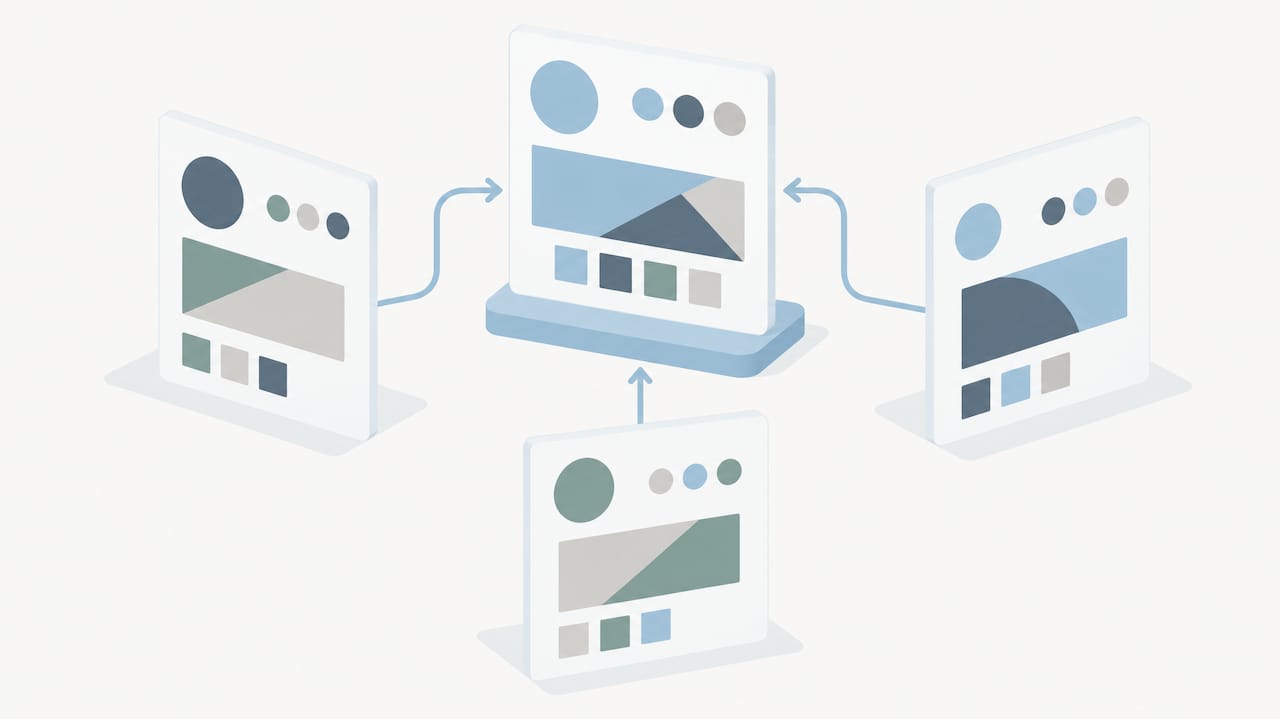
The cost is not just aesthetic. Content that aligns with a brand’s established identity generates more shares than content that does not, and promotional posts only perform when they stay congruent with that identity. Inconsistent messaging also drives wasted ad spend, slower campaign approvals, and teams rebuilding assets that should have been reusable.
Only about a third of companies with documented brand guidelines actually enforce them according to West Virginia University’s brand resources, which explains why so many customer touchpoints feel disconnected even at well-funded companies.
The core elements every channel must share
Four categories need alignment before anything else matters.
- Visual identity: logo variants, approved color codes, typography, and a defined photography or illustration style. Stretched logos and off-palette colors are the most common violations.
- Messaging: a short list of approved value propositions, key phrases, and tone rules that flex by channel without changing meaning.
- Customer experience signals: the handoff between a webpage, a support call, and packaging should feel like one brand, not three.
- Brand architecture: rules for when a sub-brand can stand alone versus when it must carry the master brand, plus co-branding guardrails for partnerships.
Each channel needs its own adaptor rather than a copy-paste version of the same asset. Social posts need cropped visuals and shorter copy, as covered in our guidance on social media content. Email needs consistent header treatment. Paid ads need to match landing page tone exactly, since a mismatch there kills conversion before it starts. For a deeper look at assembling these pieces, PHENYX’s branding and messaging guide walks through the full build.
Pro Tip: Keep a one-page “do and don’t” sheet with real examples of logo misuse pulled from your own past campaigns. It trains people faster than a 40-page PDF ever will.
How to turn guidelines into a working process
Guidelines without governance just sit in a shared drive. Build the process around them.
- Name a single brand owner and form a small cross-functional council (marketing, sales, product) that meets monthly.
- Set a creative review SLA, commonly 48 to 72 hours, so brand checks never become the bottleneck.
- Build templates for the most-repeated assets: social graphics, email headers, one-pagers, and ad variants.
- Create a change-control process so brand updates get documented and rolled out on a schedule rather than ad hoc.
- Onboard new hires and external partners with a short brand walkthrough, not just a link to a PDF.
Pacing matters here. A visual refresh works best on a two-to-three-year cycle, not a constant trickle of small tweaks that confuse the people trying to follow the rules.
Pro Tip: Build your approval workflow in the same tool your team already uses daily. A separate brand-review app that nobody opens defeats the purpose.
Martech that actually supports consistency
The right tools make governance stick instead of just sitting in a document. Gartner’s guidance on centralizing marketing capabilities points to fragmented tech stacks as a leading cause of inconsistent branding, and a hybrid centralization model as the practical fix.
- A digital asset management system makes approved files searchable by tag, version, and usage rights, which cuts the time spent hunting for the current logo file.
- Design systems and component libraries keep web and product teams from drifting into their own visual dialect over time.
- CMS templates and reusable content blocks keep site pages consistent without every page being custom-built.
- Workflow and approval tools matter less for their features and more for how well they integrate with the tools your team already uses.
When evaluating any of these, prioritize access control, search quality, and integration depth over a long feature list.
Measuring and auditing consistency
What gets measured gets fixed. Track asset usage rates, the number of brand violations caught per quarter, and engagement lifts tied to congruent content.
- Run a lightweight spot check monthly: pull five recent assets across channels and compare them against the guide.
- Run a full audit quarterly across web, social, email, and paid.
- Score each asset on logo use, color accuracy, tone, and message alignment.
- Assign a remediation owner and a fix deadline for anything that fails.
New image-analytics methods can measure color distribution and contrast across hundreds of assets at once, which is useful for high-volume brands trying to catch slow visual drift before it becomes obvious to customers.
How PHENYX approaches integrated brand delivery
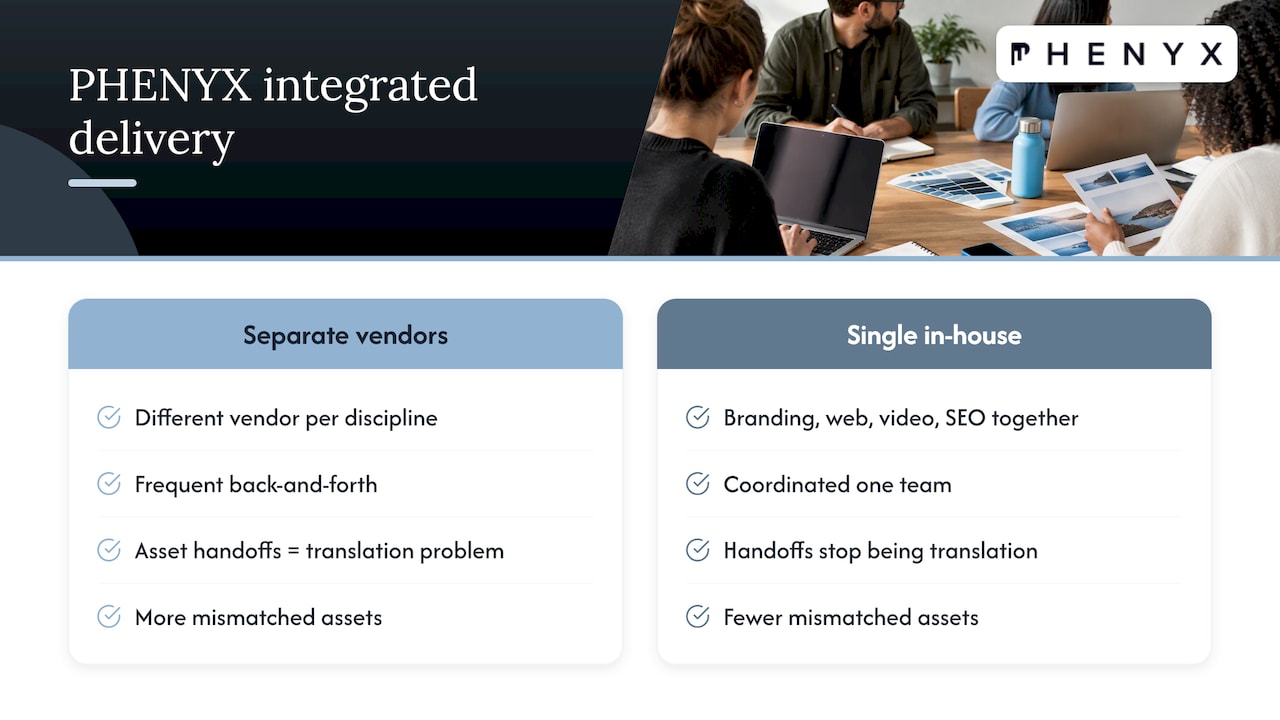
PHENYX runs branding, website design, video production, and SEO through one in-house team, which removes the usual back-and-forth between separate vendors trying to interpret the same guidelines differently. When branding, web, and video are built by a coordinated team, asset handoffs stop being a translation problem. A client moving from a logo refresh to a new website to launch video typically sees fewer mismatched assets along the way, since one team owns the standard throughout. For businesses without the staff to run this in-house, that single-team model is one practical path worth considering.
Setting realistic expectations for rollout
Full centralization sounds clean on paper, but most organizations do better with a hybrid model: central guidelines, local adaptation for regional or channel nuance. Roll out brand updates on a planned cycle instead of mid-campaign, and track adoption, not just compliance. A team that follows the letter of the guide but never understands its purpose will find workarounds the moment leadership stops watching.
— PHENYX
Get help putting this playbook into practice
Most teams know what brand consistency requires. Fewer have the in-house bandwidth to enforce it across every channel at once. PHENYX’s MODS subscription pairs ongoing branding, website, and creative support under one team, starting at $4,000 per month, so your guidelines get followed instead of filed away.
- Request a brand consistency audit of your current channels.
- Schedule a consult to scope a governance model that fits your team.
- Start with MODS for ongoing, integrated brand support.
| Next step | What it covers |
|---|---|
| Brand audit | Review of current assets against your guidelines |
| Governance consult | Roles, approval SLAs, and template planning |
| MODS subscription | Ongoing branding, web, and creative delivered by one team |
For teams running their own creative production in-house, Stefano Mazzei’s work on performance creative is a useful reference point for keeping decentralized ad creative aligned with brand standards.
FAQ
What is the 3-7-27 rule in branding?
Definitions of this rule vary across sources and it is not tied to a single established industry standard, so treat any specific numbers attached to it with caution. The general idea it points to, that customers need repeated, consistent exposure to a brand before recognition sets in, lines up with the core argument for cross-channel consistency covered above.
How do you measure brand consistency across platforms?
Track asset usage rates, the count of brand violations found in audits, and engagement differences between on-brand and off-brand content. Congruent content consistently outperforms incongruent content in social sharing, which makes engagement lift a useful proxy metric.
What are the 5 C’s of branding?
This framing is not a single standardized model, and definitions differ by source. If you are looking for a structured way to organize brand equity, the AMA’s 5Bs framework, covering brand basics, behaviors, building, benefits, and breadth, is a more recently documented alternative worth reviewing.
Can you give examples of brand consistency done well?
A consistent brand looks the same whether a customer sees it in a social ad, on the website, or in an email, down to tone, color, and the exact phrasing of the offer. Companies that run branding, web, and creative through one coordinated team, rather than separate vendors interpreting the same guide differently, tend to avoid the small mismatches that erode that consistency.
Does PHENYX offer services for building brand guidelines?
Yes, PHENYX’s branding service covers the guidelines and visual identity work described in this playbook, delivered alongside website design, video, and SEO through the same in-house team.
Sources
- WVU — Brand standards and usage
- AMA — Content that engages your customers: The role of brand congruity and promotions in social media
- Gartner — guidance on centralizing marketing capabilities