

For Marketers: Attribution Models from Rules to DDA, DIY or Managed
Start with consistent rule-based reporting, move to data-driven attribution once your first-party data is clean and sufficient, then layer in incrementality tests and marketing mix modeling for the budget decisions that carry real weight. No single model proves causality on its own; the combination of methods is what gives you a defensible view of what is actually working.
TL;DR:
- Data-driven attribution requires sufficient clean first-party data and should be complemented by incrementality tests for causal confirmation.
- Offline channels, private messaging, and browser privacy restrictions create gaps in tracking, necessitating statistical imputation and modeling approaches.
- Choosing the right attribution model depends on your business goals, funnel complexity, data volume, and stakeholder transparency needs.
- Regular review cycles, especially after privacy changes or significant media shifts, are crucial to ensure your attribution approach remains accurate.
- Building a solid measurement stack involves establishing governance, clear documentation, and ongoing management to sustain reliable and actionable insights.
Table of Contents
- What Marketing Attribution Is and Why It Matters
- Where Attribution Data Comes From and Its Limits
- How Attribution Models Assign Credit
- What Attribution Can Prove, and What It Can’t
- How to Choose an Attribution Model
- Common Mistakes That Undermine Attribution
- How Often to Review Your Attribution Approach
- A Worked Example: Credit Allocation Across a Buyer Path
- Attribution Inside a Full Measurement Stack
- A Pragmatic Take on Measurement
- A Managed Path to Measurement That Actually Holds Up
- FAQ
- Sources
What Marketing Attribution Is and Why It Matters
Marketing attribution is the practice of assigning credit for a conversion to the marketing touchpoints that led a prospect toward it. An attribution model is simply the rule set, mathematical or heuristic, that decides how much credit each touchpoint receives when a customer interacts with several channels before buying.
For marketing leaders, attribution matters because budgets are finite and channels rarely work in isolation. A model gives you a structured way to compare paid search, social, and email instead of guessing which one “closed” the sale. It will not tell you what would have happened if you had spent nothing on a channel, but it does help you prioritize where to look more closely.
Here is the quick version before we go deeper:
- Attribution assigns credit for conversions across the touchpoints a customer encountered.
- Single-touch models are simple but often overcredit the last or first channel.
- Multi-touch models spread credit using fixed rules or machine learning.
- Data-driven attribution (DDA) uses account-level data to calculate credit statistically.
- Attribution shows correlation between touchpoints and conversions, not proof of causation.
- Incrementality testing and marketing mix modeling (MMM) are needed to validate causal impact.
- Governance (consistent lookback windows, counting rules, channel definitions) matters as much as the model itself.
- Review cadence should match the pace of your media mix and privacy landscape changes.
Where Attribution Data Comes From and Its Limits
Attribution models pull from analytics platforms, ad platform conversion pixels, CRM records, server-side event streams, and first-party data collected directly on your site or app. Each source captures a different slice of the customer journey, and none captures all of it.
The gaps show up predictably: offline channels like direct mail or in-store visits rarely get logged automatically, “dark social” shares in private messaging apps leave no trackable link, and privacy changes across browsers and operating systems have reduced the visibility of individual-level paths. Google’s own guidance on data-driven attribution acknowledges that privacy restrictions change what attribution can see, which is why platforms increasingly lean on modeled or aggregated signals rather than raw event-level tracking.
Practical mitigations include statistical imputation for missing touchpoints, relying on aggregated conversion signals instead of individual identifiers, and using MMM and controlled experiments to fill in what tracking alone cannot see. Setting up clean conversion tracking from the start reduces how much you need to patch later.
How Attribution Models Assign Credit
Every attribution model answers the same question differently: when a customer touches five channels before converting, how much credit does each one get? The approaches fall into three broad families.
- Single-touch models. First-click attribution gives 100% of the credit to the first interaction, which is useful for understanding what drives initial awareness but ignores everything that happens afterward. Last-click does the opposite, crediting the final touchpoint before conversion, which overvalues bottom-funnel channels like branded search and undervalues the awareness work that got the customer there in the first place.
- Rule-based multi-touch models. Linear attribution splits credit evenly across every touchpoint, time decay weights recent interactions more heavily, and position-based attribution gives extra credit to the first and last touch while splitting the rest among the middle. These are easy to explain to stakeholders and work reasonably well when your journey has a manageable number of channels, which is part of why simple weighted-average models can still outperform complex ones for firms with constrained data.
- Data-driven attribution. DDA calculates credit using account-specific data rather than a fixed rule, comparing converting paths against non-converting paths to estimate how much each interaction actually changed the probability of conversion. Google’s cross-channel data-driven attribution in GA4 customizes credit per advertiser and conversion event rather than applying a one-size rule. Larger-scale systems go further: research on LinkedIn’s attention-based DDA architecture describes using temporal embeddings and privacy-aware imputation, then reconciling the output against marketing mix modeling through post-model scaling to correct for channels with sparse individual-level signal.
Worth noting: several legacy rule-based models have been phased out on some platforms. Google’s attribution settings documentation confirms that first-click, linear, time decay, and position-based options were deprecated in certain reporting contexts, so check current platform availability before building a model around one.
What Attribution Can Prove, and What It Can’t
Attribution is genuinely useful for tactical work: spotting which ad creative is pulling more of its weight in the middle of the funnel, or deciding which landing page variant deserves more traffic. It is a correlation tool, showing you which touchpoints tend to appear on converting paths.
What it cannot do is prove that spending more on a channel will cause more conversions. A channel can look strong in an attribution report simply because it reaches people who were already going to buy. When a decision involves real budget risk, such as doubling spend on a channel or cutting one entirely, that is the moment to run an incrementality test rather than act on attribution data alone.
How to Choose an Attribution Model
Picking a model is less about finding the “best” one and more about matching a model to your data and your decision stakes. Work through these factors before committing:
- Business objective. Are you optimizing for lead volume, revenue, or long-term customer value?
- Funnel length. A short, single-session purchase path needs less sophistication than a multi-month B2B sales cycle.
- Channel mix. More channels generally justify more granular credit-splitting.
- Data availability. DDA requires enough converting and non-converting paths to be statistically meaningful; without that volume, a rule-based model will be more stable.
- Cost and complexity. More sophisticated models take more engineering and analyst time to maintain.
- Explainability. Stakeholders need to understand and trust the model enough to act on it.
A sensible adoption path moves in stages: start with consistent rule-based reporting so everyone is comparing the same numbers, build governance around that baseline, then add data-driven attribution and incremental experiments once your data volume supports it.
Governance deserves its own attention. Decide on a standard lookback window, a consistent counting method (did you count unique users or unique sessions), which channels are even eligible for credit, and document all of it so the next person on your team does not reinvent the rules.
Pro Tip: Write your attribution rules down in a single shared document before you debate which model is “right,” so the conversation is about data, not memory.
Common Mistakes That Undermine Attribution
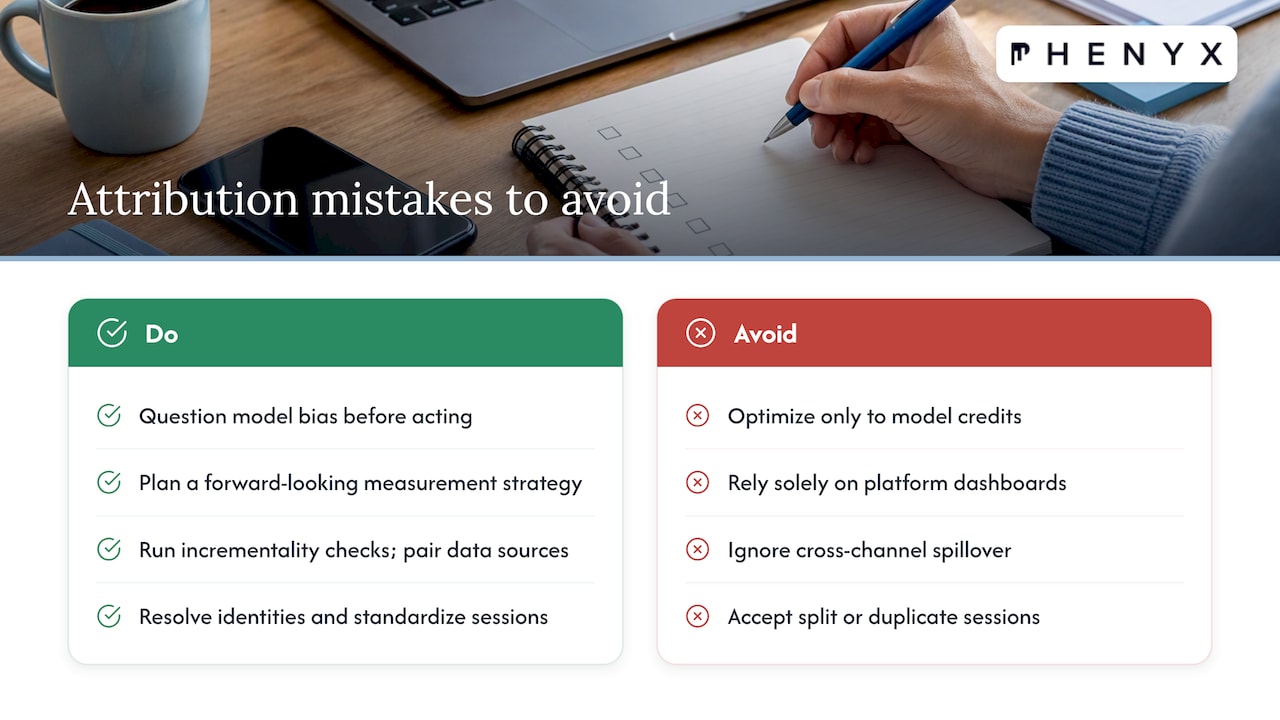
The most common trap is rear-view mirror decision-making: optimizing entirely toward whatever channel the current model credits, without asking whether the model itself is biased. Measurement researchers have flagged this pattern directly, warning that marketers often over-optimize to available attribution data instead of planning a forward-looking measurement strategy.
A close second is overreliance on platform-reported conversions. Every ad platform has an incentive to credit itself generously, so numbers pulled straight from a single dashboard tend to overstate that platform’s real contribution. Pair platform data with incrementality checks before shifting budget.
Cross-channel spillover and sessionization errors (the same user counted as two different people across devices, or a session artificially split) quietly distort multi-touch models. Fixing identity resolution and using consistent session definitions across tools solves most of this.
How Often to Review Your Attribution Approach
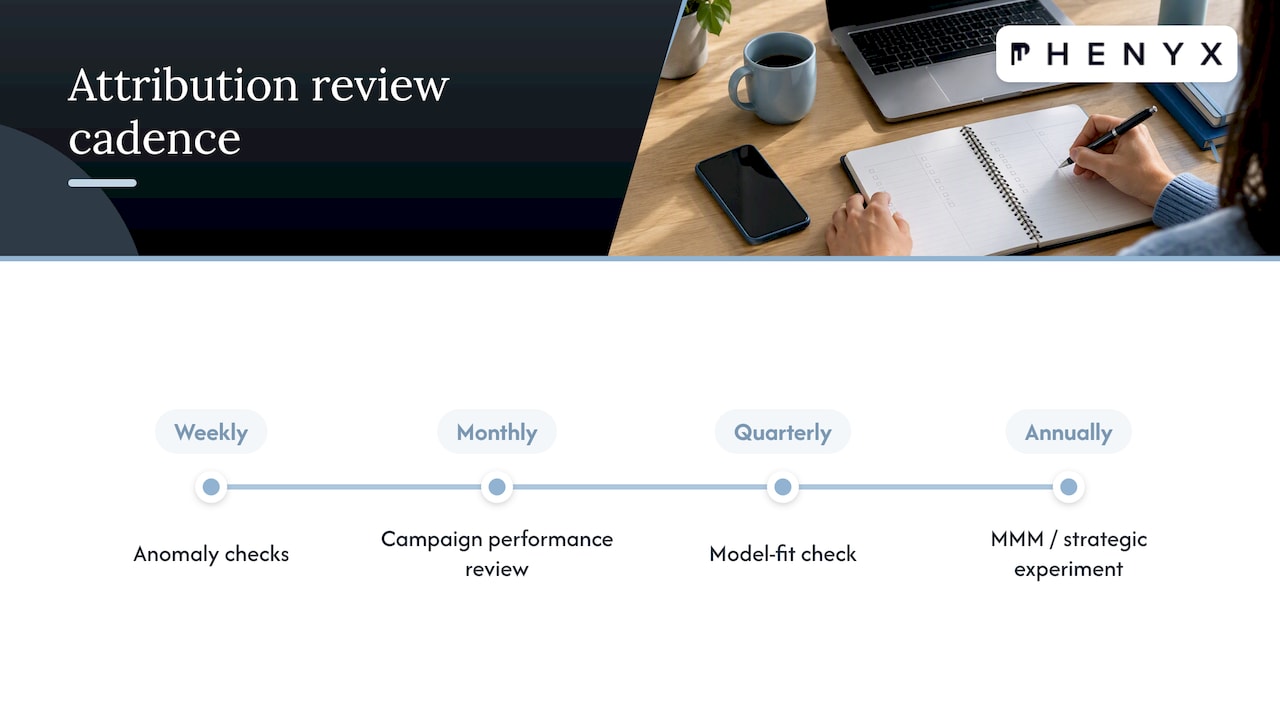
Attribution is not a set-and-forget system. A practical cadence looks like weekly dashboard checks for obvious anomalies, monthly performance reviews against campaign goals, quarterly checks on whether the model itself still fits your channel mix, and an annual MMM or larger strategic experiment to recalibrate the whole approach.
Outside that normal rhythm, a few triggers justify an out-of-cycle review: a major privacy or tracking change, a new product launch that shifts the funnel, or a significant reallocation of media spend across channels. When reviewing, check data completeness, watch for drift in how credit is being distributed over time, and confirm the model still matches current business priorities.
A Worked Example: Credit Allocation Across a Buyer Path
Say a customer’s path is paid search, then a social ad, then an email, then purchase.
The practical takeaway: last-click would tell you to cut paid search, while the other three models would tell you to protect it.
Attribution Inside a Full Measurement Stack
Attribution works best as one layer in a larger stack. Use it for channel-level granularity, run incrementality tests through holdouts or randomized trials for causal proof on high-stakes decisions, and use MMM to calibrate the aggregate picture. The IAB’s incrementality guidelines recommend rigorous experimental designs specifically for the high-stakes calls, reserving lighter attribution signals for day-to-day tactical decisions. Getting the tracking foundations and governance right before adding complex models saves rework later.
A Pragmatic Take on Measurement
Most teams overbuild their first attribution model and underbuild their governance. Start with something simple, document every decision you make about it, and prioritize changes you can actually test. Measurement only works when analytics, media, and product teams agree on what the numbers mean before they argue about what to do with them.
— PHENYX
A Managed Path to Measurement That Actually Holds Up
Building a reliable measurement stack takes clean conversion tracking, cross-channel reporting, and governance that survives staff turnover, work that pulls time away from running the campaigns themselves. We set up Google Ads conversion tracking, cross-channel measurement, and the documentation that keeps your attribution rules consistent as your team changes, all handled in-house rather than split across vendors.

If your team has the bandwidth and the data volume, building this in-house is a reasonable path. If you need it running correctly without pulling a marketer off their actual campaigns for weeks, our MODS plan folds measurement and governance work into ongoing paid ads and PPC support starting at $4,000 per month. Reach out through Phenyx to talk through what your current setup is missing.
FAQ
What are attribution models in marketing?
An attribution model is the rule or statistical method used to assign credit for a conversion across the marketing touchpoints a customer encountered. Models range from simple single-touch rules to data-driven approaches that calculate credit from account-level conversion data.
Which attribution model is best?
There is no universal best model: the right choice depends on your funnel length, channel mix, and how much clean conversion data you have. Many teams start with a rule-based model like linear or position-based, then move to data-driven attribution once their data volume supports it.
What is attribution theory in marketing?
Attribution theory in marketing is the broader idea that conversions result from a combination of touchpoints rather than one single interaction, and that a consistent model is needed to estimate each touchpoint’s contribution. It underpins why marketers use multi-touch models instead of crediting only the last click.
What is attribution modeling in performance marketing?
In performance marketing, attribution modeling applies these credit-assignment rules specifically to paid channels like search and social ads, often inside the ad platform’s own reporting. Platforms like Google Analytics 4 now support cross-channel data-driven attribution, which customizes credit per advertiser and conversion event rather than relying on a fixed rule.
How do I know when to update my attribution model?
Review your model on a regular cadence, quarterly at minimum, and immediately after major triggers like privacy or tracking changes, a product launch, or a significant shift in your media mix. Watch for drift in how credit is distributed over time as a signal that the model no longer fits your current channel mix.
Sources
- Get started with attribution - Analytics Help
- LiDDA: LinkedIn Data Driven Attribution (arXiv paper)
- Guidelines for incremental measurement in commerce media (IAB)