
Outsourced Marketing Department vs. In-House Team
An outsourced marketing department gives you a full bench of specialists for a flat monthly fee. An in-house team gives you people who live inside your business every day. For most small and midsize companies, the outsourced route is faster to launch and cheaper than building the same range of skills with salaried hires. In-house wins once marketing is large, constant and tightly bound to your product. This guide compares the two on cost, speed, skills, control and risk, so you can decide with numbers instead of instinct.
TL;DR
- Outsourcing suits businesses that need strategy, design, web, SEO and video at once but cannot justify five or six full-time salaries.
- An in-house team suits companies with steady, high-volume marketing work and deep product knowledge that is hard to hand off.
- A single marketing manager costs far more than their salary once benefits are counted, and one person rarely covers every discipline.
- Many growing businesses land on a hybrid: an internal owner of the brand and an outside team that executes.
Table of Contents
- Quick Summary
- What an outsourced marketing department actually is
- What an in-house marketing team looks like
- How much does each option really cost?
- Speed and capacity: who gets started sooner?
- Skills and specialization
- Brand consistency and control
- When an in-house team is the better call
- When an outsourced marketing department wins
- The hybrid model: keep ownership, outsource execution
- A simple way to decide
- Our perspective at PHENYX
- Get a full marketing department without the hiring
- FAQ
- Sources
Quick Summary
- Cost: An outsourced department is a predictable monthly line item. An in-house team is salaries, benefits, software and management time.
- Range of skills: An agency brings several specialties together. A small in-house team usually covers two or three.
- Speed to start: Agencies can begin within weeks. A hire can take months to find, onboard and ramp up.
- Brand knowledge: In-house staff absorb your culture faster. Agencies close the gap with a thorough onboarding and regular reviews.
- Flexibility: Scaling an agency scope up or down is a contract conversation. Scaling a team is a hiring or layoff decision.
- Control: In-house gives you direct, daily oversight. Outsourcing works best with clear goals, reporting and shared access.
- Best fit: Outsourcing for small and midsize businesses, startups and local companies. In-house for larger, marketing-heavy organizations.
What an outsourced marketing department actually is
An outsourced marketing department is an outside team that acts as your marketing function. It plans, produces and reports on the work, usually across several channels, under one agreement. You are not buying a single deliverable. You are buying the capacity of a department without putting every member on your payroll.
The quality of the arrangement depends on how the team is built. Some agencies stitch together freelancers and partner vendors, which brings you back to managing many hands. Others keep design, development, search, video and paid media under one roof, so the people building your website also talk to the people writing your search strategy. That difference matters more than the label on the contract. If you want a longer walkthrough of the model itself, our decision guide to the outsourced marketing department covers it step by step.
What an in-house marketing team looks like
An in-house team is made of employees who work only on your company. In a small business, that often starts with one generalist or a marketing manager. As the company grows, it adds a designer, a content writer, a paid media specialist, perhaps a web developer.
The appeal is obvious. These people sit in your meetings, hear customer calls and see the product evolve. They can turn around a last-minute request in an afternoon. The cost is also obvious once you do the math, which is where most comparisons should begin.
How much does each option really cost?
Start with what one senior hire costs. The U.S. Bureau of Labor Statistics reports a median annual wage of $166,790 for marketing managers as of May 2025. That is wages only. In private industry, benefits make up 30.0 percent of total employer compensation costs, with wages and salaries making up the other 70.0 percent.
If you apply that national split to the median manager wage, the full cost to the employer lands near $238,000 a year. That is our own arithmetic on two national figures, not a quote for any specific hire, and your local market, seniority and benefits package will move it. Denver, Tampa and Dallas-Fort Worth all pay differently, and a manager in a competitive metro can cost more.

Now consider what that single hire does not cover. A marketing manager can set strategy and coordinate. They cannot also design a brand identity, build and maintain a website, shoot and edit video, run paid campaigns and manage technical SEO at a professional level. Each of those is a different skill set, and each added hire repeats the cost calculation above.
The costs that never appear on a salary line add up too:
- Recruiting time, job posts and the cost of a bad hire
- Software licenses for design, analytics, SEO, email and project management
- Equipment such as cameras and editing machines if you want video
- Training and the slow period before a new hire performs at full speed
- Management time from a founder or operations lead who already has a full plate
Our MODS subscription, the monthly all-inclusive marketing plan we offer, starts from $4,000 per month. Over twelve months that is $48,000, which is the annual budget to compare against a hire’s total cost. The two numbers do not buy the same thing, because the subscription brings a team and the salary brings one person. The honest comparison is the subscription against the full set of roles you would need to hire to get equivalent coverage.
Speed and capacity: who gets started sooner?
Hiring is slow. You write the role, source candidates, interview, negotiate and wait out a notice period. After that comes onboarding. It is common for a new marketer to need a couple of months before work ships at full pace, and that is if the hire is right.
An established agency has the process, tools and people already in place. Work can begin in weeks, and capacity moves with your needs. A busy quarter does not require a requisition. For a startup launching a brand or a local business that needs leads this season, that gap is often the deciding factor. Our post on launching marketing on demand in 90 days shows what a first quarter can look like.
In-house teams do have one speed advantage: proximity. A teammate down the hall can change a headline in ten minutes. Good agencies narrow this by agreeing on response times and keeping a shared workspace, but the difference is real for companies that publish constantly.
Skills and specialization
Marketing today spans disciplines that used to be separate careers. Search optimization now includes answer engine optimization, which means structuring content so AI assistants and search features can quote it. Web design now involves performance, conversion and platform choices such as Webflow or Shopify. Video has become a core channel rather than an extra.
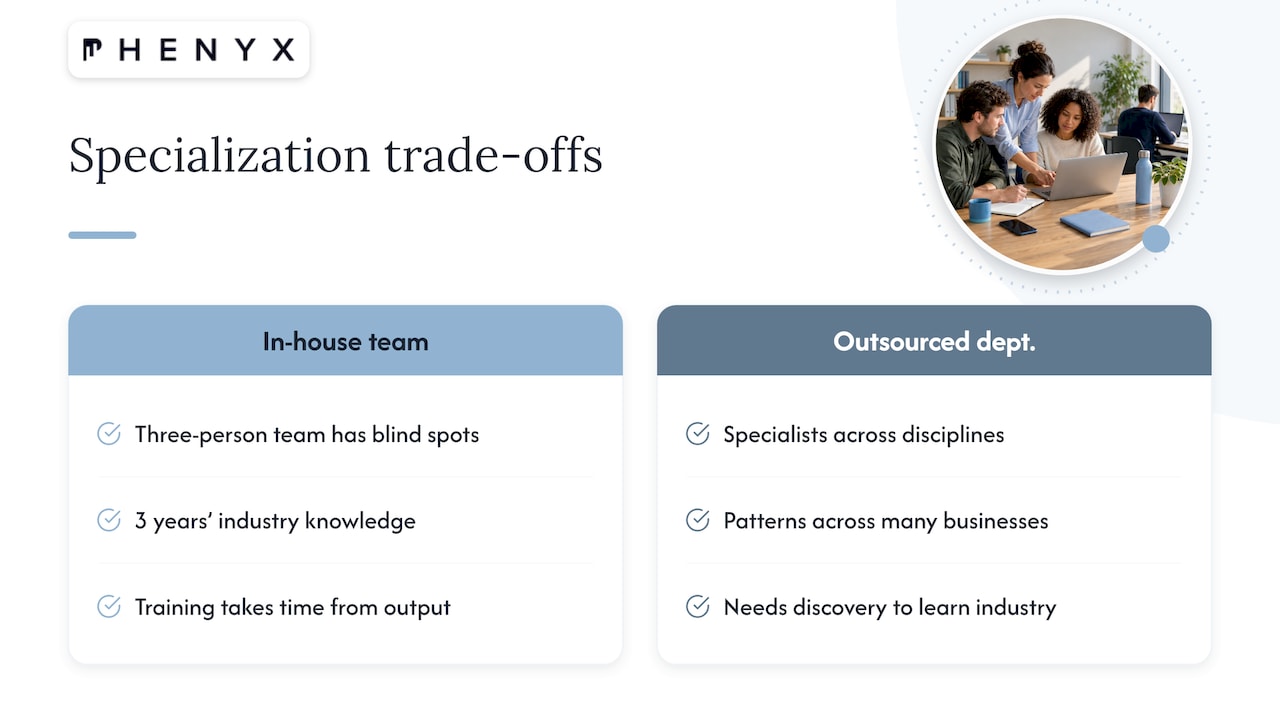
An in-house team of three cannot be expert in all of it. They will have strengths and blind spots, and training takes time away from output. An outsourced department spreads that range across specialists who work on the same disciplines for many businesses and see patterns repeat.
The trade-off is depth in your specific world. An in-house marketer who has spent three years inside your industry knows the objections your buyers raise before a sales call starts. An agency has to learn that. The best way to close the gap is a proper discovery phase, access to your sales team and a standing review of what customers actually say.
Brand consistency and control
Control is the most common worry about outsourcing, and it is a fair one. When your marketing lives outside the building, you depend on clear briefs, shared goals and honest reporting.
Consistency is where a single-team agency has a quiet advantage. When your logo, website, ads and videos come from one group of people, they share the same visual language and message by default. When they come from five vendors, someone on your side becomes the translator and referee. That someone is usually the owner, and the time is rarely counted in the budget.
In-house control is more direct, but it is not automatic. A small team without brand guidelines can drift just as easily. Whichever route you choose, write down your voice, your audience and your approval process before work begins.
When an in-house team is the better call
Outsourcing is not the answer for every company. Build in-house when:
- Marketing volume is high and constant. If you publish, test and respond every day, full-time staff are used at full capacity.
- Your product is deeply technical or regulated. Subject-matter knowledge takes time to transfer, and sometimes a person who has lived it is worth the premium.
- Marketing is a core competitive weapon. Companies that win on brand and content often want that capability inside the walls.
- You have the budget and the management. A team needs a leader who can direct, evaluate and develop it.
If two or more of these describe you, price out a hire seriously. Our comparison of five factors that decide agency or in-house for growing businesses can help you weigh them.
When an outsourced marketing department wins
Outsourcing tends to come out ahead when:
- You need many skills but not many full-time roles. Website, search, video, branding and ads are all needed, yet none fills a forty-hour week alone.
- You want a predictable monthly cost. A subscription is easier to forecast than a payroll that grows with each hire.
- You are launching or rebooting. A startup that needs a brand identity and a site quickly gains more from a ready team than from a long search.
- Your leadership has no marketing background. An experienced team brings strategy as well as execution.
- You are tired of managing vendors. Consolidating design, web and media under one team removes the coordination work.
Local businesses in particular, such as a service company in Tampa or a retailer in Boulder, often need visibility in local search more than they need a large internal team. That is a good match for a team that treats local SEO as a standing practice. For startups, the benefits of outsourcing digital marketing to an agency go deeper on the early-stage case.
The hybrid model: keep ownership, outsource execution
The choice is not always binary. A common and sensible pattern is to hire one internal marketing lead who owns strategy, budget and brand, then bring in an outside team for production and specialist work. The lead knows the business. The agency supplies the range.
This also gives you a path. You can start fully outsourced, learn what marketing actually drives revenue, and bring selected functions in-house later with a clear brief for each hire. Moving the other way is just as valid. A company that built a team too early can shift specialist work outside rather than carry idle capacity.
If you go hybrid, define who owns what. Strategy and approvals stay with the internal lead. Production, technical SEO, video and ad management sit with the agency. Shared reporting keeps both sides looking at the same numbers.
A simple way to decide
Work through these questions with your leadership team:
- Which disciplines do we need in the next twelve months? List them: web, SEO, video, branding, paid ads, social. Count how many you would have to hire for.
- How much of each role would we use? A part-time need is a signal to outsource.
- Who would manage the work? If nobody has the time or the expertise, the hire will not succeed alone.
- How fast do we need results? Weeks point to an agency. A year-long build points to either.
- What do we lose if it fails? Compare the cost of ending an agency agreement with the cost of a bad hire.
If you decide to bring in an agency, prepare before you sign. Set measurable goals, write a brief and confirm you will own your accounts and assets. Our guide to setting KPIs, preparing a brief and checking access walks through each.
Our perspective at PHENYX
We work with growing businesses every week, and the pattern is consistent. The owners who struggle are rarely short of ideas. They are short of coordination. They have a designer here, a developer there, an SEO freelancer somewhere else, and the message drifts a little at every handoff.
That is why we keep web design, SEO and AEO, branding, video, graphic design and paid media in one in-house team. The people who shape your brand also build your site and run your campaigns, so the work stays consistent and moves faster. We do not hand clients a template. We tailor the strategy to the problem in front of us, whether that is lead generation, visibility in a crowded local market or a brand that needs a clearer identity. We follow a structured approach to get there, but the plan itself always starts with your goals.
We also think in-house hires have a real place. If you have one, we work alongside them. The best results we see come when an owner is clear about the outcome they want and we are accountable for the execution.
— PHENYX
Get a full marketing department without the hiring
Our MODS plan gives you the range of a full department, from web and SEO to video, design and ads, through one team on a monthly subscription. It starts from $4,000 per month. If you are weighing a hire against an outside team, we can walk through your goals and show what coverage that budget gets you. You can see how it works on the MODS page.
If search visibility is your most urgent gap, start with our SEO and AEO services, which cover both traditional search and AI-driven answers.
FAQ
Is an outsourced marketing department cheaper than hiring in-house?
For most small and midsize businesses, yes, once you count the full range of skills. One marketing manager can cost well above their salary after benefits, and that person still cannot cover design, web, video and search alone. A monthly subscription spreads that range across a team. If your needs are narrow and constant, a single hire can cost less.
How long does it take to see results from an outsourced team?
It depends on the channel. Paid ads and new landing pages can produce activity within weeks, while search visibility usually builds over several months. Ask any agency for a timeline by channel and for the metrics it will report, and do not accept a guarantee of rankings.
Will an agency understand my business as well as an employee?
Not on day one. A good agency closes the gap with a discovery phase, access to your sales and service teams, and regular reviews of customer feedback. Over time the knowledge builds, and you keep the benefit of outside perspective.
Can I switch from outsourced to in-house later?
Yes, and many companies do. Start outsourced to learn which channels drive revenue, then hire for the functions that need daily presence. Make sure your agreement lets you keep your website, accounts, creative files and data so the handoff is clean.
What is a hybrid marketing model?
A hybrid model pairs an internal marketing lead with an outside team. The lead owns strategy, budget and brand, while the agency handles production and specialist work such as SEO, video and paid media. It suits growing companies that want control without carrying a full department.
Sources
- Advertising, Promotions, and Marketing Managers, U.S. Bureau of Labor Statistics
- Compensation costs for private industry workers, June 2026, U.S. Bureau of Labor Statistics