

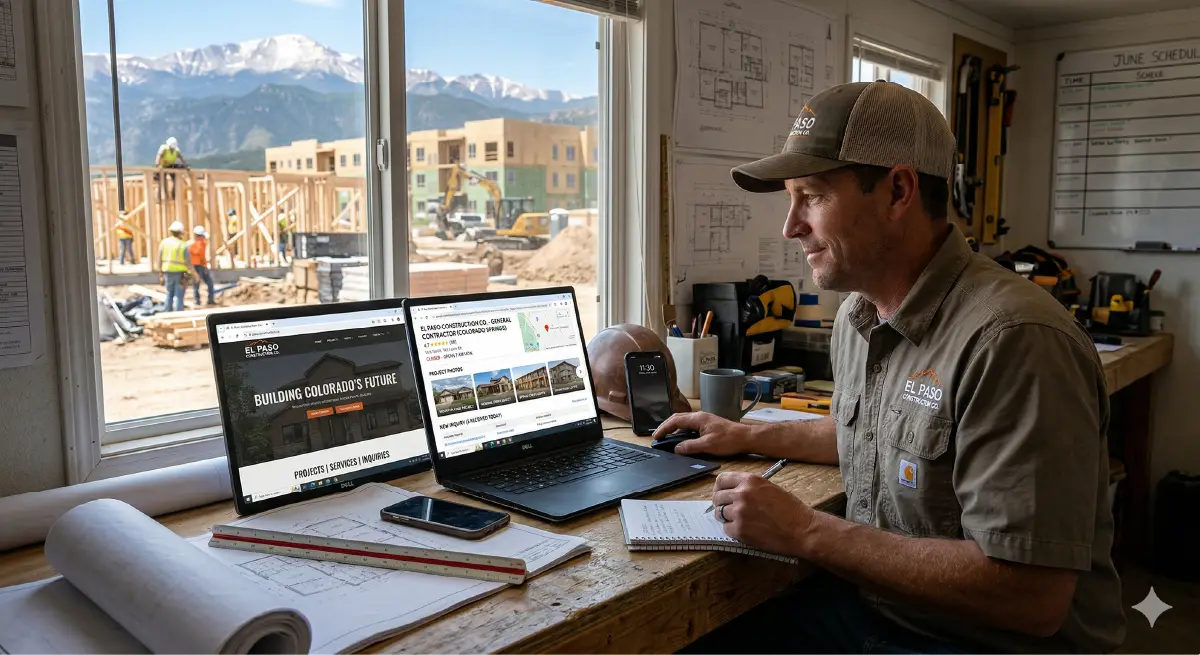
Construction companies in Colorado Springs that build a consistent digital marketing presence win more bids, command higher project prices, and spend less on cold outreach. The most effective channels are a well-ranked website, targeted social proof, and a Google Business Profile that showcases real project work. PHENYX builds and manages digital marketing systems that connect Colorado construction companies with the clients they actually want.
The construction business in Colorado Springs runs on relationships. You know that better than anyone. You've built your reputation project by project, referral by referral, and your best clients often come from someone you worked with five years ago who passed your name along. That model works — until the referrals slow down, a large job wraps up and the pipeline looks thin, or a competitor starts showing up on every project you're bidding against.
Digital marketing for construction companies isn't about replacing relationships. It's about making sure that when a commercial developer, general contractor, or homeowner owner starts looking for someone to work with — before they ask around — your company is already in front of them. This guide explains the digital marketing strategies that are actually driving growth for construction businesses in 2026.
Why Construction Companies in Colorado Springs Underinvest in Digital Marketing
Most construction companies on the Front Range underinvest in digital marketing for the same reason: the business has always grown through referrals, and it's hard to measure the ROI of a website or a Google ad the same way you can measure the cost of materials or labor. Marketing feels abstract. Job costs don't.
The result is that most construction company websites in the region are outdated, rarely updated, and not optimized to rank on Google for the searches that matter. Their Google Business Profiles are incomplete or unclaimed. They have no system for generating reviews, no portfolio of past projects presented in a way that builds trust with new clients, and no paid advertising running during the slow months when the pipeline needs filling.
Meanwhile, the construction companies growing fastest in the region — the ones winning the commercial renovation projects, the custom home contracts, and the multi-family developments — are investing in digital marketing deliberately. They understand that a website is not a brochure; it's a 24-hour sales tool. And they treat it as one.
Colorado's construction market is also increasingly competitive. Population growth on the Front Range continues to drive demand for both residential and commercial construction, but it also draws in contractors from Denver and other markets competing for the same projects. Local construction companies that have built a strong digital presence have a meaningful advantage in procurement processes where decision-makers are evaluating multiple firms they don't have direct relationships with.
What Digital Marketing Actually Looks Like for a Construction Business
Digital marketing for a construction company is a system, not a single tactic. It includes a website that clearly communicates what types of projects you take on and presents your past work in a way that builds confidence with prospective clients. It includes a Google Business Profile that's active, complete, and populated with real project photos and verified reviews. It includes content — blog posts, case studies, project spotlights — that demonstrates expertise in your specific trades and project types.
Paid digital advertising also plays a role, particularly during slower seasonal periods or when targeting a specific type of project or client. A well-structured Google Ads campaign targeting searches like "commercial general contractor Colorado Springs" or "custom home builder El Paso County" can place your company in front of qualified prospects at the exact moment they're evaluating options.
Social media, particularly LinkedIn for commercial work and Instagram for residential, functions as a portfolio platform when used correctly. The construction companies getting real business from social media aren't posting generic industry content — they're showing their actual work: before-and-after project sequences, time-lapse build videos, and behind-the-scenes content that demonstrates the quality and professionalism of their crews. That kind of content builds brand awareness among the clients and developers who eventually reach out when a project is ready.
The Digital Channels That Generate Qualified Construction Leads
Not every digital channel delivers equal results for construction companies, and spreading budget across every platform is a reliable way to get mediocre results from all of them. The channels that consistently generate qualified leads for construction businesses are Google search (organic and paid), Google Business Profile, and project portfolio content published consistently on the platforms where your target clients spend time.
Google organic search is foundational. When a property developer, facilities manager, or homeowner on the Front Range starts researching construction companies, they typically begin with a Google search. If your website doesn't rank for relevant terms — "commercial contractor near me," "general contractor El Paso County," "kitchen remodel contractors" — you don't exist in that research process.
Targeted paid search fills gaps that organic ranking can't. According to WordStream's Google Ads industry benchmark data, the construction and home services category has some of the highest conversion rates among local search campaigns — averaging between 6 and 9 percent for well-targeted ads. A campaign generating ten qualified construction inquiries per month at a cost of $200 to $400 per lead represents favorable economics compared to business development through traditional networking alone.
Email remains underused in the construction industry. A database of past clients, project owners, architects, and developers who have worked with your company is a warm audience for new project announcements, capacity availability, or seasonal promotions. A simple monthly email that showcases a recent project and includes a direct way to start a conversation can generate project inquiries that cost almost nothing to produce.
Building a Digital Reputation That Wins Bids Before the First Meeting
In the construction industry, a digital reputation is built primarily through two things: a visual portfolio of completed projects and a body of authentic client reviews. Both of these can be systematically developed and displayed in ways that shift the conversation before any proposal is submitted.
A project portfolio on your website should include high-resolution photography, a brief description of the project scope and challenges, the client type, and the outcome. For commercial projects, that means square footage, timeline, and the types of systems or trades involved. For residential work, it means before-and-after sequences and specific details about what made the project complex or unique. Generic galleries of construction photos without context don't differentiate you — specific, well-documented project stories do.
Reviews on Google and industry platforms like Houzz, Buildzoom, and Angi function as social proof for clients who don't know you. A construction company with 40 five-star reviews is perceived as a lower-risk choice than an equally competent company with 8 reviews, even if the review count is the only difference. Building reviews requires a system: ask for a review from every satisfied client as a standard part of project closeout, provide a direct link to your Google Business Profile, and follow up once if you don't hear back.
Turning Digital Visibility Into a Consistent Project Pipeline
Digital marketing for construction companies works best when it's treated as a pipeline management tool, not a brand awareness exercise. The goal isn't impressions or clicks — it's qualified project inquiries from clients who are ready to move forward.
That means your website needs to do more than display your work. It needs a clear process for prospective clients to initiate contact, a specific statement of the project types and sizes you focus on, and a response system that gets qualified inquiries in front of the right person within hours, not days. Decision-makers evaluating multiple contractors often contact several at once — the firm that responds first with a clear, professional communication wins a disproportionate share of the opportunities.
Retargeting campaigns — ads shown to people who visited your website but didn't contact you — extend your digital marketing reach cost-effectively. Someone who visited your project portfolio page but didn't submit a contact form is a warm prospect. A targeted display ad showing one of your recent projects, running across the websites and apps they use in the following days, keeps your company visible through the decision-making process.
The digital marketing campaigns built by PHENYX are designed specifically for construction and contractor businesses that need a predictable flow of the right kind of work — not volume for its own sake, but qualified project inquiries from clients worth working with.
Common Questions
What is digital marketing for construction companies?
Digital marketing for construction companies is the set of strategies used to attract qualified project leads through online channels. It includes a search-optimized website, an active Google Business Profile with project photos and reviews, content marketing through blog posts and project case studies, paid search advertising on Google, and social media content that showcases completed work. An effective digital marketing program for a construction company generates a consistent flow of qualified inbound inquiries rather than relying entirely on referrals and cold outreach.
How do Colorado Springs construction companies get more clients online?
Construction companies generate more clients online by ranking on Google for the specific project types and locations they serve, maintaining an active and complete Google Business Profile, publishing genuine project portfolio content that demonstrates their work quality and scope, and collecting client reviews systematically after project completion. Paid advertising on Google accelerates this by placing the company in front of decision-makers who are actively searching for contractors — particularly useful during slower seasonal periods or when targeting a new project type or client segment.
How long does it take for digital marketing to generate construction leads?
For construction companies, paid digital advertising can generate qualified inquiries within the first two to four weeks of a campaign going live. Organic search rankings from SEO and content marketing typically take three to six months to build meaningfully, though Google Business Profile improvements can show results within 30 to 60 days. The most effective approach combines paid campaigns for immediate lead flow with organic and content strategies that reduce cost-per-lead over a 12 to 18 month period as the company's digital presence strengthens and compounds.
If you're running a construction company in Colorado Springs and want to build a more predictable project pipeline, contact PHENYX to discuss what a focused digital marketing program looks like for your business and the types of projects you want more of.




%20(2).svg)
%20(1).svg)
