
Get More Leads Without Spending More on Ads
You can grow your lead flow without raising your ad budget by fixing what happens before and after the click: show up in local and organic search, make your website convert more of the visitors you already have, answer inquiries faster, and turn happy customers into a steady referral source. None of this is free, because it costs time. But it compounds in a way that a monthly ad bill does not.
This guide walks through seven tactics we see working for small and midsize businesses, in the order we would tackle them, with the compliance and measurement details that most lists skip.
TL;DR
- Start with conversion, not traffic: a site that turns more of its current visitors into inquiries is the cheapest lead source you have.
- Claim and maintain your Google Business Profile, and build a steady, policy-safe review routine.
- Publish search-friendly pages for buyers who are ready to act before you write top-of-funnel content.
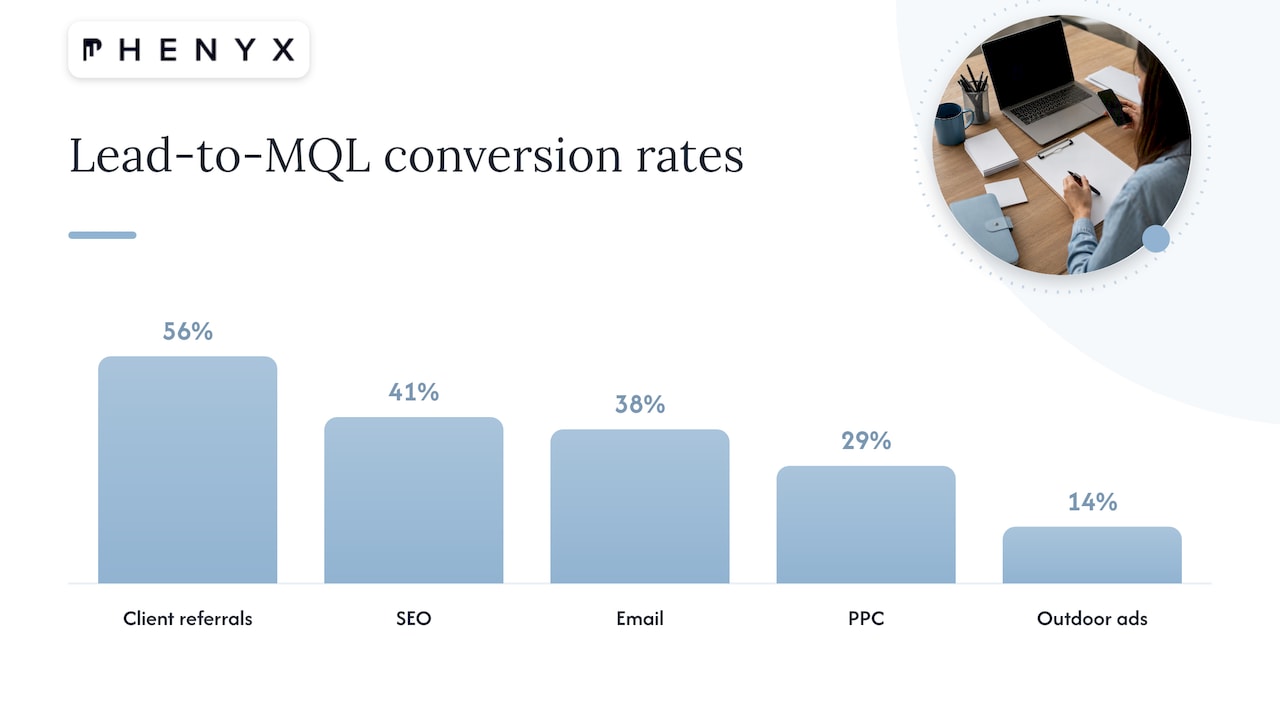
- Referrals and SEO convert strongly in B2B benchmarks, while paid channels like PPC sit lower.
- Respond to every inquiry fast, and follow the FTC’s email rules if you do outreach.
Table of Contents
- Quick Summary
- Why less ad spend does not have to mean fewer leads
- 1. Make your website convert the traffic you already have
- 2. Show up in local search with a Google Business Profile
- 3. Build pages for buyers who are ready to act
- 4. Turn customers into reviews and referrals
- 5. Use email on the people who already know you
- 6. Put content effort where it earns trust
- 7. Respond faster than your competitors
- Measure where leads really come from
- Our perspective: fix the system before adding budget
- When it makes sense to bring in a team
- FAQ
- Sources
Quick Summary
- Audit your website for friction: slow pages, buried contact forms, vague calls to action.
- Fix your Google Business Profile: accurate details, fresh photos, consistent review replies.
- Build pages for high-intent searches such as “service + city” and “cost of service.”
- Ask for reviews and referrals on a schedule, never with incentives that break platform rules.
- Use email to your existing list and past inquiries, within CAN-SPAM requirements.
- Split content effort so most of it supports your core expertise, with a smaller share for big assets and experiments.
- Track where leads actually come from, because attribution is messier than your CRM suggests.
- Cut response time to minutes, not hours.
Why less ad spend does not have to mean fewer leads
Paid ads rent attention. The moment you pause the budget, the leads stop. Organic channels, referrals and your own website behave more like owned property: the work you put in this quarter keeps paying next quarter.
The numbers back up the idea that unpaid and relationship-driven channels deserve attention. In 2025 lead-to-MQL benchmarks for B2B funnels, client referrals converted at 56%, SEO at 41% and email at 38%, while PPC came in at 29% and outdoor advertising at 14%. These are B2B averages, not a promise for your business, and your own numbers will differ. But they point in a consistent direction: the channels that earn trust tend to produce better-qualified leads than the ones that buy visibility.
That does not make ads bad. It means that before you add budget, you should be sure the rest of your system is not leaking leads.
1. Make your website convert the traffic you already have
Most businesses chase more visitors when the better problem to solve is what visitors do on arrival. If 1,000 people visit each month and 10 inquire, lifting that to 20 doubles your leads with zero extra traffic cost.
Start with a plain walkthrough on your phone, the way a prospect would:
- Check the first screen. Does it say what you do, who it is for and where you serve within a few seconds?
- Find the contact path. A phone number that taps to call and a short form (name, email, one question) outperform a long form hidden in a footer.
- Match one page to one action. Service pages should push toward a quote or call, not offer six competing links.
- Show proof near the ask. Real testimonials, project examples, certifications and review counts belong next to your call to action.
- Test speed. Slow pages lose people before they read a word.
If the site itself is the bottleneck, a redesign can pay for itself. Our website design work focuses on exactly these conversion paths, with layout, copy and calls to action planned together rather than bolted on afterward.
2. Show up in local search with a Google Business Profile
For any business that serves a city or region, the map results are often the first thing a buyer sees. You cannot pay for a better organic placement there. According to Google’s guidance, local ranking is based on relevance, distance and prominence, and you influence it by keeping your information complete and accurate.
A practical checklist:
- Confirm your business name, address, phone number and hours match your website exactly.
- Choose the most accurate primary category, then add secondary ones that truly apply.
- List every service you offer, with short plain descriptions.
- Add real photos and short videos of your team, work and location on a regular basis.
- Answer questions and respond to every review, positive or negative.
We break each of these down in our Google Business Profile optimization checklist. If you serve a specific market such as Denver, Tampa or Dallas-Fort Worth, pair the profile with location-specific pages on your site so the two reinforce each other. Our guide to local SEO tips for service-based companies covers that side.
3. Build pages for buyers who are ready to act
The usual content advice says to publish a blog and wait. Slow and uncertain. A faster route is to start with the pages closest to a purchase decision: service pages, pricing or “how it works” pages, comparison pages, and location pages.
These are what we call bottom-of-funnel pages. Someone searching “commercial HVAC repair in Tampa” or “Shopify developer for small business” has a problem and a budget. Someone searching “what is HVAC” does not, at least not yet. We lay out the thinking in Build BOFU Pages First: SEO Lead Generation for SMBs.
For each high-intent page, make sure it:
- Targets one clear service and one clear audience.
- Answers the questions buyers ask before they call: cost drivers, timelines, what the process looks like.
- Includes proof such as project examples and reviews.
- Ends with one obvious next step.
This also helps with AI-powered search. Answer engines tend to pull from pages that state clear, direct answers, so structuring pages around real buyer questions serves both traditional and AI results. If you want help sorting out which pages come first, our SEO and AEO services start from that exact question.
4. Turn customers into reviews and referrals
Trust is the engine behind both of these, and they are the cheapest leads most businesses will ever get. Referrals led the conversion benchmarks cited above for a reason: the buyer arrives pre-sold.
How to ask for reviews without breaking the rules
The U.S. Small Business Administration recommends first monitoring where reviews of your business appear, such as Google, Yelp and Facebook, so you know where to focus. From there, build a simple routine:
- Ask at the moment of peak satisfaction, right after a completed job or a delivered result.
- Send a direct link so leaving a review takes under a minute.
- Reply to every review within a couple of days.
- Never offer discounts or gifts in exchange for reviews. Google’s guidance for business profiles tells owners not to incentivize reviews, and platforms can remove reviews or penalize listings that break the rules.
How to get referrals without paying for them
The SBA’s guidance on how your best customers can help market your business points toward engagement rather than money: early access, advisory panels, and resources that make it easy for a fan to recommend you. In practice that can be a short “how to describe us” blurb, a one-page overview they can forward, or a quick introduction email you draft for them.
Ask your five best clients one direct question each quarter: “Who else do you know who has this same problem?” Most never get asked.
5. Use email on the people who already know you
Email converted at 38% in the same benchmark set, and the list is something you own. The best audience is not a purchased list. It is past customers, old quotes that never closed, event contacts and newsletter subscribers.
Useful, low-cost sequences include:
- Win-back note to past inquiries who never became clients, with one new reason to talk.
- Check-in to past customers 6 to 12 months after a project.
- Short educational series that answers the three questions every buyer asks before hiring you.
Stay inside the law
Email for business purposes is regulated, including B2B. The FTC’s CAN-SPAM compliance guide states that the law covers all commercial messages, not just bulk mail. It requires accurate header information, non-deceptive subject lines, a clear identification that the message is an ad, a valid physical postal address, and a working way to opt out that you honor within 10 business days. Penalties can reach up to $53,088 per email, per the same guide. Check the current figure on the FTC page before you set policy, since it can change. If your email program is complex, ask your attorney to review it.
6. Put content effort where it earns trust
Content that attracts leads does not need to be constant. It needs to be useful and organized. One sensible model is the 70/20/10 content formula: roughly 70% of effort on core topics you know well, 20% on deeper flagship assets, and 10% on experiments. The point is to avoid content for content’s sake and to earn attention before you make a promotional ask.
For a small team, here is what that can look like in a month:
- Three short pieces answering real customer questions (the 70%).
- One in-depth guide, case study or video that you can reuse in email and sales calls (the 20%).
- One experiment, such as a short video, a checklist download or a LinkedIn post series (the 10%).
If you sell to other businesses, LinkedIn can carry much of the distribution without paid spend. Our LinkedIn strategy for B2B outlines a staged plan. Video also earns its place, since a two-minute explainer on a service page often answers objections faster than text can.
7. Respond faster than your competitors
This is the least glamorous tactic and often the most profitable. A lead who submits a form and waits half a day has probably contacted two other companies by then.
Fix it with a few small changes:
- Route form submissions to a phone alert or a shared inbox that more than one person watches, not a single email address.
- Set an internal target, for example a reply within 15 minutes during business hours.
- Send an automatic confirmation that tells the person what happens next and when.
- Review missed or slow replies weekly.
While you are at it, look at lead quality. Not every inquiry deserves the same attention, and sorting them with simple scoring and routing rules saves your team hours. Our piece on fixing marketing lead quality shows how to do that.
Measure where leads really come from
Cutting ad spend without good tracking is how businesses accidentally cut the wrong thing. Attribution is rarely clean. LinkedIn’s own B2B benchmark report, for example, notes that search can convert better when buyers have already seen brand content, which means a CRM can credit a lead to search that was actually warmed up elsewhere. That report is published by an ad platform, so read it as a reminder about blind spots, not as a reason to buy ads.
A simple habit helps: add a “How did you hear about us?” field to every form, and ask it again on the first call. Compare the answers with your analytics every month. When the two disagree, the human answer usually reveals something the dashboard missed.
Our perspective: fix the system before adding budget
We work with small and midsize businesses that often arrive thinking they need more ads. In many cases they need the pieces connected. A website that does not convert, a Google profile that is half filled in, and a brand message that changes from channel to channel will waste any traffic you send, paid or not.
That is why we run web design, SEO and AEO, video, branding and paid media with one in-house team. When the same people handle the website, the search strategy and the creative, the message stays consistent and the fixes happen faster, because nobody is waiting on a third vendor. We build each plan around the client’s specific goals rather than a template, and we use a structured approach to decide which of these tactics comes first for a given business.
Our honest view: organic work takes longer to show up than a switched-on ad campaign, so most businesses do best by trimming ad waste gradually while the organic channels mature, not by shutting everything off in one week.
— PHENYX
When it makes sense to bring in a team
You can do much of the above yourself, especially the review routine, the response-time fixes and the email follow-ups. The parts that usually benefit from specialists are site rebuilds, search strategy and video production, since those need several skills at once.
If you would rather have one team handle it, our MODS subscription provides ongoing, all-inclusive marketing support from $4,000 per month. Projects like website design or SEO and AEO can also be scoped on their own. Tell us where your leads stall and we will point you to the first fix.
FAQ
How can I get more leads for free?
Start with assets you already control: your website, your Google Business Profile, your email list and your existing customers. Fix conversion problems on your site, complete your profile, ask satisfied customers for reviews and referrals, and email past inquiries. These cost time rather than ad dollars.
How long does it take to get leads without ads?
Faster fixes such as response time, profile updates and email follow-ups can help within weeks. Search and content work usually takes several months to build momentum, and the timeline depends on your competition and your starting point. We would not promise a specific number of days.
Is SEO better than paid ads for lead generation?
They do different jobs. Ads give you speed and control, while SEO builds a lasting presence that does not stop when you stop paying. In the benchmarks cited above, SEO converted leads to MQLs at 41% against 29% for PPC, though your results will vary. Many businesses do best with a balance that shifts toward organic over time.
What is the 70-20-10 rule in digital marketing?
It is a content planning guide: about 70% of effort on core, trusted topics, 20% on deeper flagship assets and 10% on experimental formats. It helps teams keep quality up and avoid publishing for the sake of volume.
Can I email prospects without breaking the law?
Yes, if you follow the FTC’s CAN-SPAM rules: accurate headers, honest subject lines, a clear ad disclosure, a physical postal address and an opt-out you honor within 10 business days. The rules apply to B2B email too. For specific situations, check with an attorney.
Sources
- Lead-to-MQL Benchmarks for B2B Funnels
- Tips to improve your local ranking on Google, Google Business Profile Help
- Google Support
- 10 Tactics to Get More Positive Reviews, U.S. Small Business Administration
- 6 Ways Your Best Customers Can Help Market Your Business, U.S. Small Business Administration
- CAN-SPAM Act: A Compliance Guide for Business, Federal Trade Commission
- The Content Marketing Formula: 70/20/10, Social Media Today
- From Uncertainty to Opportunity: LinkedIn Benchmarks for B2B Success
Recommended
- Roofing Marketing 101: How to Get More Leads From Your Website (Not Angi or HomeAdvisor)
- Build BOFU Pages First: SEO Lead Generation for SMBs That Converts
- Why Your Denver Business Website Is Not Generating Leads (And How to Fix It)
- Why Is My HVAC Website Not Generating Leads? 7 Fixes That Actually Work